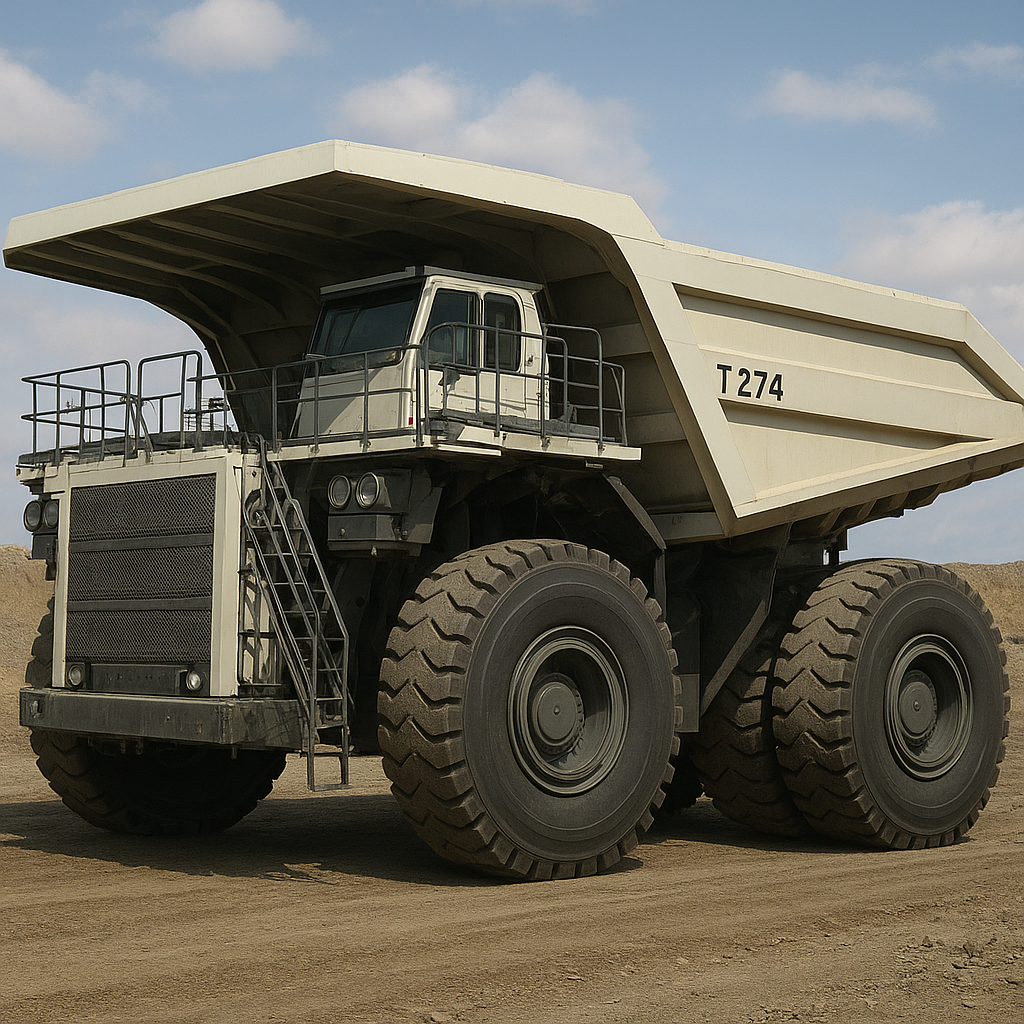
The Liebherr TI 274 is a purpose-built mining haul truck that represents a modern approach to large-scale material movement. Designed to operate in demanding open-pit environments, this machine combines heavy-duty structural design, high-capacity loading systems and advanced vehicle electronics to deliver consistent performance. In the following sections we will explore the machine’s design philosophy, typical specifications, applications, operational details, maintenance considerations and the broader economic and environmental context in which such trucks operate.
Overview and role in mining and heavy-material handling
The Liebherr TI 274 is part of Liebherr’s family of large mining trucks developed to meet the needs of bulk mines, quarries and major earthmoving projects. As a high-capacity rigid-frame truck, its principal role is to transport large quantities of overburden, ore or aggregate between loading points and processing or haul roads. The vehicle is typically integrated into a fleet that includes shovels, excavators, wheel loaders and ancillary support equipment.
Key advantages of this class of truck include the ability to move vast volumes with a single cycle, reduced unit haulage costs when matched with appropriate loaders, and the capability to operate in harsh climates and rough terrain. The TI 274 is engineered to balance structural strength, drivetrain efficiency and operator ergonomics so that individual machines can sustain high hourly productivity while minimizing downtime.
Design and engineering highlights
Liebherr’s design for the TI 274 emphasizes a robust chassis and bodywork, heavy-duty axles and a drivetrain designed for continuous heavy loads. The structural frame and dump body are typically fabricated from high-strength steels and optimized using finite element analysis to resist fatigue and impact loads over many operating cycles. Several design elements are noteworthy:
- Liebherr-designed load-bearing frame and box structure optimized for longevity and repairability.
- Modular powertrain layouts that allow different engine and transmission options depending on customer preferences and local emissions rules.
- Advanced cooling and filtration systems tailored to mining conditions where dust and extreme temperatures are common.
- Operator cabin ergonomics focused on visibility, control layout and vibration isolation to reduce fatigue during long shifts.
- Options for both mechanical and advanced electric drive assist or hybrid systems in some configurations to improve fuel efficiency.
One of the defining characteristics of modern haul trucks like the TI 274 is their integration of electronic monitoring systems. Fleet telematics provide real-time diagnostics, payload monitoring, fuel burn tracking and predictive maintenance alerts — all of which help mining operations optimize fleet availability and total cost of ownership.
Typical technical specifications (representative figures)
Exact specifications for the TI 274 can vary with configuration, regional emissions requirements and customer options. The figures below are representative of the class and reflect typical values for a truck carrying a nominal payload in the mid‑hundreds of tonnes range.
- Model designation: TI 274 (designation suggests nominal payload class)
- Nominal payload: approximately 274 metric tonnes (final value depends on body design and customer specifications)
- Empty operating weight (tare): typically 120–160 metric tonnes depending on configuration
- Gross vehicle weight (GVW): in the range of 390–440 metric tonnes when fully loaded
- Powertrain: diesel engine options commonly in the 1,700–2,200 kW range (approx. 2,300–3,000 hp) depending on tuning and supplier; electronic automatic transmission or electric drive variants possible
- Tire size: common ultra-class tire sizes such as 59/80R63 are often used to support heavy loads and improve flotation
- Top speed: unloaded top speed in the order of 60–70 km/h; loaded travel speed typically limited by safety and road gradient considerations
- Fuel consumption: highly dependent on duty cycle and gradients — representative fuel burn may be in the range of 70–140 L/h under heavy haul conditions
- Braking: multiple redundant systems including service brakes, retarders (engine or hydraulic), and emergency systems to ensure control on steep grades
These numbers are representative. For exact certified values and options (e.g., specific engine model, emissions control packages, or electric-drive configurations) the manufacturer’s specification sheet for a given serial number should be consulted.
Applications and use cases
The primary application of the TI 274 is in large open-pit mining operations, where heavy, reliable trucks are essential to move either overburden or ore to crushers, stockpiles or processing plants. Typical use cases include:
- Major copper, iron ore, coal and gold mines where production rates demand high payload-per-cycle machines.
- Large-scale quarry operations producing crushed rock for infrastructure projects.
- Bulk earthworks for dam or large civil engineering projects where temporary mines or borrow pits are established.
- Remote-site mining where logistics favor large payloads to reduce haulage cycles and unit transport costs.
When matched with an appropriately sized loading machine — hydraulic excavators, rope shovels or large wheel loaders — the TI 274 can deliver strong bucket-to-truck productivity. Cycle time optimization, dragline or shovel pairing and road design (grade and width) are essential to maximize the benefits of this truck class.
Operational performance and fleet integration
Performance is not solely the product of the truck’s nominal capacity; it depends on integration with the whole mining system. The TI 274 is often evaluated across several operational metrics:
- Payload matching: Maximizing the number of filled tons per hour requires loaders to dump full buckets and minimize rehandling. Payload monitoring systems help ensure consistent loading.
- Cycle time: Influenced by loading time, travel time, dump duration and queuing at loading/dumping points. Fleet scheduling algorithms can reduce empty time and improve utilization.
- Fuel efficiency: Managing engine load, speed and gear selection — sometimes aided by telematics and driver coaching — reduces fuel burn per ton moved.
- Availability: High uptime from robust components and effective maintenance programs increases tons-per-day. Predictive maintenance enabled by onboard diagnostics helps avoid unplanned downtime.
- Operator performance: Driver training, automatic systems (e.g., retarder assistance, traction control) and ergonomic cabins contribute to safer, more efficient operation.
It is common for modern operations to measure haul trucks on metrics like tons per operating hour, liters of diesel per tonne moved and mean-time-between-failures (MTBF). The TI 274’s onboard systems can provide the data necessary for continuous improvement programs.
Maintenance, serviceability and lifecycle considerations
Maintenance strategy is critical for any fleet of large haul trucks. The TI 274 is designed with serviceability in mind: access panels, modular assemblies and centralized lubrication points reduce service time. Key maintenance topics include:
- Scheduled preventive maintenance: Regular fluids, filter replacements and inspections to prevent component fatigue and ensure reliability.
- Predictive maintenance: Using telematics and vibration or oil analysis data to anticipate failures before they occur.
- Component reman and repair: Engines, transmissions, final drives and axles are often repaired or remanufactured to reduce lifecycle costs.
- Tire management: Tire costs are a significant portion of operating expense; rotating, inspecting and managing inflation prolongs life and reduces risk.
- Body and structural repairs: Planned inspections for stress points, welds and bed wear protect against catastrophic failures.
Effective maintenance reduces whole-life costs and ensures that capital investments in machines such as the TI 274 deliver expected returns over many years of operation. Operators typically track total cost of ownership (TCO) metrics including acquisition cost, fuel, parts, labor and resale value.
Safety systems and operator ergonomics
Given the mass and energy involved in haul truck operations, safety is paramount. The TI 274 incorporates multiple systems designed to protect operators, ground personnel and infrastructure:
- High-visibility cabins with multiple camera feeds and blind-spot monitoring.
- Proximity detection systems and collision avoidance sensors to alert drivers of personnel or obstacles.
- Automatic speed limiters, grade-based control logic and intelligent braking systems to maintain control on steep grades.
- Roll-over protection structures (ROPS) and falling-object protective structures (FOPS) integrated into cab design.
- Ergonomic seating, climate control and vibration damping to reduce operator fatigue on long shifts.
Human factors engineering reduces the likelihood of operator error, and comprehensive training programs — often supported by simulators — prepare crews for both routine operation and emergency scenarios.
Environmental considerations and emissions
Modern mining fleets face growing pressure to reduce greenhouse gas emissions, manage dust and limit local pollutants. The TI 274 can be configured with emissions control packages to meet regional standards (e.g., Tier/Stage regulations) and can also participate in broader decarbonization strategies:
- Use of engines compliant with prevailing emissions standards; selective catalytic reduction (SCR) and diesel particulate filter (DPF) technologies are common.
- Hybrid or electric drive options (where available) reduce fuel consumption and CO2 emissions by recovering brake energy and optimizing power delivery.
- Fuel management programs that include biodiesel blends or alternative fuels in compatible engines.
- Dust suppression systems and enclosed transfer points to reduce fugitive dust during loading and dumping.
Operational changes such as route optimization, reduced idling and efficient grade management provide meaningful emissions reductions without hardware changes. Fleet-wide electrification or trolley-assist systems on steep grade sections are also potential strategies to lower total emissions.
Economic considerations and lifecycle costing
Decisions to purchase or deploy a TI 274 are typically evaluated through a total cost of ownership lens. Important factors include:
- Acquisition cost versus expected productive life and residual value.
- Fuel consumption per ton moved — a major component of operating expense in haul operations.
- Parts and labor costs for scheduled and unscheduled maintenance.
- Availability and support network from the manufacturer and local dealers.
- Flexibility: the ability to repurpose or reconfigure trucks for changing mine plans or commodity cycles.
Optimizing fleet mix (how many high-capacity haulers versus mid-size units) is a strategic decision driven by ore body geometry, haul distances, loading equipment and capital availability. Consideration of resale markets and refurbishment options further refines lifecycle economics.
Trends and future directions
Looking ahead, several trends shape the development and operation of machines like the TI 274:
- Increased electrification: from hybridization to full electric drives and trolley-assist for steep grades.
- Autonomous operation: driverless haulage systems that improve safety, reduce labor variability and can operate 24/7 under supervision.
- Advanced analytics: richer telematics and AI-driven predictive maintenance to further reduce downtime and cost.
- Sustainability: more focus on lifecycle CO2, circularity of components and responsible sourcing of materials.
- Modularity: designs that allow easier upgrades to powertrain or safety tech without full vehicle replacement.
These trends will continue to influence future iterations of large mining trucks, and operators are likely to see gradual integration of multiple technologies rather than sudden wholesale change.
Summary
The Liebherr TI 274 is a representative example of modern high-capacity mining haul trucks: engineered for heavy loads, designed for rugged conditions and supported by electronics and service features that increase uptime and lower operating costs. While exact specifications vary by configuration and market, the model’s strengths lie in robust structural design, flexible powertrain options and integration with fleet management systems. For mining operations that require reliable high-tonnage haulage, the TI 274 and trucks in its class remain a central element of efficient, productive mining fleets.


)
)