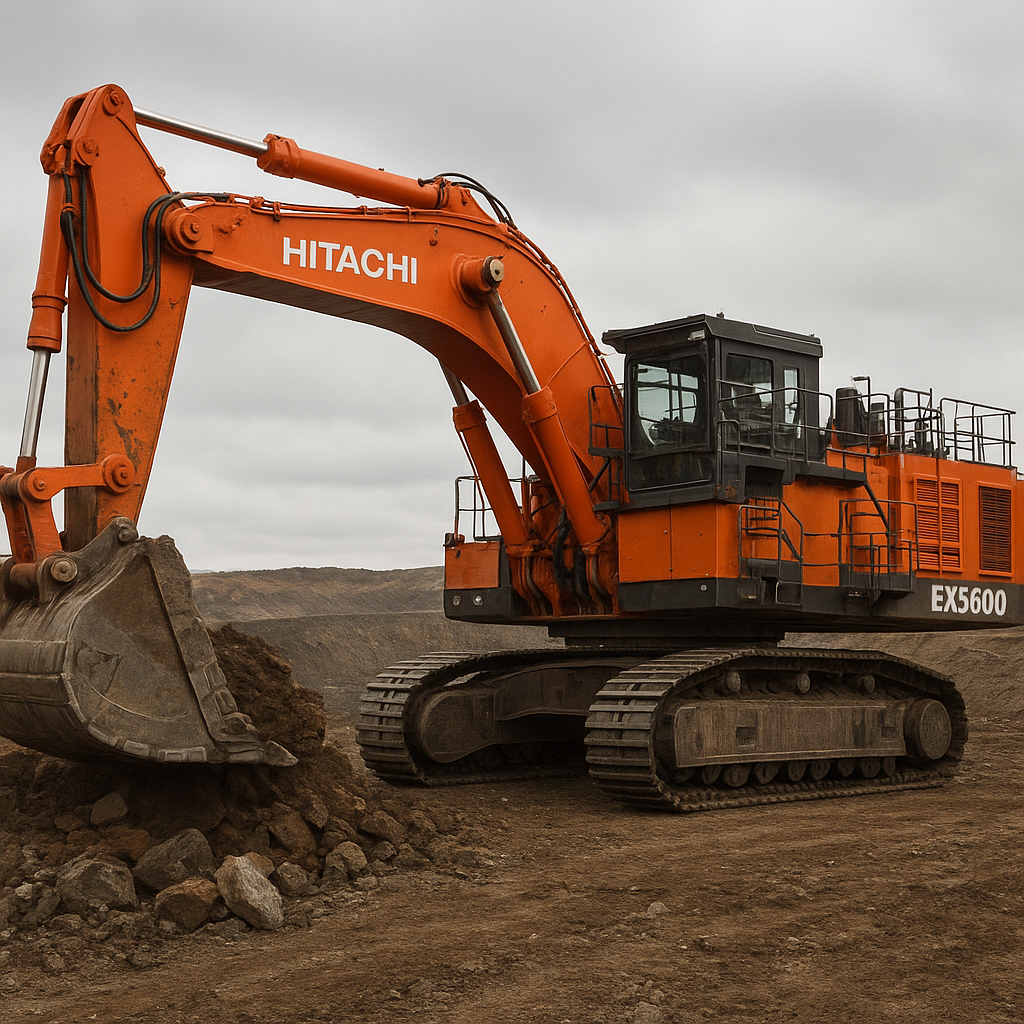
The Hitachi EX5600 is a class-leading large hydraulic excavator designed primarily for heavy-duty mining and large-scale earthmoving operations. Combining robust engineering, advanced hydraulics and operator-focused features, the EX5600 series is built to deliver high productivity, long service life and reliable performance in demanding environments. This article explores the machine’s design, typical applications, technical and operational characteristics, maintenance considerations, safety and environmental aspects, and provides practical insights for fleet managers and operators. Where numerical data is mentioned it is presented as an approximate range because exact values depend on model version, configuration and customer options.
Design and technical overview
The EX5600 is a purpose-built hydraulic excavator that occupies the upper echelon of the large mining excavator market. Its layout is conventional for large hydraulics: a heavy-duty undercarriage, a reinforced upper structure housing the engine and hydraulic pumps, and a choice of booms, sticks and large-capacity buckets to match material and cycle targets. The machine emphasizes mechanical durability, hydraulic efficiency and serviceability.
Core components
- Engine: Typically a high-displacement diesel powerplant designed for continuous heavy-duty operation. Engine output for machines in this class commonly falls in the multi-megawatt range; depending on configuration, approximate net power can be in the lower thousands of kilowatts (roughly 2,000–2,600 kW), though exact figures vary by series and emission tier.
- Hydraulic system: High-flow, variable-displacement pumps provide the flow and pressure required for fast cycle times and strong digging forces. Advanced control logic improves fuel efficiency and responsiveness.
- Boom and arm: Reinforced booms and sticks are available in multiple lengths and geometries to suit bench heights, reach requirements and specific bucket sizes. Structural members are heavily reinforced and use high-strength steels to resist fatigue.
- Buckets and attachments: Bucket capacities for the EX5600 class typically range from large material-specific buckets in the tens of cubic meters (for example, 18–34 m3 as a general range depending on design) to specialized rock and grapple configurations. Quick couplers, rippers and hydraulic breakers are possible depending on the application.
- Undercarriage: Massive track frames, large shoes and heavy-duty rollers distribute the machine’s weight and provide stability on benches and haul roads. Track gauge and shoe size are optimized for ground pressure and mobility.
Key performance characteristics
- Operating weight: The EX5600 model designation denotes a very large machine; operating weight is commonly in the several-hundred-tonne class—roughly around 500–600 tonnes depending on configuration, attachments and counterweight options.
- Bucket capacity: Depending on the material and the job, bucket sizes vary widely. Typical capacities for mine-duty buckets in this class are often in the tens of cubic meters.
- Digging force and cycle times: Powerful hydraulic circuits and robust mechanical leverage yield high bucket breakout forces and reasonable cycle times for a machine of this size, enabling efficient loading of large haul trucks and hoppers.
- Fuel consumption: Fuel burn depends heavily on the duty cycle. In heavy continuous loading, large mining excavators can consume significant volumes of diesel; realistic operating consumption can range widely, and fleet managers typically monitor fuel per bank/swing hour to optimize cycles and detect issues.
Applications and typical use cases
The Hitachi EX5600 is engineered primarily for heavy mining tasks where large material volumes must be dug, loaded and moved rapidly. Its typical roles include:
- Open-pit mining: Excavating ore and waste, loading ultra-class or large-class haul trucks, and feeding crushers or stockpiles. Machines in this category are often assigned to high-production loading faces where cycle productivity directly affects mine throughput.
- Quarry and aggregate operations: For high-output quarries producing construction aggregate, large excavators accelerate face removal and loading operations.
- Civil mega-projects: Large earthworks such as dam construction, major cut-and-fill operations and infrastructure projects where scale warrants using very large excavators.
- Port and bulk handling: Where large-volume handling of bulk materials (coal, iron ore, mineral concentrate) is required, EX5600-class machines can be used in shiploading and stockpile reclaiming with appropriate attachments.
Operators choose machines like the EX5600 when the economics of scale favor fewer, higher-capacity loaders over a greater number of smaller machines. High hourly production, lower unit cost per tonne and reduced cycle counts to move a volume are the commercial drivers.
Operational advantages and considerations
Productivity and cost-efficiency
At its best, the EX5600 delivers high-volume loading capability and consistent daily throughput. The combination of large bucket volumes and strong hydraulic digging force allows rapid filling of haul trucks, which reduces truck waiting times and increases pit productivity. Operators pursuing cost-efficiencies look at metrics such as tonnes per operating hour and fuel per tonne to evaluate return on investment.
Operator comfort and controls
Modern Hitachi mining excavators place emphasis on the operator environment to reduce fatigue and maximize effectiveness. Features commonly found include climate-controlled cabs, ergonomically arranged controls, multi-function joysticks, and advanced displays for diagnostics and machine settings. These improvements translate into more consistent cycle performance and safer operation.
Maintenance and lifecycle management
The lifecycle cost of a large excavator frequently outweighs its purchase price. Effective maintenance drives uptime and reduces total cost of ownership. Key maintenance practices include:
- Scheduled oil and hydraulic fluid analysis to detect contamination and wear.
- Proactive inspection of booms, sticks and pins for wear and fatigue.
- Monitoring track and undercarriage wear to manage shoe life and maintain ground pressure balance.
- Using OEM parts or vetted aftermarket components for critical systems such as hydraulic pumps and engine components.
Large fleets typically use telematics and fleet-management software to monitor hours, fuel consumption, idle time and fault codes. This data-driven approach enables predictive maintenance and targeted component replacement.
Safety, environmental and regulatory aspects
Safety and environmental compliance are central considerations in mining operations. The EX5600 class incorporates features and design philosophies to support safe use and lower environmental impact where possible.
Safety features
- Robust structural design to minimize risk of catastrophic failure in severe duty.
- Visibility aids such as cameras, mirrors and sensor systems to reduce blind spots around the machine.
- Cabin protection and certified ROPS/FOPS structures to protect the operator from rollover and falling-object hazards.
- Emergency shutdown systems and ergonomic access ladders and platforms for safe servicing.
Emissions and fuel efficiency
Modern models are designed to meet applicable emissions regulations and may incorporate engine technologies (aftertreatment, tuning) to reduce NOx and particulate matter. Additionally, hydraulic system improvements and smarter control logic can reduce overall fuel consumption per tonne of material moved, which lowers both operating costs and greenhouse gas emissions intensity.
Economic and market considerations
Purchasing an EX5600-class excavator is a major capital investment. Decision-makers should evaluate not only initial price but the total cost across the machine’s life, including scheduled and unscheduled maintenance, parts, fuel, operator training and resale value. Some key points:
- Depreciation and resale: Heavy-duty mining machines often retain value if maintained and if there is active demand in global mining markets. Resale values fluctuate with commodity cycles.
- Fleet optimization: Replacing multiple smaller machines with a few larger loaders can simplify logistics and reduce the number of required operators, but it increases dependence on single-unit uptime.
- Financing and fleet procurement: Leasing and structured financing are common for major fleets. OEM and dealer-backed service agreements can stabilize maintenance costs and provide access to spare parts and technical support.
Comparisons, variants and alternatives
The EX5600 competes with other ultra-large hydraulic excavators and rope shovels. Choosing between machine types depends on site specifics:
- Hydraulic excavators like the EX5600 excel in versatility, faster cycle times, and easier repositioning on the bench.
- Rope shovels often provide higher payload-to-weight ratios and can be more efficient for very abrasive materials and ultra-high production faces, but they are less mobile and require different maintenance regimes.
- Other OEMs produce comparable machines; selection often comes down to dealer support, parts availability and established performance in similar operations.
Real-world performance data and practical statistics
Exact performance figures vary with configuration and mine conditions, but some practical benchmarks used by mining teams include:
- Typical operating weight: in the order of several hundred tonnes—commonly around 500–600 tonnes for the EX5600 class, depending on options.
- Bucket capacity: large mine-duty buckets commonly in the range of tens of cubic meters, adjusted to match haul truck capacities and material density.
- Engine power: multi-megawatt class powerplants, with net outputs often measured in the low thousands of kilowatts; specific ratings depend on emission standards and version.
- Fuel consumption: varies widely by duty and load; fleet managers track litres (or gallons) per effective operating hour and litres per tonne as the key efficiency metrics.
- Availability targets: mines typically plan for machine availability of 85–95% depending on redundancy and maintenance strategy. High availability is critical to sustaining production targets.
Note: The numbers above are provided as guidance only. For project-level planning, engineers and procurement teams should consult Hitachi technical documentation for the specific model year and configuration, and perform site-specific productivity modelling that considers material hardness, bench layout and haulage matching.
Maintenance best practices and lifecycle tips
To maximize uptime and minimize total cost of ownership of an EX5600, operators and maintenance teams often follow several proven practices:
- Implement predictive maintenance using oil analysis, vibration monitoring and telematics data; early detection of wear can prevent catastrophic failures.
- Maintain a critical spares strategy for items with long lead times (hydraulic pumps, control modules, major structural parts).
- Optimize duty cycles and operator training to reduce unnecessary heavy impacts and prolonged idle running.
- Use OEM-approved lubricants, filters and parts to protect warranty coverage and ensure proper component life.
- Plan for seasonal and environmental impacts (dust mitigation in dry climates, cold-weather procedures where applicable).
Case studies and operational anecdotes
Across global mining operations, large hydraulic excavators like the EX5600 are commonly deployed in coal, copper, iron ore and bulk commodity pits. Typical case examples include:
- A high-tonnage open-pit iron ore mine replacing multiple medium excavators with EX5600-class machines to better match ultra-class haul trucks, achieving higher hourly throughput and fewer truck cycles.
- A coal operation using EX5600-type machines on medium-height benches where mobility and fast cycle times provided more flexibility compared to rope shovels.
- Quarry operations using large excavators with specialized buckets for rock handling and consistent feed to crushing circuits, reducing downtime caused by frequent bucket changes.
These operational stories underline the importance of matching machine choice to pit geometry, haul profile, and material characteristics.
Conclusion and purchase considerations
The Hitachi EX5600 represents a strong option for mining operations seeking a powerful, versatile hydraulic excavator capable of high-volume loading and long service life. Key decision criteria for procurement include compatibility with haul fleet payloads, availability of dealer support and parts, expected duty cycle, and the mine’s overall material handling strategy. Careful attention to maintenance planning, operator training and telemetry-driven fleet management will maximize returns from this class of equipment. For precise technical specifications and model variations, always consult official Hitachi product documentation or an authorized dealer to ensure the configuration matches your operational needs.
Keywords: mining, excavator, productivity, engine, fuel consumption, bucket capacity, maintenance, safety, efficiency, durability.


)
)