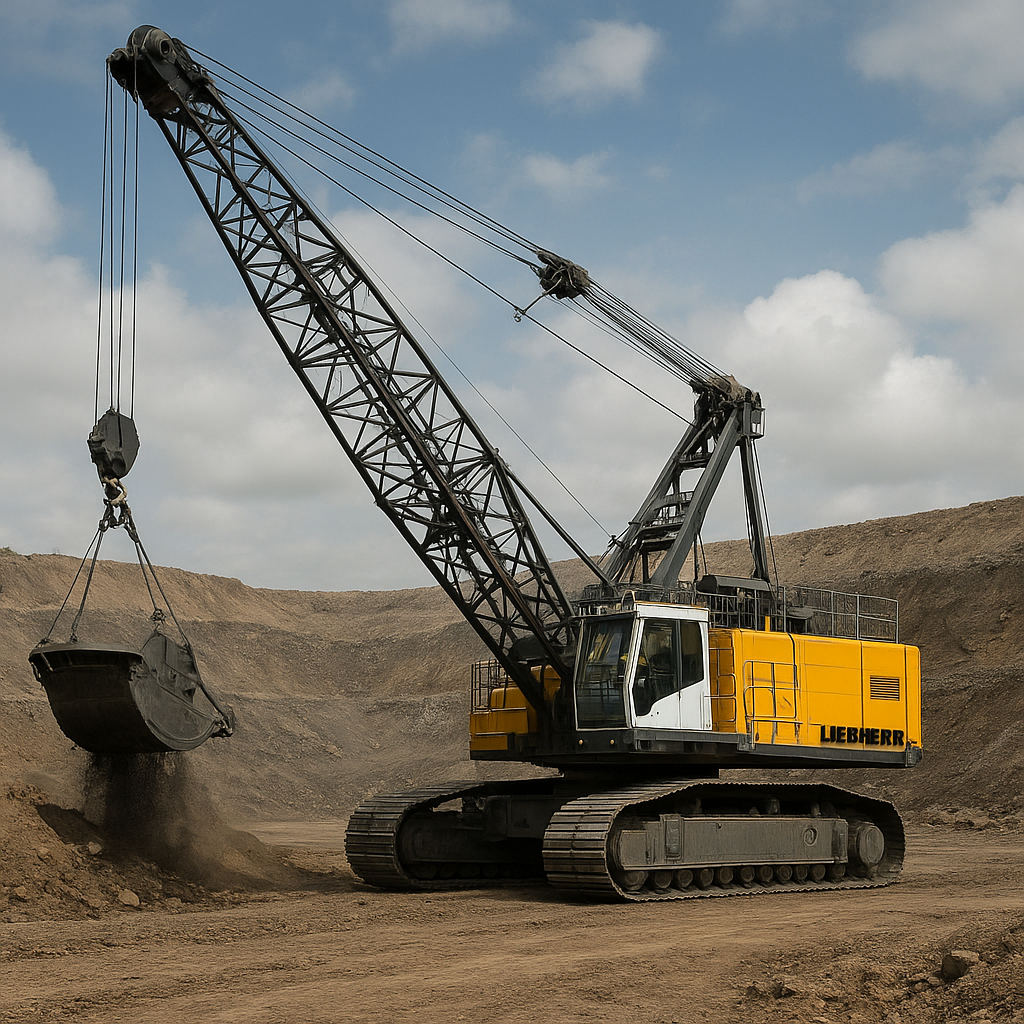
The Liebherr HS 8300 is a heavy-duty mining machine that belongs to the family of large rope-operated excavators commonly known as draglines. Designed for continuous, high-volume earthmoving tasks, the HS 8300 finds its place in large-scale surface mining and major civil engineering projects. This article provides a comprehensive look at the HS 8300 — its design and main components, typical applications, operational and logistical concerns, and the broader economic and environmental context. Throughout the text, several key concepts and terms are highlighted to help readers quickly grasp the most important attributes of this machine.
Overview and design features
The Liebherr HS 8300, like other machines in the dragline category, is engineered to remove large volumes of material quickly and efficiently. At its core, a dragline consists of a large bucket suspended from a long boom by ropes; the bucket is dragged across the surface to collect material and then lifted and swung to dump the load at a haul or spoil location. The HS 8300 embodies this principle while using modern manufacturing techniques, robust structural components and advanced control systems to maximize availability and productivity.
Key structural components include a heavy-duty crawler or stationary base, slewing mechanisms, multi-fall wire rope systems for hoist and drag, a reinforced boom that must resist compression and bending forces, and a bucket with wear-resistant linings. The machine’s powertrain is typically electric, supplied from on-site power generation or grid connections in mining operations. The combination of electric drive systems and sophisticated control electronics allows precise bucket control and improved energy use compared with older mechanical systems.
The HS 8300’s design emphasizes long service life under harsh conditions. Structural joints are engineered for fatigue resistance; wear parts such as bucket teeth, pins, and ropes are selected for high abrasion resistance; and redundant safety systems protect personnel and asset integrity. Many contemporary draglines also include condition-monitoring sensors that track rope condition, bearing wear, oil contamination and other parameters, enabling predictive maintenance and minimizing unplanned downtime.
Where the HS 8300 is used
The primary domain for the Liebherr HS 8300 is surface mining, especially in operations where large amounts of overburden must be removed to expose ore or coal seams. Specific application areas include:
- Open-pit coal mining: Removing overburden in vast coalfields, where a dragline’s reach and bucket capacity offer low cost per cubic meter of removed material.
- Open-pit metal mining (iron ore, copper, bauxite): Excavating waste rock and transporting it to spoil dumps, improving the efficiency of ore extraction by minimizing truck-and-shovel cycles.
- Large civil engineering projects: Constructing canals, widening waterways, and major dredging or reclamation works where coherent, controlled cuts are required over long durations.
- Aggregate operations: In very large gravel or sand operations, draglines can be used for bulk excavation where continuous long stroke digging is favorable.
Draglines like the HS 8300 are particularly valuable where the combination of long reach and large bucket volume reduces the need for fleets of haul trucks and shortens material handling chains. Their operational model — repetitive drag, lift, swing and dump — is most efficient in areas where spoil can be placed progressively away from the pit rim or to specially designed spoil sites.
Technical specifications and performance (typical values)
Exact technical specifications for the Liebherr HS 8300 can vary based on configuration, site-specific modifications and options ordered by the operator. Below are typical performance ranges and specification categories often associated with draglines in this class. These should be regarded as representative rather than definitive — operators should consult Liebherr documentation or dealers for certified numbers.
- Bucket capacity: Typical draglines of this scale have bucket volumes ranging from roughly 30 to over 100 cubic meters, depending on application and bucket design. The HS 8300 is commonly paired with buckets designed to optimize cycle time and energy per cubic meter.
- Boom length: Boom lengths for large draglines commonly range from 40 to more than 80 meters, providing the long reach necessary to strip overburden from wide pit benches.
- Operating weight / Installed mass: Machines in this class often weigh several thousand tonnes in operating configuration, where structural mass provides stability during heavy lifts and large swings.
- Powertrain and installed power: Draglines typically use electric motors with total installed power typically in the low megawatts to multi-megawatt range, depending on size and cycle demands; for large units, installed electrical power may range from around 2 MW to more than 10 MW when accounting for hoist, drag and swing drives.
- Cycle time and productivity: Productivity depends on bucket size, cycle time, material characteristics and bench layout. Typical cycle times for large draglines can be in the 30–90 second range, and daily movement in tens to hundreds of thousands of cubic meters is possible in continuous operations.
- Rope and hoist systems: Multiple-part rope systems with high-strength steel wire ropes are used to provide the required mechanical advantage. Rope diameters, drum capacities and fall configurations are tailored for load, redundancy and service life.
- Life-cycle expectations: Structural life can extend for decades with proper maintenance; wear parts have shorter replacement cycles and are a routine part of in-service management.
While these numbers provide a snapshot, the real-world performance of an HS 8300 will be influenced by soil conditions, material abrasiveness, bench layouts, operator skill, and maintenance regimes. Modern control and monitoring features can significantly improve effective productivity relative to older models.
Operation, assembly and logistics
Deploying and operating a dragline such as the HS 8300 requires careful planning across several domains: transport and assembly, crew training, maintenance scheduling and site power. Due to its size, the HS 8300 is typically transported in sections and assembled on-site using heavy lift equipment. Transport logistics include disassembly into manageable modules, road and rail permits, and possible temporary infrastructure upgrades to accommodate oversized loads.
Assembly and commissioning are specialist activities often undertaken by the manufacturer or authorized contractors. Key commissioning steps include alignment and testing of the hoist and drag systems, verification of electrical systems, safety instrument checks and tuning of control systems. Commissioning timelines can range from weeks to months depending on complexity and site conditions.
Operationally, draglines are most efficient when run in continuous shifts with planned maintenance windows. Predictive and condition-based maintenance strategies are now common: sensors and analytics detect early signs of wear in ropes, bearings and gearboxes so parts can be replaced during planned stops rather than during unplanned breakdowns. Effective spare parts management and in-situ machining capabilities can further reduce downtime.
Safety is paramount: swing radii are carefully fenced and interlocked, approach zones are controlled, and hoist/drag interlocks prevent overloading. Modern operator cabins provide ergonomic control, climate control and digital displays that present machine health and productivity data in real time.
Economic factors and life-cycle costs
While the upfront capital cost of a dragline is high — often in the tens to hundreds of millions of dollars depending on size and configuration — the machine can deliver very low unit costs for material movement over its operational life. The economic rationale for a dragline like the HS 8300 usually rests on:
- Low operating cost per cubic meter when compared to truck-and-shovel fleets for large, continuous stripping operations.
- Long useful life with refurbishments and component replacements extending service for decades.
- Lower labor intensity per cubic meter moved, because one dragline can replace many trucks and shovels.
Operators consider not only purchase price but also installation/commissioning cost, on-site power infrastructure, spares inventory, and ongoing service agreements. Life-cycle cost models frequently show that, for suitable operations, a high-capacity dragline will outperform truck-based systems in terms of cost per ton moved, provided the mine layout and geology are favorable.
Environmental and social considerations
Draglines have both environmental advantages and challenges. On the positive side, electric-drive draglines have lower direct greenhouse gas emissions on-site compared with diesel-powered truck fleets. Fewer trucks also reduces local emissions of particulates and NOx, and reduces road construction and maintenance within the pit. The continuous nature of spoil placement can allow for engineered dumps with stability and progressive reclamation in mind.
Challenges include the visual and land-use impacts of very large equipment and the permanent alteration of landscapes typical of open-pit mining. Responsible operators plan rehabilitation and progressive reclamation strategies and often use draglines within frameworks intended to reduce long-term environmental impacts. Noise and vibration are operational concerns as well, addressed with equipment shielding, buffer zones and community engagement programs.
Maintenance, upgrades and digitalization
Maintenance strategy for an HS 8300 revolves around maximizing availability and extending the life of critical components. Common maintenance activities include rope inspection and replacement, bucket and tooth replacement, boom inspection for cracks or fatigue, gearbox servicing, and electrical system checks. Predictive maintenance using vibration analysis, oil condition sensors and rope-monitoring systems has become standard practice for operators aiming to reduce catastrophic failure risk.
Modern draglines can be retrofitted with digital control systems that enhance operator feedback, automate routine sequences, log productivity data, and integrate into mine-wide planning systems. Remote monitoring allows maintenance teams to analyze trends in component wear and schedule interventions. Some operators have implemented semi-automated or remotely assisted control to reduce exposure of personnel to risky environments and to improve consistency in digging cycles.
Notable deployments and industry context
Although specific deployments of the HS 8300 vary by operator and region, machines in this class have been used in coalfields and large open-pit mines worldwide. Their advantages are most pronounced in operations characterized by:
- Extended benches and wide stripping faces where the boom reach and swing of the dragline can be fully utilized.
- Consistent material characteristics where bucket fill factors are predictable and efficient.
- Access to reliable electric power or stable on-site generation capacity.
In many legacy mining areas, older draglines continue to operate alongside newer models, demonstrating the longevity and robustness of the concept. Upgrades to electrics, controls, and monitoring systems keep older machines viable in modern production environments.
Summary and outlook
The Liebherr HS 8300 represents a class of powerful, purpose-built machines that shine in large-scale surface mining applications and substantial civil engineering tasks. With a design focus on heavy structural integrity, robust rope and bucket systems, and modern electric drives and controls, the HS 8300 and similar draglines remain attractive where continuous, high-volume excavation is required. While upfront costs are significant, life-cycle economics, lower per-cubic-meter operating costs in suitable contexts, and the capacity for long-term refurbishment make draglines a strategic choice for many operators.
As the mining industry continues to prioritize energy efficiency, automation and predictive maintenance, machines such as the HS 8300 will increasingly integrate digital tools and cleaner power sources. These trends are likely to enhance safety, reduce environmental footprints, and further improve the cost-efficiency of large-scale earthmoving operations.


)
)