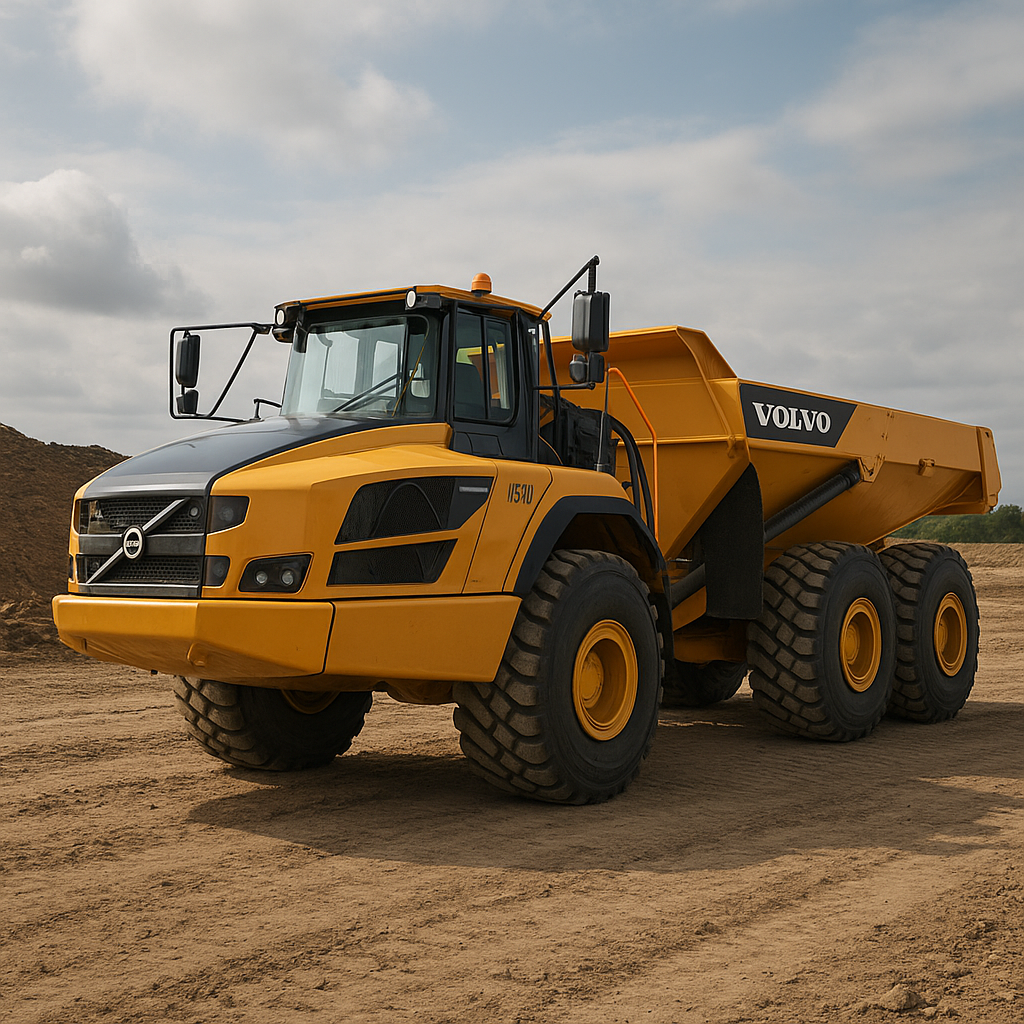
The Volvo A60H is a heavy-duty, high-capacity articulated hauler designed to transport large volumes of material across rough, off-road terrain. Built by Volvo Construction Equipment, the A60H belongs to the H-series lineage that emphasizes robust structural design, improved operator comfort and enhanced productivity. This article explores the machine’s design, typical uses, technical characteristics, operational advantages, maintenance considerations and its place in modern construction and mining fleets.
Design and engineering overview
The Volvo A60H is engineered as a full-sized, six-wheel-drive articulated hauler that combines a strong chassis with a high-capacity body to move heavy loads efficiently. Its articulated frame enables excellent maneuverability on uneven surfaces, while the suspension and driveline are tuned to handle heavy payloads without compromising stability or traction.
Chassis and articulation
The A60H uses a heavy-duty frame with an articulated joint between the front and rear sections. This articulation provides a tight turning radius compared to rigid trucks of similar capacity, allowing the machine to operate in confined quarry faces, road construction sites and large-scale earthmoving projects. The articulation is combined with robust steering cylinders and a central oscillating axle to maintain ground contact and traction on rough ground.
Body and load handling
The hauler’s rear body is built to carry large volumes of loose material such as rock, soil, sand and aggregate. Typical body designs include high-strength steel wear plates, reinforced sidewalls and options for bolt-on wear systems to extend service life in abrasive conditions. Many bodies are optimized for fast, clean dumping to reduce cycle times. The combination of a large body volume and a high payload makes the A60H suitable for operations where productivity and reduced cycle counts matter.
Powertrain and driveline
The A60H is equipped with a powerful diesel engine, a robust transmission and a heavy-duty drivetrain that transmit torque to all wheels. The powertrain is designed for high tractive effort when climbing grades and for stable performance during loaded travel. Electronic control systems manage power distribution, traction and transmission shifting to balance fuel economy with performance.
Technical specifications and performance
Below are representative specifications that typify the Volvo A60H. Exact figures can vary by configuration, market and optional equipment; however, the following figures provide a reliable baseline for understanding the machine’s capabilities.
- Payload capacity: approximately 55 tonnes (metric)
- Body volume: roughly 33–36 m³ (heaped, dependant on material bulk density)
- Operating weight: in the vicinity of 70–75 tonnes
- Engine power: typically in the range of 300–350 kW (about 400–470 hp), depending on emissions tuning and market specifications
- Top speed: up to about 55 km/h (on-road, unloaded, model-dependent)
- Turning radius: compact for vehicle class due to articulation, improving site maneuverability
- Fuel capacity: large tank to support long operating shifts; exact liters vary by option
These specifications translate into a machine intended for continuous heavy work: moving high payloads at moderate speeds across uneven ground while maintaining stability and operator comfort. The A60H’s combination of load capacity and mobility is what distinguishes it from smaller haulers and makes it attractive for large projects.
Typical applications and industry use
The Volvo A60H finds application across multiple sectors where high-volume material movement is required. Its design is optimized for sustained, heavy-duty work in challenging environments.
Quarrying and mining
In surface mining and quarrying, the A60H is used to haul blasted rock, overburden and processed aggregate from working faces to crushers, stockpiles or waste dumps. Its high payload reduces the number of cycles required to move a given mass of material, which can significantly reduce operating costs in large-scale operations. The robust body structure and optioned wear-protection packages make the A60H suitable for abrasive rock handling.
Large-scale earthmoving and civil construction
Major infrastructure projects—such as highway construction, dam construction, airport expansion and large civil earthworks—benefit from the A60H’s ability to move substantial quantities of material quickly. The articulated design allows the hauler to operate on rough haul roads and in confined areas where rigid-frame trucks might struggle.
Road building and reclamation
For road construction and land reclamation projects, the A60H transports aggregates, fill material and sub-base. Its stability under heavy loads and ability to maintain traction on prepared but uneven surfaces help accelerate project timelines and reduce fleet size compared to using many smaller trucks.
Specialised roles
Beyond standard hauling, the A60H can be outfitted with features such as tailgate modifications for controlled spreading, rock protection kits, tarp systems and payload management systems that make it adaptable to niche tasks like controlled material placement and environmental remediation.
Operator environment, safety and productivity features
Volvo has historically placed emphasis on operator comfort, ergonomics and integrated safety systems; the A60H builds on these priorities to improve productivity and reduce downtime.
Cab comfort and controls
The operator cab is typically soundproofed and climate-controlled, with an ergonomic seat, adjustable controls and a clear instrument layout. Visibility is improved by wide glass areas and camera options for rear and side views. Infotainment and telematics displays provide information on machine status, fuel consumption and diagnostics.
Safety systems
Standard and optional safety features often include comprehensive braking systems, automatic traction control, hill assist functions, and stability aids. Modern A60H units can be equipped with cameras and proximity detection systems to reduce collision risk on busy sites. Structural roll-over protection and reinforced cabs contribute to operator safety in rollover events.
Productivity aids
Telematics integration and onboard payload monitoring help fleet managers and operators optimize cycles, reduce overloading and measure real-time productivity. Systems that monitor fuel consumption, idle time and maintenance intervals are used to reduce total operating costs and to plan preventive service activities.
Maintenance, serviceability and lifecycle costs
When evaluating a hauler like the Volvo A60H, buyers consider not only purchase price but also lifetime costs including fuel, maintenance, downtime and resale value. The A60H is designed to be serviceable with long maintenance intervals and accessible components.
Service access and intervals
Key service points—filters, fluids and maintenance panels—are located for easy ground-level access where possible. Component modularity in the engine, transmission and axles simplifies replacement and repair. Preventive maintenance intervals are engineered to be long enough to minimize unscheduled downtime while protecting machine longevity.
Wear parts and durability
In abrasive operations, wear on body plates, tailgates and undercarriage components is the main maintenance expense. The A60H offers bolt-on wear liners and hardened steel options to reduce replacement frequency. Axles, differentials and final drives are built to withstand large impacts and prolonged stress.
Total cost of ownership (TCO)
Factors influencing TCO include fuel economy, productivity (payload per hour), maintenance cost per hour, and resale values. The A60H’s large payload capacity reduces the number of trips required, which can improve overall fuel efficiency per tonne moved. When combined with Volvo’s telematics and service agreements, operators can plan predictable maintenance and optimize operational parameters to lower TCO.
Environmental considerations and regulations
Like other modern heavy machines, the A60H is designed to meet stringent emission standards in many markets. Engines are typically tuned and equipped with aftertreatment systems—such as selective catalytic reduction (SCR) and diesel particulate filters (DPF)—to comply with local regulations.
Fuel efficiency
Operator training, telematics-based monitoring and optimized transmission control play major roles in reducing fuel consumption. Volvo emphasizes engine mapping and drivetrain control strategies that match power delivery to the task, reducing unnecessary fuel burn during empty travel and while idling.
Noise and emissions mitigation
Engine and exhaust systems are engineered to minimize noise and emissions. Cab insulation and reduced NVH (noise, vibration and harshness) levels improve comfort and reduce environmental impact on sites located near populated areas.
Comparison with alternatives and fleet integration
The A60H sits at the upper end of the articulated hauler class and is often compared to other large articulated models from competing manufacturers and to large rigid dump trucks. The choice between articulated and rigid machines depends on site conditions, haul distances and payload requirements.
When to choose an articulated hauler like the A60H
- Rough, uneven haul roads where suspension and articulation provide better traction and comfort
- Short to medium haul distances inside quarries, large construction sites and earthmoving areas
- Sites with confined or winding haul routes where turning ability is important
When rigid dump trucks may be preferred
- Long, smooth haul roads where higher speeds and lower operating cost per tonne over distance favor rigid-frame machines
- Very high production open-pit mines where tyre sizes and rigid-frame economies dominate
Integrating the A60H into a mixed fleet often improves flexibility. Smaller articulated haulers can handle tighter areas, while the A60H is tasked with mainline hauling to crushers or stockpiles. Telematics and fleet-control systems help managers assign the right machine to each task and track productivity.
Case studies and field performance highlights
Across quarries and construction sites, fleet managers report that the A60H’s primary benefits are its high productive payload, reduced loading cycles and comfortable cab that keeps operators effective for long shifts. In many cases, replacing several smaller haulers with one A60H results in simplified logistics, fewer drivers and reduced fuel per tonne moved.
Operators commonly note the machine’s resilience in harsh conditions. Reinforced body options, robust axles and strong frame construction reduce the frequency of structural repairs. Coupled with Volvo’s global parts network and dealer support, many operations experience predictable uptime and manageable service scheduling.
Operational best practices
To extract maximum value from an A60H, operators and fleet managers should follow a set of best practices focused on safety, efficiency and longevity.
- Operator training: Skilled drivers who understand load distribution, efficient shifting and site routing can reduce fuel use and tyre wear.
- Payload management: Use onboard weighing to avoid overloading and to optimize cycles for material density.
- Preventive maintenance: Use telematics to monitor engine hours, filter changes and fluid conditions to prevent unscheduled downtime.
- Route planning: Design haul roads to minimize steep grades and reduce empty return time.
- Wear protection: In abrasive operations, fit wear liners and heavy-duty body options early to preserve structural components.
Market position and availability
The Volvo A60H is marketed to large construction contractors, quarry operators and mining companies that need a dependable, high-payload articulated hauler. Availability of specific configurations and emissions packages varies by region, and Volvo dealers commonly offer tailored packages—such as cold-climate kits, heavy-duty bodies and telematics subscriptions—to suit local needs.
Resale values for well-maintained A60H units tend to remain competitive due to the productivity advantages and brand reputation. Warranty and service packages available from Volvo can further enhance fleet managers’ confidence in long-term ownership.
Conclusion
The Volvo A60H is a purpose-built machine for heavy, off-road hauling where large payloads and robust capability are required. Its core strengths are high load capacity, articulated maneuverability, operator comfort and an engineering focus on durability. For large-scale quarry, mine and civil earthmoving projects, the A60H can reduce cycle counts and operating costs per tonne while providing a reliable workhorse that performs across demanding environments.
Key words emphasized: Volvo A60H, articulated hauler, payload, fuel efficiency, reliability, maintenance, operator comfort, drivetrain, productivity, telematics.


)
)