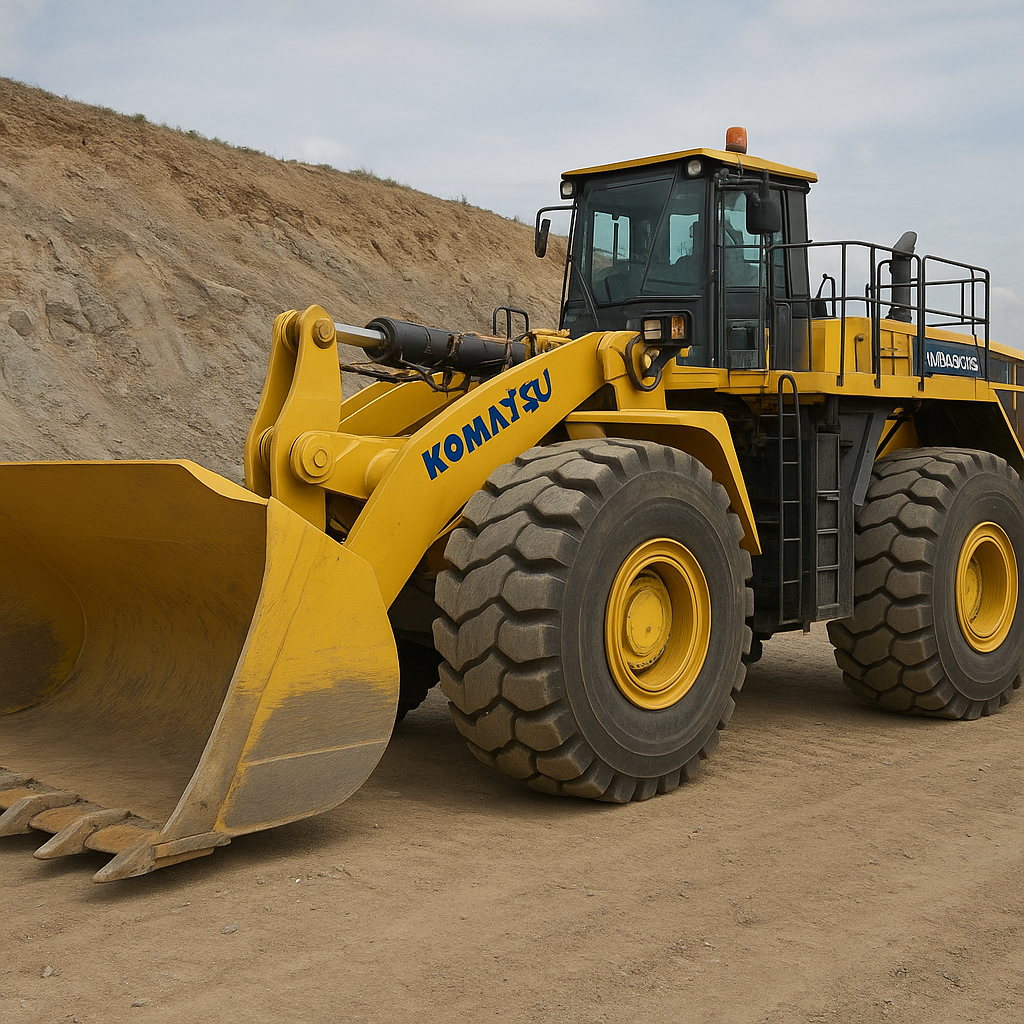
The Komatsu WA1200-6 is a purpose-built, ultra-large wheel loader designed for the most demanding mining and bulk-handling environments. Combining robust construction, high-capacity material handling and modern operator comforts, this machine has been used where productivity, uptime and efficient integration with large haul trucks are critical. Below is a detailed overview of the WA1200-6: its primary applications, core design features, operational considerations, and practical information on performance, maintenance and economics.
Overview and design philosophy
The Komatsu WA1200-6 is part of Komatsu’s family of heavy wheel loaders intended primarily for the mining sector. Its design emphasizes heavy-duty durability, high production capability and compatibility with the very largest loaders and haulage systems used in open-pit operations. The machine integrates strong structural components, a powerful driveline, and an efficient hydraulic and cooling package to sustain long shifts in severe conditions.
The WA1200-6 is engineered around a few core principles: maximize bucket payload per cycle, minimize unscheduled downtime, and provide the operator with tools and ergonomics that support sustained high productivity. Structurally, the loader employs robust frame sections, heavy-duty front linkage and reinforced attachment points to withstand the high stresses of loading large haul trucks and handling abrasive materials.
Primary applications and typical working environments
The Komatsu WA1200-6 is most commonly deployed in the following environments:
- Open-pit mining — loading large haul trucks and feeding primary crushers.
- Heavy quarries — moving blasted rock, overburden removal and aggregate stockpiling.
- Bulk materials terminals — handling coal, iron ore, bauxite and other bulk commodities at ports and stockyards.
- Infrastructure and earthworks — major projects requiring high cycle rates for earthmoving where large machines are justified.
- Specialized heavy-lift operations — where custom buckets or attachments are used for tailored moving tasks.
Typical operating conditions include dusty, abrasive rock, high ambient temperatures, and long operating shifts often exceeding 10–12 hours per day. The WA1200-6 is designed for continuous heavy use, with components sized to resist wear and to be maintainable in remote locations.
Key technical characteristics (typical ranges and notes)
Specifications for machines of this size vary with configuration, regional emission standards and optional equipment. The values below represent commonly reported ranges for large Komatsu loaders in the WA1200 class and should be treated as indicative rather than absolute factory data for every unit.
- Operating weight: typically in the range of 60–90 metric tons, depending on configuration, attachments and counterweights.
- Bucket capacity: standard buckets commonly range from 12 to 25 cubic meters, with special high-capacity or rock buckets tailored to the material and loading method.
- Engine power: gross power ratings generally fall in the 800–1,200 kW class for ultra-large loaders; specific engine output depends on model year and emissions package.
- Breakout force and torque: designed to deliver very high breakout forces to penetrate compacted or frozen material; exact figures vary with bucket and linkage.
- Transmission: heavy-duty torque converter with multi-stage planetary transmissions or powershift systems optimized for low-end torque and high tractive effort.
- Fuel capacity: large on-board fuel tanks to support long shifts between refueling — often in the several-thousand-liter range for continuous operation in remote mines.
Because Komatsu offers regional variations and mine-customized options, final specification sheets for a given WA1200-6 should always be obtained from the supplier or the machine’s data plate when precise numbers are required for planning and integration.
Structural and mechanical features
The WA1200-6’s frame and linkage are designed for durability and serviceability. Key structural highlights include:
- Reinforced frame sections with heavy-gauge steel to resist torsional stresses encountered during truck loading and rock handling.
- Robust front linkage and Z-bar or parallel-lift arrangements (depending on bucket and application) for high breakout force and dump reach.
- Heavy-duty axles and wheel ends engineered to carry substantial loads while providing long life under constant shock and impact.
- Service access designed into the upper structure and engine compartment so that filters, fluid points and major components can be reached for routine maintenance.
Hydraulics are sized for rapid cycle times and smooth control when loading large trucks. The hydraulic pumps, valves and cylinder bores are specified for heavy-duty applications, providing the force needed to raise large bucket loads quickly and reliably.
Operator environment and controls
Despite its size, the WA1200-6 offers an operator-centric cab designed to reduce fatigue and improve productivity. Typical cab features include:
- Ergonomically arranged controls with joystick or lever options that reduce repetitive strain.
- Climate control to maintain operator comfort in extreme temperatures.
- Sound insulation and vibration dampening to protect operator health over long shifts.
- Advanced monitoring displays for engine, hydraulics and machine diagnostics.
- Visibility enhancements — large glass areas, mirrors and optional camera systems to reduce blind spots during truck loading.
Many WA1200-6 units have been equipped with telematics packages (Komatsu’s KOMTRAX or other systems) allowing remote monitoring of operating hours, fuel consumption, health codes and location. These systems support preventive maintenance programs and fleet optimization strategies.
Performance and productivity considerations
In high-capacity applications, the WA1200-6’s value is measured in cycle times, payload per cycle and availability. Productivity is influenced by bucket selection, operator skill, site layout and matching with haul trucks. Some operational considerations include:
- Bucket fill technique — achieving full and consistent bucket fills is essential to maximize tonnes moved per hour. Bucket geometry and tooth configuration must match the material characteristics.
- Truck match — loaders should be paired with haul trucks whose box dimensions match the loader’s dump reach and bucket width to reduce spillage and cycle time.
- Cycle time optimization — well-maintained hydraulics, correct tire pressures and operator proficiency reduce lift and swing times.
- Fuel management — large engines consume significant fuel; monitoring fuel burn per tonne and reducing idle time are major levers to control operating cost.
When properly configured and operated, machines like the WA1200-6 can move enormous quantities of material per shift, making them central to large-scale mining productivity.
Maintenance, lifecycle and total cost of ownership
The total cost of ownership (TCO) for ultra-large loaders includes initial capital, parts, labor for maintenance, fuel and downtime costs. Key maintenance and lifecycle themes:
- Preventive maintenance — regular lubrication, filter changes and inspections are crucial. Mines often run weekly preventive schedules with more comprehensive checks during planned shutdowns.
- Component life and rebuilds — major components such as engine, transmission and axles are candidates for mid-life overhauls or rebuilds. Planning for these interventions can extend life by many years.
- Wear parts — bucket liners, teeth, cutting edges, tires and hydraulic hoses are high-consumption items in abrasive environments. Stocking critical spares at site reduces downtime.
- Diagnostic tools — telematics and onboard diagnostics provide early warnings, reducing the likelihood of catastrophic failures.
Because these machines represent significant capital investment, many mines track detailed metrics such as cost per tonne moved, maintenance hours per operating hour and mean time between failures (MTBF) to manage fleet economics. Skilled technicians and a good spare parts program are essential to keep cycle losses to a minimum.
Safety and environmental considerations
Safety is paramount with ultra-large loaders. Design and site practices aim to protect operators, service personnel, truck drivers and other ground staff. Common safety features and practices include:
- ROPS/FOPS-certified cabs to protect operators from rollover and falling-object hazards.
- Camera systems and proximity detection to reduce collisions in busy loading areas.
- Lockout/tagout procedures and clear maintenance access points to protect service crews during repairs.
- Environmental controls — engines and exhaust systems meet regional emissions standards; dust suppression and proper oil/fuel handling reduce environmental impact.
Operators are trained in safe loading techniques, and many operations employ ground guides or electronically enforced exclusion zones to maintain safe distances during truck loading and machine maneuvering.
Fuel efficiency, emissions and technological trends
Fuel consumption is a major operating expense for machines of this size. Manufacturers and fleet operators use several strategies to improve efficiency:
- Engine management and tuning to match power output with the load profile of the operation.
- Hydraulic control optimization to reduce unnecessary flow and loss during non-productive movements.
- Idle reduction technologies and automated shutdown features to limit fuel wasted during waits.
- Telematics-driven operator coaching to encourage fuel-efficient habits (smooth cycles, minimal over-revving).
In addition, the heavy equipment industry is gradually moving toward lower-emission powertrains (Tier/Stage-compliant engines) and exploring hybridization and electrification in mining applications. While full electrification at the WA1200-6 scale presents challenges, auxiliary electric systems and battery-assist concepts are under investigation across the industry to reduce fuel use and emissions.
Comparisons, fleet integration and alternatives
Although the Komatsu WA1200-6 is positioned as a high-capacity loader for major mining operations, fleet planners consider several factors when choosing between models and brands:
- Payload and bucket matching — ensuring the loader can load target haul truck capacities efficiently (i.e., payload per pass vs. truck box size).
- Availability of parts and service — local dealer networks and aftermarket support influence machine choice for remote operations.
- Resale value and lifecycle cost — reliability records, operating costs and rebuild/support programs affect long-term cost of ownership.
- Interoperability — compatibility with existing fleet telematics, service schedules and operator training considerations.
Competitors in similar size classes include ultra-large models from other global OEMs; selection often depends on site-specific factors such as existing fleet brand alignment, dealer presence, and total cost estimates for expected lifecycle use.
Operational best practices and productivity tips
To extract the best performance from a WA1200-6, mine operators and supervisors typically focus on the following operational best practices:
- Pre-shift inspections — quick checks on tires, hydraulics, fluid levels and structural components reduce the risk of in-shift failures.
- Operator training and benchmarking — consistent technique across shifts preserves cycle times and reduces wear.
- Bucket selection and maintenance — choosing the right bucket profile for material type and maintaining cutting edges improves fill factor and reduces fuel per tonne.
- Optimized truck-truck and loader-truck choreography — laying out the loading zone to minimize swing and travel time.
- Data-driven maintenance — using telematics to schedule filter changes, oil analyses and component inspections before failures occur.
Well-run operations will measure tonnes per hour, fuel burn per tonne, and machine availability, using those KPIs to guide continuous improvement programs.
Lifecycle examples and resale considerations
The lifespan of a well-maintained WA1200-6 can stretch over many years and several rebuild cycles depending on the intensity of use and the quality of maintenance. Typical lifecycle stages include:
- Initial deployment with manufacturer warranty coverage and rig-integration support.
- Full production phase where the loader completes the bulk of its operational life and generates the majority of the value.
- Major overhaul or rebuild around mid-life to refresh engine, transmission and structural wear components.
- Secondary market — many large loaders retain value in secondary markets where rebuilding or repurposing is economical.
When calculating resale value, buyers look at documented maintenance history, hours on major components, whether rebuilds were performed by factory or accredited shops, and overall condition of wear items. Machines with complete telematics records often command better resale prices.
Environmental, social and governance (ESG) factors
Modern mining operations pay close attention to ESG metrics. For wheel-loader fleets, key ESG considerations include:
- Emissions compliance: engines meeting regional standards reduce regulatory risk and can be required for permit compliance.
- Noise and dust control: proper attachments, enclosures and suppression systems limit environmental and community impacts.
- Worker health and safety: ergonomic cabins, effective safety systems and training lower incident rates and improve social performance.
- Energy efficiency: lowering fuel consumption directly reduces scope 1 emissions from site operations.
Manufacturers and operators often publish case studies and environmental data to demonstrate improvements in these areas. Fleet electrification and hybridization remain long-term trends that could influence future generations of ultra-large loaders.
Summary and concluding observations
The Komatsu WA1200-6 is a heavyweight asset for large-scale mining and bulk-handling operations. Its strengths are built around structural robustness, high payload capacity, and systems designed to support continuous heavy use. While exact specifications vary by configuration and region, the machine’s real value is realized through careful bucket matching, operator expertise, effective maintenance programs and telematics-driven fleet management.
For planners and fleet managers, key questions when considering a WA1200-6 relate to truck matching, site layout, parts and service availability, and long-term lifecycle costs. When these elements are aligned, the WA1200-6 can deliver substantial production gains and form a dependable core of a high-tonnage mining operation.


)
)