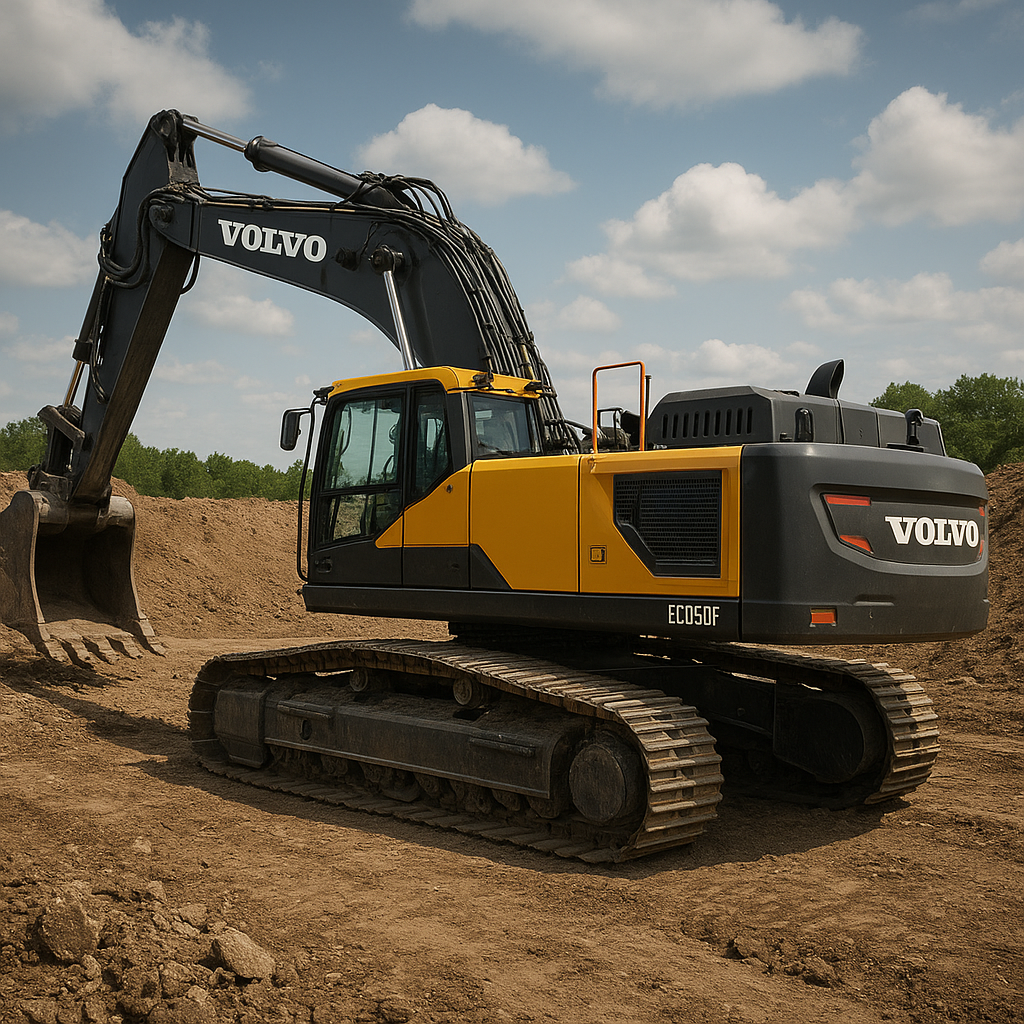
The Volvo EC950F is a heavy-duty tracked excavator designed for the most demanding tasks in mining, quarrying, major civil works and large-scale earthmoving. Combining robust structural design with advanced hydraulics, electronics and operator features, the EC950F represents a class of machines built to handle continuous, high-production cycles while minimizing downtime. In this article we explore the machine’s design, typical specifications, main areas of application, performance characteristics, maintenance demands, environmental considerations and how it compares in the global market of large hydraulic excavators.
Overview and design philosophy
The EC950F belongs to Volvo Construction Equipment’s range of large excavators intended for owners who need a balance of raw digging power, durability and fuel efficiency. While Volvo’s design language emphasizes operator comfort and systems integration, the EC950F is first and foremost engineered to withstand punishing operating conditions found in open-pit mining and heavy civil construction.
Key design features include a heavy-duty undercarriage and reinforced structures in the house, boom and stick areas to resist high cyclical loads. The hydraulic systems are sized for both high-flow and high-pressure operation, allowing rapid cycle times and effective control of large buckets and attachments. Electrical and electronic control units manage engine and hydraulic interactions to optimize performance and reduce unnecessary fuel burn during non-productive movements.
Technical specifications and typical figures
Exact specifications for an EC950F can vary by configuration, region and optional packages. The numbers below reflect typical published ranges for machines in this class and for this model family; end users should consult Volvo dealers or official documentation for certified figures relevant to their machine.
- Operating weight: Typically in the range of approximately 90,000–100,000 kg (90–100 tonnes) depending on undercarriage, counterweight and attachments.
- Engine power: Approximately 350–420 kW (470–560 hp) depending on tuning and emissions level.
- Bucket capacity: Commonly between 3.5 and 6.0 m3 for general-purpose buckets; larger rock or mining buckets may be specified differently.
- Maximum digging depth: Roughly 9.5–11.5 m depending on boom and arm length.
- Maximum reach at ground level: Typically in the 13–16 m range.
- Lifting capacity: Lift capacities at predefined radii can range from several tonnes close to the machine to 20–40 tonnes at short radii with heavy counterweights and reinforced linkages (values vary greatly depending on configuration).
- Hydraulic system: High-flow main pumps with system pressures tailored to deliver both high breakout forces and smooth fine control; pilot-controlled proportional valves for operator responsiveness.
- Fuel consumption: Highly variable; in heavy-duty continuous mining operations consumption may average 25–60 L/hour, depending on cycles, load factors and operator technique.
- Travel speed: Low-speed travel geared for moving around large sites; often in the range of 2–5 km/h in working conditions with higher top speeds on transit.
These numbers provide a snapshot of the EC950F’s capability envelope. OEMs frequently offer tailored configurations (heavy counterweights, reinforced tracks, cold-weather packages, upgraded hydraulic cooling) that materially affect final weights and performance metrics.
Primary applications and work environments
The EC950F is most often deployed where high production and long mean-times-between-failure are required. Typical application areas include:
- Open-pit mining: Loading dump trucks, feeding primary crushers, and stripping overburden. The machine’s size and bucket capacity make it suitable for mining fleets that require high hourly material movement.
- Quarrying and aggregate production: Loading feed hoppers, stockpile management and bench-scale excavations.
- Major civil engineering: Large earthworks for dams, ports, highways and airport construction where deep cuts and high cycle volumes are necessary.
- Bulk material handling: Operations such as scrap yards, biomass and other industries that can use large hydraulic excavators with specialized attachments.
Beyond these standard roles, the EC950F can be fitted with a wide range of attachments — from heavy-duty hydraulic breakers and shearers to specialist grapples and multi-purpose buckets — allowing it to serve in demolition, primary rock breaking and other niche tasks.
Performance, productivity and operating economy
Productivity with a machine of this class is influenced by mechanical capability, hydraulic efficiency, operator skill and site logistics. High-level indicators of EC950F performance include hourly material moved, cycle time for bucket fill and lift, and fuel efficiency per ton moved.
- Cycle times: A well-matched bucket and an experienced operator can achieve fast fill-and-dump cycles on suitable material, significantly improving tonnes-per-hour output versus smaller machines.
- Fuel per tonne: On heavy-duty sites, metric of fuel consumption per tonne is commonly used to evaluate efficiency. Modern engine management systems and hydraulic controls in machines like the EC950F reduce specific fuel consumption under typical load profiles compared with older-generation units.
- Component life: The heavy structural parts (boom, stick, bucket linkage) are engineered for long life under cyclic loads. Extended component life reduces total cost of ownership when combined with proactive maintenance.
Volvo often equips large excavators with telematics and machine monitoring platforms, enabling fleet managers to track fuel usage, idle time, load factors and maintenance intervals. These data-driven tools help optimize deployment and reduce lifecycle costs by identifying inefficient operating habits and mechanical issues before they become major failures.
Operator environment and safety features
Operator comfort and safety are major considerations for large excavators because machines run long shifts in harsh conditions. The EC950F typically includes:
- Spacious cabs with climate control, ergonomic seating and low-vibration mounting to reduce operator fatigue.
- Advanced visibility arrangements including large windows, camera systems and mirrors to minimize blind spots.
- Integrated safety systems such as overload warnings, automatic engine protection, and easy-exit ladders and handholds.
- Intuitive controls and display screens that provide engine, hydraulic and fault-code information for quick diagnostics.
Safety measures also extend beyond the cab: heavy-duty guards for hydraulic lines, reinforced walkways for service access, and lockout features for electrical systems are common in machines intended for mining and quarrying. Compliance with regional standards (e.g., ROPS/FOPS certified cabs) is typically a baseline requirement.
Attachments and versatility
One of the strengths of the EC950F platform is its adaptability through attachments. Quick couplers and robust hydraulic circuits allow fast changeover between tools, including:
- Rock and heavy-duty buckets for mining and trenching.
- Hydraulic breakers for primary rock fragmentation and secondary breaking in quarries.
- Rippers for loosening compacted material or permafrost.
- Sorting and demolition grapples for material handling and recycling.
- Specialized tools such as shearers and pulverizers for demolition projects.
Choosing the right attachment and matching bucket geometry to the material type is critical for achieving optimal digging forces, bucket fill factors and cycle efficiency.
Maintenance, uptime and lifecycle cost considerations
Large excavators such as the EC950F involve significant investment, and owners focus intensely on maximizing uptime and minimizing per-hour operating cost. Practical maintenance and lifecycle considerations include:
- Preventive maintenance: Scheduled oil and filter changes, hydraulic fluid sampling, and track tension checks to prevent unplanned downtime.
- Access for service: Design features that allow rapid access to daily check points, cooling packs and major components reduce service time and keep machines working.
- Component modularity — for example, bolt-on linkages and replaceable bushings — that simplify repairs and part replacement in the field.
- Telematics-enabled monitoring that supports predictive maintenance by identifying trends (rising temperatures, leak development, fuel spikes) before failures occur.
When operating at scale (fleets of large excavators), OEM support networks and local parts availability become decisive factors. The total cost of ownership (TCO) for machines in this class is heavily influenced by parts price, consumables, dealer service rates and machine utilization levels.
Environmental and emissions aspects
Modern large excavators must meet stringent emissions standards in many markets. Volvo has historically integrated engine controls and aftertreatment systems to comply with stages (e.g., EU Stage V) and similar regulations worldwide. Environmental and efficiency measures include:
- Advanced engine management and selective catalytic reduction (SCR) or diesel particulate filter (DPF) systems to meet emissions limits.
- Hydraulic system efficiency gains that reduce parasitic loads and minimize fuel burn.
- Idle management and auto-shutdown features to limit unnecessary idling.
- Design choices that facilitate recycling of materials at end-of-life, reducing the machine’s environmental footprint.
Operators are increasingly tracking emissions and fuel use to meet corporate sustainability goals. Data from telematics can be used to calculate carbon intensity per tonne moved, enabling optimization strategies at fleet level.
Market position, competitors and lifecycle trends
In the market of large hydraulic excavators, Volvo competes with major manufacturers such as Caterpillar, Komatsu, Hitachi, Liebherr and Doosan among others. The EC950F’s competitive differentiators often include build quality, operator comfort, integrated electronics and dealer support.
Lifecycle trends in the heavy excavator market include rising interest in electrification and hybridization for specific use cases, greater adoption of autonomous and semi-autonomous control systems for mine sites, and expanded telematics-driven fleet optimization. While fully electric machines at the EC950F size are not yet widespread due to battery energy-density constraints and duty-cycle demands, hybrid hydraulic techniques and electrified peripherals are areas of active development.
Typical on-site examples and productivity scenarios
To illustrate how the EC950F might be used in practice, consider these scenarios:
- Open-pit copper mine: An EC950F fitted with a 4.5 m3 mining bucket cycles between the bench and 40–60 tonne haul trucks, achieving high tonnes-per-hour outputs during day shifts. Telemetry shows load factor improvements when machine operators coordinate with truck dispatch to minimize truck waiting time.
- Quarry operation: The machine cycles heavy rock buckets into a primary crusher and performs occasional ripper work to break up compacted benches. The operator leverages hydraulic hammer attachments for stubborn sections.
- Large civil earthworks project: Multiple EC950-class machines work together for mass excavation and leveling, where the EC950F acts as the primary digger and material handler, reducing the need for additional loading equipment.
In each case, matching bucket selection, hydraulic settings and operator training determines whether the owner achieves the expected productivity and operating cost targets.
Choosing the right machine and final considerations
Selecting a machine like the Volvo EC950F requires careful evaluation of the project demands: expected daily production, material density and abrasiveness, haul distances, and site logistics. Key considerations include:
- Capacity matching: A machine that is too large can waste fuel on light-duty jobs; a machine that is too small will underperform and cost more in cycle times.
- Attachment strategy: Plan for the range of work to be done and the attachments required to avoid expensive retrofits later.
- Dealer support and parts availability: In remote mining sites, prompt spare parts delivery and skilled service technicians are necessary to sustain operations.
- Resale and residual value: Machines from established OEMs with good service networks tend to retain value better in secondary markets.
Considering these factors together with lifecycle cost models provides a pragmatic way to determine whether an EC950F is the right match for a specific fleet or project.
Summary
The Volvo EC950F is a purpose-built, large hydraulic excavator intended for high-production environments such as mining, quarrying and major civil projects. With robust structures, powerful hydraulic systems and modern electronic controls, it is engineered to deliver significant material-moving capability while keeping operator safety and serviceability in focus. Actual performance and economics depend heavily on configuration, attachments, operator skill and maintenance regimes. For companies whose work demands high hourly throughput and long-term durability, the EC950F is positioned as a competitive choice among ultra-large excavators available on the market.


)
)