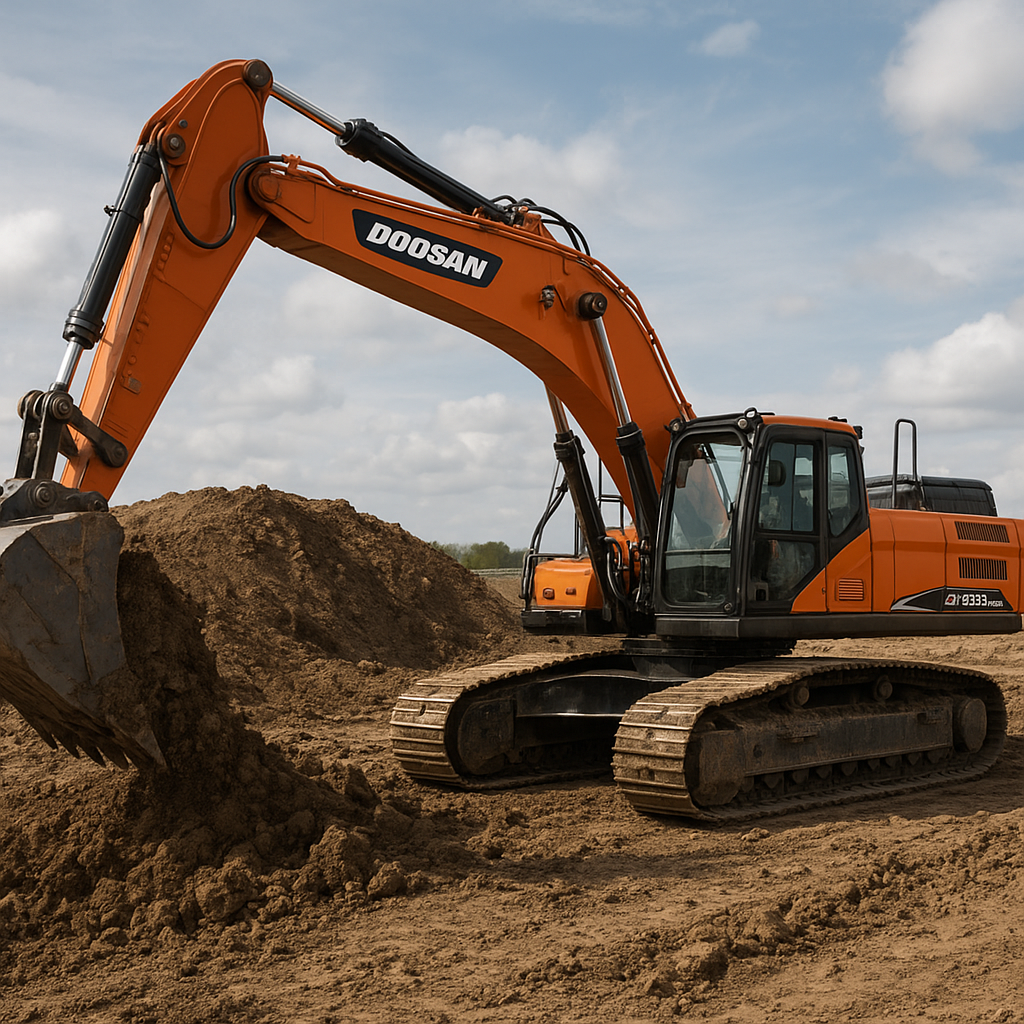
The Doosan DX800LC-5 is a heavy-duty hydraulic excavator designed for demanding earthmoving, quarrying and mining operations. Combining robust construction with modern electronics and hydraulic systems, this machine targets contractors and fleet operators who require reliable performance in harsh environments. In the following sections you will find an overview of the machine’s design philosophy, typical technical characteristics, primary applications, operator- and maintenance-focused features, and some market and operational considerations. Wherever figures are given they are presented as approximate values and may vary by configuration, optional equipment and regional specifications.
Overview and design
The Doosan DX800LC-5 belongs to Doosan’s DX-5 series of excavators, which emphasizes a balance between durability, productivity and fuel efficiency. Built on a heavy undercarriage and a reinforced upper structure, the DX800LC-5 is engineered to handle continuous cycles of digging, loading and material handling in challenging conditions. Key design priorities include serviceability, operator comfort and the capacity to accept a variety of attachments.
Structurally, the machine features a reinforced boom and arm with heavy-duty pins and bushes intended to extend life under high-stress conditions. The undercarriage uses wide track shoes and multiple track rollers to distribute weight and improve stability on uneven terrain. The hydraulic system is configured to deliver steady, high-flow oil to the main functions—boom, arm, bucket—and to auxiliary lines for attachments such as breakers and grapples.
Important components that contribute to its real-world performance include a modern high-torque engine with emissions control systems, a variable-displacement pump arrangement for energy efficiency, and an electronic control module that integrates engine, hydraulic and machine monitoring functions. These systems together provide smoother control, reduced fuel consumption under partial-load conditions and better responsiveness when high hydraulic power is needed.
Typical technical specifications and performance
Specifications for heavy machines like the DX800LC-5 vary by market and option packages; the values below represent commonly cited ranges and are intended as general guidance.
- Operating weight: approximately 75,000–85,000 kg (approximate, depends on counterweights and attachments)
- Engine power: roughly 350–420 kW (470–560 hp), depending on tuning and emission stage
- Bucket capacity: typical buckets range from 2.5 m³ to 6.0 m³ depending on material density and application
- Maximum digging depth: commonly around 9–10 meters with standard arm configuration
- Maximum reach at ground: often in the 13–15 meter range
- Travel speed: low and high ranges, generally up to about 3–4 km/h in low gear and higher in transit mode depending on undercarriage spec
- Hydraulic system pressure: high-pressure system typically in the range of 28–35 MPa (varies by pump specification)
- Fuel tank capacity: commonly between 1,200 and 1,800 liters, influenced by regional spec and optional tanks
Performance in the field is shaped not just by these headline numbers but by system integration: powerful combined hydraulic flow for simultaneous functions, programmed power modes for productivity or economy, and attachment control logic that optimizes pump output to match operator commands.
Primary applications and industries
The Doosan DX800LC-5 is most often deployed where large volumes of material must be moved quickly and reliably. Common application sectors include:
- Quarrying and aggregates — loading large haul trucks, bench excavation and processing plant feed.
- Mining (surface) — overburden removal, high-cup productivity in open-pit operations and secondary digging tasks.
- Heavy civil construction — large earthworks, dam construction, deep foundation excavation support and major infrastructure projects.
- Bulk material handling — stockpile management, reclamation and port or terminal work when fitted with appropriate grapples or clamshells.
- Pipeline and energy sector — trenching for pipeline corridors, clearing and site preparation for power plants and substations.
Because of its size and hydraulic capacity, the DX800LC-5 is particularly well-suited to tasks that require sustained dig cycles and large bucket loads. When paired with heavy-duty buckets or specialized attachments (tilt couplers, pulverizers, hydraulic breakers, sorting grapples), the machine can be adapted to a wide spectrum of operations.
Operator comfort, control and safety features
Modern heavy excavators are designed around the operator as much as the mechanical systems, and the DX800LC-5 is no exception. A comfortable, ergonomic cab contributes directly to productivity and safety. Typical operator-focused features include:
- Spacious cab with heating and air conditioning to maintain comfort over long shifts.
- Adjustable, suspension seats with multiple adjustments and lumbar support to reduce operator fatigue.
- Low-vibration design and sound insulation to reduce noise exposure and improve concentration.
- Large, clear multi-function display providing machine diagnostics, service reminders and camera feeds.
- Integrated rear and side cameras and proximity sensors for enhanced situational awareness on crowded sites.
- Electronic controls and adjustable joystick settings that allow operators to tune responsiveness to personal preference or task requirements.
Safety systems typically include emergency stop functions, automatic engine shutdown on severe fault conditions, fail-safe hydraulic systems, and well-located access points with non-slip surfaces and robust handrails to limit slips and falls during maintenance or inspection. These elements combined reduce downtime from incidents and improve overall fleet safety metrics.
Maintenance, serviceability and life-cycle costs
For large excavators, predictable maintenance and reduced downtime are as important as raw machine performance. The DX800LC-5 emphasizes serviceability areas that help operators and technicians keep machines productive:
- Ground-level service points for routine checks (oil, filters, coolant), minimizing time spent accessing the engine compartment.
- Modular filter placements and long-life filters to extend service intervals where possible.
- Onboard diagnostic systems that communicate faults and recommended corrective actions to reduce troubleshooting times.
- Robust component design for pins, bushes, track assemblies and hydraulic cylinders to extend replacement intervals.
- Availability of telematics options that allow fleet managers to monitor machine health remotely, track fuel consumption and schedule preventive maintenance.
When evaluating life-cycle costs, consider fuel consumption (a major operating expense), scheduled maintenance parts, expected component life (undercarriage, hydraulic pumps, control valves), and resale value. The DX800LC-5 aims to deliver competitive life-cycle economics by combining durable components with fuel management strategies and telematics-enabled maintenance planning.
Attachment versatility and specialized configurations
One of the advantages of a large platform like the DX800LC-5 is its ability to accept a broad array of attachments that extend its utility beyond simple digging. Popular options include:
- Large, deep-bucket and general-purpose buckets for bulk excavation and loading.
- Rock buckets and side-cutters for quarry and rocky terrain operations.
- Hydraulic breakers for secondary fragmentation and demolition work.
- Grapples and sorters for material handling, recycling and scrap operations.
- Tilting quick couplers to increase attachment flexibility and speed change-over.
- Long-reach booms and arms for dredging, riverbank, or deep excavation tasks.
Attachment integration also requires consideration of hydraulic flow rates, auxiliary circuit control, counterweight balance, and the machine’s duty cycle. Proper matching of attachment size and type to job requirements preserves cycle times and reduces undue wear on the machine.
Fuel efficiency and environmental considerations
Large hydraulic excavators have a substantial environmental footprint due to fuel consumption and emissions. Manufacturers have focused on improvements in engine management, hydraulic efficiency and idle-reduction features to reduce that footprint. Typical strategies applied to models like the DX800LC-5 include:
- Tier-stage compliant engines with aftertreatment systems to meet regional emissions regulations.
- Variable-displacement pumps and power-sharing hydraulic architectures that reduce wasted energy during low-demand operations.
- Auto-idle and shutdown features to reduce fuel burn during prolonged idle periods.
- Telematics-enabled monitoring to allow operators and fleet managers to spot fuel-inefficient behaviors and correct them through training or machine settings.
Adopting these measures can reduce both direct fuel costs and indirect regulatory risks. Additionally, many operators are now evaluating alternative fuels, hybrid technologies or further electrification for smaller machines—trends that may influence the long-term development of large excavator platforms.
Operational tips and productivity best practices
Maximizing the productivity of a DX800LC-5 requires attention to both machine setup and operator technique. Consider the following best practices:
- Match bucket size to material density and haul-truck volume. Oversized buckets can reduce cycle speed; undersized buckets waste potential machine power.
- Use the correct power mode—economy modes for light work and full-demand modes for heavy digging to balance fuel use and productivity.
- Maintain proper undercarriage tension and inspect track components regularly to prevent accelerated wear and potential downtime.
- Train operators on smooth, simultaneous control of boom, arm and swing motions to cut cycle times and minimize hydraulic shocks.
- Plan work sequence and machine positioning to reduce moves and non-productive time when loading trucks or feeding crushers.
- Implement a telematics-driven preventive maintenance schedule to replace parts on condition rather than strictly by hour, when appropriate.
Market considerations and resale value
In the market for large excavators, total cost of ownership and resale value are heavily influenced by brand reputation, local dealer support, parts availability and the presence of service networks. Doosan, backed by a global presence and authorized dealer networks in many regions, typically offers competitive aftermarket support, which helps preserve resale value and reduce downtime.
Resale values for machines like the DX800LC-5 are affected by global commodity cycles (mining and construction demand), operating hours, documented maintenance history and how well the machine has been stored and protected. Well-maintained units with telematics logs and full service records generally command higher prices on the secondary market.
Real-world examples and case scenarios
Typical deployments in operational settings illustrate how this class of excavator delivers value:
- Quarry operator: The DX800LC-5 loads 40–60 tonne haul trucks at a steady cycle, feeding a primary crusher. Productivity hinges on bucket size and truck compatibility; in many configurations these excavators drive daily tonnage well above smaller machines, reducing the number of excavators required on a site.
- Surface mine: Used for removing overburden, where high cycle counts and heavy buckets increase pit advance rates. Fuel management and quick scheduling of service intervals preserve production windows in continuous operations.
- Large civil project: Employed for deep excavation and embankment shaping; long-reach configurations extend reach while maintaining stability for precise digging adjacent to structures or utilities.
Conclusion
The Doosan DX800LC-5 is a heavyweight excavator platform designed for high-volume earthmoving and material-handling tasks. With a focus on robustness, serviceability and operator comfort, it suits quarrying, surface mining and major construction projects where uptime and productivity are paramount. While exact specifications depend on the chosen configuration and regional model variants, the general strengths of the DX800LC-5 include its heavy build, hydraulic power, and the ability to support a wide range of attachments. For fleet managers and contractors evaluating large excavators, considerations should center on matching machine configuration to application, optimizing operator training and leveraging maintenance and telematics tools to reduce life-cycle costs and maximize resale value.


)
)