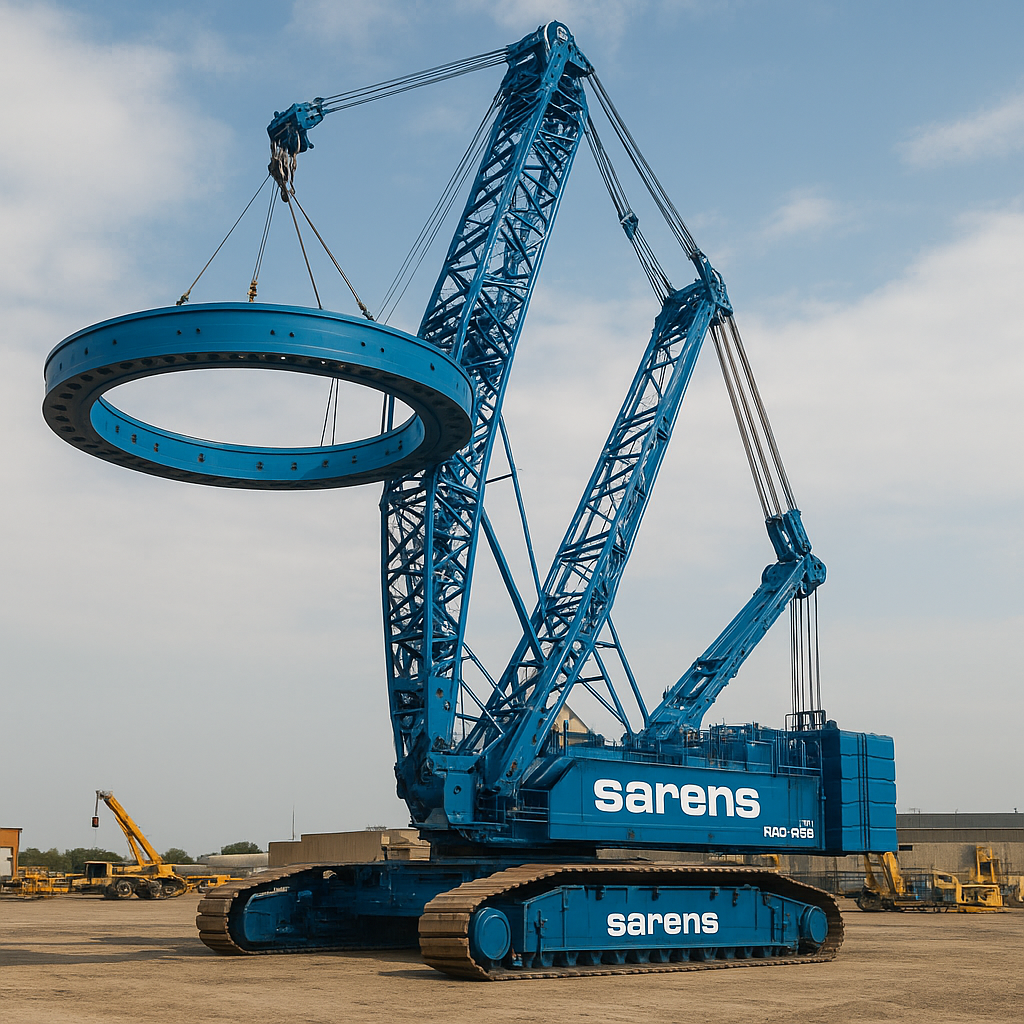
The Sarens SGC-250 is one of the most remarkable pieces of heavy lifting equipment ever developed for land-based projects. As a purpose-built ring crane designed to handle extremely heavy and complex lifts, it has redefined what is possible in construction, power generation, petrochemical, and offshore fabrication. In this article we examine the machine’s design and technical features, typical applications, logistics of transport and assembly, operational and safety considerations, and real-world uses that illustrate its unique capabilities. The goal is to give a comprehensive, practical picture of the SGC-250 and why it is considered a game-changer for very large lifts.
Overview and design philosophy
The Sarens SGC-250 is a specialized heavy lift crane often categorized as a ring crane. Unlike conventional crawler or tower cranes, ring cranes operate on a circular rail track that distributes load forces evenly and allows the crane to perform very large-capacity lifts with controlled rotation. The SGC-250 was conceived to address the growing demand for lifting ever larger modules, reactor components, containments, and other megastructures that exceed the capabilities of standard cranes.
Fundamental characteristics
- The SGC-250 uses a lattice boom and multiple hoist systems to manage loads and boom stress efficiently.
- A circular track or ring mounted on a prepared foundation provides the base for the crane’s turntable, combining high stability with smooth rotational capability.
- Massive counterweight assemblies and modular ballast blocks are used to balance loads and tune crane performance for specific lifts.
- Multiple winches and independent hoist lines allow precise load control, staged lifts, and synchronized operations.
The machine’s modular concept permits disassembly into transportable components that can be shipped to site and reassembled. The ring crane approach eliminates some of the stability limitations of tall towers and enables lifting very heavy loads at relatively long radii while maintaining the ability to slew (rotate) the load 360 degrees under control.
Technical specifications and performance
Exact configuration and performance data depend on how the SGC-250 is assembled for a specific job. However, several widely reported general characteristics define its operational envelope. These are often presented by manufacturers and industry reports as indicative values rather than fixed limits, because the crane’s configuration, counterweight, boom length, and setup radius all affect capacity.
- Lifting capacity: The SGC-250 is commonly cited as capable of handling lifts in the multi-thousand-tonne range for single lifts. Industry publications and project reports often describe its capacity in the range of several thousand metric tonnes for conventional lifts under rated configurations.
- Radius and reach: The crane’s main boom and auxiliary jib configurations allow significant reach. Depending on assembly, reach can extend to tens of metres or well over one hundred metres, enabling placement of large modules at the required craft or structure locations.
- Rotation: Full 360-degree slewing capability on the ring track provides flexible positioning and the capacity to perform complex lift sequences without re-rigging the crane.
- Counterweight: Substantial counterweight systems—assembled from modular blocks—are essential. Depending on project needs, counterweight mass can be many hundreds or thousands of tonnes.
- Foundation and ring: The supporting ring and foundation must be engineered to accommodate the distributed loads from lifting operations. This often involves large volumes of concrete, ground improvement, or temporary support structures.
Because the SGC-250 is tailored per contract, project-specific load charts are prepared for each lift plan. These charts map allowable loads against radius and boom configuration, accommodating the chosen counterweight arrangement and site constraints.
Applications and industries
The SGC-250 is used where exceptionally large, heavy, or awkward lifts are required and where precision and safety are paramount. Typical sectors and tasks include:
- Nuclear power: Lifting reactor vessels, containment domes, steam generators, and other prefabricated nuclear modules that can weigh thousands of tonnes. The controlled rotational capability and high capacity reduce the number of lifts and on-site assembly steps.
- Petrochemical, refinery, and LNG plants: Installing large pressure vessels, columns, and pre-assembled process modules that are too large for standard cranes.
- Offshore platform topsides: Installing or moving heavyweight topside modules during fabrication or transfer to launch sites.
- Bridge and infrastructure construction: Handling large bridge segments and precast concrete elements, particularly in constrained urban or riverine settings where staged lifting and rotation are required.
- Heavy fabrication yards and shipbuilding: Managing oversized machinery and ship sections that require controlled heavy lifts.
Projects that would otherwise require complex multi-crane lifts, prolonged on-site assembly, or bespoke lifting frames can often be simplified by using a ring crane like the SGC-250. Its ability to lift a very heavy object and rotate it into position reduces intermediate handling steps and can significantly shorten critical-path activities.
Transport, assembly and site preparation
Deploying the SGC-250 is a major logistical operation. The crane is modular by design, but the size and weight of individual components, the need for a prepared ring foundation, and the volume of ballast and tooling make pre-planning essential. Typical steps include:
Transport logistics
- Components are shipped by road, rail, or sea as large payloads. Transport schedules must coordinate with local authorities for oversized loads and often require night moves or special permits.
- Heavy-lift barges or specialized trailers may be used for coastal or river sites. The modular nature of the crane allows shipment in commercial ports and yards for reassembly near the worksite.
Foundation and ring construction
- The ring track is usually built on a reinforced concrete foundation or on a substantially prepared platform. The diameter and design depend on the crane’s configuration and the soil bearing capacity.
- Ground improvement, piling, or temporary matting may be required to ensure uniform support under variable loads.
Assembly sequence
- Experienced Sarens teams or certified contractors carry out staged assembly, often taking weeks to months depending on site conditions and configuration complexity.
- Once assembled, comprehensive testing and calibration of winches, hoists, slewing mechanisms, and safety systems are carried out before lifting operations commence.
The assembly and demobilization phases are among the largest line items in a project’s scope when a giant ring crane is deployed. However, the ability to perform a single heavy lift that would otherwise require repeated handling can justify these costs by reducing total project time and risk.
Operational considerations and safety
Operating the SGC-250 requires expert planning, engineering oversight, and rigorous safety procedures. Given the magnitudes of loads handled, even small errors can have major consequences. Important operational themes include:
- Lift planning and engineering: Detailed lift studies, finite element analysis, and step-by-step procedures are prepared for each heavy lift. Engineers evaluate load paths, sling configurations, lifting points, and the effect of the crane’s geometry as the lift progresses.
- Weather and environmental controls: Wind, rain, and icing can limit operations. Strict environmental thresholds are set for allowable wind speeds and visibility for lifts of different magnitudes.
- Redundancy and monitoring: Multiple sensors, load cells, and monitoring systems provide live feedback on load distribution, boom deflection, and slew position. These systems are integrated with operator consoles and safety interlocks.
- Personnel and exclusion zones: Large exclusion zones and coordinated communications ensure that non-essential personnel are kept at a safe distance. Rigging teams are trained and certified in specialized lifting techniques for modular heavy components.
The emphasis on planning and real-time monitoring helps manage the complex interplay of forces in very large lifts and ensures compliance with international safety standards and best practices.
Case studies and notable projects
The SGC-250 has been deployed on several high-profile projects worldwide. While project specifics can vary, these deployments highlight typical uses and benefits:
- Nuclear containment and reactor component installation: The crane’s heavy-lift capability and controlled rotation have been used to install prefabricated nuclear components, reducing time in which critical systems are exposed and minimizing on-site welding and assembly.
- Large module installation at power and chemical plants: Pre-assembled process modules weighing thousands of tonnes have been positioned precisely on foundations using the SGC-250, enabling faster plant commissioning.
- Bridge segment placement and heavy civil lifts: Where single-lift placement of giant precast segments or gantries is required, ring cranes provide a method with fewer intermediate lifts and lower risk of misalignment.
Project reports describe advantages such as reduced total construction schedules, fewer concurrent crane lifts (which reduces coordination risks), and improved safety records due to predictable load behavior and integrated monitoring.
Economic and environmental considerations
Deploying an SGC-250 is capital- and logistics-intensive, but the economic calculus is based on overall project value rather than crane rental alone. Key considerations include:
- Schedule compression: A single-capacity heavy lift reduces multiple handling stages and may unlock earlier commissioning dates for power plants, refineries, or bridges. Early operation of revenue-generating assets often outweighs the crane mobilization costs.
- Risk reduction: Replacing multiple rigging steps with a single controlled lift reduces the cumulative risk of damage, misalignment, and rework. This lowers contingency costs and potential insurance premiums.
- Environmental footprint: Although assembly requires materials and temporary works, the reduction in overall machine-hours (compared to multiple cranes over a longer period) can reduce total fuel consumption and emissions associated with heavy lifting operations.
When life-cycle analysis is conducted for very large projects, the SGC-250 often provides strong cost-benefit performance by streamlining high-risk operations.
Maintenance, lifecycle and future developments
Long-term reliability of such a specialized machine depends on scheduled preventive maintenance, thorough inspections, and refurbishment of critical components. Typical lifecycle practices include:
- Regular non-destructive testing (NDT) for structural members, rings, and boom sections.
- Scheduled overhaul of winches, gearboxes, and hydraulic systems after defined operating hours.
- Periodic recertification of hoist lines, slings, and lifting attachments according to regulatory requirements.
Innovations and future directions in the ring crane field focus on automation, remote sensing, and digital twin technology. Integrating advanced sensors, simulated lift rehearsals using digital twins, and more autonomous control functions can further increase safety and reduce lift preparation time. Improved modularity and standardized transport modules continue to reduce assembly time and adaptive capability for diverse project sites.
Practical advice for owners and project managers
Successful use of the SGC-250 requires coordination among owner representatives, lifting engineers, logistics teams, and site contractors. Practical tips include:
- Start planning early: Engage heavy-lift specialists during the design and procurement stages to ensure lift points, foundations, and logistics are compatible with the crane’s envelope.
- Invest in simulations: Use lift simulations and rehearsals to validate plans and train personnel. Digital visualization helps identify clashes and alternative sequences before physical assembly.
- Allocate time for assembly and testing: Avoid compressing the mobilization schedule. Thorough testing of winches and safety systems pays off during critical lifts.
- Coordinate local authorities: Night moves, road closures, and oversize permits can significantly impact transport scheduling. Early engagement with authorities avoids last-minute delays.
Summary and final observations
The Sarens SGC-250 represents a significant advancement in heavy lifting technology for land-based megaprojects. With a design that combines a ring foundation, modular boom components, sophisticated hoist systems, and vast counterweight flexibility, it is engineered to lift extremely heavy loads with precision and safety. Its primary value lies in enabling single-lift strategies for components that would otherwise require complex multi-crane operations or extensive on-site assembly.
While the mobilization and setup costs are non-trivial, the crane’s capacity to reduce schedule risk, improve installation accuracy, and minimize intermediate handling often yields strong commercial justification on large power, petrochemical, and infrastructure projects. For project teams facing very heavy, high-risk lifts, the SGC-250 is a proven option that marries engineering rigor with practical execution capabilities.


)
)