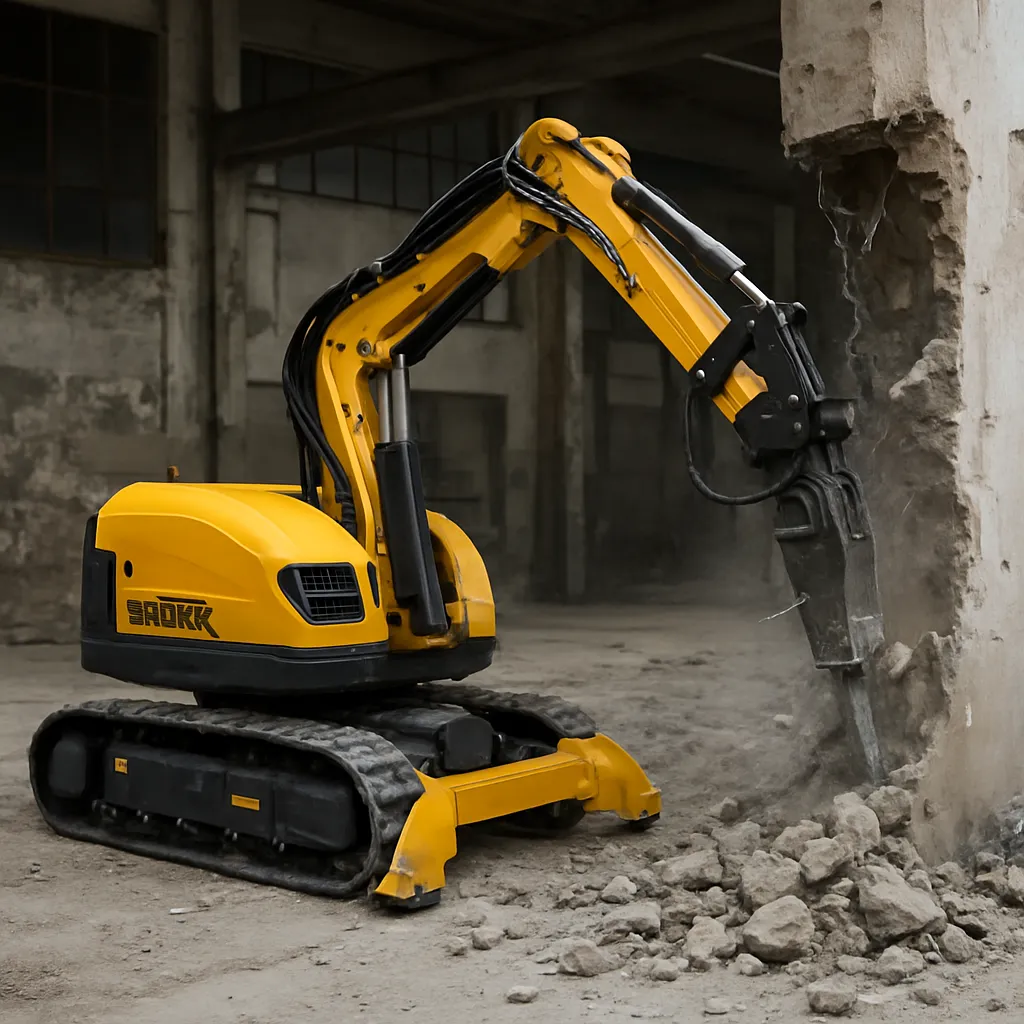
The Brokk 110 is a compact, powerful remote-controlled demolition machine designed for demanding jobs where access is limited and human safety is a priority. Built by Brokk AB, a leader in remote-operated demolition equipment, this unit combines hydraulic power, robust engineering and a small footprint to perform tasks in confined spaces such as tunnels, basements, industrial facilities and renovation sites. In the sections that follow, the machine’s design, typical applications, operational advantages, attachments and maintenance considerations are examined in detail to give a thorough picture of why the Brokk 110 remains a popular choice among contractors, rental companies and specialist demolition crews.
Overview and design philosophy
The Brokk 110 embodies the company’s long-held emphasis on remote operation and operator safety. As a purpose-built demolition platform, it replaces manual labor in hazardous environments, allowing a single operator to control the machine from a safe distance. The compact dimensions and intelligent hydraulic layout allow the machine to reach into tight voids while delivering the impact and reach required for light-to-medium demolition tasks.
Compactness and mobility
One of the defining characteristics of the Brokk 110 is its compactness. The chassis, track arrangement and boom geometry are optimized so the unit can be transported on small trucks or trailers and can pass through narrow doorways and corridors. This makes it particularly suited to renovation projects in urban buildings, confined underground works and industrial clean-ups where larger machinery cannot operate.
Remote operation and controls
The machine is fully remote-controlled, meaning the operator can stand well clear of falling debris, dust and vibration. Modern variants use ergonomic radio transmitters with proportional joysticks, clear feedback and multiple safety interlocks. Remote operation not only increases site safety but also facilitates fine manipulation of hydraulic tools and attachments that require precise control.
Robust hydraulic system
At the heart of the Brokk 110 sits a hydraulic powerpack engineered to deliver smooth, consistent power to breakers, crushers, and other tools. The hydraulic system is designed to be hardy and easy to service, with protected hoses and clear access points for daily checks. Hydraulic power combined with a light, articulated boom creates a machine that is both nimble and capable of delivering strong percussive force where needed.
Typical specifications and performance (indicative)
Manufacturers periodically update model details; below are approximate and indicative figures representing the Brokk 110’s class. Exact values vary by production year, optional packages and local configurations. For procurement decisions, always consult the manufacturer’s data sheet or an authorized dealer.
- Operating weight: approximately 1,000–1,300 kg (compact, trailer-transportable)
- Transport width: typically under 1.1 m (allows passage through standard doors with some configurations)
- Height (transport): compact folding boom design to minimize transport height
- Working reach: designed for confined environments—suitable for interior demolition and tunnelling tasks
- Power source: electric motor or diesel engine options depending on site constraints and emission rules
- Hydraulic power: sized to operate hydraulic breakers, crushers, drum cutters and other attachments used in medium-duty demolition
- Remote control range: tens of meters with line-of-sight radio control; wired control options exist for special circumstances
These figures place the Brokk 110 in the class of small, versatile demolition robots that balance portability with meaningful breaking power for a wide variety of applications.
Applications and use cases
The Brokk 110 is used across many sectors. Its small profile and remote operation make it ideal for environments where larger machines cannot reach or where human operators would be exposed to undue risk.
Construction and renovation
In urban renovation projects, the machine excels at selective demolition—removing sections of concrete, masonry or tile without compromising surrounding structures. Contractors use it to strip interior floors, remove staircases, and dismantle constricted sections in multi-storey buildings. Precision attachments allow for controlled removal of structural elements while minimizing vibrations and reducing the need for manual dismantling.
Underground and tunnelling work
Tunnels, sewers and other subterranean works are environments where the Brokk 110’s compact design and remote control provide clear advantages. Operators can perform mucking, trimming and secondary demolition within excavations without being exposed to dust, rockfall or confined-space hazards.
Industrial demolition and maintenance
Refineries, power plants, and manufacturing facilities often require plant-specific dismantling where heavy machinery cannot be introduced due to space or hazard constraints. The Brokk 110 can enter through access hatches and be used to remove heavy, awkward components using dedicated tooling. Routine maintenance tasks that involve cutting, grinding or light demolishing also fall within its remit.
Disaster recovery and hazardous environments
In emergency responses—collapsed structures, partial building failures, or areas with potential chemical contamination—the ability to operate remotely and remove debris with precision is invaluable. Robots like the Brokk 110 reduce the need to send humans into unstable areas and help clear access for rescue teams.
Attachments, tooling and versatility
A defining strength of Brokk machines is the wide palette of work attachments that transform the base carrier into a multi-purpose tool. The Brokk 110 supports a selection of hydraulic implements that enable it to perform a range of tasks beyond simple breaking.
- Hydraulic breakers — primary tool for concrete and masonry demolition; various sizes available depending on required impact energy.
- Hydraulic crushers — for confined crushing tasks where controlled material size reduction is required.
- Hydraulic cutters and shears — used for dismantling metal structures, piping and reinforcement.
- Rotating drum cutters — suitable for rock trimming, tunnel profiling and precise surface removal.
- Buckets and grapples — for material handling, sorting and load transferring in tight spaces.
- Drilling and coring implements — for making holes, installing anchors or sampling material.
The ease of switching attachments and the modular design of the hydraulic interface allow rental companies and contractors to adapt the same unit to multiple jobs, reducing downtime and maximizing utilization.
Safety, ergonomics and operator benefits
Safety is the primary argument for remote-operated demolition robots. The Brokk 110 removes operators from direct exposure to falling debris, airborne dust and hazardous atmospheres.
- Operator safety: Remote operation reduces risk of injury from collapses and flying fragments.
- Reduced vibration exposure compared with handheld tools, improving operator health and reducing fatigue.
- Better site ergonomics: a single operator can perform tasks that would otherwise require a team of laborers, reducing coordination risks and easing site congestion.
- Integrated safety interlocks and emergency stop functions in the controller prevent unintended movements.
Additionally, the compact footprint helps minimize collateral damage to adjacent structures. In refurbishment projects, this leads to lower repair costs and faster project completion.
Operation, training and maintenance
Operating a Brokk 110 requires trained personnel who understand remote-control dynamics, hydraulic systems and safe demolition practice. Manufacturers and authorized dealers typically provide operator training and certification programs. Routine maintenance keeps the machine reliable and extends service life.
Daily and periodic maintenance
- Visual inspection of boom, hoses and mounts for wear or damage.
- Hydraulic oil checks and filter changes as recommended by the manufacturer.
- Track tension and undercarriage inspections to avoid premature wear.
- Tool inspection and mounting checks to ensure secure attachment of breakers and cutters.
- Battery or engine checks depending on the power configuration (electric vs. diesel).
Because the Brokk 110 is used in harsh environments, a stringent preventive maintenance schedule reduces the likelihood of costly on-site failures. Remote diagnostics available on modern units can report error codes or impending faults before they become critical.
Economic and productivity considerations
From a cost perspective, using a Brokk 110 can yield several economic advantages even though the initial acquisition or rental cost may be significant compared to handheld tools. Key economic benefits include lower labor costs, fewer stoppages due to safety incidents, and faster task completion in restricted environments.
- Higher effective productivity: the machine can operate continuously with fewer breaks than manual crews.
- Reduced need for scaffoldings and temporary protections, since the robot can fit into small openings.
- Lower indirect costs: diminished insurance exposure and fewer medical incidents.
- Rental market: many contractors prefer renting to purchasing, and machines like the Brokk 110 are a popular rental choice for short-term specialized projects.
When comparing overall lifecycle costs, companies should evaluate uptime, maintenance intervals, tool wear rates and anticipated utilization to determine the break-even point versus traditional methods.
Environmental and regulatory considerations
Many modern demolition projects are subject to strict environmental and noise regulations. The Brokk 110 helps meet several compliance goals:
- Lower emissions when using electric motor variants—especially important in indoor projects or low-emission zones.
- Reduced noise and localized dust compared with large hydraulic breakers on heavy excavators.
- Improved waste segregation: precise demolition reduces uncontaminated material mixing, aiding recycling and waste management.
Contractors should also be mindful of local regulations regarding remote-working equipment, operator certification and emission rules that could influence the choice between diesel and electric powerpacks.
Case studies and practical examples
Across Europe, North America and other markets, the Brokk 110 has been used in a variety of notable projects:
- Urban apartment renovations where crews needed to remove load-bearing partitions inside occupied buildings with minimal disturbance to residents.
- Tunnel refurbishment works where the robot trimmed rock overhangs and prepared surfaces for new linings without exposing workers to rockfall risks.
- Industrial plant upgrades in constrained process halls where access was limited by machinery and piping—robotic demolition minimized shutdown time.
In many documented cases, machines of this class have lowered project times by enabling simultaneous operations—in which the demolition robot clears a section while other crews prepare finishes—resulting in overall faster delivery.
Comparisons with other demolition approaches
When choosing demolition methods, managers often weigh the Brokk 110 against handheld pneumatic tools, mini-excavators with breakers, and larger robotic platforms. The primary selection criteria are access, precision, safety and cost:
- Compared with handheld tools: the robot drastically reduces operator exposure and increases per-hour removal rates for heavy materials.
- Compared with mini-excavators: the Brokk 110 can access tighter spaces and operate with greater precision; excavators typically offer higher brute force and mobility on open sites.
- Compared with larger demolition robots: the Brokk 110 is more economical for small-to-medium jobs while still offering essential remote-operation advantages.
A balanced choice often involves combining methods—using robots for confined or dangerous sections and larger machines for bulk removal in open areas.
Future trends and technological developments
The demolition robotics field is progressing quickly. Trends likely to influence platforms like the Brokk 110 include:
- Electrification: greater adoption of battery-electric powerpacks to meet urban emission restrictions and reduce site ventilation needs.
- Telematics and predictive maintenance: improved connectivity will allow real-time monitoring of machine health and optimize service intervals.
- Advanced tooling: new cutter and crusher designs increase versatility, enabling more precision in selective demolition and salvage operations.
- Operator-assist features: semi-autonomous functions (such as collision avoidance and motion smoothing) enhance safety and lower the operator learning curve.
These developments will likely increase the appeal of compact demolition robots by lowering total ownership costs and improving on-site productivity.
Concluding remarks
The Brokk 110 represents a practical solution for contractors and specialized teams facing demolition tasks in confined, hazardous or sensitive environments. Its compact design, remote operation and adaptable tooling make it a strong choice where safety and precision are paramount. While exact specifications vary by model year and configuration, the overall value proposition emphasizes enhanced safety, improved productivity, operational efficiency, and easier compliance with environmental regulations. For many renovation, tunneling and industrial applications, the Brokk 110 or similar compact demolition robots deliver measurable gains over traditional manual or larger mechanical approaches.


)
)