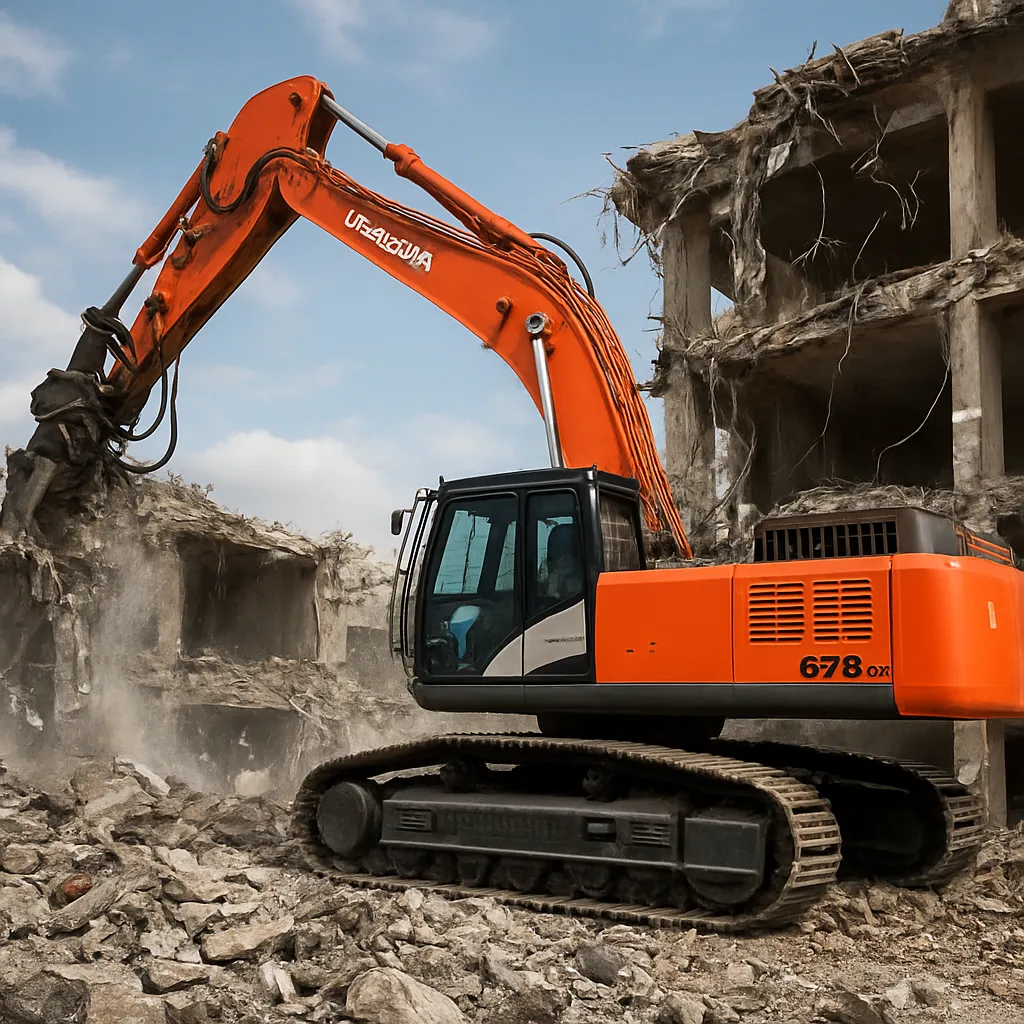
The Hitachi ZX670 Demolition is a purpose-built variant of Hitachi’s heavy crawler excavator family, engineered specifically for large-scale demolition projects where reach, power and stability are essential. Combining reinforced structures, specialised booms and arms, and a platform designed to accept heavy demolition attachments, the ZX670 Demolition is used across urban renewal, industrial dismantling and civil engineering projects that require safe, efficient removal of large structures. This article describes the machine’s design principles, typical applications, performance and maintenance considerations, and real-world deployment notes that contractors and equipment managers will find useful.
Design and core technical features
The ZX670 Demolition is based on Hitachi’s large excavator chassis but modified with features that address the unique demands of demolition work. These modifications focus on structural reinforcement, hydraulic capacity, operator protection and serviceability. While detailed specifications depend on the exact factory configuration and region, the Demolition variant typically includes reinforced booms and arms, extended undercarriage options and upgraded counterweights for enhanced stability when working with long reaches and heavy attachments.
Structure and reach
- Reinforced upper frame and boom/arm assemblies designed to withstand the dynamic loads of impact tools and heavy shears.
- Long-reach or ultra-long-reach configurations are available, with reach options commonly ranging up to the mid-20 metres in factory or dealer-built setups (exact reach varies by configuration and attachment).
- Modular boom sections and dedicated pinning points allow rapid conversion between standard excavating and demolition layouts, improving versatility on mixed-job sites.
Powertrain and hydraulics
Demolition tasks demand high hydraulic flow and robust engine torque. The ZX670 Demolition is equipped with a high-displacement diesel engine tuned for sustained low-end torque and reliability under heavy load. Hydraulic systems are adapted to provide high-flow circuits for powerful hydraulic breakers, shears and pulverisers, and commonly include multi-function hydraulic control to operate complex attachment combinations without loss of main system performance.
Undercarriage and counterweight
- Wider track gauges and heavier track frames increase ground contact area, improving overall machine stability on uneven demolition sites.
- Counterweight packages are available in different masses to balance extra-long booms and heavy attachments, and are often configured to be removable for transport.
Operator station and protection
Operator safety and visibility are priorities. The Demolition model commonly features a reinforced, FOPS/ROPS-certified cab or optional protective cages, polycarbonate window guards and rear/camera systems to improve situational awareness. Climate control, ergonomic seating and refined control layouts reduce operator fatigue during long, precision-demanding demolition tasks. Emphasis is placed on both physical safety and comfort to maintain productivity and reduce operator error.
Applications and typical use cases
The ZX670 Demolition is designed for high-demand tasks that smaller excavators cannot handle efficiently. It fits a niche where large size, long reach, and heavy attachment capability are required.
Urban building dismantling
- Multi-storey concrete and steel building demolition where operations require the safe removal of upper structures before controlled deconstruction of lower floors.
- Long-reach configurations enable contractors to work from a safe setback distance, reducing the need for scaffolding and manual labour at height.
Industrial plant and refinery dismantling
- Removal of heavy steel structures, chimneys, tanks and processing units where high-tonnage attachments like shears, crushers and grapples are used.
- The machine’s robust hydraulic output and strengthened frame allow prolonged operation with heavy tools.
Civil engineering and bridge/overpass removal
- Partial or full removal of bridges, viaducts and elevated roadways, especially where precise sectional demolition is required to protect underlying infrastructure or traffic.
- Hydraulic breakers and pulverisers are commonly employed to break and compact concrete components for easier removal.
Selective dismantling and recycling
- Sorting and processing of demolition materials on site — using sorting grapples, magnet attachments and mobile crushers to minimize landfill and maximise material recovery.
- The ZX670’s capacity to carry heavy, complex attachments supports integrated demolition-recycling workflows.
Attachments and configurations
One of the strengths of a demolition-spec ZX670 is the wide variety of attachments it can operate. Proper selection and configuration of attachments determine productivity, safety and total project cost.
- Hydraulic shears: for cutting steel columns, beams and rebar; mounted with reinforced couplers and adapted hydraulic flow.
- Hydraulic breakers: for concrete and rock fracturing; require anti-shock mounting and high-flow circuits.
- Concrete pulverisers/crushers: to crush sections into transportable sizes, often integrated with material-sorting systems.
- Grapples and sorting tines: for handling rebar, wood, and mixed demolition debris with precision.
- Multi-processor heads: combining shear and pulveriser functions to increase on-site versatility and reduce reattachments.
- Specialised quick couplers and remote-control hydraulic switching minimize downtime when changing attachments.
Performance, fuel economy and emissions
In demolition work, raw power must be balanced with fuel efficiency and emissions compliance. The ZX670 Demolition models commonly employ engines compliant with local emissions regulations — in many markets these meet Stage V (EU) or Tier 4 Final (US) requirements — while implementing fuel-saving features to reduce operating costs.
Fuel efficiency strategies
- Auto-idle and eco-modes that reduce engine RPM when full power is not required.
- Advanced hydraulic circuitry and load-sensing pumps that provide oil only where and when needed, lowering parasitic losses.
- Optimised engine mapping for demolition tasks that often require sustained low-speed, high-torque output rather than high-revving peak power.
Expected operational metrics (approximate)
Exact figures depend on configuration and attachment. Typical ranges for a machine in this class are:
- Operating weight: roughly 55,000–75,000 kg, depending on counterweights and long-reach kits.
- Engine power: typically in the 250–350 kW range (approximate and configuration-dependent).
- Operational fuel consumption: highly variable by task, but heavy demolition work often ranges from tens to over one hundred litres per hour depending on load and tool usage.
These numbers should be used as planning guidelines; site trials and telematics data yield the most accurate project estimates.
Safety systems and operator aids
Safety is paramount in demolition. The ZX670 Demolition integrates both passive and active systems to protect the operator and crew.
- FOPS/ROPS-certified cabins, optional protective screens and reinforced glazing to guard against falling debris.
- Surround-view camera systems, rear and side cameras, and radar-based proximity sensors to reduce blind spots and avoid collisions with personnel or structures.
- Load-sensing alarms and structural monitoring systems which can alert the operator to overload or abnormal stresses on boom/arm assemblies.
- Remote-control operation options for high-risk tasks, allowing operators to work from a safe distance when required.
Maintenance, serviceability and total cost of ownership
Because demolition work is punishing, maintenance access and quick serviceability are crucial to maximize uptime. The ZX670 Demolition emphasizes ease of service with ground-level access panels, centralized lubrication points, and modular hydraulic and electrical components that can be serviced or replaced quickly.
Planned maintenance and inspection
- Daily visual checks focused on attachment mounting points, hydraulic lines and protection guards.
- Frequent inspection of boom and arm welds and pins for fatigue and wear; demolition cycles induce significant bending loads.
- Hydraulic oil and filter service intervals shortened relative to general excavator applications when abrasive dust and debris are common.
Telematics and remote monitoring
Hitachi’s fleet management and telematics solutions (such as ConSite and other remote monitoring platforms) are commonly integrated to provide operational statistics: engine hours, fuel burn, hydraulic pressures and maintenance alerts. These systems significantly improve maintenance planning, reduce unexpected downtime and optimize overall project costs by enabling data-driven scheduling.
Market context and deployment considerations
Large demolition excavators like the ZX670 Demolition are capital-intensive but can yield strong project economics when deployed on suitable contracts. Ideal scenarios include multi-month demolition projects, industrial dismantling where heavy attachments are required, and contracts that include on-site material processing for recycling.
Transport and logistics
- Due to size and weight, transporting the ZX670 requires heavy-haul trailers and permits; many owners use modular counterweights to meet road transport limits.
- Staging of long-reach booms often requires crane assistance or specialised rigging, so job planning must include assembly/disassembly time and personnel.
Resale and lifecycle
Demolition-spec machines may have different resale dynamics than general excavators because of specialised wear on booms and attachments. Properly documented maintenance, structural inspections and use of OEM parts help preserve residual value. Many contractors maintain service and inspection records to support resale and trade-in negotiations.
Case examples and operational tips
Based on common industry practice and contractor experience, the following tips improve safety and productivity when operating a large demolition excavator like the ZX670 Demolition.
Site setup and staging
- Establish exclusion zones and clearly marked escape routes; falling debris patterns change as structures are removed.
- Set up material sorting and temporary stockpiles to minimise machine travel and cycle time for material handling attachments.
Attachment selection and matching
- Match hydraulic flow, pin size and mass to the attachment; under-sizing hydraulic supply or using incorrect pins accelerates wear and increases downtime.
- Consider multi-head processors that can switch between cutting and crushing functions to reduce attachment changeover time.
Operator training and fatigue management
- Operators require specific training for long-reach and heavy-attachment control; simulation and supervised on-job training reduce risk.
- Rotate operators to prevent fatigue during repetitive, high-concentration demolition tasks; strong ergonomic features help but do not eliminate the need for breaks.
Summary
The Hitachi ZX670 Demolition is purpose-designed to meet the heavy demands of large-scale demolition, offering reinforced structures, long-reach capability, and the hydraulic power needed to drive major attachments. Its strengths are stability, high hydraulic performance, and operator protection, while efficient fleet management and telematics reduce lifecycle costs. Proper configuration, rigorous inspection routines and experienced operators are essential to maximise productivity and lifespan. For contractors facing major deconstruction, plant removal or bridge dismantling tasks, the ZX670 Demolition represents a robust platform that balances power, safety and adaptability.


)
)