From the earliest water mills to the latest smartphone interfaces, machines have always shaped the way we work, live, and interact. This article explores the transformative journey of **controls** and **interfaces**, highlighting key milestones, innovations, and the ever-evolving relationship between humans and machines.
Mechanical Origins and Early Innovations
The development of mechanical controls began with simple **levers**, gears, and pulleys that converted human or animal power into productive work. Early artisans and engineers experimented with various configurations to gain **mechanical** advantage and improve efficiency. Some notable landmarks include:
- Lever Systems: Simple pivoting bars used in seesaws and balance scales.
- Gear Trains: Sets of interlocking wheels for adjusting speed and torque.
- Camshafts: Rotating mechanisms that transformed circular motion into reciprocating motion in looms and presses.
These devices laid the groundwork for more complex machinery by providing **precision**, reliability, and the ability to scale up manufacturing processes. With each improvement, craftsmen learned how to harness **force** more effectively, paving the way for the Industrial Revolution.
Electro-Mechanical Systems and Early Automation
As electricity became widely available in the late 19th and early 20th centuries, machines incorporated **electrical** components—motors, relays, and switches—to increase speed and reduce manual labor. The introduction of **electro-mechanical** controls marked a shift from purely mechanical linkages to hybrid systems:
- Electromagnets driving actuators and solenoids.
- Relay logic replacing complex gear assemblies.
- Early conveyor belts and automated assembly lines pioneered by visionaries like Henry Ford.
These innovations ushered in higher production rates and consistent **quality**, but they also introduced new challenges, such as electrical safety, maintenance complexity, and the need for specialized **skillsets** in engineering and troubleshooting.
Programmable Controllers and Digital Revolution
The 1960s and 1970s saw the emergence of Programmable Logic Controllers (PLCs), which replaced hardwired relay panels with software-configurable modules. PLCs offered unparalleled flexibility:
- Customizable logic through ladder diagrams and function blocks.
- Rapid reprogramming to adjust production parameters.
- Integration with sensors and feedback devices for closed-loop control.
By the 1980s, personal computers and microprocessors further accelerated the digital transition. Machine controls evolved into complex networks—SCADA systems monitored entire plants, while Human-Machine Interfaces (HMIs) provided graphical **displays** and touch-sensitive panels. These interfaces allowed operators to visualize system status, adjust setpoints, and review historical data in real time.
The Rise of Touchscreens and Intuitive Operation
Touchscreen technology revolutionized machine controls by offering intuitive and user-friendly interfaces. Capacitive and resistive screens replaced rows of buttons and dials, enabling:
- Dynamic menus and customizable dashboards.
- Multi-touch gestures for zooming, panning, and parameter entry.
- Graphical icons that reduced language barriers and training time.
Manufacturers began embedding touchscreens in everything from CNC machining centers to packaging robots. The modern HMI incorporates interactive charts, alarm summaries, and live camera feeds—transforming control panels into powerful command centers. This shift streamlined workflows and minimized operator fatigue, leading to safer and more **productive** operations.
Integrating IoT and Smart Sensors
In recent years, the Industrial Internet of Things (IIoT) has connected machines, sensors, and cloud services in unprecedented ways. Smart sensors gather data on vibration, temperature, and pressure, feeding it into analytics platforms that predict maintenance needs and optimize performance. Key benefits include:
- Real-time condition monitoring and remote diagnostics.
- Predictive maintenance that reduces downtime and **costs**.
- Data-driven optimization of energy consumption and throughput.
These systems rely on robust communication protocols—Ethernet/IP, MQTT, and OPC UA—to ensure secure and reliable data flow. The result is a digital ecosystem where machines adapt to changing conditions, self-correct, and support decision-making at all levels of the enterprise.
Human-Machine Collaboration and Augmented Reality
As automation and AI advance, the role of humans shifts from direct control to supervision, planning, and problem-solving. Augmented Reality (AR) and Virtual Reality (VR) tools assist technicians during maintenance and assembly by overlaying digital instructions on physical equipment. Applications include:
- AR headsets guiding step-by-step repair procedures.
- Remote expert support via shared live video feeds.
- VR-based training simulations for high-risk environments.
This collaboration enhances **safety** and knowledge transfer while reducing errors. Moreover, voice recognition and gesture controls are being integrated, allowing operators to interact with machines hands-free in hazardous or sterile conditions.
The Future of Machine Controls
Looking ahead, machine interfaces will become even more **adaptive** and human-centric. Developments to watch include:
- Artificial Intelligence-driven operator assistants that anticipate needs.
- Haptic feedback devices offering tactile sensations for remote operation.
- Brain-computer interfaces enabling direct neural control of machinery.
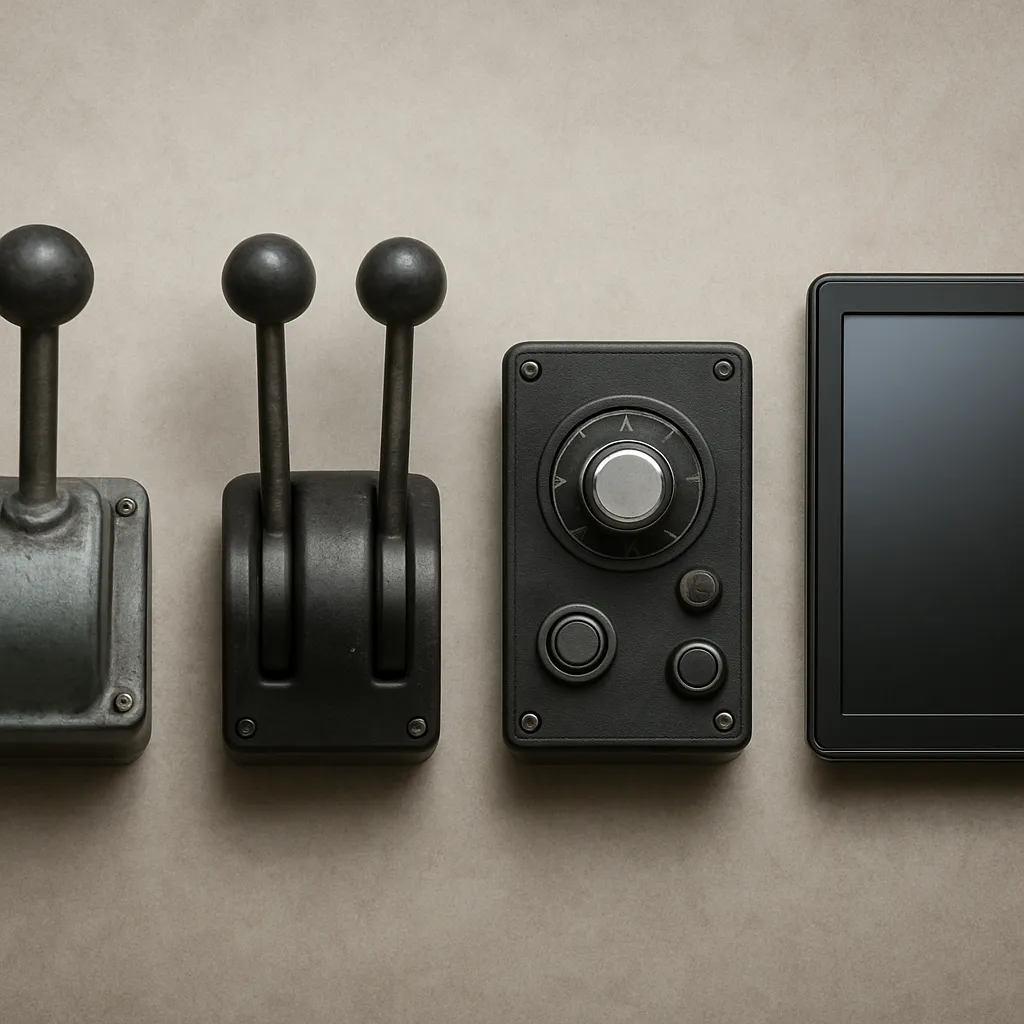
These advancements promise to further blur the line between human intent and machine action, unlocking new levels of efficiency, personalization, and accessibility across industries. The journey from simple levers to intelligent touchscreens demonstrates a **relentless** pursuit of better ways to harness technology—and that pursuit shows no signs of slowing down.