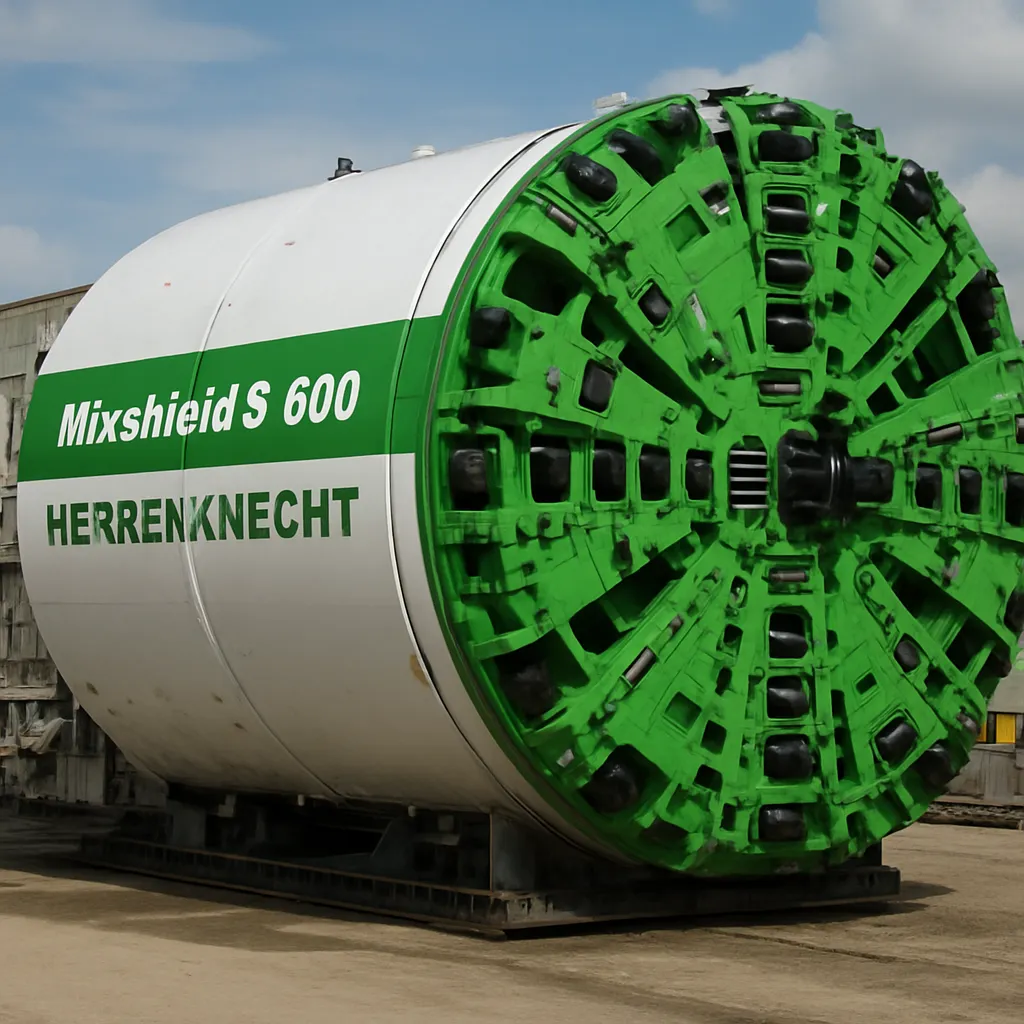
The Herrenknecht Mixshield S-600 represents a class of modern slurry-shield tunnel boring machines (TBMs) engineered for reliable excavation in challenging, water-bearing and mixed-ground conditions. Designed to combine precise face support with flexible soil conditioning, the S-600 is used where conventional open-face or Earth Pressure Balance machines would struggle to maintain stability or control groundwater inflows. This article describes the machine’s design principles, typical applications, operational workflow, performance characteristics and relevant technical and logistical considerations, offering a comprehensive view of where and why the Mixshield S-600 is selected for complex urban tunneling works.
Design and technical characteristics
The Herrenknecht Mixshield S-600 is part of the company’s family of slurry/mixshield TBMs optimized for diameters around six meters (hence the designation “S-600”), though the exact outer and excavation diameters vary depending on project-specific lining and overcut requirements. The machine is engineered to operate as a closed-face system using a pressurized slurry (bentonite, polymer-enhanced fluids, or other special mixtures) to balance groundwater and earth pressures at the face, while also permitting mechanical interaction with heterogeneous materials through specialized cutterheads.
Key components
- Cutterhead and cutting tools: robust, often tool-adaptable heads designed to handle mixed soils, boulders and obstructions while supporting excavation under pressure.
- Shield and main drive: a cylindrical steel shield that supports the excavated face and transfers thrust from the hydraulic jacks to advance the machine.
- Thrust system: sets of hydraulic cylinders delivering the high compressive force required to push the shield forward and to install segmental linings.
- Slurry circuit: a closed-loop system including pumps, pressure control devices and valves that maintain face pressure and convey the slurry-soil mixture back to the surface.
- Slurry treatment plant: surface-based separation units (cyclones, centrifuges, filter presses) that clean and recondition slurry for reuse, minimizing environmental impact and slurry consumption.
- Segment erector and trailing gear: mechanisms for installing precast concrete segments for permanent lining, plus conveyors, pumps and ancillary equipment trailing behind the shield.
- Instrumentation and automation: sensors for slurry pressure, face pressure, torque, thrust, inclination, and settlement monitoring, integrated into a control system for safe and optimized operation.
Operating modes and adaptability
The Mixshield S-600 is characterized by flexible operational modes. In true slurry-shield fashion it maintains a pressurized face via a slurry column, but the “mix” designation also indicates the machine’s capability to work with conditioned soil-slurry mixtures and, where appropriate, to apply mechanical cutting strategies for stiffer layers or localized obstacles. This hybrid approach offers advantages in heterogeneous ground where part of the face may be cohesive clay while adjacent pockets contain sands, silts or gravels.
Critical design considerations include cutterhead geometry tailored to specific geologies, the ability to apply chemical or mechanical soil conditioning agents, and a robust slurry circulation and separation plant sized to match expected muck volumes. The machine’s configuration is custom-engineered for each contract, with variability in back-up train length, slurry plant capacity and segment dimensions.
Typical applications and project contexts
The Mixshield S-600 is commonly chosen for projects where controlled tunneling under urban infrastructure, high groundwater tables or sensitive surface structures is required. Its strengths lie in minimizing settlement and preventing uncontrolled groundwater inflows while maintaining an acceptable tunneling advance.
Common project types
- Urban metro and rail tunnels with constrained alignments beneath built-up areas.
- Sewer, stormwater and drainage tunnels where limited diameter and groundwater control are paramount.
- Utility and service tunnels carrying cables, pipelines or district heating where precise excavation and low disturbance are needed.
- Rock–soil transition zones, river crossings and groundwater-rich alluvial deposits where mixed-face conditions prevail.
Because of its diameter, the S-600 often suits single-track metro tunnels, small-bore water conveyance tunnels, and utility corridors. Its capacity to control face conditions makes it especially valuable in historic city centers or areas with strict settlement limits.
Operation and construction process
Tunneling with a Mixshield S-600 involves an integrated sequence of steps, where machine operation and slurry management are tightly coordinated. The following outlines a typical workflow from launch to breakthrough.
Pre-launch preparation
- Detailed geotechnical investigations to determine soil types, groundwater conditions, and potential obstructions.
- Design of a launch shaft (or adit) sized for assembly and for installation of the slurry treatment plant and logistics.
- Assembly of the TBM shield, cutterhead and trailing gear in the launch shaft, plus commissioning of instrumentation and control systems.
Excavation cycle
- Pressurized face support: the slurry circuit establishes a controlled hydrostatic pressure at the cutterhead to balance external groundwater and earth pressures.
- Cutting and mixing: the cutterhead engages the ground, producing a slurry-soil mix that is pumped to the surface using high-capacity slurry pumps or transported via gravity/slurry pipelines.
- Slurry separation and reuse: surface treatment separates excavated solids from the slurry so the clean fluid can return to the TBM. Solids are dewatered and disposed of per environmental regulations.
- Thrusting and lining: after a controlled excavation stroke, hydraulic jacks push the shield forward; a segment erector installs precast concrete segments to form the permanent lining.
- Continuous monitoring: face pressure, torque, penetration rate, slurry properties and ground settlement are monitored to adjust operations in near real time.
Environmental and community considerations
Because the Mixshield method controls groundwater and confines excavated material within a closed slurry circuit, it reduces the risk of contamination and the need for dewatering. However, slurry disposal, noise from pumps and logistics of slurry plant operation require careful management. Typical mitigation measures include enclosed separation plants, acoustic enclosures for pumps, controlled trucking schedules, and continuous environmental monitoring.
Performance and statistical data
Performance of any TBM is highly site-dependent. The following figures represent representative ranges and key metrics for an S-600 class mixshield machine under typical urban mixed-ground conditions. These should be treated as indicative; project-specific values can differ substantially based on geology, logistics, lining protocols and contract constraints.
- Nominal diameter: approximately 5.5–6.5 meters excavation diameter, depending on lining and overcut requirements.
- Machine length: the shield plus a single backup train and trailing gear yields an overall machine train of roughly 30–80 meters; multiple trailing units extend this length further.
- Machine mass: a fully equipped Mixshield S-600 with shield, cutterhead and significant trailing gear plus slurry equipment can weigh in the hundreds of tonnes—often between 200 and 1,000 tonnes depending on configuration.
- Typical thrust: hydraulic jacks provide several thousand kilonewtons of thrust; exact values are specified per machine based on soil and lining requirements.
- Drive power: main drive motors on machines of this class typically use several hundred to a few thousand kilowatts total (combined for cutterhead and supporting systems).
- Advance rate: site-dependent; typical daily production in mixed urban ground ranges from a few meters to several tens of meters per day. A conservative everyday planning figure is 5–20 meters/day, while record advances in favorable conditions can exceed 30–40 meters/day for short bursts.
- Slurry flow and treatment capacity: designed to handle the anticipated muck volumes; plants are sized to process several cubic meters per minute—exact rates determined from predictive geotechnical models and planned advance rates.
- Face pressure control: capable of maintaining precise slurry pressures to closely match in-situ hydrostatic pressures, minimizing groundwater drawdown and settlement.
Real-world productivity depends heavily on non-excavation activities: segment erection, ring grouting, supply logistics, machine maintenance and unexpected ground conditions. Thus contract performance data usually show a wide spread around theoretical maximums.
Logistics, maintenance and safety considerations
Deployment of a Mixshield S-600 requires careful planning across multiple fronts. The machine’s segmented transport, assembly in a launch shaft, and the large auxiliary slurry plant and backup train create complex logistics chains that must be synchronized to maintain production.
Transport and assembly
- Components are modular and shipped by truck or rail. Shaft dimensions are designed to allow on-site assembly of the cutterhead, shield and trailing components.
- Heavy-lift cranes, temporary structures, and extensive onsite fabrication facilities are commonly needed for launch and retrieval operations.
Maintenance and wear management
- Cutter tools, seals and wear parts are subject to abrasion and must be regularly inspected and replaced on-site. Adequate inventories of critical spares reduce downtime risk.
- Predictive maintenance via sensor data (torque trends, vibration analysis, slurry properties) helps preempt failures and optimize interventions.
- Turnkey service arrangements with the manufacturer often include spare-part packages, on-call engineering support and periodic overhauls to maintain performance over long drives.
Safety and monitoring
Safety-critical systems and real-time geotechnical monitoring are integral. Continuous observation of settlement, building response, face pressure, and slurry composition reduces risks to surface structures and workers. Additionally, emergency procedures for rapid face depressurization or access to the cutterhead area must be in place, as well as contingency plans for slurry spills or separator failures.
Economic factors and project planning
Selecting a Mixshield S-600 involves evaluating capital costs, operational costs (slurry, power, labor), environmental compliance costs and the potential benefits of reduced surface remediation and compensation payments related to settlements or groundwater impacts. While slurry TBMs and their treatment plants represent a significant upfront investment, they often provide the only feasible method for tunneling under sensitive urban areas where uncontrolled settlement or groundwater drawdown would be unacceptable.
- CapEx considerations: machine fabrication, shipping and on-site assembly, plus the slurry treatment plant and backup train.
- OpEx considerations: energy consumption for pumps and main drives, slurry consumables, disposal and treatment of separated solids, maintenance labor and spare parts.
- Time and risk management: unexpected ground conditions or obstructions can extend schedules; robust geotechnical investigation and contractual risk allocation are vital.
Innovations, digitalization and future trends
Herrenknecht and the broader tunneling industry continue to innovate in areas that directly enhance the capabilities of machines like the Mixshield S-600.
- Digital tunneling and monitoring: integrated data platforms aggregate machine telemetry, geotechnical sensor data and surface monitoring to enable real-time decision-making and predictive maintenance.
- Improved cutterhead designs: adaptable and modular tool layouts that can be reconfigured to match varying ground conditions without major downtime.
- Slurry chemistry and conditioning: advanced additives and conditioning techniques reduce wear, improve separability and lower environmental impact.
- Automation and remote operation: more processes can be automated or operated remotely, improving safety and efficiency, particularly in sensitive or hazardous environments.
- Sustainability: emphasis on reducing slurry waste, reusing process water, electrification of support systems and lowering the carbon footprint of tunneling operations.
Practical advantages and limitations
Advantages that make the Mixshield S-600 an attractive choice include precise face control, reduced settlement risk, suitability for mixed and water-bearing ground, and the ability to install segmental linings continuously. These strengths make it particularly valuable in urban environments, historic districts, and under critical infrastructure.
Limitations include higher initial capital and setup costs relative to simpler TBM types or conventional methods, the requirement for a sizeable launch and retrieval shaft, and complexity in slurry management and disposal. Furthermore, extremely abrasive or large rock mass conditions may necessitate different TBM types or pre-treatment measures.
Concluding observations
The Herrenknecht Mixshield S-600 embodies a pragmatic balance between face-pressure control and mechanical excavation capability for medium-diameter tunnels in demanding ground conditions. Its tailored design, comprehensive slurry systems and advanced monitoring make it a preferred choice for projects where minimizing settlement and controlling groundwater are non-negotiable. As digital tools and materials science continue to evolve, the mixshield concept will likely gain further refinements, offering even greater efficiency, safety and environmental performance for future tunneling challenges.


)
)