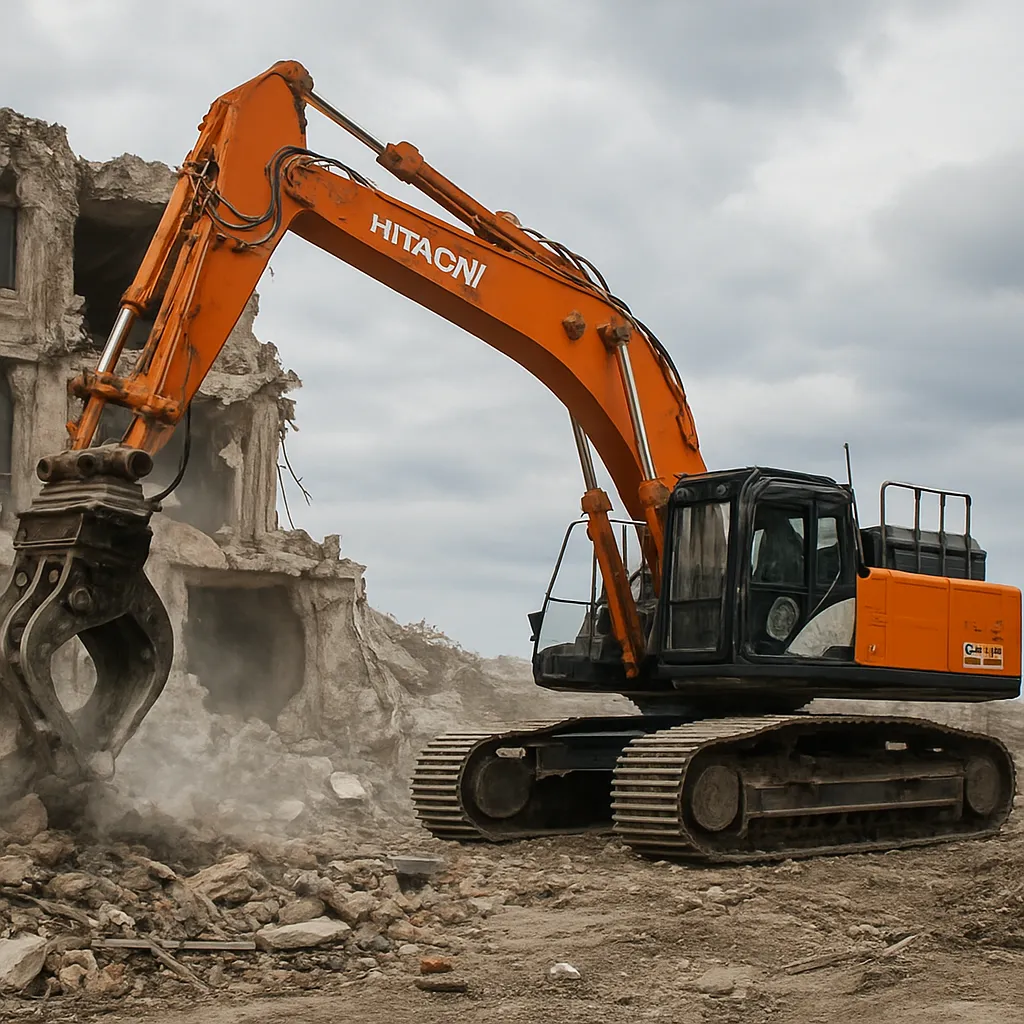
The Hitachi ZX490LCH-5 Demolition is a heavy-duty excavator platform adapted specifically for demanding demolition work. Combining the proven base of Hitachi’s large excavator series with demolition-oriented reinforcements, specialized attachments and enhanced operator protection, this machine addresses the needs of urban teardown, industrial dismantling and selective deconstruction projects. The following article explores the machine’s design principles, real-world applications, typical configurations, safety and maintenance considerations, and market context—providing a broad view of why the ZX490LCH-5 is chosen where power, reach and controlled demolition capability are required.
Design and key features
The ZX490LCH-5 is built on a robust excavator chassis but tailored for demolition tasks through a set of deliberate design choices. At its core are elements that improve structural strength, hydraulic capacity and operator protection. These enhancements make the machine more suitable for repetitive, high-impact operations while maintaining the serviceability and reliability expected from Hitachi equipment.
Structural reinforcement and boom design
- Reinforced upper-structure and undercarriage: Demolition variants typically include strengthened frame members, additional welds and thicker steel in high-stress areas to resist the repeated shock loads generated when using heavy attachments such as pulverizers and shears.
- Specialized boom and arm options: Long or high-reach booms and purpose-engineered arms improve reach and precision. These are often fitted with additional support brackets and heavy-duty pinning to handle off-axis loads and to minimise wear during prolonged demolition cycles.
Hydraulics and powertrain
Hydraulic performance is a defining element for demolition machines. The ZX490LCH-5’s hydraulic system is designed to deliver high flow and sustained pressure for demanding attachments. Key points include:
- High-flow hydraulic circuits and optional auxiliary lines to feed shears, crushers and hydraulic breakers with the consistency needed for efficient fragmentation.
- Robust hydraulic pumps and piping routed to reduce the risk of damage and to facilitate quicker repair if a hose or line is impacted on site.
- Engine and cooling systems optimised for heavy-duty duty cycles—ensuring stable performance during extended demolition shifts where engines often run at elevated loads.
Operator protection and comfort
Operator survivability and comfort are central to demolition machine design. The ZX490LCH-5 demolition spec commonly includes:
- FOPS/ROPS-certified cabs with enhanced guarding: mesh guards, polycarbonate windows or deployable screens protect against falling debris while maintaining visibility.
- Improved seating, HVAC and ergonomic controls to reduce operator fatigue during long shifts—important for maintaining safety and productivity.
- Camera systems and proximity sensors to give operators a better sense of surroundings in cluttered demolition sites.
Typical applications and demolition use cases
The ZX490LCH-5 Demolition is versatile and used in many demolition scenarios, particularly where a combination of reach, power and stability is required. Its applications span from urban building teardown to specialized industrial dismantling and concrete recycling operations.
Urban multi-storey demolition
In dense urban environments, selective demolition is often necessary to preserve adjacent structures and minimise dust and vibration impacts. The ZX490LCH-5, when fitted with a long-reach boom or high-reach configuration, enables operators to work floor-by-floor with precision. The machine’s reinforced structure and controlled hydraulic response help prevent sudden impacts that could generate excessive vibrations.
Industrial plant dismantling and selective deconstruction
Industrial sites present complex demolition challenges—heavy steel structures, thick concrete, and hazardous materials. The ZX490LCH-5 is frequently used to remove structural steelwork, cut piping, and break up foundations with the aid of hydraulic shears, multi-processor attachments and rotating grapples. Its size allows it to move reasonably across larger sites while offering the stability needed for handling heavy fragments.
Concrete recycling and material processing
Equipped with crushers and processors, the ZX490LCH-5 can convert demolition waste into reusable aggregate on site, reducing transport costs and supporting circular construction practices. This application often pairs the machine with screening and sorting equipment to optimise recovered material value.
Bridge and infrastructure removal
Removing bridge spans or dismantling elevated structures requires controlled disassembly and significant lifting and breaking force. The ZX490LCH-5, combined with heavy-duty grapple and shear attachments, is suitable for breaking reinforced concrete and cutting steel members while maintaining controlled piece removal to protect below-clearance areas.
Attachments and configurations
One of the ZX490LCH-5’s major strengths is its adaptability via attachments. Demolition work relies on a suite of specialised tools; selecting the right combination changes the machine from a breaker to a shear, crusher or material handler.
Common demolition attachments
- Hydraulic shears — used for cutting steel beams and rebar; require strong, reliable hydraulic flow and reinforced mounting points.
- Multi-processors / pulverizers — versatile attachments that crush and cut, allowing efficient size reduction of concrete and separation of rebar.
- Hydraulic breakers — ideal for breaking concrete and masonry in confined spaces; good for foundation removal and slab breaking.
- Grapples and sorting claws — used for handling and sorting demolition material, improving cycle times for loading and processing.
- Rotating couplers and tilt systems — these enhance positioning and allow attachments to be oriented precisely for selective demolition.
Underbody and track options
Demolition machines often operate on uneven, debris-filled ground. Track guards, rock pads and heavy-duty undercarriage components protect travel systems. Some operators use widened undercarriages for added stability when using long-reach booms or when lifting large pieces.
Remote and semi-remote operation
For particularly hazardous tasks or when working near unstable structures, some ZX490LCH-5 units are set up for remote or semi-remote operation. This reduces operator exposure to falling materials or chemical risks. Remote systems are paired with enhanced camera and sensor packages to preserve situational awareness.
Safety, operation and maintenance
Safety and maintenance protocols are paramount in demolition environments. The ZX490LCH-5 is designed to meet high safety standards, but on-site procedures and a disciplined maintenance program ensure long-term reliability and operator safety.
Pre-shift inspections and safety checks
- Daily walk-around inspections should include attachment pins and locks, hydraulic hoses, protective guards, and undercarriage condition.
- Verify functionality of cameras, alarms and operator restraint systems before each shift.
- Confirm that any remote-control interfaces or fail-safe systems are working properly.
Planned maintenance and component life
Demolition duties accelerate wear on hydraulic components, pins and bushings, and the undercarriage. A proactive maintenance schedule should include:
- Hydraulic oil and filter changes at manufacturer-recommended intervals, with closer monitoring under heavy-duty cycles.
- Frequent greasing of pins and linkages and inspection for wear beyond tolerance limits.
- Regular undercarriage inspections, with track tension adjustments and replacement of worn rollers and sprockets.
Operator training and fatigue management
Skilled operators increase both safety and productivity. Training on attachment-specific handling, awareness of swing radii and controlled fragmentation techniques reduces risk. Because demolition is intensive and mentally demanding, shift scheduling that manages fatigue is critical to preventing accidents.
Performance, statistics and economic considerations
When evaluating a machine like the ZX490LCH-5 for demolition work, buyers and fleet managers examine operating costs, productivity potential and lifecycle economics. The figures below are indicative ranges and operational considerations—actual values depend on configuration, attachment choice and job profile.
Typical performance metrics (indicative)
- Operating weight: typically in the mid-to-upper 40 tonne range for a demolition-configured 49-class excavator, dependent on boom and counterweight choices.
- Hydraulic flow and pressure: demolition variants prioritise high auxiliary flow and sustained pressure to operate shears and crushers effectively—operators often select auxiliary pump upgrades where available.
- Reach and lift: high-reach booms can extend the working envelope substantially, enabling controlled deconstruction at several storeys high; however, long-reach setups trade off lift capacity at maximum reach.
- Fuel efficiency: modern Hitachi engines combined with hydraulic control strategies aim to balance power with fuel consumption; efficient cycle management and idle reduction practices reduce overall fuel costs.
Productivity and lifecycle cost
Productivity is measured in tonnes processed per hour, cycle times for removal and fragmentation, and the speed and safety of selective demolition. Key factors include:
- Attachment efficiency: choosing the right attachment for the material reduces cycle counts and fuel use.
- Operator skill: experienced operators who can plan cuts and control fragment size improve throughput and reduce attachment wear.
- Maintenance regime: machines with disciplined preventive maintenance experience fewer unscheduled downtime hours, improving overall equipment effectiveness (OEE).
Resale value and fleet considerations
Demolition machines often retain value if they are kept in good condition and have documented maintenance histories. Fleet managers weigh initial acquisition cost against uptime, attachment versatility and potential resale in secondary markets. A well-maintained ZX490LCH-5 can serve multiple roles across projects, increasing its utilisation rate and spreading ownership costs more evenly.
Sustainability and environmental factors
Demolition projects are increasingly judged by their environmental footprint. Machines like the ZX490LCH-5 support sustainability objectives through on-site processing, emissions control and reduced transport needs.
- On-site material processing: by breaking and sorting concrete and steel on site, operators reduce haulage distances and enable reuse of reclaimed aggregate.
- Engine emissions and noise: modern diesel engines incorporate emissions-reduction technology; selecting the right exhaust after-treatment and maintaining the powertrain reduces environmental impact.
- Fuel management and oil handling: careful management of fuels and hydraulic fluids prevents spills and minimises contamination risks at worksites.
Practical tips for buyers and operators
Choosing and operating a ZX490LCH-5 in demolition requires attention to configuration, lifecycle support and operator skillsets. Practical advice includes:
- Match boom and arm length to typical job requirements—long reach is attractive but reduces lifting capacity and increases stress on components.
- Invest in quality attachments and ensure correct hydraulic sizing to avoid underperforming tools.
- Document maintenance and damage history meticulously—this improves resale value and simplifies warranty or rebuild decisions.
- Consider telematics and fleet monitoring to track utilisation, fuel use and predictive maintenance alerts.
- Plan operator rotation and training programs to maintain safe, efficient site practices and to maximise attachment life.
Conclusion
The Hitachi ZX490LCH-5 Demolition variant represents a purposeful evolution of a heavy excavator into a specialised demolition platform. Through reinforced structures, high-capacity hydraulics, operator protection and flexible attachment options, it meets the demands of complex deconstruction projects—urban teardowns, industrial dismantling, bridge removal and on-site recycling. While exact specifications and performance metrics vary with configuration and job conditions, the machine’s strength lies in its versatility and the ability to be tailored to specific demolition challenges. Proper attachment selection, preventive maintenance and skilled operation are the key factors that unlock the ZX490LCH-5’s full potential in real-world demolition environments.


)
)