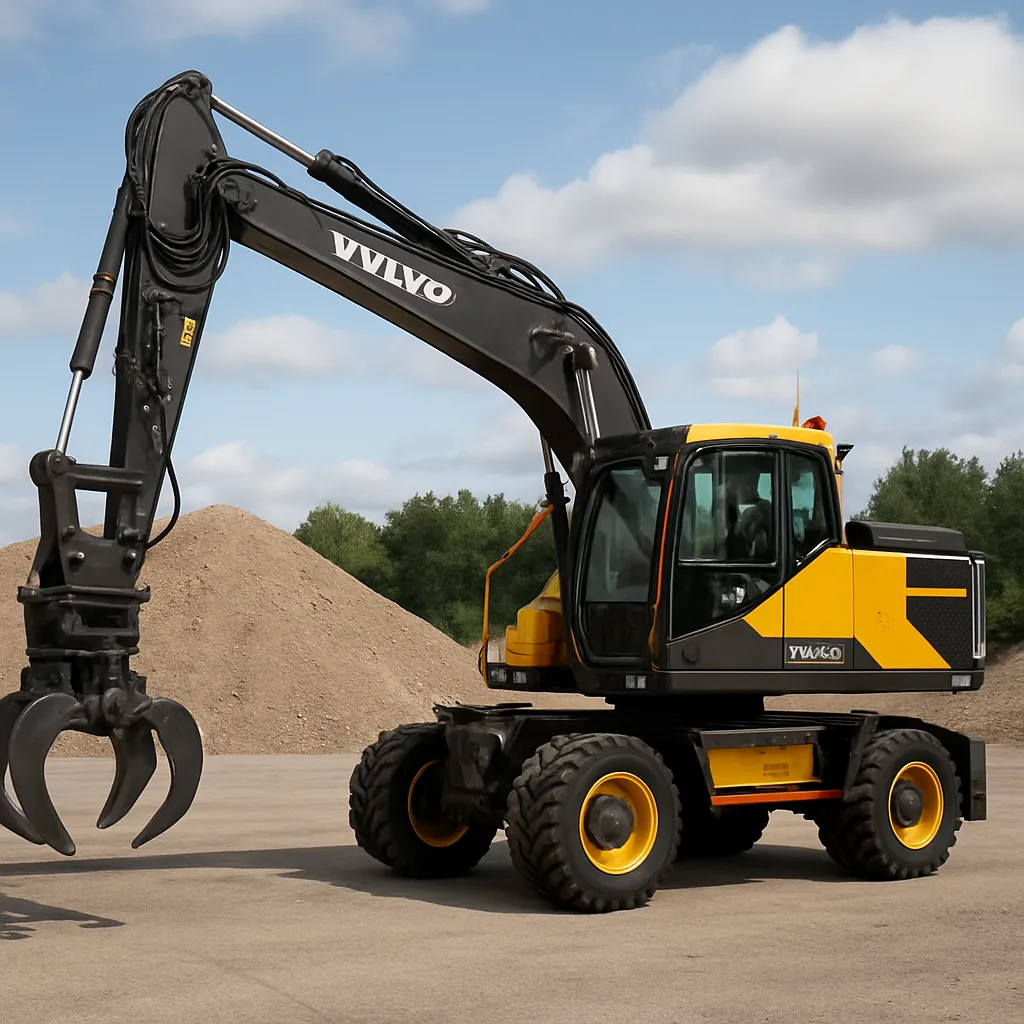
The Volvo EW200E MH is a purpose-built wheeled excavator converted into a specialist material handler, designed to deliver high productivity, mobility and versatility across a wide range of bulk-handling environments. Combining the proven undercarriage and chassis of Volvo’s EW-series wheeled excavator with a high-reach superstructure, specialised cab, and industry-specific attachments, the EW200E MH is aimed at operators who need fast relocation on paved surfaces, stable lifting, and reliable performance in demanding applications such as recycling, ports, timber yards and demolition. This article reviews the machine’s design, typical uses, notable technical and operational features, and practical considerations for purchasers and fleet managers.
Design and Key Features
The EW200E MH is fundamentally a transformation of a mainstream wheeled excavator into a dedicated handling tool. The conversion focuses on three key areas: reach and lifting capability, operator visibility and ergonomics, and hydraulic/attachment options.
- High-reach configuration: The machine is fitted with a purpose-designed long boom and stick or a multi-piece handling boom, which provide extended reach and superior lifting geometry compared with standard excavator arms. This allows safe and efficient handling of materials at height—important in ports, scrap yards and timber handling.
- Elevated operator cab: A material handler cab is often installed, which provides increased height for improved sight lines to loads, panoramic visibility, and specialised controls. The cab usually features reinforced glazing, climate control, ergonomic seating, and optimized control placement for long shifts.
- Hydraulic and control adaptations: The hydraulic system is configured to prioritise smooth, precise flow for grapples, magnets and other attachments. Proportional joysticks, fine control settings, and options like a two-pump system or load-holding valves are common for consistent performance under varying loads.
- Counterweight and stability: Material handlers require a different ballast distribution compared to general excavators. The EW200E MH typically incorporates additional or reconfigured counterweights to ensure stability during heavy lifts at long reach, sometimes including a wider or electronically managed ballast system.
- Mobility: As a wheeled platform, the EW200E MH delivers fast on-site repositioning and economical travel between nearby sites without the need for a trailer. Optional stabilisers or outriggers are typically available to maximise lifting stability when stationary.
Applications and Industries
The strength of the EW200E MH lies in its ability to adapt to multiple industrial environments. Its wheeled mobility, extended reach and attachment flexibility make it attractive across several sectors.
Ports and terminals
- Moving breakbulk, handling scrap metal and loading/unloading bulk cargo are typical port tasks where the EW200E MH excels. Quick repositioning and precise handling help reduce ship turnaround times and increase terminal throughput.
Recycling and scrap yards
- The machine is well suited to processing mixed scrap, ferrous and non-ferrous metals and feedstock handling for shredders. With attachments such as rotating grapples, orange-peel buckets and electromagnets, operators can sort and load materials efficiently while keeping cycle times low.
Timber and biomass yards
- Long-reach booms and specialised timber grapples allow safe stacking, de-stacking and sorting of logs. For biomass processing and woodchip operations, the handler helps maintain continuous material feeds.
Demolition and industrial decommissioning
- When fitted with shears, grapples or crushers, the EW200E MH becomes a precise demolition tool capable of selective dismantling and material segregation for recycling—reducing transport costs and maximising material recovery.
Waste handling and transfer stations
- The ability to operate at height and accurately place or pick bulk loads means the machine is useful in municipal and industrial waste transfer, where materials must be compacted, screened or re-directed.
Attachments and Configurations
One of the EW200E MH’s main strengths is attachment versatility. Attachment choice defines the machine’s role and directly impacts productivity.
- Grapples (rotating and non-rotating) – multi-tine, scrap and timber grapples for sorting and stacking.
- Orange-peel buckets – for efficient handling of mixed scrap and bulk waste.
- Electromagnets – for rapid separation and loading of ferrous materials in yards and ports.
- Shears and crushers – for selective demolition and pre-processing of metal structures.
- Clamshell/hinged buckets – for bulk material handling where precision filling is needed.
- Quick couplers and rotators – to speed attachment changes and provide 360° rotation of attachments where required.
The hydraulic circuit and boom geometry can be configured to match the chosen attachment set, increasing safety and ensuring consistent cycle times. Many operators choose to equip the machine with a hydraulic rotator to improve grapple performance in tight sorting tasks.
Performance and Technical Overview
Exact technical specifications depend on the year, market and optional packages, but some general parameters typically apply to the EW200E MH family. Below are common indicators of performance and capabilities, presented as typical ranges or features rather than immutable figures.
- Operating weight: Typically in the region of 18–22 tonnes, depending on counterweights and superstructure options.
- Engine power: Machines in this class normally carry engines rated from roughly 110 to 150 kilowatts, tuned for torque and fuel efficiency suitable for high-hydraulic-demand applications.
- Reach: With a material-handling boom, working reaches commonly vary from 8 to 12 metres and can extend further with specialised long-reach configurations.
- Lifting capacity: Lifting performance is a function of reach, ballast and boom geometry; typical pick-and-place capacities near the swing center may be 3–6 tonnes, falling off substantially at maximum reach.
- Mobility and travel speed: As a wheeled handler, road travel between sites is straightforward; top travel speeds and axle options are manufacturer-dependent and may include high-speed travel axles for efficient relocation.
- Hydraulics: Load-sensing or pressure-compensated hydraulic systems with variable-displacement pumps are common, providing smooth, efficient power delivery to attachments while lowering fuel consumption under partial load.
- Fuel consumption: Fuel use is influenced by duty cycle and operator technique. In handling roles with intermittent heavy hydraulic demand, fuel consumption is typically lower than continuous heavy-duty excavation, but values vary widely; telematics can help manage usage.
- Emissions compliance: Depending on production year and market, engines meet current emissions regulations such as EU Stage IV/V or equivalent tiers in other regions. Retrofit and aftertreatment options are common across the industry.
For buyers needing precise numbers—such as lifting charts at different reaches—consult the manufacturer or local dealer for certified load charts and the configuration-specific spec sheet. Material handler conversions often change weight distribution and lifting envelopes, and safe operation requires adherence to these certified figures.
Operator Comfort, Safety and Ergonomics
Material handlers are often used in environments where operators work long shifts and need crisp visibility to avoid costly mistakes. The EW200E MH addresses this with several operator-focused features.
- High-visibility cab: The elevated cab and large glazing area give a clear view of loads and surrounding activity, which reduces the risk of collisions and improves picking accuracy.
- Ergonomic controls: Proportional joysticks, adjustable seating and intuitive control layouts reduce operator fatigue and improve precision for sorting or stacking tasks.
- Safety equipment: Standard and optional features can include 360° cameras, rear-view cameras, LED work lighting for night shifts, fire suppression systems and reinforced cabs for operations near hazardous materials.
- Acoustics and climate: Sound-insulated cabs and effective HVAC systems maintain operator comfort in extremes of temperature and help sustain concentration during long operations.
Maintenance, Serviceability and Telematics
Availability and low operating costs are essential for commercial handlers. The EW200E MH aims for straightforward maintenance with accessible service points and telematics integration.
- Access to service points: Engine compartments, hydraulic filters, and routine inspection points are designed for ground-level access where possible, speeding daily checks and routine maintenance.
- Extended service intervals: Volvo and many OEMs tune equipment to extend intervals for oil and filter changes where appropriate, reducing downtime.
- Telematics and fleet management: Modern units can be equipped with telematics systems that report hours, fuel consumption, fault codes and location. This data supports predictive maintenance, reduces downtime and helps optimise fleet utilisation.
Economic and Operational Considerations
Choosing a material handler like the EW200E MH has several economic implications and operational benefits to evaluate when comparing options or planning a fleet acquisition.
- Total cost of ownership: Upfront cost, fuel consumption, maintenance intervals, resale value and attachment options all contribute to lifecycle costs. Material-specialist conversions can command a premium but may yield lower operational costs through improved cycle times.
- Resale and remarketing: Well-maintained Volvo-based handlers often retain value due to brand recognition and a broad dealer network; the resale market for material handlers is active in recycling and port sectors.
- Utilisation and productivity: Faster cycle times, fewer machine moves and improved loading efficiency can significantly reduce per-ton handling costs compared to less-suited equipment. Mobility also reduces the number of machines required across multiple small sites.
- Regulatory and site considerations: Noise limits, emissions regulations and ground-bearing constraints on asphalt or sensitive surfaces should be factored into the selection and operation plan.
Case Examples and Typical Performance
Typical uses showcase how an EW200E MH adds value in concrete terms. Below are illustrative scenarios rather than manufacturer-specific case studies.
- In a medium-sized metal recycling yard, a single EW200E MH with a rotating scrap grapple and electromagnet can increase sorting throughput by 20–40% compared with a standard excavator with ad-hoc attachments, primarily by reducing repositioning time and improving pick accuracy.
- At a regional timber terminal, a handler can reduce manual handling and turnaround time for truck loading by enabling rapid stacking and placement of sorted timber grades.
- In port applications, the machine can complement larger crane operations by handling smaller bulk loads and sorting breakbulk cargo on quayside, thereby improving overall terminal efficiency.
Buying Tips and Spec Choices
When considering an EW200E MH or a comparable material handler, pay attention to the following decision points:
- Attachment package: Choose attachments that match the primary duty. Rotating grapples and electromagnets are key for scrap yards; timber grapples and longer sticks suit timber yards.
- Ballast and stability: Confirm the configuration’s lifting charts and counterweight options to ensure safe operation at required reaches.
- Lift and reach charts: Demand certified lifting envelopes for the exact machine configuration; these are essential for safe working practices and compliance with site rules.
- Dealer support and parts availability: A strong local dealer network reduces downtime and improves long-term ownership costs.
- Telematics package: Include fleet-management features from the outset if you operate multiple sites or machines; this can quickly pay dividends in uptime and fuel savings.
Summary
The Volvo EW200E MH represents a practical intersection of wheeled excavator mobility and material handler specialisation. With its high-reach boom options, purpose-built cab and hydraulic adaptations, it suits environments where rapid repositioning, consistent lift performance and attachment flexibility are crucial. Whether in recycling yards, ports, timber depots or demolition projects, a carefully specified EW200E MH can deliver improved throughput, lower handling costs and enhanced operator comfort. Exact performance figures vary by configuration and market; prospective buyers should consult local specifications and certified load charts to match machine capability precisely to operational needs.


)
)