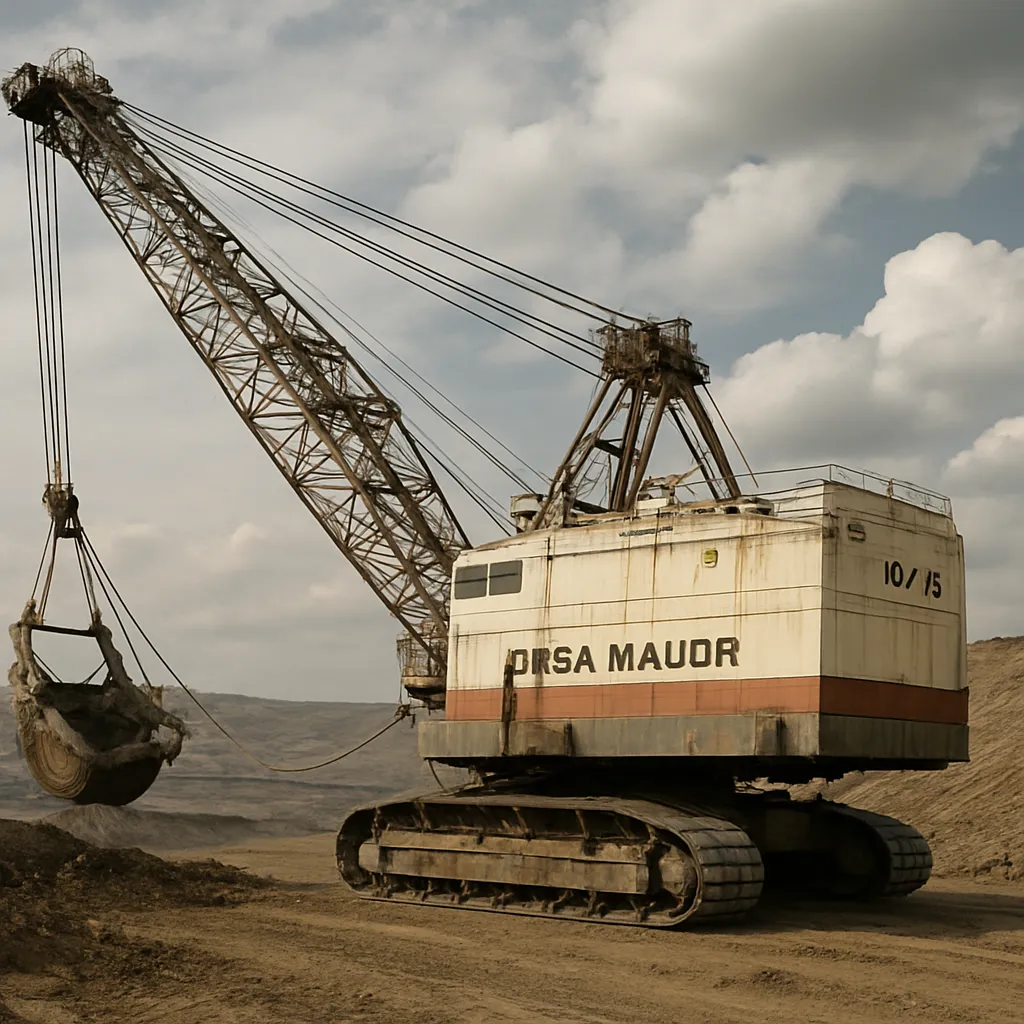
The Ursa Major 10/15 dragline is a heavy earthmoving machine designed for large-scale excavation tasks where high reach and continuous material handling are required. In the context of open-pit mining, civil engineering and large reclamation projects, this class of dragline combines long-reach capability with robust digging power. The following article explores its design, typical applications, operational statistics, maintenance needs and future developments, offering a comprehensive picture for engineers, project managers and machine enthusiasts.
Overview and Design of the Ursa Major 10/15
The Ursa Major 10/15 is built around the classical dragline concept: a fixed or revolving superstructure supporting a long boom, winches for hoist and drag lines, and a large hanging bucket that tears into and drags material toward the machine. The designation 10/15 is commonly interpreted in industry terms as indicating a machine whose standard bucket capacity lies in the range of 10 to 15 cubic metres (roughly 13–20 cubic yards), placing it in a medium-large class of draglines used across many sectors.
Key design elements include:
- Boom: A lattice-structured boom typically ranging from 30 to 60 metres in length, designed to provide a long reach and a high dumping height for moving overburden or material into haul trucks and stockpiles.
- Bucket and ropes: A heavy hanging bucket rigged to a dragline system that uses both hoist and drag ropes. Rope diameter, material and configuration are selected according to duty cycle and abrasive conditions.
- Drive systems: The Ursa Major 10/15 may use an electric drive (AC or DC) or diesel-electric configuration. Electric drives are common due to high torque requirements and energy efficiency in continuous operations.
- Superstructure: Houses the operator cabin, winches, pivot bearings and counterweight systems. The design focuses on durability and accessibility for maintenance.
Mobility can vary: some Ursa Major 10/15s are built on crawler undercarriages for limited travel within a pit, while others are semi-permanent installations mounted on a large turntable for full 360-degree swing capability. Transport between sites usually requires disassembly of the boom and other components and specialized heavy-haul logistics.
Applications and Operational Use
Draglines like the Ursa Major 10/15 excel in projects that demand high-volume, long-reach excavation with minimal repositioning. Typical applications include:
- Open-pit mining (coal, lignite, some metal ores): removal of overburden ahead of production benches. The long reach of the 10/15 class reduces the need to relocate the machine frequently, improving overall productivity.
- Bulk earthworks on large civil projects: creating large embankments, excavating foundations for dams and levees, and preparing terraces for infrastructure.
- Reclamation and environmental works: moving dredged material, constructing containment berms and reshaping landscapes for rehabilitation after mining.
- Harbours and river works: in some configurations draglines handle dredged sediments and construct river training works where mechanical reach is advantageous.
Operationally, the dragline cycle is unique when compared with shovels and excavators. Instead of loading discrete trucks at the face, a dragline can strip large swathes of overburden and dump material into stockpiles or onto haul roads. This makes it particularly cost-effective for continuous stripping over large areas where haul distances are manageable.
Performance, Typical Technical Data and Statistics
Precise specifications for the Ursa Major 10/15 depend on manufacturer options and configuration, but the following figures represent realistic ranges and industry norms for this class of dragline. Where specific model data is not publicly available, ranges are given based on comparable draglines.
- Bucket capacity: 10–15 m³ (≈ 13–20 yd³)
- Boom length: typically 30–60 m (100–200 ft) depending on reach required
- Maximum digging depth: approximately 15–35 m (50–115 ft)
- Operating weight (in working configuration): commonly in the range of 300–900 tonnes
- Installed power: from around 500 kW up to 2,000 kW or more for electrically driven components (hoist/drag/swing)
- Cycle time: highly variable; typical drag/hoist cycles may be 30–90 seconds depending on operator technique, dump conditions and rope lengths
- Typical material moved per hour: for a 10–15 m³ bucket and an average cycle of 45–60 seconds, practical productivity can be estimated as 600–1,200 m³/hour, though site conditions can increase or reduce this significantly
- Service life: with rigorous maintenance, main structural elements and boom assemblies can serve 20–40 years in many installations; ropes, winches and motors are subject to shorter life cycles
Note: The volumetric productivity numbers above are indicative. Real productivity depends on material density, bench geometry, throw/dump distance, operator skill and the balance between hoist and drag line speeds. For example, moving heavy, wet clay will yield substantially lower cubic metres per hour than handling dry overburden of similar volume.
Control Systems and Operator Environment
Modern variants of the Ursa Major 10/15 are commonly fitted with advanced control and monitoring systems to improve efficiency and safety. Typical features include:
- Electronic motor controllers and programmable logic controllers (PLCs) for precise handling of hoist, drag and swing functions
- On-board sensors and condition monitoring for rope tension, motor temperatures, and gear pressures
- Operator cabins with ergonomic controls, climate control, and enhanced visibility; some cabins include cameras and augmented displays for blind spots
- Remote operation capability: partial or full remote-control operation can be implemented for hazardous environments or to reduce operator fatigue
Maintenance, Safety and Operational Best Practices
Maintaining a dragline like the Ursa Major 10/15 requires a structured regime due to the machine’s size and the wear it experiences. Key maintenance and safety points:
- Rope inspection and replacement: hoist and drag ropes are critical items; routine non-destructive testing, monitoring for wear and scheduled replacements are standard practice.
- Boom and structural inspections: periodic checks for fatigue cracking, especially around welds and pin connections, are essential due to high cyclic loads.
- Winch and gearbox servicing: ensure lubrication, seal integrity and alignment to avoid costly failures.
- Electrical system maintenance: check motors, transformers, and switchgear according to manufacturer schedules; downtime for electrical faults can be substantial.
- Operator training: skilled operators substantially improve cycle efficiency while reducing wear and safety incidents. Simulator training and competency assessments are recommended.
- Site safety: exclusion zones during swing and dump operations, real-time communication between machine and ground crews, and strict lockout/tagout procedures for maintenance.
Implementation of condition-based monitoring and predictive maintenance can significantly reduce unscheduled downtime. Typical maintenance intervals for major rope changes or gearbox refurbishments vary from months to several years depending on usage intensity.
Economic Considerations and Life-cycle Costs
Buying and operating a dragline like the Ursa Major 10/15 involves substantial capital and operating expenditures. Budgeting considerations include:
- Capital cost: new 10–15 m³ class draglines can range widely depending on specification and OEM; indicative purchase prices might fall between several million to tens of millions of US dollars. (Exact pricing depends on custom options, transport and local market.)
- Operating cost: electrical energy (or fuel for diesel-electric systems), routine maintenance, rope replacements, haul road maintenance and operator costs are principal drivers.
- Cost per cubic metre moved: in strip-mining scenarios, draglines often offer very low operating cost per m³ compared to truck-and-shovel fleets, provided the deposit geometry suits continuous stripping.
- Depreciation and residual value: robust structural design and long service life generally sustain residual values; well-maintained units can be refurbished and re-sold.
When calculating project economics, the decision to use a dragline is highly dependent on geology, pit layout and required overburden removal volumes. Payback periods can be short in large, continuous stripping operations but may be long or uneconomic in small or highly fragmented projects.
Environmental Impact and Site Rehabilitation
Draglines have both positive and negative environmental implications. Positive aspects include the ability to remove overburden with fewer haul trucks, which can reduce overall diesel consumption and haul-road wear. Conversely, the scale of disturbance from dragline operations is large and requires careful planning for eventual site rehabilitation.
- Dust and noise control: water sprays, dust suppressants and noise-mitigating enclosures at the operator cab can help meet environmental controls.
- Rehabilitation integration: because draglines can place overburden in large, managed fills, operators can design progressive rehabilitation schemes that re-contour and re-vegetate disturbed areas while work continues in other sectors of the site.
- Energy efficiency: modern electric drives and optimized control systems can reduce energy consumption. Opportunities to integrate renewable energy sources into site power supply are increasing.
Innovations and Future Trends
Recent and emerging trends affecting machines like the Ursa Major 10/15 include:
- Automation: semi-autonomous cycle control, machine guidance systems and automated drag/hoist synchronization to maximize production and reduce human error.
- Digital twins and predictive analytics: using high-fidelity models and sensor data to predict wear, optimize schedules and extend component life.
- Improved materials: higher-strength, lighter boom components and advanced rope technologies reduce weight and increase reach without sacrificing durability.
- Remote operation and reduced crew footprints: remote-controlled draglines allow operations in hazardous environments and can broaden the labour pool.
- Sustainability improvements: more efficient electric drives, regenerative braking concepts and integration with renewable-power microgrids on site.
Comparative Examples and Practical Notes
Compared with hydraulic excavators and backhoe-shovel combinations, the Ursa Major 10/15 occupies a niche where reach and economy of mass excavation are paramount. Practical notes for prospective users include:
- Site suitability assessment: evaluate bench geometry, required swing radius and haulage arrangements before selecting a dragline solution.
- Material characterization: softer, unconsolidated overburden is ideal; very hard rock will dramatically reduce productivity and increase wear.
- Integration with haulage: where haul trucking systems are retained, plan for effective material transfer points and dump locations to avoid bottlenecks.
Summary
The Ursa Major 10/15 dragline class represents a versatile and powerful solution for large-scale excavation where long reach and sustained bulk movement are required. With a typical bucket capacity of 10–15 m³, booms up to 60 m, and installed power often in the range of 500–2,000 kW, these machines provide efficient overburden removal in mining, extensive civil earthworks and reclamation projects. Key advantages include high volumetric productivity and low unit operating costs in the right settings, while challenges lie in logistics, maintenance of critical components (notably ropes and winches) and environmental management. Ongoing innovations in automation, materials and electrical systems are likely to further improve the capability and efficiency of draglines in coming years.


)
)