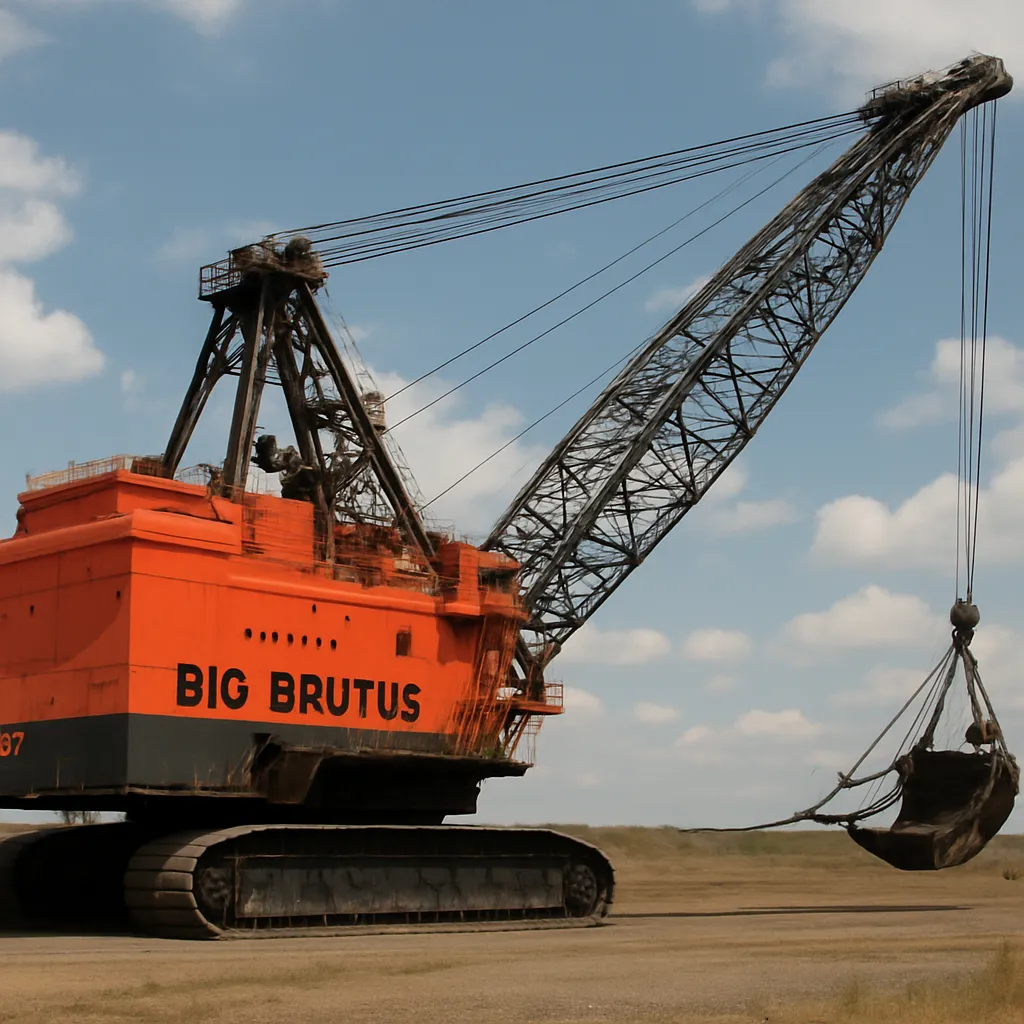
The colossal machine known as Big Brutus stands as an icon of industrial might and a testament to mid-20th-century engineering. As a Bucyrus-Erie model 1850-B dragline, it played a central role in large-scale surface coal mining in the American Midwest, and today it remains preserved as a museum piece and educational landmark. This article explores the machine’s history, technical characteristics, fields of application, environmental and social impact, and its ongoing role as an example of industrial heritage.
History and context of the machine
The rise of large-scale surface mining after World War II created demand for ever-larger excavation equipment. Manufacturers such as Bucyrus-Erie responded with electric and diesel-powered draglines designed to remove vast layers of overburden and to expose coal seams and other near-surface mineral deposits. Among these machines, Big Brutus — a model 1850-B — became one of the most famous.
Built in the early 1960s, Big Brutus was installed at a surface mine near West Mineral, Kansas. It worked for a period in the 1960s and early 1970s removing overburden and exposing coal seams for the Pittsburg & Midway Coal Mining operation. When the mine’s economics changed and the operation wound down, the enormous cost of moving such a machine made it uneconomical to redeploy; instead, a local preservation effort secured the machine and, over time, Big Brutus became an educational exhibit and centerpiece of a museum and park dedicated to mining history and industrial technology.
Big Brutus sits within a broader tradition of large excavation machines, like the more widely known “Big Muskie” and other giant draglines and shovels used throughout the 20th century. What sets Big Brutus apart is not only its size but also the community’s decision to preserve it in situ, transforming a once purely industrial apparatus into an object of public interest and historical reflection.
Design and main technical characteristics
Draglines are specialized excavators that operate by dragging a bucket along the surface using wire rope and winch systems. The bucket is typically suspended from a long boom and controlled by a system of hoists and draglines to scoop and lift material. Big Brutus, as an example of the Bucyrus-Erie 1850-B class, combined scale, power, and reach to move millions of cubic yards of overburden during its working life.
Structure and mechanical systems
- Boom: A very long structural member from which the bucket is suspended; the boom provides reach and height for the bucket to clear spoil piles. The long boom is a defining feature of a dragline, enabling it to move large amounts of material in a single cycle.
- Bucket: The bucket used by Big Brutus was large enough to remove substantial volumes of overburden per pass. Buckets on machines of this class are designed for durability and rapid cycle times under heavy loads.
- Winch and hoist systems: Heavy-duty electric motors and gear trains powered the hoists, which raised and lowered the bucket and manipulated the dragline cables. The precision and strength of these systems are critical for reliable, safe operation.
- Undercarriage and house: While some draglines use crawlers or rails to reposition, many giant units are semi-permanently mounted at a job site and moved only occasionally. The operator’s house contains controls, instrumentation, and power distribution equipment.
Operational performance (commonly reported figures)
Exact specifications for preserved historic machines can vary by source. Commonly reported parameters for Big Brutus and similar 1850-B class draglines include:
- Bucket capacity: Approximately 70–90 cubic yards (roughly 50–70 m3). This allowed each scoop to move an enormous volume of overburden compared with conventional excavation equipment of the time.
- Overall mass: Reported in many accounts as several million pounds; sources commonly cite a mass in the multi-million-pound range (for example, figures in the order of 8–11 million pounds have circulated in public materials). Such mass includes the house, machinery, boom, and counterweights required for stability.
- Reach and height: Booms for machines in this class provide reach on the order of tens of meters, enabling excavation across broad swaths of a mining bench without frequent repositioning.
- Power: Large electric motors supplied power to hoists and swing drives. Machines of this scale required substantial electrical infrastructure at the mine, sometimes including dedicated substations and heavy cabling.
These statistics underline why a machine such as Big Brutus was used for operations where removing vast amounts of overburden quickly and efficiently was economically advantageous.
Applications and modes of operation
The primary purpose of a dragline like Big Brutus was to remove overburden — the soil and rock layers above a coal or other mineral seam — in surface mining operations. When working, a dragline would be positioned on a bench above the targeted area and would drag its bucket across the surface, filling it with overburden. The operator then rotated the house or swung the boom to a spoil area and dumped the bucket, creating spoil piles or regrading land as necessary.
Key applications include:
- Coal surface mining: Removing overburden to expose seams for subsequent extraction. Draglines were particularly valuable where seams were broad and shallow, providing economies of scale not achievable with smaller equipment.
- Large civil excavation projects: In certain cases, very large draglines have been used for bulk excavation in dam or canal construction where continuous, large-volume excavation is desirable.
- Bulk earthmoving: Any application requiring repeated removal and relocation of large volumes of unconsolidated material can benefit from dragline operations.
The operational profile of a dragline emphasizes long reach and continuous movement over repositioning. Compared to truck-and-shovel operations, a properly sited dragline can achieve lower unit costs for overburden removal because it does not require the same level of hauling logistics and vehicle maintenance.
Environmental, economic, and social aspects
The use of massive draglines changed the scale at which landscape transformation occurred. While they enabled more efficient access to coal and other minerals, their operation had several environmental and social implications.
Environmental considerations
- Landscape alteration: Draglines remove substantial horizontal areas of topsoil and subsoil, leaving large spoil piles and dramatically altered topography. Rehabilitation and reclamation are necessary to restore ecological function.
- Hydrology and soil: Large-scale excavation affects drainage, groundwater recharge, and soil profiles. Reclamation often requires careful grading, soil replacement, and revegetation to stabilize the site.
- Emissions and energy: Big draglines are electrically powered, concentrating energy use at the mine site. Although they avoid diesel emissions associated with large fleets of haul trucks, the upstream emissions associated with electricity generation remain relevant.
Economic and social impact
- Job creation and local economies: Large mines equipped with draglines supported regional employment, both directly in mining operations and indirectly through services and suppliers.
- Community change: The arrival (and later departure) of large-scale mining operations reshapes local demographics, infrastructure, and long-term economic stability.
- Heritage and tourism: When preserved, machines like Big Brutus become focal points for heritage tourism and education, offering communities a way to interpret the industrial past and draw visitors.
Preservation, museum interpretation, and educational value
Unlike many large industrial machines that were scrapped after their working life, Big Brutus was preserved in place and converted into a museum attraction. The preservation effort demonstrates several important themes: public interest in industrial history, the feasibility of large-structure conservation, and the educational potential of machinery as artifacts.
As a museum piece, Big Brutus provides multiple learning opportunities:
- Engineering education: Visitors can learn about mechanical systems, structural engineering, power transmission, and control systems at scales rarely seen in a classroom.
- Mining history: Exhibits often explain the role of surface mining in regional development, the technologies that made it possible, and the socioeconomic forces shaping resource extraction.
- Environmental lessons: Preservation offers a platform to discuss reclamation methods, environmental impacts of mining, and modern approaches to sustainable resource management.
Comparisons and legacy among large excavators
Big Brutus is part of a family of remarkable mid-20th-century excavation machines that redefined what was possible in earthmoving. Machines such as Big Muskie, Marion draglines, and other Bucyrus-Erie models are often compared on the basis of bucket size, boom length, overall mass, and productivity. While some of these machines were larger or had greater bucket capacities, Big Brutus is noteworthy for being among the largest of its class to be maintained as a permanent exhibit.
The legacy of Big Brutus is multifaceted: it represents a particular era of mining technology, showcases the ambitions of mid-century industrial engineering, and provides a locus for community memory. Its presence encourages reflection on how societies extract and use natural resources and how they remember and interpret industrial pasts.
Operational safety and maintenance challenges
Operating a dragline of Big Brutus’s scale demands significant attention to safety, maintenance, and skilled personnel. Key challenges include:
- Structural integrity: Fatigue and wear on the boom, ropes, and pivot points require rigorous inspection and timely replacement to avoid catastrophic failures.
- Rope and cable management: Draglines rely on massive wire ropes that must be inspected, lubricated, and replaced on planned cycles.
- Electrical systems: Large motors and control gear require protection, monitoring, and coordination with mine electrical supplies to ensure safe operation.
- Operator skill: Efficient and safe operation depends on experienced crews who understand cable handling, bucket control, and site planning.
Conclusion and continuing relevance
Big Brutus stands as more than an oversized tool; it is a cultural and educational resource that encapsulates a period of industrial scale. As a preserved museum exhibit, it invites public engagement with engineering, mining history, and environmental stewardship. Although the economics of mining and technology have continued to evolve — with different machinery and approaches now common — the story told by Big Brutus remains relevant for engineers, historians, planners, and communities thinking about how to balance resource needs with environmental and social concerns.
Big Brutus continues to draw attention because it embodies the intersection of ambition, technology, and community. It is a powerful reminder of how machines shape landscapes and lives, and how communities can choose to preserve industrial heritage for education and reflection.


)
)