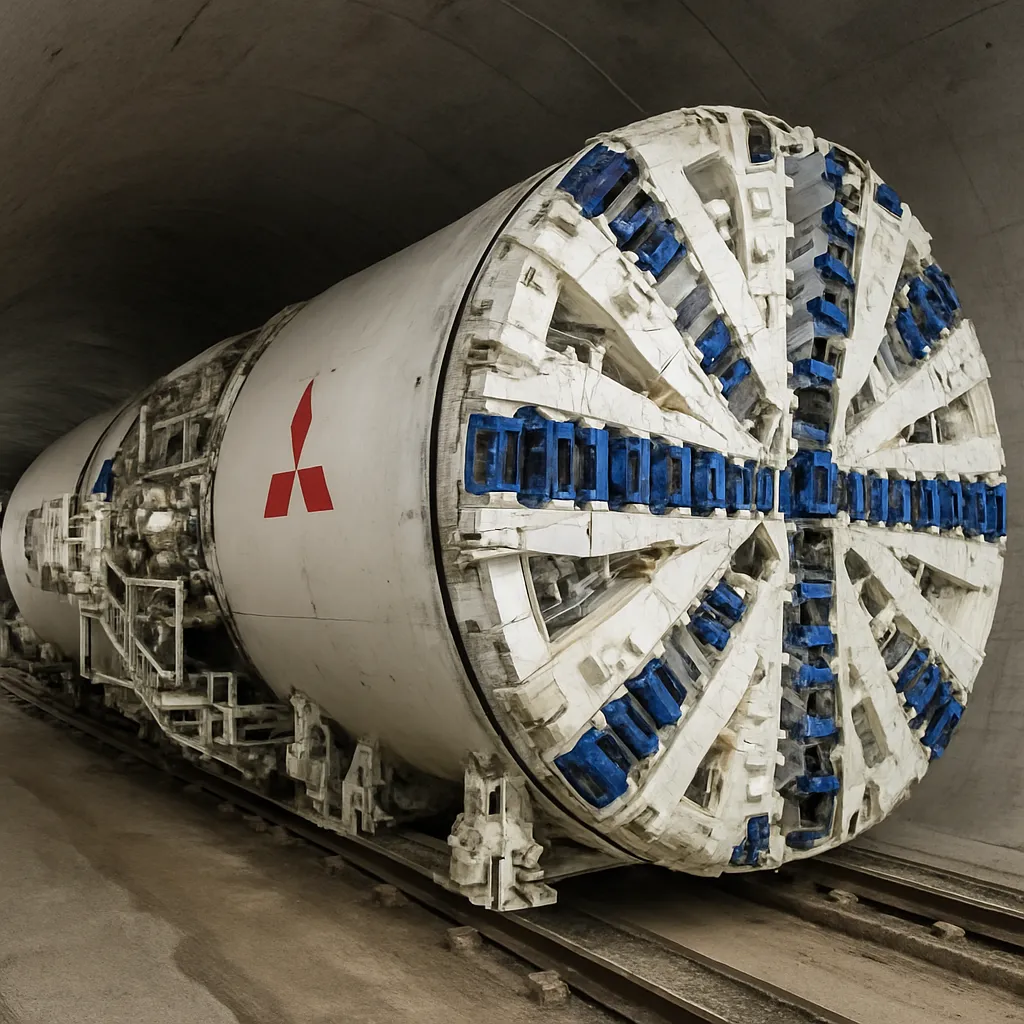
The Mitsubishi EPB TBM represents a class of modern mechanized tunneling machines developed and supplied by Mitsubishi-affiliated engineering companies and their partners for busy urban and complex geological environments. These machines combine robust mechanical design with precise hydraulic and electronic control systems to excavate underground tunnels with minimal surface disruption. This article examines the machine’s design, operational principles, common applications, performance characteristics, maintenance considerations, and the trends shaping future development.
Design and technical features
The fundamental objective of an Earth Pressure Balance (EPB) tunnel boring machine is to maintain control of the tunnel face by balancing earth and water pressures through the excavation chamber. Mitsubishi’s EPB TBMs are engineered to deliver this control reliably in a wide variety of ground conditions, from soft cohesive clays to mixed-face soils with varying water content.
Core components
- Cutterhead: The front rotating element equipped with disc cutters, scrapers, and wear-resistant tools tailored to the soil type. Cutterhead geometry and cutter selection are optimized to the planned geology.
- Shield: The cylindrical steel shell that supports the tunnel face and allows the machine to advance while workers and equipment are protected behind the shield.
- Excavation chamber: Immediately behind the cutterhead, this chamber holds the excavated material and provides the controlled environment for pressure balance.
- Screw conveyor: A variable-speed auger system that meters and ejects spoil from the excavation chamber, crucial for maintaining face pressure.
- Thrust and steering systems: Large hydraulic jacks provide the pushing force and steering control to guide the TBM along line and grade.
- Segment erector: An automated mechanism for placing precast concrete lining segments as the TBM advances.
- Support systems: Comprising ventilation, slurry handling (if applicable), grouting pumps, and comprehensive electronic control systems for monitoring.
Control and instrumentation
Mitsubishi EPB TBMs incorporate advanced electronic controls to manage face pressure, torque, cutterhead speed, and thrust. Key monitoring parameters include face pressure, screw conveyor torque and speed, cutterhead torque, annulus grouting rates, and forward advance. Integrated sensors and telemetry allow operators to make rapid adjustments to soil conditioning agents, conveyor speeds, and thrust to prevent face instability or over-excavation.
Operational principles and soil conditioning
The EPB method relies on maintaining a balance between the pressure at the tunnel face and the surrounding ground and water pressures. In practice, this is achieved by keeping excavated material in the chamber under controlled compression and removing it at a rate that sustains the desired face pressure.
Soil conditioning
One of the most important operational aspects is soil conditioning. When natural soil properties are unsuitable for stable control—too granular, too wet, or too sticky—conditioning agents (such as bentonite slurry, polymers, or foam) are injected into the excavation chamber. These agents modify the rheological properties of the spoil so it behaves as a plastic medium that can sustain pressure and be transported through the screw conveyor without causing clogging or excessive wear.
- Benefits of proper conditioning: reduced cutter wear, stabilized face, smoother conveyor operation, improved progress rates.
- Risks of poor conditioning: face collapse, cutterhead blockage, excessive vibration, downtime for clearing and repairs.
Typical operational workflow
- Pre-launch: assembly of the TBM shield, installation of the cutterhead, commissioning of electrical and hydraulic systems.
- Excavation cycles: cutterhead rotation and excavation, spoil accumulation in the chamber, screw conveyor export of spoil, segment erection.
- Monitoring and adjustment: continuous measurement of face pressure and system parameters, adjustment of soil conditioning and discharge rate to maintain balance.
- Maintenance intervals: planned stops for cutter replacement, conveyor inspection, and lubrication.
Applications and typical use cases
The Mitsubishi EPB TBM is well-suited to a variety of tunneling tasks where ground conditions are soft to mixed and where surface settlement must be minimized. Its design and operational flexibility make it a preferred choice in congested urban environments and in projects requiring precise, low-impact excavation.
Urban rail and metro projects
EPB TBMs are commonly used for subway and light-rail tunnels beneath densely built-up areas where limiting settlement is critical to protect surface infrastructure. Mitsubishi machines have been used, either directly or through partnerships, on numerous metro projects around the world due to their reputation for reliability and precise control.
Utility and service tunnels
Sewer, water, and utility tunnels often run through heterogeneous soil layers with varying moisture content. The EPB system’s ability to handle mixed-face soils and to control groundwater ingress makes it suitable for these projects.
River and undersea crossings
While sometimes slurry TBMs are chosen for pressurized face conditions, EPB machines can be employed for shallow undersea or river crossings when combined with rigorous ground conditioning and dewatering strategies.
Microtunneling and smaller diameter works
Mitsubishi and related suppliers also offer smaller EPB-style machines for microtunneling and specialized conduit installations. These compact units prioritize precision steering and limited surface disturbance.
Performance metrics and typical statistics
Performance of EPB TBMs depends heavily on geology, logistics, and operational practices. Below are representative ranges and benchmarks that operators and engineers commonly reference. These numbers are industry-typical values and can vary by project.
- Diameter range: EPB TBMs are manufactured across a wide spectrum, commonly from about 2 meters up to 15 meters or more for large-diameter drives. Machines beyond 10 meters require specialized design considerations for cutterhead torque, thrust, and spoil handling.
- Advance rates: Typical daily advance rates in favorable ground are in the range of 10–50 meters per day. In difficult or mixed-face conditions the rate may fall below 5 meters per day.
- Production per month: For long, consistent drives in homogeneous ground, monthly progress can reach several hundred meters. Short drives with frequent interventions will see lower monthly totals.
- Thrust and torque: Thrust forces for large EPB TBMs can reach several thousand tonnes; cutterhead torques span from tens to thousands of kNm depending on diameter and rock content. Exact figures depend on machine model and configuration.
- Wear and replacement: Cutter disc life and wear rates depend on abrasivity; in mixed-face operations replacement of cutter tools can be required every few weeks to months depending on intensity and geology.
These metrics underscore the critical role of pre-construction geological investigation, continuous monitoring, and adaptive operational control in achieving planned productivity. Mitsubishi equips its TBMs with instrumentation to track these parameters in real time, allowing for optimization of excavation rate and minimization of downtime.
Notable project considerations and case studies
While many major tunneling projects involve consortia and equipment from multiple manufacturers, Mitsubishi’s TBMs and engineering services have contributed to significant urban and infrastructure tunnels worldwide—especially where compact design and precise control were required. Key considerations in notable projects typically include:
- Managing transition zones where geology changes from cohesive soil to coarse granular layers.
- Mitigating settlement risks near heritage buildings and sensitive utilities.
- Implementing robust spoil transport logistics in constricted urban sites.
- Coordinating segment supply and erection to maintain continuous progress.
Case studies often highlight that the success of an EPB-driven project hinges not only on the machine but on integrated site management: quality of ground investigation, availability of conditioning materials, spoil handling infrastructure, and the experience of the operating team.
Maintenance, lifecycle, and operational logistics
Mitsubishi EPB TBMs are designed for reliable continuous operation but require disciplined maintenance and logistics planning. The lifecycle of these machines spans many years but depends on how intensively they are used and the abrasivity of the encountered ground.
Planned maintenance
- Routine inspections of cutterhead and cutting tools, typically scheduled based on operating hours and monitored wear indicators.
- Hydraulic system servicing, including filter changes and oil analysis.
- Replacement of screw conveyor components and wear plates as needed due to abrasive spoil.
- Calibration and testing of sensors and control electronics to ensure accurate face pressure and torque readings.
Spare parts and logistics
Having a well-stocked inventory of critical spares—cutters, hydraulic seals, conveyor flighting, instrumentation modules—reduces downtime. For long drives, staging of logistics yards and efficient spoil transport (conveyor belts, muck cars, or pumped slurry) are decisive for maintaining planned production rates.
Safety and environmental management
EPB TBMs contribute to safer tunneling by reducing the need for ground support and open excavations, thereby protecting workers and the public. However, strict protocols are required to manage risks associated with face instability, gas ingress, and groundwater control.
- Settlement monitoring: Real-time surface and building monitoring networks prevent unexpected damage by detecting any ground movement early.
- Gas detection and ventilation: Underground gas detection systems and robust ventilation are essential for worker safety in urban drives.
- Waste handling: Proper management of spoil and conditioning agents (e.g., bentonite) ensures compliance with environmental regulations and minimizes impacts on disposal sites.
- Noise and vibration control: EPB TBMs are generally quieter than alternative excavation methods, but mitigation measures for spoil removal and on-site activities are often required in residential zones.
Innovations and future trends
The tunneling industry continues to evolve. Mitsubishi and other manufacturers are focusing on improvements in automation, energy efficiency, and adaptive control systems to improve safety, reduce costs, and increase reliability.
- Automation and digitalization: Enhanced sensor suites, predictive maintenance via machine learning, and semi-autonomous control systems reduce human error and optimize performance.
- Energy efficiency: Electrification of auxiliary systems, regenerative drives, and optimized hydraulic systems reduce energy consumption in long drives.
- Material science: Advances in wear-resistant alloys and cutter design extend tool life in abrasive conditions.
- Hybrid machine concepts: TBMs able to switch modes or integrate slurry and EPB features to handle complex, layered geology without machine changes.
Economic considerations and project planning
Selecting an EPB TBM involves balancing capital costs, expected advance rates, ground risk, and site constraints. Mitsubishi’s offerings span a range of sizes and customizations, which enables clients to align machine choice with project-specific requirements.
- Capital expenditure: Larger, heavily outfitted machines command higher upfront costs but can deliver economic benefits on long drives through higher daily yields and lower overall risk.
- Operating expenditure: Consumables (cutters, conditioning agents), energy use, and labor represent ongoing costs that must be forecasted during planning.
- Risk mitigation: Investing in thorough geotechnical surveys and reserving contingencies for unexpected ground conditions typically pays off by reducing schedule delays and cost overruns.
Conclusion
The Mitsubishi EPB TBM is a versatile tool for modern underground construction, particularly where control of the tunnel face and minimal surface disturbance are essential. Combining robust mechanical systems with advanced control and conditioning strategies enables high-quality, predictable tunneling across a broad spectrum of projects—urban transit, utilities, river crossings, and specialized microtunneling assignments. Success with EPB technology depends as much on project planning, geotechnical understanding, and logistics as it does on the machine’s specifications. As automation, materials, and energy systems advance, Mitsubishi and the broader TBM industry are poised to deliver quieter, more efficient, and safer underground solutions for the growing demands of urban infrastructure development.


)
)