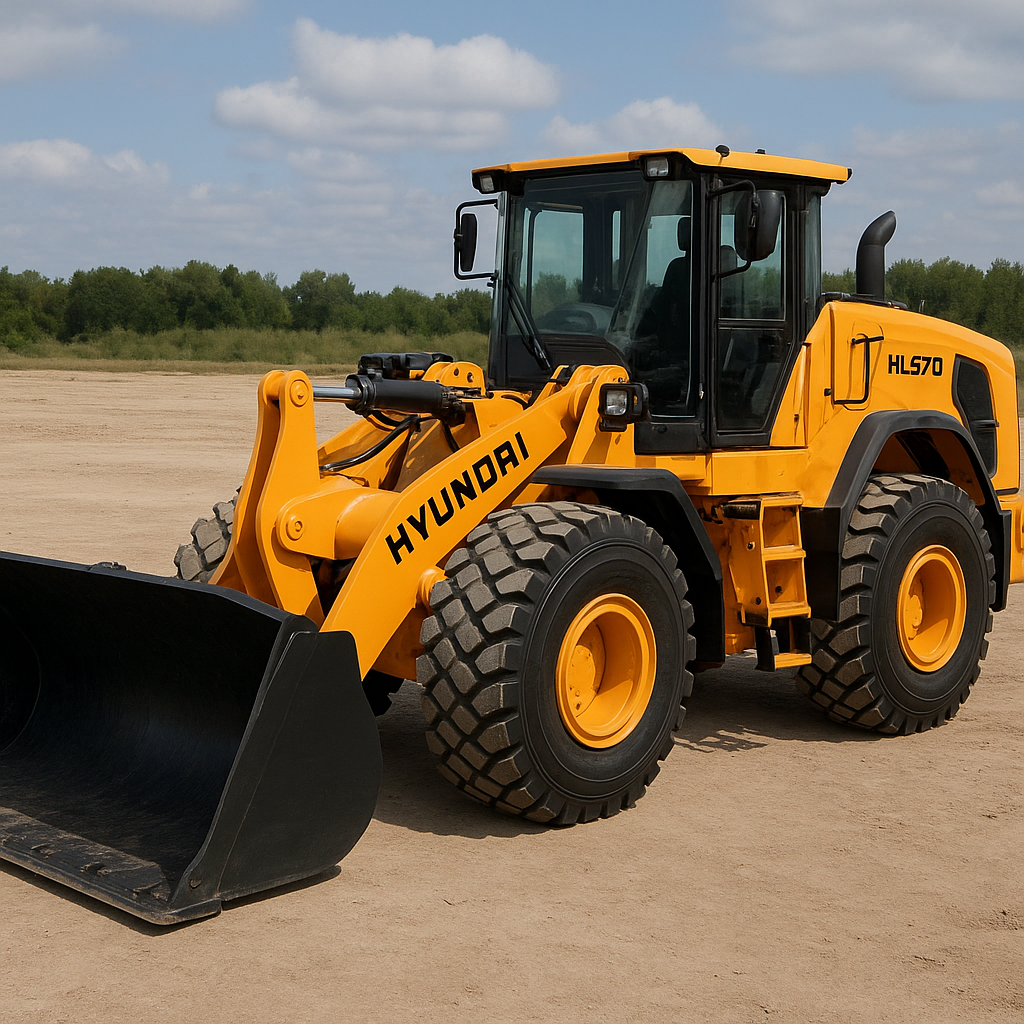
The Hyundai HL970 wheel loader is a versatile heavy machine designed to move large volumes of material efficiently across a wide range of industrial and construction settings. Combining robust mechanical components with modern operator conveniences and adaptable attachments, the HL970 series is valued for its balance of productivity, reliability and cost-efficiency. The following article examines the machine’s design, typical uses, technical characteristics (with approximate figures where applicable), maintenance considerations, and practical advice for prospective users.
Overview and design philosophy
The Hyundai HL970 is part of Hyundai Construction Equipment’s lineup of medium-to-large wheel loaders. It is built to serve tasks that require both power and mobility — moving aggregate, loading trucks, site clearing, and stockpile management. The design philosophy behind the HL970 focuses on delivering strong hydraulic performance, durable drivetrain components, and an operator-centric cab that reduces fatigue during long shifts.
Key design elements include a heavy-duty chassis, reinforced loader arms and linkage, and a powerful engine tuned for torque at low RPMs. The machine typically incorporates an advanced hydraulics system to ensure smooth control of the bucket and attachments, which improves cycle times and material handling precision. Hyundai also integrates service access points and modular component layouts to simplify maintenance and reduce downtime.
Primary applications and industries
The HL970 finds use across multiple sectors where volumetric material handling and mobility are essential. Common applications include:
- Construction: site preparation, backfilling, road building and general material handling.
- Quarries and mining: loading haul trucks, moving blasted rock and handling aggregate stockpiles.
- Waste management and recycling: turning compost, loading waste containers, and processing materials at transfer stations.
- Agriculture and bulk handling: moving feed, fertilizer, and bulk commodities in farm or terminal environments.
- Ports and logistics: container yard tasks, loading/unloading bulk materials and ship-side handling where wheel mobility is advantageous.
The machine’s adaptability is enhanced by a wide range of available attachments — different bucket types (general purpose, light-material, heavy-duty rock), pallet forks, grapple buckets, bale spears, snow plows and mulchers — allowing fleet managers to use the same base machine for multiple seasonal and operational roles.
Technical characteristics and performance (typical figures)
Technical specifications can vary with model year and sub-variants (for example HL970A vs HL970-9 in different production periods). The values below are provided as approximate ranges representative of this class of Hyundai wheel loaders; for purchase or fleet planning decisions always consult the specific model datasheet.
- Operating weight: typically in the range of 17,000–22,000 kg (37,500–48,500 lb).
- Engine power: commonly around 120–200 kW (160–270 hp), depending on emission stage and tuning.
- Bucket capacity: varies from roughly 2.0 up to 4.0 m3 for standard buckets; specialized light-material or high-capacity buckets may exceed this.
- Breakout force: typical bucket breakout forces fall in the approximate range of 120–200 kN.
- Top travel speed: road speeds of 30–40 km/h are typical for this class, enabling efficient transfer between sites.
- Hydraulic flow: main hydraulic systems are designed to support rapid cycle times; auxiliary circuits vary by configuration and attachment needs.
- Fuel consumption: highly dependent on load and duty cycle; broad typical values range from 10–25 liters per hour under working loads.
Performance highlights of the HL970 series often emphasize quick bucket cycles, strong breakout power for tough digging, and fuel-optimized engine maps for extended operating range. The machine’s weight and balance are tuned to maximize lift capacity while preserving stability during high-load maneuvers.
Operator environment and safety features
Modern HL970 cabs prioritize operator comfort and visibility. The cab layout typically includes an adjustable suspended seat, ergonomic joystick or lever controls, intuitive instrument cluster and sizable glass areas for enhanced sightlines to the bucket and work area. Climate control (air conditioning and heating) helps maintain productivity in extreme weather.
- Visibility and camera systems: many models can be fitted with rear-view and side cameras, plus proximity sensors to improve safety in busy yards.
- Rollover protection and structural safety: cab structure and safety glass are designed to meet international ROPS/FOPS standards, protecting the operator in rollover or falling-object scenarios.
- Emergency and operational aids: backup alarms, automatic park brakes, and hydraulic lockout features are often standard or available options.
Emphasis on safety reduces accident risk and contributes to lower insurance and downtime costs. For operators working long shifts, improved cab ergonomics and noise reduction directly affect productivity and job satisfaction.
Maintenance, lifecycle costs and reliability
Understanding lifecycle costs is critical when evaluating an HL970 for fleet duty. Key factors that influence long-term cost of ownership include planned maintenance, fuel efficiency, parts availability, operator behavior and resale value.
Maintenance-friendly design elements on Hyundai loaders generally include grouped service points (filters, drains, and fluid reservoirs), wide-opening engine access doors, and modular components for quicker replacement. Routine tasks such as greasing pivot points, changing hydraulic and engine filters, and monitoring cooling systems are straightforward when scheduled and documented.
- Typical maintenance intervals: daily visual checks and greasing, filter changes and oil checks every few hundred operating hours depending on OEM recommendations, and major service intervals at larger hour milestones (e.g., 1,000 – 3,000 hours).
- Parts and dealer network: Hyundai’s commercial presence in many regions means replacement parts are generally available, though lead times can vary by country and component.
- Resale value: machines with well-documented service histories and non-abusive operating records command higher resale prices. Condition of the undercarriage, drivetrain and hydraulic systems heavily influence market value.
Operational best practices — such as training operators in efficient bucket loading techniques, avoiding unnecessary engine idling, and performing preventive maintenance — prolong machine life and lower per-ton handling costs.
Attachments, configurations and versatility
One of the HL970’s strengths is its ability to handle a broad selection of attachments, making it useful across seasons and multiple contract types. Common attachments and configurations include:
- General-purpose buckets for mixed material handling.
- Heavy-duty rock buckets for quarry and hard-rock applications.
- High-capacity buckets for light, bulky materials like snow or wood chips.
- Grapple buckets for demolition, scrap handling and recycling.
- Pallet forks for loading and logistics tasks.
- Snowplow and snow pusher packages for winter maintenance.
- Quick couplers to speed attachment changes and reduce downtime.
Choosing the right attachment optimizes cycle times and fuel consumption. For example, a narrow heavy-duty bucket will improve penetration and breakout in rocky ground, while a lighter, higher-capacity bucket increases productivity in low-density materials.
Operational tips for maximizing efficiency
To get the most from an HL970, operators and fleet managers should consider the following practical tips:
- Match bucket capacity to the truck bed or downstream process to avoid overfilling and spillage — right-sizing improves cycle efficiency.
- Train operators on proper bucket fill techniques (use of tilt and lift to bucket-fill efficiently rather than aggressive digging which increases fuel burn and wear).
- Use electronic monitoring or telematics where available to track fuel use, idle time and maintenance intervals; data-driven adjustments lower operational cost.
- Maintain proper tire pressure and wheel alignment to reduce rolling resistance and improve fuel economy.
- Plan site traffic flows to minimize unnecessary machine travel between stockpiles and loading points.
Buying considerations and lifecycle planning
When assessing the purchase of a Hyundai HL970 — whether new or used — consider these core questions:
- What is the expected duty cycle (hours per day, material type, and environment)?
- Which attachments will be required, and are quick couplers or hydraulic circuits included?
- What emission regulations apply in your operating region (this affects engine configuration and fuel type)?
- What dealer support and parts availability exist locally?
- Can telematics be integrated for remote monitoring and service planning?
Buyers should request maintenance histories for used machines, inspect for wear in key areas (articulation joints, pins and bushings, hydraulic rams, drive axle housings), and verify that the hydraulic system and transmission shift smoothly under load. A pre-purchase inspection by a qualified technician can reveal hidden issues that affect lifecycle costs.
Environmental and regulatory considerations
Modern wheel loaders are subject to emissions and noise regulations that vary worldwide. Hyundai has updated engine and aftertreatment systems across model iterations to meet prevailing emission standards (Stage V in Europe, Tier 4 Final in North America, etc.). These systems may include diesel particulate filters (DPF), selective catalytic reduction (SCR) and exhaust gas recirculation (EGR).
Operators should plan for the additional maintenance associated with emission control systems, such as periodic DPF regeneration events and urea (DEF) replenishment where SCR is used. Proper fuel and fluid choices, and adherence to recommended service intervals, reduce the risk of emissions system faults and maintain machine performance.
Summary and final observations
The Hyundai HL970 wheel loader is a multi-purpose machine suitable for construction, quarry, waste-management and logistics operations that require dependable material moving capability. Strengths include a robust drivetrain, adaptable attachments, operator-focused cab features and generally straightforward maintenance. While specific technical specifications can differ by variant and model year, the HL970 class typically offers a strong balance of productivity, fuel efficiency and reliability, making it a popular choice for contractors and plant operators seeking a versatile loader.
Prospective buyers should evaluate machine configuration against intended duty cycles, verify local parts and service support, and consider telematics and operator training to maximize return on investment. With proper maintenance and matched attachments, the HL970 can be a long-serving asset in a variety of heavy-material handling environments.


)
)