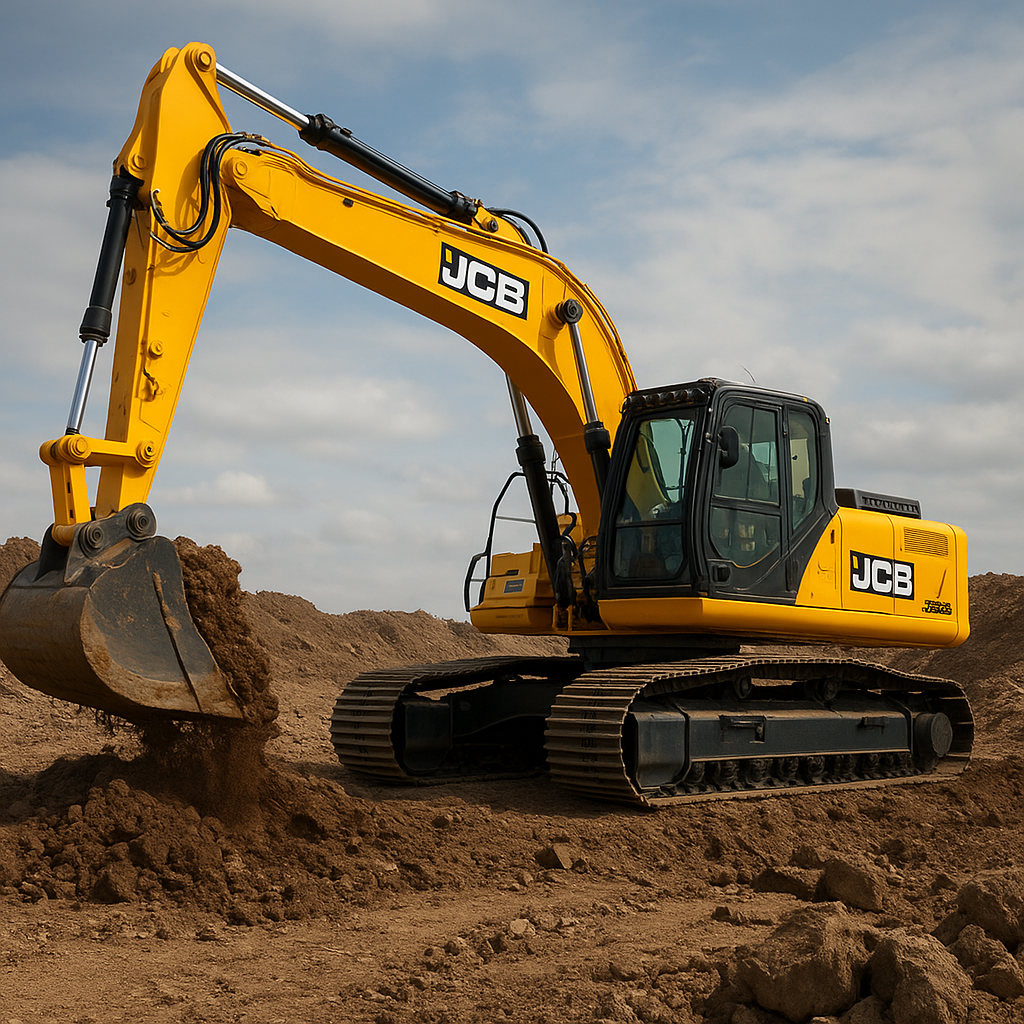
The JCB JS520 is a heavy-duty tracked excavator designed to meet the demands of large-scale construction, quarrying, and earthmoving projects. Built on JCB’s long-standing reputation for robust engineering and practical site-focused innovations, this machine balances raw power with modern controls and efficient systems. In the following sections, we examine its core features, typical applications, technical performance, operator environment, and practical considerations for buyers and fleet managers. The goal is to provide a comprehensive view that will help contractors, rental companies, and project planners understand where the JS520 fits into large-worksite operations.
Overview and design philosophy
The JCB JS range has been developed to cover a broad set of duties from medium-sized jobs to the most demanding heavy earthmoving assignments. The JS520 sits in the upper segment of this range and is engineered for long hours in harsh conditions while minimizing downtime and operating costs. Key aspects of its design focus on structural strength, ease of maintenance, and efficient hydraulics.
- Durability: The undercarriage, boom, and arm are reinforced with heavy-gauge steels and optimized weld patterns to withstand repeated high-stress cycles. Critical wear surfaces are designed for serviceability to limit long-term repair costs.
- Efficiency: JCB integrates fuel-efficient engines and hydraulic systems tuned to provide the best balance of power and fuel consumption under varied load conditions.
- Hydraulics: The hydraulic architecture typically features responsive pilot controls, high-efficiency pumps, and heat management systems that keep performance consistent across long shifts.
- Modularity: Localized and modular component placement simplifies routine checks and reduces downtime for replacements or scheduled maintenance.
JCB has aimed to build a machine that performs reliably in a wide spectrum of tasks, from digging and loading to heavy-duty demolition and quarry applications. The design also reflects attention to transportability and compliance with emissions standards relevant to major markets, often including Stage V or Tier 4 Final engines depending on the region and production year.
Primary applications and industry use cases
The JS520 excels where high-capacity excavation, loading, and material handling are required. Its typical roles include:
- Large-scale earthworks for infrastructure projects — embankment construction, foundation excavation, and mass earthmoving.
- Quarrying and aggregate handling — bench cutting, loading haul trucks, and material processing support.
- Mining and pit work — secondary excavation tasks, stockpile management, and site preparation.
- Pipeline and civil engineering projects — trenching for large-diameter pipelines, backfilling, and site grading.
- Demolition with heavy attachments — when fitted with breakers, crushers, or shears for dismantling structures or processing concrete and steel.
- Port and bulk handling — loading/unloading aggregates, recycling material, and general-purpose handling with specialized grapples.
Because of its scale and hydraulic capacity, the JS520 is particularly valuable in contexts where cycle times and throughput directly affect project timelines and profitability. For example, in a quarry operation, a high-capacity excavator like the JS520 can substantially reduce the number of passes required to load large haul trucks, improving overall productivity.
Attachments and versatility
One of the main strengths of large excavators is the breadth of supported attachments, which multiplies the machine’s value across tasks:
- Buckets of various sizes and profiles (general-purpose, rock, V-shaped, and heavy-duty loading buckets).
- Hydraulic breakers for primary or secondary concrete and rock breaking.
- Screening and crushing attachments that enable processing on site and reduce hauling costs.
- Grapples and clamshells for timber, recycling, and bulk material handling.
- Tiltrotators and quick couplers that increase the machine’s agility when doing precise digging, grading, or pipe-laying work.
Well-configured attachment systems and hydraulic options allow fleet managers to switch machine roles quickly, keeping the JS520 in productive use across different job stages.
Performance, technical specifications and statistics
Specifications for the JS520 can vary by model year and regional configuration, especially concerning emissions packages and optional equipment. Typical figures for a machine in the 50-tonne class (which the JS520 represents) are provided below as a practical reference. Where exact values vary by configuration, the figures are presented as representative ranges.
- Operating weight: approximately 45,000–55,000 kg (50 tonne class).
- Net engine power: roughly 180–220 kW (240–295 hp), depending on engine tuning and emissions stage.
- Bucket capacity: commonly 1.2–2.5 m³ for standard buckets; larger specialized buckets are available for bulk loading.
- Maximum digging depth: in the order of 6.5–8.5 m depending on boom/arm configuration.
- Maximum reach at ground level: roughly 10.5–12.5 m.
- Hydraulic system flow: pump flows typically range between 250–400 L/min for main circuits when high-flow options are fitted.
- Bucket breakout force: sizeable for class, often in the order of 200–300 kN depending on arm geometry.
- Travel speed: usually two-speed travel configurations delivering 3–5 km/h in low and 5–7 km/h in high range.
Performance statistics such as fuel burn per hour or cycle times are strongly dependent on duty cycle, operator skill, ground conditions, and attachment selection. Real-world fleet data often show that properly specified 50-ton class excavators yield higher tonnage-per-hour figures than smaller machines when matched to high-capacity haul trucks or conveyor systems, justifying their higher acquisition and operating costs on continuous high-throughput sites.
Fuel economy and lifecycle costs
Manufacturers including JCB emphasize lifecycle operating cost reductions through engine efficiency, hydraulic control logic, and smart idle/shutdown features. Modern engines and hydraulics are tuned to provide high torque at lower RPMs, which reduces fuel consumption under many typical loading conditions. Telematics and maintenance packages further lower lifecycle costs by optimizing service intervals, tracking fuel use, and enabling proactive maintenance.
As a general rule, while the hourly fuel consumption of a 50-ton class excavator will be higher than smaller machines, the productivity-per-litre ratio can be superior when the machine is used for appropriately sized tasks. This is why fleet managers must match excavator class to the scale of loading equipment and haulage systems to maximize return on investment.
Operator environment, safety and serviceability
The working environment and ease of maintenance are key differentiators on modern heavy excavators. JCB has placed significant focus on creating a cab and service layout that reduces fatigue and simplifies upkeep.
- Operator comfort: ergonomic seats with multiple adjustments, climate control, and low-noise cabs help reduce fatigue during long shifts. Visibility from the cab is optimized through large glazed areas and, where specified, camera systems for complete site awareness.
- Controls and infotainment: precise joysticks, adjustable control patterns, and configurable displays allow operators to tailor responses and monitor machine parameters in real time.
- Safety: ROPS/FOPS-rated cabs, anti-slip surfaces, handrails, and emergency exit provisions are standard. Worksites with heavy equipment also benefit from optional LED lighting packages and proximity-detection systems.
- Serviceability: grouped service points, large access doors, and ground-level maintenance points reduce the time needed for daily checks, oil changes, filter replacements, and greasing.
- Telematics and remote monitoring: JCB’s telematics (e.g., LiveLink or similar systems depending on region) allow remote tracking of machine hours, fuel usage, fault codes, and geolocation — improving fleet oversight and enabling predictive maintenance planning.
These features combine to improve uptime, lower operational risks, and support healthier daily utilization figures for contractors who prioritize machine availability and operator wellbeing.
Practical considerations for purchase and fleet integration
Choosing a JS520 or a similar 50-ton class excavator should be based on a thorough analysis of project scale, attachment needs, transport logistics, and total cost of ownership. Below are several practical points to evaluate.
- Match the excavator class to the site: A machine of this size provides excellent throughput for large haul trucks, but is inefficient on small, constrained jobs where a compact excavator or mid-size machine would be more appropriate.
- Transport and permits: Operating weight and transport dimensions may require special trailers, escort vehicles, or route permits in some jurisdictions. Factor transport time and costs into total operating budgets.
- Attachment ecosystem: Verify local availability of required attachments (buckets, breakers, grapples) and compatible hydraulic circuits to ensure quick turnaround between tasks.
- Maintenance support and parts availability: A strong dealer network and availability of spare parts are critical for minimizing downtime. Check service agreements, warranty terms, and on-site support options.
- Fuel and emissions compliance: Confirm that the machine’s engine and after-treatment systems meet local emissions regulations. Availability of low-sulphur diesel and maintenance of SCR/DPF systems influence long-term operating costs.
- Operator training: For best performance and safety, invest in operator training tailored to the JS520’s controls, hydraulic behavior, and safety systems.
Rental and second-hand market considerations
For rental firms, the JS520 represents high earning potential on large-scale projects but a significant capital outlay. Depreciation, utilization rates, and maintenance history are key metrics to evaluate when acquiring new or used units. For buyers of used machines, inspect structural integrity (boom/arm welds), hydraulic system condition, and service records — these areas reveal much about how the machine was operated and maintained.
Comparisons, alternatives and market positioning
The JS520 competes with other manufacturers’ 50+ tonne class excavators. When comparing machines, contractors commonly examine:
- Fuel economy per ton moved.
- Breakout force and lifting capacity at different radii.
- Cycle times and hydraulic responsiveness.
- Cab comfort and operator visibility.
- Dealer support and regional parts availability.
The decision often hinges on total lifecycle costs rather than initial purchase price alone. A slightly higher upfront cost can be justified by lower fuel usage, longer service intervals, or superior uptime backed by a strong dealer network. JCB’s global footprint and hybrid manufacturing approach (with plants in multiple countries) can be attractive in markets where parts and service availability are critical.
Concluding perspective
For projects that demand sustained high-capacity excavation and material handling, a large tracked excavator such as the JCB JS520 offers a compelling combination of strength, hydraulic power, and modern operator amenities. While exact specifications may change with production year and market, the core value proposition remains: deliver high throughput, reduce cycle times, and provide a machine that can be adapted through attachments for multiple tasks. Buyers should consider machine match, lifecycle costs, and after-sales support to ensure the JS520 (or any similar class excavator) is the right choice for their fleet or project needs.
Key words highlighted for emphasis: JCB JS520, durability, efficiency, hydraulics, engine, productivity, attachments, operator comfort, telematics, safety.


)
)