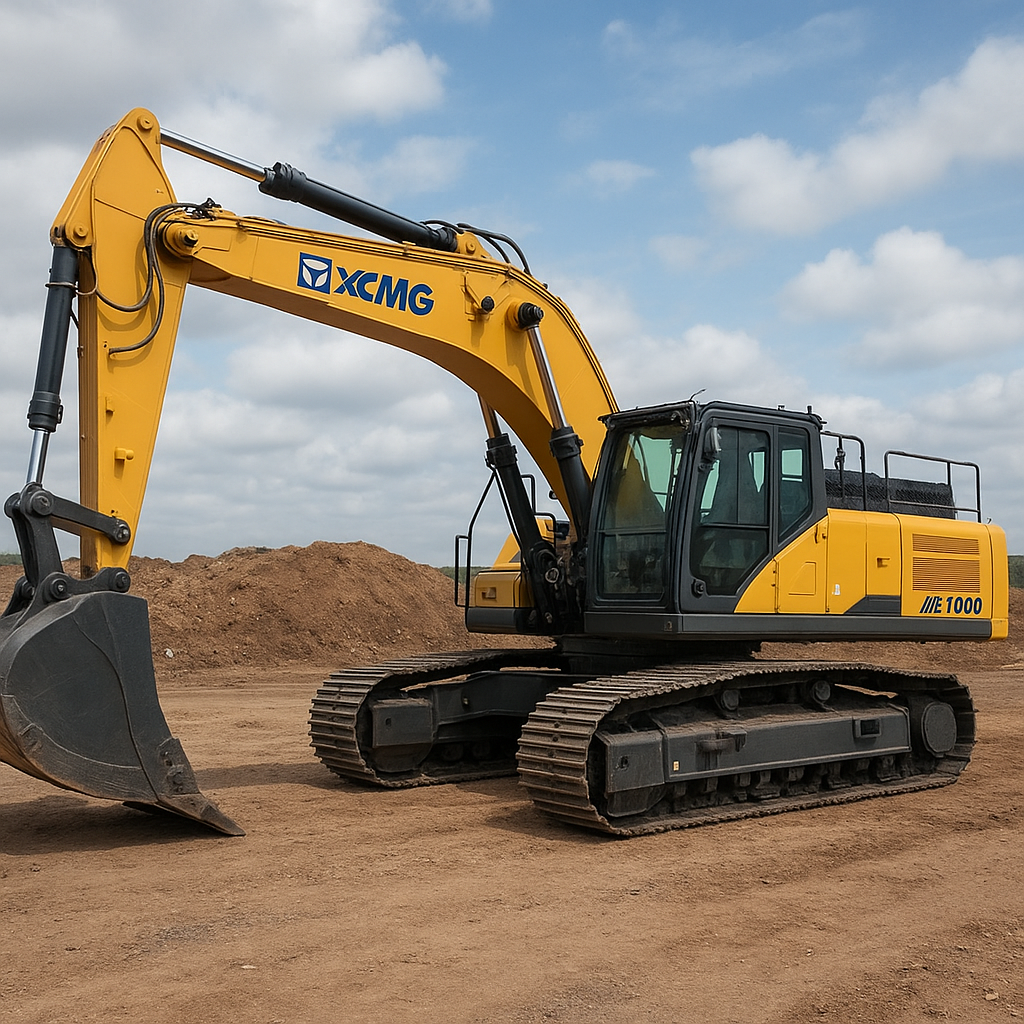
The XCMG XE1000 represents a class of heavy-duty, large hydraulic excavators designed to meet the demands of modern mining, large-scale construction and earthmoving projects. This article examines the machine from multiple angles: its design philosophy, typical specifications, operational roles, maintenance considerations and its place in global markets. The aim is to provide a comprehensive portrait that will help fleet managers, operators and prospective buyers understand where the XE1000 fits and why such machines are critical for high-productivity projects.
Overview and design intent
The XCMG XE1000 is positioned as a heavy, high-capacity hydraulic excavator meant for continuous, high-load duty cycles. Manufactured by Xuzhou Construction Machinery Group (XCMG), one of the largest global construction equipment companies, the XE1000 is intended for operations where high material handling rates and robust durability are required. Core design goals include maximizing cycle productivity, ensuring long-term reliability, and delivering lower life-cycle costs per tonne moved.
Key design elements
- Hydraulic system optimized for high-flow, high-pressure operation to enable powerful digging and lifting.
- Heavy-duty structural components—booms, arms and undercarriage—designed to withstand continuous use in abrasive environments.
- Crew comfort and ergonomics: roomy cab, visibility enhancements and controls that reduce operator fatigue.
- Service access engineered to shorten routine maintenance intervals and reduce downtime.
Typical specifications and variants
Exact specifications for the XE1000 depend on regional configurations, optional packages and specific sub-models. Below are commonly reported ranges and characteristics observed for machines in the 100-ton class produced by XCMG and comparable manufacturers. Where precise official figures are not publicly available for every market, ranges are given to reflect typical configurations.
- Operating weight: approximately 90,000–110,000 kg (about 90–110 tonnes), depending on counterweight and attachments.
- Bucket capacity: typically 4.5–7.0 m³ for standard buckets; specialized rock buckets and coal/scoop configurations may vary.
- Engine power: mid- to high-horsepower diesel engines in the range of roughly 350–600 kW, depending on emissions package and tuning.
- Hydraulic system: high-flow pumps and main control valves supporting heavy digging cycles and fast cycle times.
- Track and undercarriage: wide gauge, heavy track links, and large rollers to distribute ground pressure for stability.
These figures place the XE1000 firmly in the 100-ton class of excavators. Depending on configuration, the machine may be optimized for either bench mining (high breakout force and heavy buckets) or rehandle duties (fast swing and high breakout cycles).
Applications and industries
The XE1000 is used in a variety of heavy-duty applications. Its combination of weight, hydraulic power and bucket capacity make it suitable for operations where volume and durability matter most. Typical applications include:
- Mining: open-pit mining for overburden removal, ore extraction and loading of large haul trucks. The XE1000 can be configured with rock buckets or heavy-duty coatings for abrasive materials.
- Large-scale construction projects: earthworks, foundation digging for heavy structures, and material handling at major infrastructure sites such as dams and ports.
- Quarrying: loading of crushers and haul trucks with stone, aggregate and raw materials.
- Bulk material handling: stockpile re-handling, port terminal operations and large-scale reclamation works.
In mining and quarrying roles the XE1000 is often paired with haul trucks in the 40–100 tonne payload range, or is used to fill larger trucks by cycle sequencing depending on fleet composition.
Performance, productivity and economics
Performance of a machine like the XE1000 is measured not only by peak power or bucket size but by real-world productivity: tonnes moved per hour, fuel consumption per tonne and uptime. Several features contribute to competitive performance:
- High-flow hydraulics delivering strong breakout forces and quick arm/bucket speeds.
- Optimized bucket geometries and linkage ratios for rapid fill and dump cycles.
- Electronic control systems that can manage spool flow, power delivery and automatic idle to reduce fuel use during non-productive periods.
From an economic standpoint, key considerations include:
- Acquisition cost vs. lifecycle cost — larger machines have higher purchase prices but can reduce unit costs through higher hourly production.
- Fuel efficiency — modern XE1000 variants typically incorporate fuel-saving strategies (engine control, hydraulic optimization) to lower cost per tonne.
- Maintenance intervals and parts availability — simplified service access and standardized components reduce downtime and parts inventory complexity.
Operation, ergonomics and human factors
Operator comfort and safety affect both productivity and retention. XCMG has focused on improving cab ergonomics, visibility and control layouts on its larger excavators. Common features include:
- Spacious cab with adjustable seat, climate control and low-noise design to reduce fatigue.
- Large windows, optional cameras and mirrors to improve visibility of boom, bucket and surrounding area.
- Intuitive joysticks and monitor panels that simplify operation and provide diagnostic readouts and fuel/efficiency guidance.
Training and skilled operators are crucial for achieving promised productivity numbers—proper technique, bucket selection and cycle control strongly influence hourly output and fuel consumption.
Maintenance, durability and lifecycle management
For a heavy excavator such as the XE1000, planned maintenance and robustness of components are vital. Manufacturers and fleets aim to maximize machine availability and manage total cost of ownership by:
- Providing long-life components for swing bearings, undercarriage parts and bucket linkage.
- Designing easy access to filters, lubrication points and service panels to reduce routine service time.
- Offering telematics and remote diagnostics to monitor machine health, schedule maintenance and forecast component replacement.
Wear parts—especially buckets, teeth, pins and bushings—need to be monitored, and replacement intervals will vary with material abrasiveness. Proper ground engagement techniques and adherence to service schedules prolong component life.
Safety and environmental considerations
Large excavators must follow strict safety protocols. Standard features that improve safety on the XE1000 class machines include:
- Rollover protective structures (ROPS) and falling object protective structures (FOPS) integrated into the cab.
- Safe cab egress, anti-slip surfaces on walkways, and lockout/tagout points for service.
- Advanced monitoring to detect hydraulic leaks, overheating or abnormal vibrations.
Environmental controls are increasingly important. Engines are configured to meet regional emissions standards (Tier/Stage equivalents), and fuel-management systems reduce unnecessary idling. Some fleets pair excavators with dust suppression and noise reduction measures to meet site-specific regulations.
Market presence, supply chain and fleet integration
XCMG has expanded its global footprint over the past decades, increasing service networks and parts availability outside China. The XE1000 is offered through dealer networks and direct sales in many mining and construction markets. Considerations when integrating the XE1000 into a fleet include:
- Compatibility with existing haul trucks and supply logistics — matching bucket payload to truck capacity optimizes cycle efficiency.
- Parts lead times and local dealer support for rapid repair turnaround.
- Availability of operator training and remote service capabilities for uninterrupted operations.
Case studies and real-world deployments
Large excavators like the XE1000 see use in diverse environments. Representative deployment examples include:
- Open-pit mines where operators run continuous 24/7 shifts to maintain ore delivery to processing plants. In such settings, the excavator may operate in a multi-machine fleet with coordinated maintenance campaigns to limit downtime.
- Major civil works projects—such as dam construction—where heavy lifting and large earthmoving volumes are necessary during peak earthworks phases.
- Quarries and aggregate operations where high material throughput is necessary to feed crushing and screening lines.
Performance metrics in these settings typically track tonnes per hour, fuel consumption per tonne and mean time between failures (MTBF). Values vary by application, but well-managed operations of 100-ton class excavators can achieve several thousand tonnes per operating hour in favorable conditions when paired with large-capacity buckets and efficient haul cycles.
Statistics, benchmarks and performance indicators
While exact numbers for the XE1000 depend on configuration and operating conditions, the following benchmarks are useful for comparison and planning:
- Average production: Depending on bucket size, cycle times and material, a 100-ton class excavator can handle between 1,500 and 6,000+ tonnes per 8-hour shift in typical mining or quarry scenarios. Lower-end values reflect heavy rock with slow cycles; higher-end values reflect softer materials and optimized truck-excavator matching.
- Fuel consumption: Typical hourly fuel use ranges widely—roughly 30–80 L/hr—depending on engine tuning, load pattern and operator behavior. Fuel per tonne is a key KPI and can be reduced with eco modes and careful operation.
- Availability targets: Mining operations often aim for 90%+ availability for primary excavators through proactive maintenance.
These benchmarks are indicative; individual sites should conduct on-site trials and data logging to establish precise KPIs for their XE1000 machines.
Upgrades, attachments and customization
One of the strengths of large excavator platforms is the ability to fit specialized attachments and configurations:
- Different bucket types: general-purpose, rock, coal/scoop and high-capacity buckets.
- Hydraulic breakers or shears for secondary demolition tasks.
- Extended booms and arms for deep digging benches or stockpile reach.
- Quick couplers for fast attachment changes to adapt to multi-role operations.
Customization for severe environments may include enhanced filtration packages, cold-weather kits, or upgrades to undercarriage components for abrasive ground conditions.
Future trends and technological integration
Large excavators are evolving with trends that will influence future XE1000-like machines:
- Automation and semi-autonomous operation: cycle optimization, autonomous tideloading and restricted-area autonomous operation increase safety and can boost productivity.
- Telematics and predictive maintenance: advanced analytics to predict component wear and reduce unplanned downtime.
- Hybrid and electrification pathways: while full electrification for 100-ton machines is challenging today, hybrid systems and site electrification (e.g., tethered electric excavators) are being explored to reduce emissions and operating costs.
Buying considerations and lifecycle costs
When evaluating the XE1000 or similar machines, buyers should weigh the following:
- Match machine size to job requirements—oversizing increases fuel use and acquisition cost, undersizing reduces productivity.
- Consider total cost of ownership: fuel, maintenance, parts, operator training and resale value.
- Assess dealer support, parts logistics and warranty terms, especially for remote or demanding projects.
- Plan for fleet integration: pairing with correct truck sizes and ensuring site logistics are optimized.
Summary
The XCMG XE1000 class excavator represents a compelling option for heavy mining, quarrying and large civil earthworks where high-volume material movement is required. Its strengths include a design focused on robust hydraulics, heavy-duty structures and operator comfort—elements that combine to deliver high productivity and long service life. While precise specifications can vary by market and configuration, the machine sits squarely in the 100-ton class with bucket capacities and engine power tuned for demanding tasks. Buyers should focus on lifecycle economics, matching machine configuration to application, and ensuring adequate dealer and maintenance support to maximize uptime and reduce cost per tonne.
XCMG’s XE1000 and its peers will continue to evolve with increased automation, telematics integration and potential electrification pathways—trends that promise higher efficiency and safer operations in the years ahead. For any organization planning to deploy such equipment, a detailed application study, site trial and robust maintenance plan are essential to realize the full potential of these powerful machines.


)
)