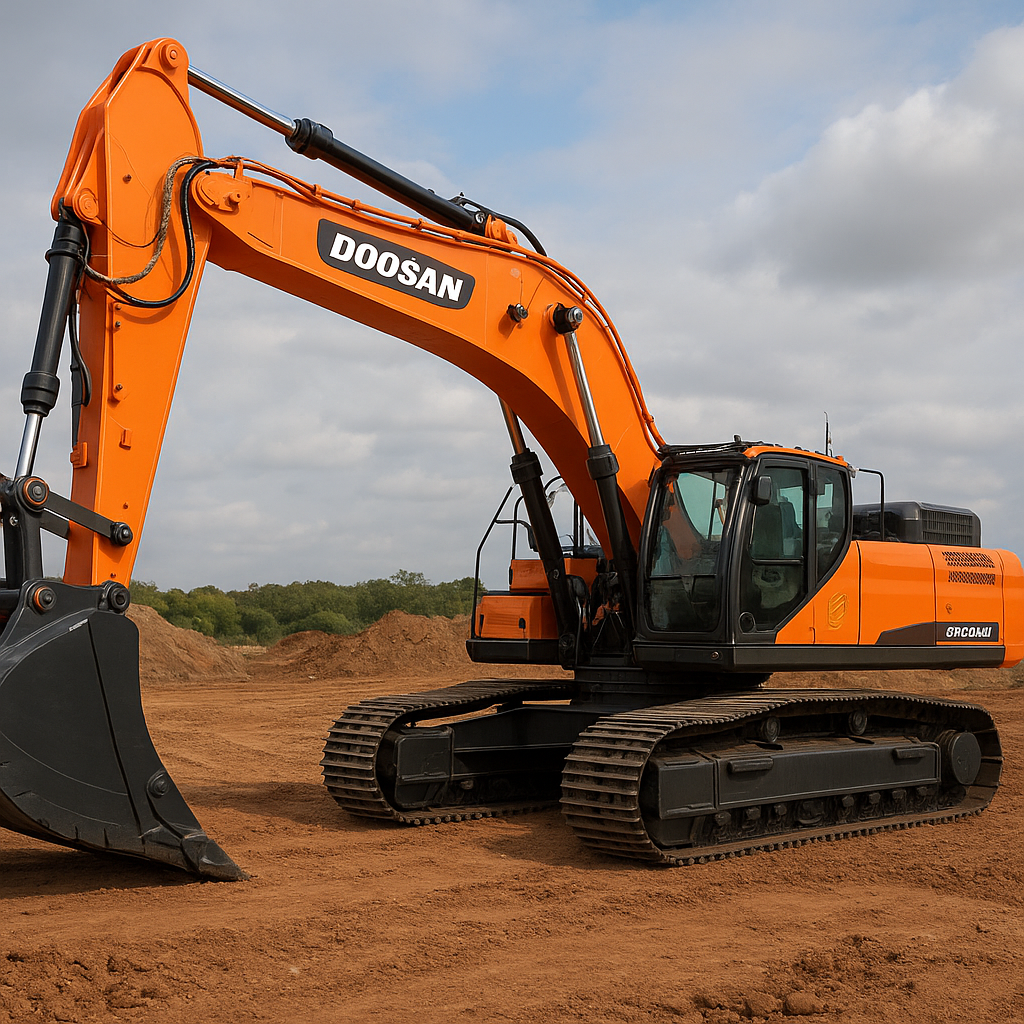
The Doosan DX800LC is a heavy-duty hydraulic excavator designed for demanding mining, quarrying, and large civil engineering projects. Combining robust construction with advanced hydraulics and operator-focused features, this machine is built to deliver long-term productivity in severe working conditions. Below you will find a detailed exploration of the DX800LC’s design, capabilities, typical applications, technical characteristics (approximate and configuration-dependent), maintenance considerations, safety features, and market context.
Overview and design philosophy
The Doosan DX800LC occupies the class of large excavators intended for operations where scale and endurance matter. Its platform emphasizes structural strength, serviceability and operator comfort while integrating modern hydraulic and control elements to maximize cycle times and fuel economy. The machine’s undercarriage and superstructure are engineered to work for thousands of hours in abrasive environments, and components are grouped to simplify access during routine checks and major servicing.
Doosan’s approach to this model centers on three priorities: reliability, total cost of ownership, and on-site productivity. The DX800LC typically competes in markets where an excavator must lift and move very large volumes of material—coal, overburden, blasted rock, and bulk earthworks for major infrastructure projects.
Typical technical specifications (approximate)
Specifications for the DX800LC vary by model year, optional equipment and regional configurations. The figures below represent typical values for an 80-ton class Doosan excavator and should be verified against the machine’s specific serial number and manufacturer documentation for exact ratings.
- Operating weight: approximately 75–85 tonnes (75,000–85,000 kg)
- Engine power: roughly 350–400 kW (470–540 hp), depending on tuning and emissions package
- Bucket capacity: commonly 2.5–5.0 m³ for general-purpose buckets; rock buckets may be lower in volumetric capacity but heavier-duty
- Maximum digging reach: typically 12–15 meters, depending on boom/arm configuration
- Maximum digging depth: commonly 7–10 meters for standard stick lengths
- Hydraulic system: high-capacity, variable-flow pumps with load-sensing control; main relief pressures in heavy-duty range (manufacturer-specific)
- Fuel tank capacity: typically 900–1,200 liters to support long shifts in remote sites
- Travel speed: low and high ranges designed for stability when shifting across site terrain
These values are indicative and will vary with optional counterweights, stick length, and specialized configurations (e.g., heavy-duty rock packages, extended reach versions, or multipurpose arrangements).
Primary applications
The Doosan DX800LC is suited to a variety of heavy applications where its mass, power and hydraulic capacity can be fully utilized. Typical applications include:
- Mining and quarrying: material handling, bench mining, loading large haul trucks, and processing high-density rock or ore.
- Bulk earthworks: construction of dams, large-scale excavation for ports, power plants and major transportation corridors.
- Infrastructure projects: foundations for bridges and skyscrapers, preparation for tunnel portals, and large-scale dredging support when fitted with specialized attachments.
- Demolition and recycling: with appropriate attachments such as shears or crushers, the DX800LC can handle concrete and structural steel recycling tasks.
Hydraulics, attachments and versatility
One of the DX800LC’s strengths is its advanced hydraulic architecture. The machine typically features high-flow, variable-displacement pumps and electronic control modules that balance power and efficiency. Load-sensing hydraulic systems permit the excavator to apply power where needed while reducing wasted flow during lighter cycles, improving overall fuel efficiency and response.
Common attachments include:
- General-purpose buckets for bulk digging and loading;
- Rock buckets with reinforced lips for heavy abrasion;
- Hydraulic breakers for secondary demolition and rock breaking;
- Grapples and orange-peel buckets for demolition and scrap handling;
- Thumbs and quick couplers to improve cycle speed when switching tasks;
- Tilting and rotating quick couplers for precision work and complex placement.
Attachment choice greatly affects productivity metrics and fuel burn; heavy-duty rock work will reduce volumetric throughput per hour but extend component life where appropriate heavy-duty reinforcement is fitted.
Operator environment and controls
Doosan places emphasis on operator comfort and ergonomics in large models like the DX800LC. The cab typically includes climate control, adjustable seating, low-noise insulation, and a logical arrangement of joysticks and displays designed for reduced fatigue over long shifts. Key operator features often found on this class include:
- Large touchscreen or multi-function display for machine diagnostics and configuration
- Rear- and side-view cameras integrated with the display for enhanced visibility
- Joystick pattern selection and sensitivity adjustment
- Automatic idle and eco modes to reduce consumption during idling
- Heated seats and pressurized cabs for dust mitigation in mining environments
These features improve both safety and productivity by lowering the risk of operator error and reducing downtime caused by fatigue.
Performance, fuel consumption and productivity
Performance of the DX800LC depends on application, ground conditions, attachment and operator skill. When optimized, this class of excavator provides high cycle rates for loading large haul trucks and high breakout forces for handling compacted materials.
Fuel consumption varies widely: light-duty trenching or leveling might consume significantly less than heavy rock loading. As a rough guideline for similar machines in this class, one might expect average hourly fuel consumption in the range of 25–45 liters per hour during typical load-and-carry cycles, while continuous heavy-duty rock work can push that figure higher. Actual figures for the DX800LC should be obtained from on-site fuel logging or manufacturer data for the specific configuration.
Key metrics operators track include:
- Bucket loads per hour
- Tonnes moved per hour
- Fuel consumed per tonne moved (cost-efficiency metric)
- Average cycle time (dig, swing, dump, return)
Optimizing these metrics comes from matching bucket size to haul truck capacity, maintaining clean hydraulic systems, using eco operating modes when possible, and training operators on efficient digging techniques.
Maintenance, serviceability and life-cycle costs
For heavy excavators like the DX800LC, maintenance strategy is central to minimizing total ownership cost. Important serviceability design features often include grouped service points, large access doors, centralized filters and modular components that can be replaced with minimal disruption. Typical maintenance considerations:
- Routine daily checks: grease points, hydraulic oil level, engine oil and coolant, visual inspection for leaks or wear.
- Filtration: regular replacement of hydraulic and engine filters is critical in dusty or abrasive settings.
- Undercarriage wear-management: track tensioning, shoe replacement and sprocket monitoring are major cost drivers.
- Component refurbishment: boom, arm and bucket linkage pins/bushings are wear items that require periodic measurement and replacement.
- Scheduled major services: hydraulic oil changes, engine overhaul intervals and hydraulic system flushes as recommended by the manufacturer.
Because downtime is expensive in mining and major earthworks, many owners adopt condition-based monitoring (oil analysis, vibration sensors, telematics) to plan interventions before catastrophic failures occur and to maximize component life. Well-maintained DX800LC machines can accumulate tens of thousands of operating hours when refurbished and serviced appropriately.
Safety, regulatory and environmental features
Large excavators carry inherent hazards; Doosan (and OEMs broadly) equip machines with features to reduce risk. Common safety features include:
- ROPS/FOPS certified cabs to protect operators in roll-over or falling object incidents
- Integrated camera systems and proximity detection to reduce blind-spot incidents
- Emergency stop circuits and redundant safety interlocks
- Automatic shutdown routines for over-temperature or low-pressure conditions
- Emission-compliant engines meeting regional Stage/ Tier standards to limit environmental impact
Many operators retrofit additional safety equipment—fire suppression systems, beacon lights, and operator vigilance systems—to meet specific site regulations or insurance requirements. Emissions systems (selective catalytic reduction, diesel particulate filters) can affect fuel consumption and servicing intervals but are necessary to meet modern environmental standards.
Market positioning, lifecycle and resale value
The DX800LC sits in the upper tier of general-purpose heavy excavators. Market factors that influence its value and lifecycle economics include:
- Availability of local dealer support and parts network
- Fuel price volatility (affects operating cost per hour)
- Global commodity cycles—high mining activity increases demand and resale values
- Competition from similar models by other major manufacturers—selection often rests on dealer relationships, warranty offerings and service contracts
Resale values are best preserved by documented maintenance history, lower actual hours for the machine’s age, and availability of refurbishment options. Heavy equipment market data shows machines maintained with condition-based programs and telematics often command premiums on the resale market.
Real-world examples and case studies
Typical deployments of 80-ton class machines like the DX800LC include:
- A surface coal mine using DX800LC excavators to load 100–140 tonne haul trucks; a properly sized bucket and experienced crew can achieve high truck-turn metrics and maintain favorable fuel-to-tonne ratios.
- A large infrastructure contractor using multiple DX800LC units for dam excavation: extended working hours and night shifts demanded robust lighting, upgraded cooling packages and scheduled night-service protocols.
- A quarry operation that pairs DX800LC machines with primary crushers, where the excavator serves both load-and-carry and feed roles, emphasizing uptime and heavy-duty bucket durability.
In each case, success relies on matching bucket geometry to material density, implementing preventative maintenance, and using operator training programs to standardize best practices.
Buying, rental and lifecycle considerations
Prospective buyers should consider the following checklist when evaluating a DX800LC:
- Confirm exact model year and factory options (emissions package, heavy-duty undercarriage, counterweight)
- Inspect maintenance records and request oil analysis reports if purchasing used
- Assess local dealer capabilities for parts and scheduled services
- Evaluate the total cost of ownership: initial price, expected fuel consumption, wear component lifetimes, and anticipated resale value
- Consider renting as a short-term solution for project peaks to avoid capital locking
For rental fleets, DX800LC machines are valuable for high-demand projects where short-term access to large capacity equipment offsets the capital expense. For owners, lifecycle cost modeling often shows that strong maintenance practices and telematics integration can significantly lower per-hour ownership costs.
Summary and final remarks
The Doosan DX800LC is a purpose-built heavy excavator aimed at demanding mining, quarrying and large civil construction tasks. Its advantages include a robust structural design, high-capacity hydraulics, and operator-focused systems intended to maximize uptime and reduce long-term costs. While exact technical data depends on configuration and model year, the DX800LC class typically offers high power, substantial operating weight for stability, and flexible attachment compatibility to handle a wide range of tasks.
Owners and operators who achieve the best outcomes with machines like the DX800LC prioritize regular maintenance, match bucket and attachment choices to the task, and use operator training and telematics to optimize fuel consumption and productivity. When properly supported by dealer networks and maintained in line with manufacturer guidance, these excavators remain productive assets across multiple project cycles and can deliver a strong return on investment in high-production environments.


)
)