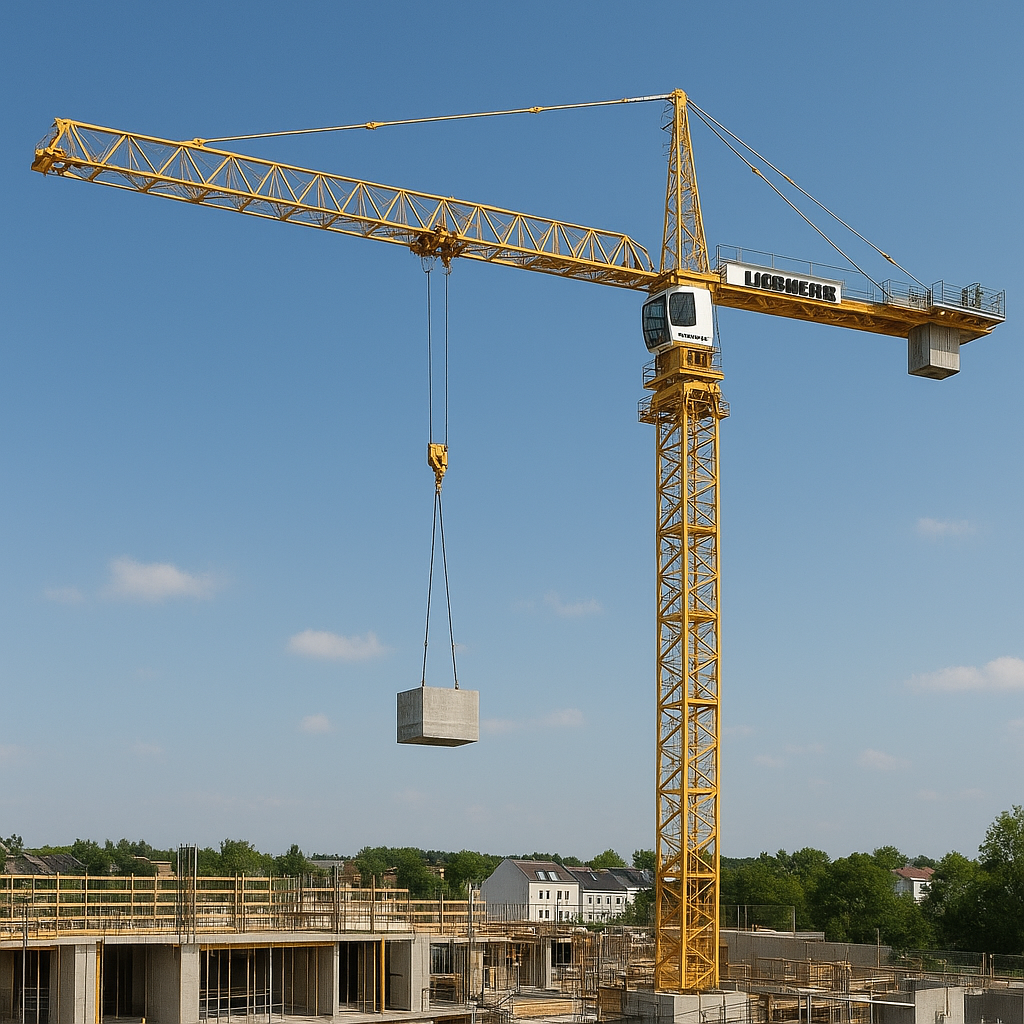
The Liebherr 630 EC-H is a member of Liebherr’s heavy-duty tower crane family designed for demanding construction sites where reach, capacity and reliability are critical. In this article we examine the machine’s typical applications, key technical characteristics, operational benefits and maintenance considerations. The information below combines general manufacturer design principles with typical configuration data and practical insights from construction practice so that architects, site managers and equipment planners can better evaluate the crane’s suitability for specific projects.
Design and core characteristics
The 630 EC-H is engineered as a high-capacity, high-reach tower crane suitable for medium-to-large scale projects. Its design philosophy focuses on a combination of structural strength, modular assembly and electronic control to deliver predictable performance across a wide range of lift conditions. Important structural elements include a rigid slewing ring, a robust counter-jib, a long working jib made of lattice sections and a modular tower system that enables variable hook heights by adding mast sections.
On the control side, Liebherr’s cranes typically integrate an advanced onboard computer and remote diagnostics to optimize hoisting, luffing and trolley travel. The 630 EC-H usually features features such as variable speed drives, soft-start hoists and precision load sensing that together improve cycle times and extend component life.
Typical technical specifications (example ranges)
Exact specifications depend on the crane’s configuration, the options fitted and the installation (free-standing, tied to structure, or climbing). Below are representative ranges and example values frequently seen in the EC-H class and comparable Liebherr models. Treat these as indicative: always consult the machine’s official datasheet and the lifting plan prepared by a qualified rigger before operation.
- Maximum lifting capacity: commonly in the range of 6 to 12 tonnes at short radii depending on block and hook configuration. Tip loads decrease substantially with increasing radius.
- Jib length (working radius): typical jib lengths range from 40 m up to 80 m in extended configurations; many installations use jibs in the 48–60 m range for a balance of reach and transportability.
- Load moment: rated load moment figures for cranes in this class often range from several hundred to a few thousand tonne-metres depending on variant. Load moment determines how much weight can be lifted at specific radii.
- Maximum hook height: depends on the number and height of modular tower sections; free-standing heights of 40–80 m or more are possible with appropriate tie-ins or climbing frames.
- Hoist speeds and trolley travel: manufactured to provide variable hoisting speeds for delicate lifts and faster speeds for routine cycles; typical hoisting speeds might range from a few metres per minute on heavy gear to tens of metres per minute on light gear.
- Power: electric motors with frequency inverters are common; power consumption and supply requirements vary by configuration and regional electrical standards.
Because designs evolve and Liebherr offers many optional packages, project planners must obtain the model-specific technical data sheet for precise planning. Nevertheless, these sample ranges give a practical picture of the machine’s capabilities and the types of lifts it can perform.
Primary applications and industries
The 630 EC-H is versatile and well-suited to several construction and industrial sectors. Its combination of reach and capacity makes it a preferred choice where frequent heavy lifts must be made at extended radii.
- High-rise and multi-storey construction — lifting structural steel, precast concrete panels, façade elements and mechanical plant into position at tall buildings.
- Industrial plants and factories — installation and positioning of heavy equipment, process vessels and modular skids where stable, repetitive heavy lifts are required.
- Bridge and infrastructure projects — placing precast bridge segments, beam elements and formwork in constrained urban or riverine sites.
- Energy sector — foundations and components for onshore power substations, transformer installation and certain support tasks in wind farm construction (for onshore assembly operations).
- Logistics and port facilities — site preparation and installation of port cranes or terminal equipment when fixed, site-tied cranes are acceptable.
In addition to these typical roles, the machine is often used in dense urban redevelopments where a reliable, fixed lifting solution reduces the need for repeated mobile crane mobilizations and helps maintain continuous workflow on constrained sites.
Operational advantages and noteworthy features
The 630 EC-H offers several advantages that make it attractive to contractors and rental fleets. These features improve safety, productivity and cost-effectiveness when properly applied in project planning:
- Predictable capacity at reach — tower cranes maintain rated capacities over time more consistently than many alternatives because they are bolted and secured rather than driven onto soft ground.
- Continuous operation — electric drive systems and efficient cooling enable long operating hours with stable performance on multi-shift projects.
- Precision handling — modern control electronics deliver fine positioning capability for placing heavy or delicate elements exactly where needed.
- Space efficiency — a fixed tower crane footprint often occupies less ground area than frequent repositioning of large mobile cranes.
- Integration with site logistics — the crane can be positioned to serve multiple work fronts with long jib variants, reducing material handling times and traffic on congested sites.
- Advanced safety equipment — load moment indicators, rated capacity limiters and optional anti-collision systems enhance operational safety when multiple cranes work on the same site.
Additionally, Liebherr’s emphasis on modular design and standardized components simplifies spare parts provisioning and speeds up both erection and dismantling compared with bespoke crane solutions.
Safety systems, controls and digital features
Safety is central to modern tower crane operation. The 630 EC-H typically incorporates or can be equipped with a suite of electronic and mechanical safety measures:
- Load moment limiting systems and overload cut-outs to prevent structural overloads.
- Anemometers and wind speed alarms to ensure lifts stop under unsafe wind conditions.
- Angle and radius sensors to continuously monitor load geometry and provide operator feedback on permissible lifts.
- Liebherr’s control electronics such as the LICCON system or equivalent, which provide diagnostics, operating history, and optimized motion profiles for smoother operation and reduced mechanical stress.
- Optional anti-collision and zone-restriction systems to coordinate multiple cranes on a single site and to prevent encroachments into prohibited airspace.
- Remote diagnostics and telematics for predictive maintenance: modern machines can transmit operational data to fleet managers for condition monitoring, helping to schedule service before faults develop.
These technologies support not only compliance with local regulations and standards but also site-specific risk management strategies required by many large contractors and owners.
Transport, erection and site logistics
One of the advantages of the EC-H design family is modularity. Transportable lattice sections for the jib, counter-jib and mast allow the crane to be moved in discrete loads on trucks and reassembled on site. Erection is typically performed by a mobile crane or by using a top-climbing assembly method where the tower crane raises sections of its own tower sequentially.
- Transport — components are sized to match common transport regulations, but very long jibs or heavy counterweights may require special permits and escort vehicles.
- Erection — the process includes laying the base, bolting or welding the tower to the base, assembling the slewing unit and boom, and adding the counter-jib and counterweights. Typical assembly times depend on site access, weather and availability of erection cranes.
- Tie-in and climbing — for very tall projects the crane is often tied into the building structure or uses a climbing frame so it can be elevated safely as floors are added.
Planning for foundation loads, ground bearing capacity and temporary access roads is a critical part of mobilizing a tower crane of this class.
Maintenance, lifecycle and operating costs
Maintenance for the 630 EC-H follows rules common to heavy lifting equipment: scheduled inspections, lubrication, periodic replacement of wear items (pins, ropes, brakes), and monitoring of electrical components. A few points to consider when estimating lifecycle costs:
- Regular rope inspections and replacement intervals are essential because hoist ropes carry most of the dynamic load during lifts.
- Brake systems must be tested and adjusted periodically to maintain safe holding capacity, especially when heavy loads are frequently handled.
- Control electronics and sensors require both software updates and calibration checks to ensure the reliability of load and position readings.
- Access to manufacturer-approved spare parts and trained technicians reduces downtime and extends useful life.
- Telematics and condition-based maintenance reduce unplanned downtime by predicting component wear before failure.
From a cost perspective, while capital investment and assembly costs can be high, the productivity gains on long-duration projects and reduced need for repeated mobile crane mobilizations can make tower cranes economically favorable for many jobs.
Environmental and urban considerations
Using a fixed tower crane like the 630 EC-H can help reduce emissions and noise relative to frequent mobile crane operations, because electric drives and continuous site occupancy avoid repeated heavy transporter trips. In dense urban sites, the crane’s fixed footprint also helps with traffic management by concentrating lifting operations into a predictable zone. However, planners need to account for the visual impact, shadowing and temporary wind effects associated with tall masts. Early engagement with local authorities, neighbors and site stakeholders usually eases permitting and scheduling.
Market position, availability and statistical context
The Liebherr brand is widely recognized globally for reliability and broad product range. Models in the EC series and similar classes are extensively used by large contractors and rental fleets. Exact sales figures for a single variant such as the 630 EC-H are typically not published in detail by manufacturers, but some general points are worth noting:
- The market for tower cranes in Europe and North America is dominated by a few established manufacturers, including Liebherr, Potain (Manitowoc), and Terex. Liebherr holds a significant share in the tower crane segment because of its integrated engineering and global support network.
- Demand for high-capacity tower cranes correlates strongly with the level of large-scale construction activity: high-rise residential, commercial, and infrastructure projects are primary drivers.
- Rental fleets commonly standardize on a limited set of versatile models to ensure flexibility; models like the 630 EC-H are attractive to fleets because they can serve many job types with interchangeable configurations.
For project planners and fleet managers seeking specific regional statistics such as number of units in service, average utilization rates or resale values, industry rental associations and heavy equipment market analysts provide periodic reports. Manufacturers and dealers can also supply local fleet data to support procurement and scheduling decisions.
Case scenarios and practical use examples
Here are a few illustrative scenarios where a 630 EC-H-type crane provides clear benefits:
- On a 30-storey apartment tower with extensive precast elements, the crane’s long jib and steady hoist enable rapid placement of panels from a single fixed position, reducing site congestion and speeding assembly.
- During the construction of an industrial plant, repeated heavy lifts of process modules and steel columns can be performed with fewer repositionings than a mobile crane fleet, saving on mobilization and road permits.
- In bridge construction where multiple large precast segments are lifted into place over an extended span, the crane’s load moment at mid-range radii and its precision controls make it suitable for accurate alignment work.
Final considerations for procurement and project planning
Choosing a tower crane like the Liebherr 630 EC-H requires an integrated evaluation of site geometry, lifting plan, foundation and transport logistics, assembly time and long-term project schedule. Key steps that help ensure successful deployment include:
- Commissioning a qualified lift planner to produce a detailed lift plan and to verify rated capacities at the required radii.
- Confirming the electrical supply, foundation design and any required special transport permits well in advance.
- Specifying necessary safety and digital options such as anti-collision, telematics and advanced load moment limiting to match site complexity.
- Budgeting for assembly/disassembly, tie-in fixtures and possible climbing frames if the crane will be raised along with the structure.
- Arranging for manufacturer-certified maintenance support and spare parts availability for the crane’s expected deployment period.
Summary
The Liebherr 630 EC-H class of tower cranes offers a combination of reach, capacity and modern control systems that make it suitable for high-rise construction, industrial installations and infrastructure projects. Its modular design, advanced safety features and potential for remote diagnostics support efficient operation across long project lifecycles. While specific performance figures vary with configuration, the machine is representative of heavy-duty tower cranes that contractors and rental fleets rely on to deliver predictable, high-volume lifting capability on complex sites.
When planning to use this crane, obtaining the exact technical datasheet for the specific variant, preparing a comprehensive lifting plan and coordinating logistics early will ensure that the investment in the crane yields both operational efficiency and a high standard of safety on site.


)
)