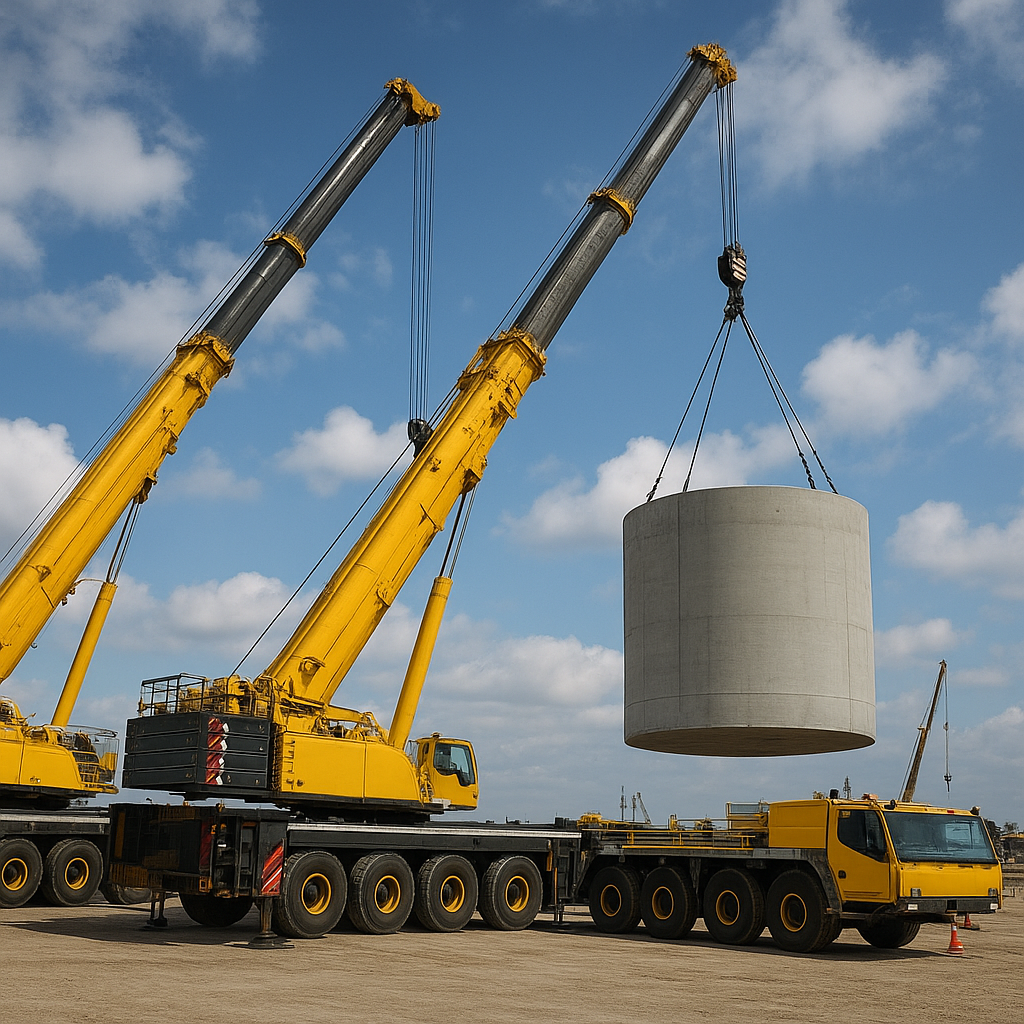
Mobile cranes are among the most impressive feats of modern machinery, showcasing unmatched mobility and raw power on construction sites, oil fields, and major infrastructure projects. The World’s Largest Mobile Cranes in Action examines how these towering giants push the boundaries of innovation, tackle engineering obstacles, and deliver critical performance where fixed cranes cannot reach. From assembly challenges to real-world applications, this article explores key aspects of deploying and operating colossal mobile lifting machines.
Massive Machines and Their Capabilities
When it comes to moving loads that weigh hundreds of tons, only the largest mobile cranes can rise to the occasion. These vehicles combine a robust chassis with multi-axle trailers and telescopic or lattice booms that extend to more than 200 meters. Capacity ratings often exceed 1,000 tons, an astonishing figure that few fixed cranes can match without complex counterweights and special foundations.
Record-Breaking Load Capacities
Leading manufacturers such as Liebherr, Terex, and XCMG have produced models like the Liebherr LTM 11200-9.1, which delivers a maximum lifting capacity of 1,200 metric tons. Rigorous testing ensures durability under repeated heavy lifts, while hydraulic systems and winches provide smooth control over massive weights.
Extended Reach and Boom Configurations
Telescopic booms can be extended in multiple sections, giving operators the precision needed to place heavy elements at extreme heights. For ultra-tall lifts, lattice-boom extensions are bolted on, trading ease of transport for increased length. Innovative boom designs minimize bending moments, enhancing overall stability during high-angle lifts.
- Telescopic Hydraulic Sections: Quick extension and retraction with synchronized control.
- Lattice-Type Extensions: Higher capacity at extended reaches, assembled on site.
- Counterweight Systems: Modular blocks that balance enormous loads.
- Multi-Axle Carriers: Distribute weight for road transport and reduce ground pressure.
Engineering Challenges and Solutions
Designing a mobile crane that can be driven on public roads, assembled on a confined site, and lifted to extreme heights requires meticulous engineering. Each component, from the carrier chassis to the boom sections, must meet stringent safety regulations and performance standards.
Transport and Assembly Logistics
Planning the journey of a crane that may span 15 axle lines is no small matter. Transport permits, route surveys, and temporary pavement reinforcements are often necessary. Once on site, crews assemble booms and counterweights, sometimes using smaller cranes to lift each segment. This logistical ballet highlights the importance of efficiency and precise scheduling.
Hydraulic and Control Systems
Modern cranes use multi-circuit hydraulic systems, allowing independent movement of boom sections, slewing, and winch operations. Advanced electronic controls with load-moment indicators ensure that an operator never exceeds safe limits, dramatically improving safety. Redundant sensors, emergency-stop functions, and remote diagnostics add further layers of protection.
Materials and Structural Integrity
Alloy steels and high-strength fibers in boom construction reduce weight while boosting load capacity. Finite element analysis helps engineers fine-tune the design, ensuring sections flex within acceptable limits. By optimizing cross-section geometry, manufacturers achieve the ideal trade-off between lightness and durability.
Applications Across Industries
From offshore oil platforms to urban high-rise construction, the world’s largest mobile cranes serve a variety of critical roles. Their capability to relocate quickly and operate on uneven terrain makes them invaluable where permanent lifting solutions are impractical.
Energy and Infrastructure
In the energy sector, mobile cranes lift turbine components weighing hundreds of tons onto foundations. Offshore modules, subsea templates, and wind-turbine towers all rely on cranes with exceptional capacity and precise load placement. Road and rail infrastructure projects deploy these machines to install long bridge girders in a single lift, minimizing traffic disruption.
- Wind Farm Installations: Putting nacelles and tower segments in place.
- Bridge Construction: Single-piece girder lifts for faster completion.
- Oil and Gas Platforms: Transporting modules offshore and onshore.
- Heavy Industrial Equipment: Positioning reactors, generators, and boilers.
Urban Construction and Emergency Response
In dense city centers, mobile cranes navigate tight streets to erect skyscrapers or reposition steel trusses. Their versatility shines when disaster strikes—collapsed structures demand rapid clearing and lifting of debris, where specialized cranes can rescue trapped individuals or remove hazardous materials.
Entertainment and Event Logistics
Large-scale concerts and sporting events often require roof trusses weighing tens of tons. Mobile cranes install lighting rigs, video screens, and audio arrays with minute-by-minute timing. Here, impeccable planning and precision are crucial to meet tight schedules and ensure public safety.
Future Developments and Technological Trends
The horizon for mobile crane technology brims with innovations aimed at boosting performance and reducing environmental impact. Electrification, digital integration, and autonomous systems promise to transform how heavy lifts are executed.
Hybrid and Electric Drives
Manufacturers are exploring fully electric crawler cranes and hybrid carriers that combine diesel engines with battery packs. These solutions lower emissions, cut operational costs, and allow quieter work in urban environments. Regenerative braking systems harvest energy during boom lowering, feeding power back into the batteries for increased efficiency.
Digital Twins and Predictive Maintenance
By implementing digital-twin models, operators can simulate each lift in virtual space, optimizing crane configuration and rigging before physical assembly. Real-time monitoring of hydraulic pressures, joint stresses, and wear patterns enables sustainability through predictive maintenance, minimizing downtime and extending equipment life.
Remote Operation and AI Assistance
Advances in remote-control technologies allow skilled operators to manage lifts from a safe distance, benefiting hazardous environments or sites with limited access. Artificial intelligence analyzes load data and site conditions to suggest optimal boom angles, counterweight placement, and travel routes, further enhancing safety and operational stability.
Modular and Rapid‐Assembly Designs
New crane models focus on plug-and-play modules that reduce onsite assembly time. Standardized connections and quick-release pins enable teams to erect lattice booms and counterweight frames within hours rather than days. This modularity boosts project turnaround and maximizes equipment utilization, underlining the drive for greater versatility.