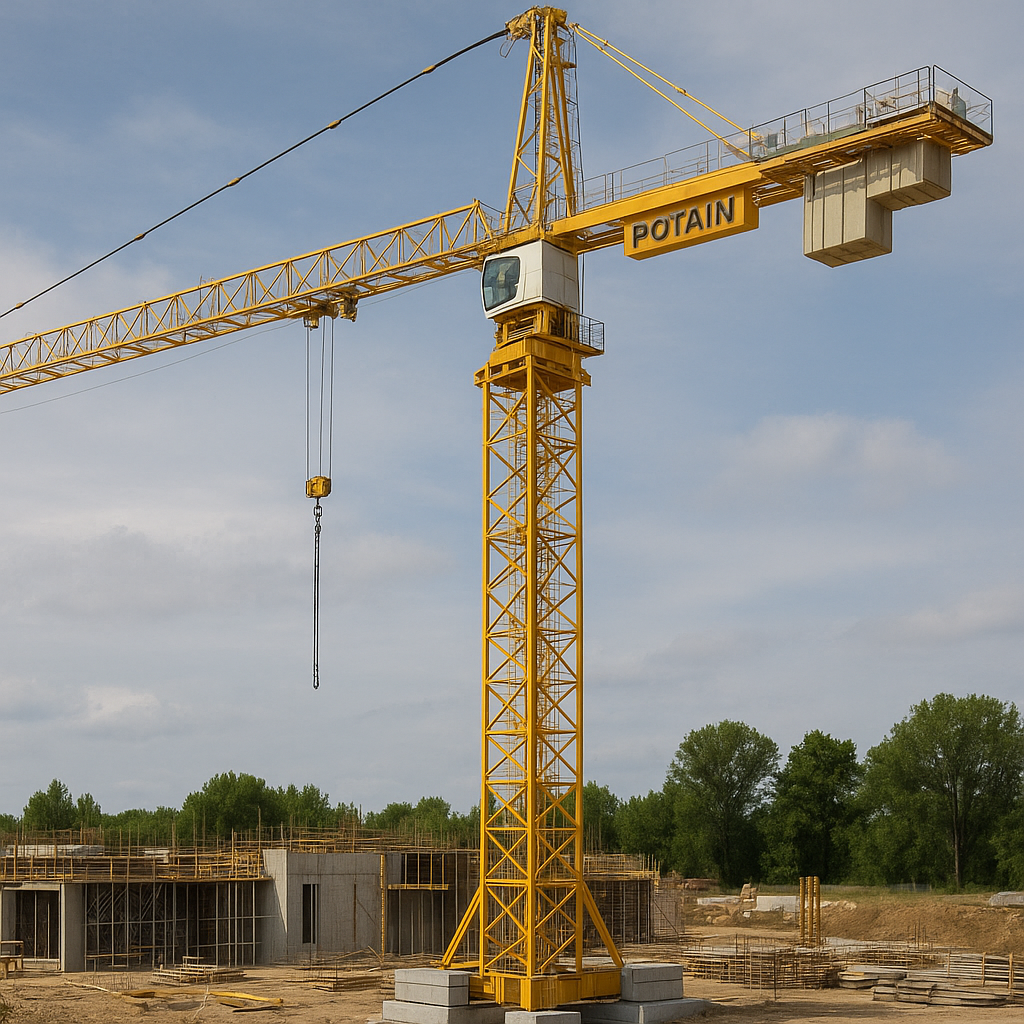
The Potain MD 689 is a versatile example of a modern tower crane designed to meet the demands of a wide range of construction projects. Combining modular design, advanced control systems and configurations that allow adaptation to different site constraints, the MD 689 has been used in many markets where reliability and operational flexibility are required. This article reviews the machine’s design philosophy, typical technical features, practical applications, operational advantages and important considerations for site use, maintenance and safety.
Design and technical features
The Potain MD 689 follows the Potain tradition of offering cranes that balance lifting performance with adaptability. Key to its appeal is a modular architecture that allows the crane to be configured for specific tasks — from compact urban jobsites with limited space to larger construction sites requiring extended reach and higher hook heights. The core components are a slewing unit with powertrain, a lattice or tubular jib, a counter-jib and counterweights, a mast made of bolted sections, and the hoisting and trolleying systems.
Modular mast and climbing options
The mast of the MD 689 can be assembled from standard sections, enabling straightforward erection and takedown. It also supports different climbing systems: external climbing frames for tying into the structure being built, and internal climbing for applications where the crane climbs within the building shell. This modularity permits rapid adaptation of mast height and anchoring arrangements based on project phasing.
Jib design and reach
Jib length is one of the most configurable elements. Typical installations use jibs that provide a clear radius suited to the project — medium-length jibs for residential and commercial mid-rise buildings and longer jibs for large-site works or precast element handling. The jib’s lattice structure reduces wind resistance while delivering strength and stiffness required for precision lifting.
Hoisting and motion control
Modern Potain MD series cranes incorporate robust hoisting motors, precise frequency-controlled drives and electronic controls to provide smooth lifting and trolleying. These systems reduce swing and shock loads on the structure and permit fine placement of loads. The crane’s controls typically include load moment indicators (LMI), torque-limiting features and adjustable speed profiles to match site-specific operational strategies.
Capacity and performance (typical ranges)
Exact performance numbers depend on the crane’s configuration (jib length, counterweight, mast sections and anchoring). However, in practice the MD 689 is positioned as a mid-to-upper-range model in Potain’s MD family. Typical observed values across different installations include:
- Rated lifting capacity at the hook in the strongest configuration: approximately 6–12 tonnes (configuration-dependent); lower capacities are common at maximum reach.
- Jib lengths commonly used: approximately 40–60 meters depending on the jobsite.
- Freestanding hook heights: typically up to 70–90 meters with standard mast sections; greater heights achievable with climbing or tower tie-in systems.
- Lifting speed and trolley speed: designed to balance fast cycle times with precise control; variable frequency drives are commonly used to enable smooth operations.
Because the MD 689 is configurable, contractors should consult the manufacturer’s load charts for the exact combination of jib length, counterweight and mast height to obtain certified capacity at every radius and elevation.
Typical applications and sectors
The adaptability of the Potain MD 689 makes it suitable for a wide variety of construction sectors. Its ability to be reconfigured rapidly and its relatively compact foundation requirements (for certain builds) broaden its possible uses.
Residential and commercial buildings
Mid-rise residential and commercial construction (typically 6–30 storeys, depending on the local urban fabric) are common application areas. The MD 689’s combination of reach and capacity allows it to lift prefabricated components, concrete formwork, steel sections and mechanical equipment efficiently across a building footprint.
Infrastructure and civil engineering
Bridgeworks, road projects and infrastructure installations often require medium-sized tower cranes to position formwork, reinforcement cages, precast elements and utilities equipment. The crane’s capacity and modular mast options facilitate staged construction where cranes must be moved or reconfigured as the project proceeds.
Industrial sites and heavy mechanical installations
For industrial plants, petrochemical facilities and heavy equipment yards, the MD 689 can be specified with heavier-duty configurations and additional counterweight to lift heavy modules and plant components. Its precise control systems are beneficial when aligning heavy machinery and piping modules.
Prefabrication and modular construction
Prefabricated and modular construction benefits from repetitive, precise lifts. The MD 689 is capable of repetitive cycle lifts of wall panels, facade units and volumetric modules — improving productivity in modular assembly yards and on-site module installation.
Operational advantages and safety features
Operational efficiency and safety are central to modern crane design. The Potain MD 689 includes features designed to increase uptime, reduce operating risk and simplify daily workflows.
Safety systems
Standard safety systems for modern Potain tower cranes include load moment indicators (LMIs) to prevent overload conditions, automatic cutoffs for prohibited operations, and alarms for wind and configuration anomalies. Many machines also come equipped with anti-collision options when multiple cranes are operating on the same site. These systems enhance safety for operators and ground personnel and allow project managers to manage multiple cranes with reduced risk.
Operator ergonomics and controls
Operator cabs (where fitted) are designed for visibility and comfort, with intuitive controls and informative displays. Some projects prefer remote-control operation from the ground for specific lifts; remote-control options improve operator sightlines for line-of-sight tasks and can reduce the need to install cab access on tight sites.
Efficiency and productivity
By combining smooth hoist motion, precise trolley controls and robust installation speeds, the MD 689 helps reduce lift cycle times. Compact transportable modules reduce assembly and disassembly time between projects. Overall, productivity gains arise from reduced reconfiguring time and the crane’s ability to perform diverse lift types without additional specialist equipment.
Logistics, assembly and site planning
How a Potain MD 689 is moved, assembled and integrated into a site plan affects project schedules and costs. Thoughtful logistics planning reduces idle time and improves safety during erection and dismantling.
Transport and modularity
Because the crane is modular, components are transported on standard road trailers. The lattice jib and mast sections stack efficiently in transport mode. A site with limited access can benefit from the MD 689’s packing efficiency. For tall structures, mast extensions and climbing frames are delivered in sequenced batches to match the construction schedule.
Erection and dismantling
Erection is typically performed using mobile cranes or self-erecting sequences depending on availability. Erection teams must follow certified procedures and use manufacturer-provided charts for safe lifting of mast sections and jibs. Anchoring and foundation planning must account for overturning moments and dynamic loadings. Dismantling uses the reverse sequence and often requires similar planning to avoid costly delays.
Foundations and anchoring
Foundations range from concrete pads with baseplates to piled foundations for larger cranes or poor soil conditions. The required foundation depends on the crane configuration and local geotechnical data. Anchoring and ties into the building stabilize the mast against lateral loads and allow higher freestanding heights.
Maintenance, lifecycle and total cost of ownership
Mechanical reliability and planned maintenance are crucial for minimizing downtime and maximizing return on investment. The MD 689’s components are designed to be serviceable and supported by manufacturer parts and training.
Planned maintenance
Routine maintenance includes lubrication of slewing gears, inspection and replacement of hoist ropes and wire, checking electrical systems and drives, and structural inspections for fatigue or corrosion. Keeping comprehensive maintenance records improves safety and asset value for resale or redeployment.
Common wear items and inspections
Wire rope, sheaves, brake systems, bearings and electrical controls are typical wear items. Inspections should be scheduled per local regulations and manufacturer guidance, with additional checks after severe weather events or unusual lifts. Regular NDT (non-destructive testing) on critical structural joints is recommended on high-cycle sites.
Residual value and resale
A well-maintained MD 689 typically retains significant residual value due to its modularity and broad applicability. The resale market values units that have documented maintenance histories, up-to-date electrical upgrades and compliant safety systems.
Case examples and statistical observations
While project-by-project performance varies, several patterns emerge from industry practice that illustrate how machines like the Potain MD 689 contribute to construction programs.
- Productivity impact: On mid-rise building projects the use of a single mid-range tower crane often reduces lift cycle times for façade panels and precast components by 20–40% versus smaller mobile cranes, primarily by maintaining a continuous and centralized lift point.
- Site footprint savings: Compared to multiple mobile cranes, one MD 689 with adequate reach can reduce ground congestion and crane repositioning needs, saving logistic time and permitting denser site layouts.
- Utilization: Average utilization rates on multi-month projects commonly exceed 60% of available working hours when the crane is properly integrated into the construction sequencing, though high-utilization industrial projects can reach much higher rates.
These observations depend on proper planning, operator skill and the match between crane configuration and project requirements. Project managers should analyze lift plans and simulate tasks to ensure the MD 689 is sized and positioned to maximize return.
Environmental and regulatory considerations
Increasingly, buyers and contractors evaluate cranes not only by lifting capacity but also by environmental and regulatory performance. The Potain MD 689 can be specified with energy-efficient drives and electrical systems that reduce fuel consumption where diesel generators might otherwise be used.
Noise and emissions
Electric drive systems reduce onsite emissions and may help projects comply with urban air quality standards. Noise is primarily from auxiliary equipment and hoist motors; frequency-controlled drives help by smoothing motor operation. Site managers should consider localized emissions and noise regulations when planning the crane’s power source.
Regulatory compliance
The crane must be installed and operated under local regulatory frameworks for tower cranes, including certification of foundations, periodic safety inspections, operator licensing and record-keeping. In many jurisdictions, formal handover documentation and load charts signed by a competent engineer are mandatory before operation.
Buying, renting and lifecycle choices
Deciding whether to buy or rent an MD 689 depends on fleet needs, project pipelines and financial considerations. The flexibility of rental markets means many contractors prefer to rent medium-sized towers for finite projects; owners of larger portfolios may prefer to own to reduce long-term costs.
- Buying: Best when predictable demand exists across multiple projects; benefits from asset control, customization and potential tax advantages.
- Renting: Offers flexibility and offloads maintenance and storage responsibilities to the rental provider; ideal for irregular or single-project use.
- Refurbishment and upgrades: Upgrading control systems, adding anti-collision and remote-monitoring kits can extend the useful life and improve resale value.
Conclusion
The Potain MD 689 is an adaptable and capable tower crane platform suitable for a wide array of construction and industrial tasks. With modular components, reliable drive systems, and an emphasis on operational safety and efficiency, it can serve as a workhorse on sites ranging from urban residential builds to heavy industrial installations. Because its certified performance depends strongly on configuration, project teams should consult manufacturer load charts and work with experienced rigging and erection teams to ensure that the chosen setup meets the lifting profiles and site constraints. When specified and managed correctly, the MD 689 delivers a balance of efficiency, capacity and reliability that supports fast, safe and cost-effective construction workflows.


)
)