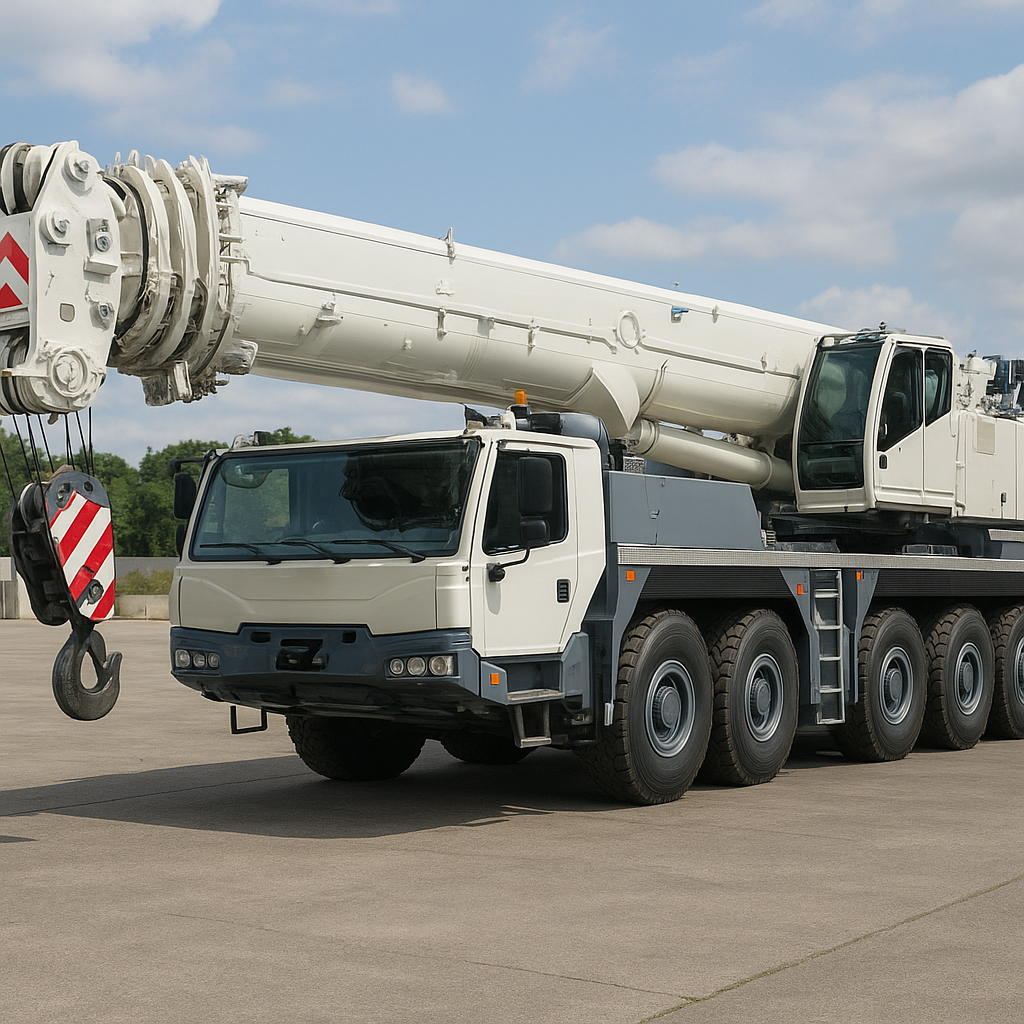
The Tadano AC 700-5 is a modern example of an all-terrain crane designed to combine highway mobility with robust off-road capability. It blends powerful lifting solutions with advanced hydraulic systems and operator-focused controls to serve a wide range of industries. In the text below you will find an overview of the machine’s design, typical technical characteristics, common applications, operation and maintenance considerations, and market context. The aim is to provide a practical and informative profile suitable for fleet managers, rigging coordinators, project planners, and crane operators.
Design and technical overview
The Tadano AC 700-5 follows the manufacturer’s approach to all-terrain cranes: a dedicated carrier and a fully hydraulic, telescoping boom system integrated with advanced safety and control electronics. The suffix -5 indicates a 5-axle carrier configuration, which gives the crane a favorable balance of roadability and load-carrying capacity while meeting many regulatory limits for gross vehicle weight and axle loads.
Key structural elements
- Carrier chassis: heavy-duty multi-axle frame engineered for both on-road travel and site mobility. The 5-axle arrangement improves distribution of weight and allows higher counterweight and lifting capabilities without compromising drivability.
- Telescopic boom: multiple-section boom made from high-strength steel, hydraulically extended and retracted. A typical telescopic configuration provides rapid extension and precise control, often supported by a hydraulically controlled boom hoist and internal wear strips to minimize maintenance.
- Superstructure and counterweight system: the crane’s upper turret houses the winch drums, hydraulic pumps, operator cabin, and modular counterweight blocks that can be added or removed to match lift requirements.
- Outriggers: multi-stage outriggers with hydraulic extension and jacking capabilities to stabilize the crane on uneven ground. Outrigger pads are sized for heavy loads and can be fitted with crane mats or support plates.
Powertrain, hydraulics and controls
AC series cranes typically use diesel engines tuned to meet emission regulations, driving hydraulic pumps that supply the crane’s main winches, boom extension, slewing and outrigger functions. Electronic control systems provide smooth, proportional control of movements, and integrate safety functions such as load moment indicators (LMI), rated capacity limiters (RCL), anti-two block prevention, and automatic engine/rpm management for optimal hydraulic power delivery.
Typical specifications (indicative)
Exact specifications depend on factory configuration, regional options, and aftermarket modifications, but operators can expect the following ballpark figures for a machine in this class:
- Nominal maximum lifting capacity: around lifting capacity of approximately 60–80 tonnes in the basic configuration, with variations depending on counterweight and boom configuration.
- Maximum main boom length: often in the range of 40–50 meters when fully extended without jib; availability of a lattice or hydraulic jib can extend reach further.
- Number of axles: 5, delivering a compromise between maneuverability and load distribution.
- Counterweight: modular, hydraulically or manually removable blocks to adapt to working requirements.
- Travel speed and roadability: designed for highway travel at legal speeds, with steering axles and steering modes to improve maneuvering on tight sites.
Applications and typical use cases
The Tadano AC 700-5 is suitable for a wide variety of heavy lifting tasks across multiple industries because of its combination of mobility, reach and lifting performance. Its adaptability is one of the machine’s greatest strengths.
Construction and infrastructure
- Urban building projects where machines must drive on public roads between jobs and then operate on constrained sites. The 5-axle carrier helps meet municipal gross vehicle requirements while carrying useful counterweight.
- Bridge construction and maintenance, where medium-to-large components, formwork, and precast elements must be placed with precision at varying radii and heights.
- Highway and rail projects that require rapid repositioning and operations in areas with limited access—especially where crane mats or reinforced outrigger pads are used.
Energy sector
- Wind turbine installation and maintenance: the crane’s telescopic boom and optional jibs can assist with nacelle and blade handling on medium-size turbines, and its mobility allows access to rural wind farms.
- Power plant erection and heavy equipment placement during maintenance or upgrades.
Industrial plants and petrochemical facilities
- Mechanical equipment lifts, replacement of large vessels, or lifting of piping sections inside plants; the ability to configure counterweight and use specialized rigging enables safe lifts in constrained industrial environments.
- Maintenance shutdowns that require fast mobilization and precise placement of heavy components.
Logistics, ports and specialized lifting
- Portside lifts for machinery and cargo where shore access is available; while all-terrain cranes are not substitutes for specialized mobile harbor cranes, they fill many mid-range capacity needs.
- Assembly of modular structures and precast concrete elements in manufacturing yards or on-site.
Operation, safety and maintenance
Professional operation and rigorous maintenance regimes are essential to extract maximum service life and performance from an all-terrain crane such as the AC 700-5. Because cranes operate under heavy loads and often in challenging environments, both mechanical integrity and operator competency are critical.
Operator interface and safety systems
- Load Moment Indicator (LMI) and Rated Capacity Limiter (RCL): continuously monitor boom angle, length, load and outrigger position, providing warnings and limiting functions to prevent overloads.
- Automatic interlocks for outriggers and travel modes to reduce risk of unsafe movement while set up for lifting.
- Anti-two block device to prevent boom hook block from contacting the boom tip and causing cable damage or structural failure.
- Multiple steering modes and selectable axle steering to enhance maneuverability and reduce tire and chassis stress when traveling on road or negotiating tight jobsite turns.
Maintenance best practices
- Regular inspection of wire ropes, hooks and sheaves for wear and deformation; replace per manufacturer intervals or immediately if damage is detected.
- Hydraulic system monitoring: check fluid cleanliness, filter elements, hoses and fittings, and maintain correct hydraulic pressures and temperatures.
- Structural inspections for boom section wear, fatigue cracks and corrosion—particularly for high-cycle urban use where frequent extensions occur.
- Scheduled engine and drivetrain service in accordance with hours of operation and local conditions (dusty, coastal or high-humidity environments require more frequent attention).
Rigging and lift planning
Successful lifts depend on thorough planning: assess ground-bearing capacity, use appropriate outrigger pads, verify certified slings and hardware, and prepare contingency procedures. Modern cranes offer onboard charts and computer-assisted lift planning features, but these must be validated by competent riggers who account for site-specific factors like wind, proximity to structures, and ground conditions.
Economic and market considerations
All-terrain cranes like the Tadano AC 700-5 occupy a niche between smaller truck-mounted cranes and larger lattice-boom crawler or heavy-duty truck cranes. Their economic value comes from the ability to move between sites without a separate transport rig, reduced setup time, and flexibility to operate on rough terrain.
Fleet integration and utilization
- For rental fleets and contractors, the AC 700-5’s multi-role capability makes it useful across multiple projects, improving utilization rates compared with single-purpose equipment.
- Ownership cost considerations include initial capital expenditure, fuel efficiency, scheduled maintenance, tires and axle service, and specialized operator training.
- Resale value is influenced by service history, region, and demand for mid-capacity all-terrain cranes; machines with detailed maintenance records and OEM-approved parts typically retain value better.
Environmental and regulatory aspects
Manufacturers design modern cranes to comply with emissions and noise regulations relevant to their markets. Buyers should consider emission stage (EU Stage V, EPA Tier 4, etc.), and available options for exhaust treatment and sound suppression if working in urban or environmentally sensitive locations. Additionally, adherence to national lifting regulations and operator licensing is required in most jurisdictions.
Comparisons, limitations and practical recommendations
When comparing the AC 700-5 to other all-terrain cranes, users should evaluate not just rated capacity and boom length, but also transportability, setup time, axle loads, and the availability of local service and spare parts. In many projects, the selection will be driven by the heaviest lift required at the greatest radius, plus the need to travel between jobs on public roads.
Strengths
- Versatility: suitable for a broad range of tasks because of configurable counterweight and boom/jib options.
- Mobility: 5-axle design enables efficient on-road travel while carrying useful working weight.
- Operator ergonomics and safety systems: electronic aids and comfortable cabs increase productivity and reduce risk.
Limitations
- Capacity limits: compared with larger lattice-boom or crawler cranes, an all-terrain crane in this class may not be suitable for extremely heavy or high-capacity lifts.
- Ground pressure requirements: despite outriggers, heavy lifts still demand good ground preparation; poor soils can limit allowable loadings unless mats or timber are used.
- Transport and permit considerations: depending on regional rules, additional permits may be required for oversize or overweight moves, particularly when transporting attachments or large counterweights.
Practical recommendations
- Perform a thorough lift plan and use certified rigging gear sized for the lift. When in doubt, increase factor of safety and consult the manufacturer’s load charts for the exact configuration.
- Ensure operator and rigger training is up to date and that the crew knows how to interpret onboard safety systems and respond to alarms.
- Maintain a local supply of high-wear consumables such as wire rope, hydraulic filters, and engine filters to minimize downtime.
- Work with an authorized dealer for major service intervals and to obtain genuine replacement parts to preserve machine life and resale value.
Concluding observations
The Tadano AC 700-5 represents a pragmatic balance of lifting power, reach and road mobility that suits a wide spectrum of projects. Its modular counterweight system, telescopic boom and integrated safety electronics make it adaptable for construction, energy, industrial and logistics tasks. Successful deployment depends on careful lift planning, diligent maintenance and selecting the right configuration of boom, jib and counterweight for the job. For organizations seeking a mid-capacity all-terrain crane that can move quickly between sites and perform reliably under diverse conditions, a machine of this class is often a strong candidate.


)
)