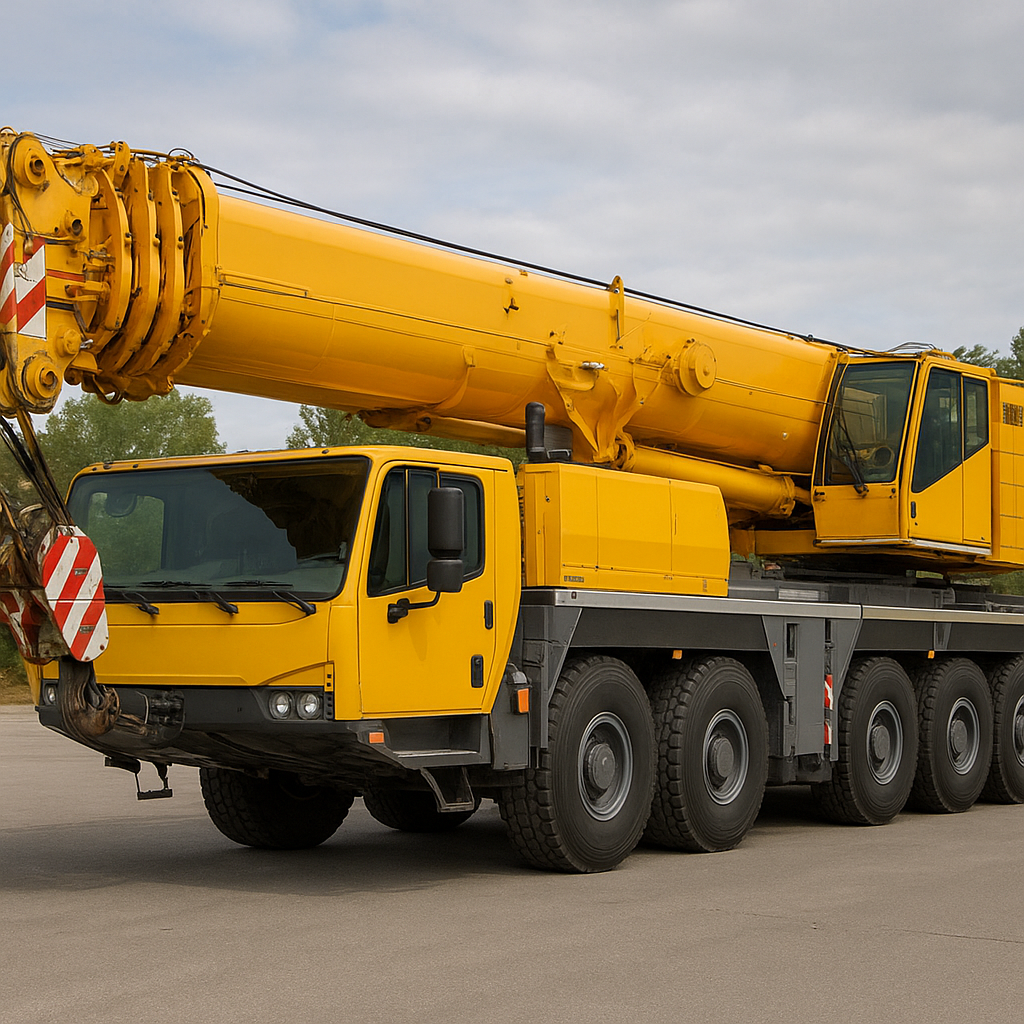
The Demag AC 500-2 is an iconic example of a heavy-duty all-terrain crane designed to combine on-road mobility with robust off-road performance and high lifting capacity. Developed under the Demag brand (now part of the global crane manufacturer family), this model is intended for demanding projects where both transport flexibility and large-scale lifting power are required. The following article examines the machine’s design, typical applications, technical highlights, operational considerations, and the role it plays in modern heavy lift projects.
Design and technical characteristics
The AC 500-2 was engineered to bridge the gap between mobile truck cranes and crawler cranes by offering the speed and roadability of a carrier-mounted unit with the lifting versatility of a lattice or telescopic boom system. Its fundamental design principles focus on stability, versatility, and relatively straightforward transport and assembly.
Main structural features
- Carrier and superstructure: The unit consists of a wheeled carrier for road travel and a separate powered superstructure that houses the engine, winches, and operator’s cab. This separation allows the crane to be driven to site and then quickly set up for work.
- Telescopic boom: The crane typically uses a multi-section telescopic boom as its primary lifting tool. The boom length can be extended or retracted to match job requirements, allowing flexible radius and height performance.
- Jib options: For very high or long-reach lifts, lattice or hydraulic extension jibs can be fitted to increase the effective boom length and allow for high-elevation placements such as wind turbine components.
- Counterweights: Modular counterweight systems permit operators to adapt the crane’s ballast to achieve the desired lifting moment, balancing capacity with transportability.
- Outriggers and support system: Four outriggers with adjustable pads provide leveling and ground pressure distribution; their extension range enables operation on uneven terrain within rated limits.
Powertrain, hydraulic and control systems
The AC 500-2 combines powerful diesel engines for both carrier mobility and superstructure operations. The hydraulic system drives the winches, boom extension, and slewing functions, while modern versions are equipped with electronic control systems for improved precision and safety. Typical control and safety elements include an electronic load moment indicator (LMI), overload protection, anti-two-block systems, and integrated diagnostics to assist in maintenance and trouble-shooting.
Performance specifications (typical values)
Exact specifications vary by configuration, optional equipment, and regional model revisions. The following are typical reference figures for this class of crane:
- Rated lifting capacity: approximately 500 metric tonnes at optimal radius and configuration.
- Maximum main boom length: commonly in the range of 50–65 meters, depending on telescopic sections and design variations.
- Maximum tip height with jib: when fitted with lattice jibs and extensions, tip heights can exceed 80–100 meters, depending on combinations used.
- Transport mass: overall on-road weight depends on counterweight and configuration; typical combined weights fall in a wide range often between ~70 and 110 metric tonnes for complete equipment sets.
- Operating modes: multiple boom and jib configurations allow the crane to adapt to lifting tasks ranging from short-radius heavy lifts to long-reach, lower-capacity placements.
Applications and industry use cases
The versatility and capacity of the AC 500-2 make it suitable for a broad range of industries. Operators rely on cranes of this class for lifts that require a combination of significant capacity and rapid repositioning.
Construction and infrastructure
- Placement of large prefabricated structural elements for bridges and buildings.
- Installation of precast segments and heavy support components where a fixed crane would be impractical or cost-inefficient.
Energy sector
- Wind energy: erection of mid-to-large wind turbine nacelles, hubs, and tower sections. The crane’s reach and lifting moment allow it to handle turbine components onshore and at straightforward offshore staging locations.
- Power plant construction and maintenance, including setting heat exchangers, turbines, and generators.
Oil, gas and petrochemical
- Lifting and installation of heavy process modules and columns, often required during plant construction or module exchange operations.
Industrial plant assembly and heavy equipment placement
- Installation and maintenance of heavy machinery in industrial plants, shipyards, and fabrication yards.
- Handling of transformer units, large tanks, and other oversized components.
Mobility, transportability and site setup
A defining advantage of an all-terrain crane like the AC 500-2 is its ability to travel on public roads between job sites and then continue to the lift location with minimal auxiliary transport. This reduces the number of specialist trailers required for movement compared with crawler or modular cranes.
Road travel and on-site maneuvering
- The carrier is designed for strategic balance between axle count, gross vehicle weight, and legal road limits in target markets. This allows faster repositioning and reduced logistical complexity.
- All-wheel steering and multiple steering modes (where fitted) improve maneuverability in confined sites, while off-road capability allows access to less prepared terrain.
Set-up time and logistical considerations
- Set-up time depends on site conditions, counterweight configuration, and jib assembly requirements. A typical medium-complexity set-up for a crane in this class can range from under an hour for simple lifts to several hours for complex, high-lift configurations that require lattice jib erection and heavy counterweights.
- Transport of additional counterweights or jib sections may require separate vehicles and planning to meet axle-load regulations and local transport permits.
Safety systems and operator ergonomics
Modern heavy cranes prioritize safety and predictability. The AC 500-2 is fitted with systems designed to protect both the operator and the load.
Electronic protections
- Load moment indicator (LMI): continuously monitors boom position, load, and radius to alert the operator when approaching limits.
- Anti-two-block and overload cut-outs reduce the risk of hook block contact with boom tip or lifting beyond rated capacities.
- Integrated diagnostics and fault logging help maintenance teams identify issues quickly and reduce downtime.
Cab and controls
Operator cabins emphasize visibility, comfort, and clear instrumentation. Ergonomic controls (joysticks, electronic displays) reduce operator fatigue and improve precision. Some versions provide remote-control capability for certain functions, allowing the operator to position themselves for the best view during complex lifts.
Operation, maintenance and lifecycle considerations
Effective use of an AC 500-2 demands careful planning of maintenance, operator training, and lifecycle management. These cranes represent significant capital investments, and their uptime is critical to project schedules.
Maintenance
- Regular hydraulic system checks, wire-rope inspections, and structural inspections (booms, pins, and sheaves) are essential to safe operation.
- Periodic engine servicing aligned with manufacturer intervals maintains fuel efficiency and compliance with emissions rules applicable in the operating region.
- Software and electronics updates may be required to keep control systems and diagnostics current.
Operator qualifications and training
Operators must hold appropriate licenses and certifications per local regulations. Specialized training for complex lift planning, multi-crane lifts, and the specific control logic of the AC 500-2 is recommended to minimize risk and ensure efficient operation.
Economic and logistical advantages
Compared with similarly rated crawler or modular cranes, the AC 500-2 offers several tangible benefits:
- Faster relocation: The ability to drive on public roads reduces time and cost associated with transporting a larger number of modular components.
- Lower setup complexity: For many jobs the crane can be deployed without major site preparation, saving days of assembly time.
- Versatility: A wide range of boom and jib configurations allow operators to tailor the crane to many different lifts, reducing the need to hire multiple specialized machines.
Comparisons, market placement and lifecycle value
In the market of heavy mobile cranes, the AC 500-2 competes with other manufacturers’ 400–600 tonne-class all-terrain cranes. Buyers evaluate not only lifting capacity but also transportability, setup time, reliability, parts availability, and lifecycle costs.
Typical competition factors
- Manufacturer support network and parts availability.
- Fuel efficiency and emissions compliance of powertrains.
- Resale value and adaptability to different industries (construction, energy, petrochemical).
Real-world examples and case studies
Crane models with the AC 500-2’s capabilities have been widely used in the following illustrative scenarios:
Wind farm construction
Onshore wind farms, particularly those using mid-sized turbines where nacelles and tower sections are heavy but transport distances between turbines are moderate, regularly make use of cranes in this class. The crane’s ability to lift a nacelle and install tower pieces without the need for extensive auxiliary gear reduces overall project time.
Bridge girder placement
When placing long, heavy girders, the AC 500-2’s combination of reach and capacity permits single-lift placement where smaller cranes would require multiple lifts or temporary supports, cutting both time and risk.
Industrial module setting
During refinery or petrochemical plant expansions, pre-assembled process modules weighing many tens of tonnes are placed onto foundations. A 500-ton class all-terrain crane can often handle such modules with minimal additional rigging gear compared to larger lattice-derrick solutions that would require more complex transport logistics.
Environmental and regulatory considerations
Operators of heavy cranes must consider emissions regulations, noise limits, and transport permits. Engines and exhaust after-treatment systems must meet regional standards (e.g., EU Stage V, EPA tiers) where applicable. In many markets, manufacturers and fleet operators focus on more efficient engines and improved hydraulics to reduce fuel consumption and environmental impact.
Summary and final observations
The Demag AC 500-2 all-terrain crane occupies an important niche for projects that need high lifting capacity combined with mobility and relatively quick setup. Its core strengths are flexibility, robust lifting capability, and the ability to be reconfigured with jibs and counterweights for a wide variety of lifts. While exact specifications and options vary, cranes in this class typically offer around 500 tonnes of rated capacity, telescopic main booms in the tens of meters range, and extension options for very high or long-reach lifts.
Operational success with the AC 500-2 depends on experienced crews, rigorous maintenance, and careful lift planning. For many industrial, energy, and infrastructure projects, a crane of this capability can reduce overall project time and logistical complexity compared with alternative heavy-lift solutions. The model remains a practical choice when purchasers seek the balance of mobility and power that defines the all-terrain crane category.


)
)