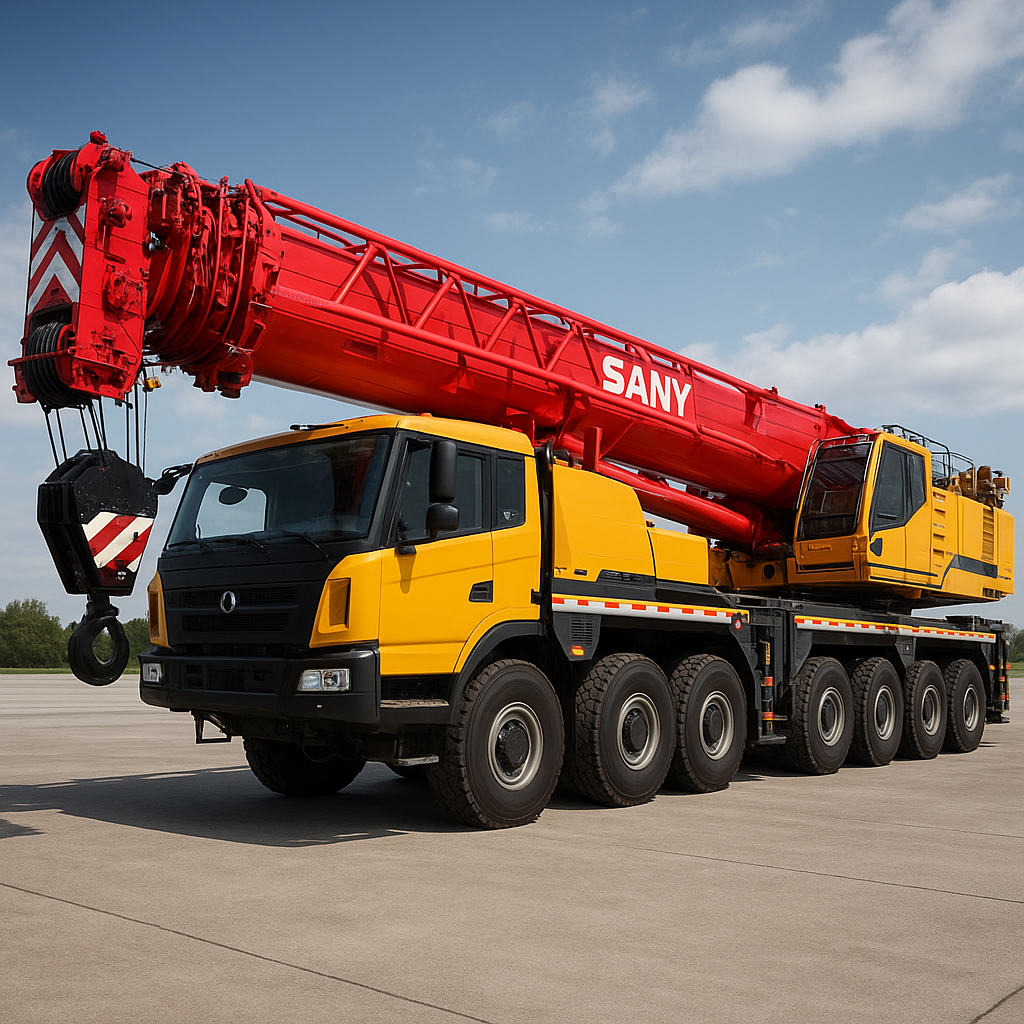
The SANY SAC3500 is a modern all-terrain crane designed to combine the on-road mobility of a truck crane with the off-road capability and lifting performance needed on challenging job sites. This article explores the SAC3500’s design philosophy, typical applications, technical characteristics, safety and control systems, logistical considerations, and how it compares to other cranes in the 350-ton class. The goal is to give a practical, in-depth view of where and why the SAC3500 is used and what operators, fleet managers, and project planners should know when selecting or operating this machine.
Overview and key features
The SANY SAC3500 belongs to the family of large-capacity all-terrain cranes that are intended for projects requiring heavy lifts combined with mobility across mixed surfaces. The model designation suggests the crane is positioned in the ~350-ton class, which places it in the medium-large segment of mobile all-terrain cranes used worldwide for industrial, energy, and infrastructure work.
- Modular lifting systems: The SAC3500 typically uses a multi-section telescopic boom with optional lattice-type jibs to extend reach and tip height while keeping transport dimensions manageable.
- All-wheel drive and steering: As an all-terrain machine, it features multi-axle drive with selectable steering modes for tight-radius maneuvers on roads and improved traction on uneven surfaces.
- Outriggers and stabilization: Heavy-duty hydraulically-deployed outriggers create a wide footprint to stabilize lifts, enabling safe operation at long radii and with heavy loads.
- Advanced hydraulics and controls: SANY integrates electronic controls, load moment indicators, and hydraulic systems focused on smooth, precise lifting and safety interlocks.
- Transportability: Despite its lifting power, the SAC3500 is engineered to meet road-legal dimensions in many markets when broken down into truckable modules, minimizing special-transport requirements in most situations.
Applications and industry use cases
The SAC3500 is intended for a wide range of heavy-lift and installation tasks. Its combination of mobility, lifting capacity, and reach makes it a common choice in sectors where both site access and high-capacity lifting are required. Typical applications include:
- Energy and renewables — installation and maintenance of wind-turbine nacelles, blades, and towers; placement of heavy components in solar thermal or hydroelectric facilities.
- Oil & gas and petrochemical — lifting of modules, skids, vessels, and piping during construction and turnaround projects where confined access and heavy components are common.
- Infrastructure and civil engineering — bridge girder erection, metro and rail infrastructure installation, and heavy precast placement in constrained urban sites.
- Industrial and mining — machinery installation, maintenance lifts in factories and plants, and heavy-equipment handling in mining facilities.
- Port and logistics — placement and servicing of heavy port equipment and cargo handling where a mobile crane that can move between quays and yards is valuable.
Technical specifications and performance characteristics
Exact specifications depend on regional configurations, optional packages, and market homologation. The following figures represent the typical characteristics and performance parameters of a 350-ton class all-terrain crane such as the SAC3500:
- Nominal lifting capacity: around 350 tonnes at close radii (model-class nominal rating).
- Telescopic boom: a multi-section telescopic boom commonly ranging from ~40 m up to ~60–70 m in some configurations; extensions and lattice jib modules can increase tip height and reach.
- Maximum tip height: with full boom and jib combinations, tip heights in the range of ~70–85 m are typical for this class.
- Jib options: folding lattice jibs or offsettable lattice-type fly jibs typically add 10–30 m of reach and allow more flexible lifting angles.
- Counterweight: modular counterweight systems allow operators to adapt the ballast to job requirements; total counterweight packages commonly reach several tens of tonnes.
- Axles and mobility: multi-axle carrier (often 5–7 axles on similar class cranes) with all-wheel steering and selectable drive modes for on- and off-road use.
- Steering modes: several steering modes such as front-wheel, crab, and coordinated multi-axle steering for tight maneuvering.
- Operator cab and visibility: ergonomically designed cab with climate control, adjustable seating, and large glazed areas for visibility; many units also include camera systems.
Note on exact figures: Manufacturers sometimes offer multiple sub-models or optional packages that change rated capacities, boom lengths, and axle counts. Always consult SANY’s official technical datasheets or a local dealer for precise, legally certified performance charts for the configuration to be used on a specific project.
Safety, control systems and operator features
Modern all-terrain cranes place heavy emphasis on safety and intelligent control systems. The SAC3500 is typically equipped with the following features that improve operational safety and reduce the risk of incidents:
- Load Moment Indicator (LMI) and rated capacity limits that actively prevent unsafe combinations of radius and load.
- Anti-two-block systems to avoid the load block contacting the boom tip, which could damage the hoist system or cause overloading.
- Electronic stability aids and interlocks that restrict boom movements if the outriggers are improperly deployed.
- Precision control systems with smooth hydraulic modulation enabling fine positioning for delicate installs, such as turbine components or pre-cast elements.
- Remote-control capability on some configurations, allowing the operator to control boom functions from a vantage point with better line-of-sight during complex lifts.
- Diagnostic systems for predictive maintenance and on-board fault reporting.
Transport, setup and site logistics
Operational efficiency is heavily influenced by how easily a crane can be mobilized and set up. The SAC3500’s design balances transport dimensions with lifting performance:
- Road transport: The carrier and superstructure are designed so that when disassembled into common transport modules (carrier, counterweight packs, boom sections, and jib elements), the crane can be moved on standard heavy-haul trailers without extreme escort or permit requirements in many jurisdictions.
- Setup time: Hydraulic outriggers and modular counterweights reduce assembly time on site. Typical setup times vary by site conditions and crew experience but modern all-terrain cranes are optimized to reduce non-productive hours.
- Site footprint: Spread of outriggers and counterweight placement determine the usable working area; job planners should prepare level platforms or adequate cribbing for safe deployment.
- Accessory ecosystem: A range of hook blocks, spreader beams, and lifting attachments expand the SAC3500’s versatility, enabling it to undertake specialized lifts without resorting to hire additional rigging equipment.
Maintenance, lifecycle and operating costs
Fleet managers should consider total cost of ownership beyond purchase price. Key factors affecting lifecycle costs include:
- Preventive maintenance: Regular hydraulic-system checks, boom wear inspection, wire-rope replacement intervals, and scheduled engine and transmission servicing are critical for longevity.
- Parts availability: SANY’s global dealer network usually ensures access to parts and service, but planners should verify local stock and support contracts for remote projects.
- Fuel and operating hours: Fuel consumption depends on engine size, lifting duty cycle, and travel; heavy lifting operations and long idling periods increase hourly operating costs compared to routine transport tasks.
- Resale and depreciation: Well-maintained cranes from major manufacturers tend to hold value; proper documentation of service, inspections, and timely repairs improves resale prospects.
Market position, competitors and economic considerations
SANY has positioned itself as a competitive global manufacturer of construction equipment; the SAC3500 competes with established models from brands such as Liebherr, Grove (Manitowoc), Terex, and XCMG. Key commercial drivers for choosing the SAC3500 include:
- Cost-performance balance: SANY models often offer competitive pricing relative to equivalent Western-brand machines while providing similar capability and modern features.
- Service network: The value proposition improves when matched with strong local dealer support and training services, which SANY has been expanding globally.
- Financing and fleet utilization: Rental companies evaluate acquisition costs against utilization rates; an all-terrain crane that can handle a wide spectrum of jobs increases fleet flexibility and return on investment.
Real-world examples and typical lift scenarios
While specific project data varies, cranes in the 350-ton all-terrain class are commonly deployed in the following illustrative scenarios:
- Wind farm installation: Lifting a 60–80 tonne nacelle onto a 90 m tower requires both reach and stable load handling; the SAC3500’s telescopic boom and jib options allow lifts where a crawler would be impractical due to mobility constraints.
- Bridge girder placement: Handling precast concrete girders of 50–150 tonnes with limited site access and tight road approaches is a textbook application for a 350t all-terrain crane.
- Modular plant installation: Lifting and placing process modules and skids in refineries or chemical plants where precise positioning and predictable setup time reduce costly shutdown windows.
Choosing the right crane: selection checklist
When evaluating the SAC3500 for a project, use the following practical checklist:
- Confirm the rated capacity at the required radius, including any dynamic factors (wind, load on the hook, pick-and-carry needs).
- Assess access roads, bridge load limits, and permitted axle loads for transport to site.
- Verify setup area and ground-bearing capacity for outriggers; plan for cribbing if necessary.
- Decide on necessary jib and counterweight configurations in advance to ensure availability on-site.
- Arrange operator certification, lift planning, and safety oversight consistent with local regulations and company procedures.
Environmental and regulatory considerations
Crane operations increasingly must comply with environmental and noise regulations. The SAC3500’s modern engines and hydraulics are designed to meet contemporary emissions standards in many markets, but buyers should:
- Confirm local emissions (Tier/Stage) compliance for the engine and exhaust after-treatment.
- Plan for noise-sensitive areas — operations during night hours may require special permits or noise abatement measures.
- Ensure proper containment for hydraulic fluids and fuel to avoid environmental contamination in sensitive sites.
Concluding recommendations
The SANY SAC3500 represents a practical choice for contractors, rental fleets, and infrastructure developers who need a powerful yet mobile lifting machine. Its strengths lie in combining solid lifting capability with on-road mobility, modularity for transport, and modern safety and control systems. When considering the SAC3500, prioritize accurate lift planning, confirm the exact technical datasheet for the intended configuration, and coordinate logistics and maintenance support in advance to maximize uptime and return on investment.
SANY and the SAC-series cranes have become notable in global equipment fleets because they offer a compelling combination of performance, cost-effectiveness, and expanding service coverage. For projects that require balancing reach, capacity, and mobility—such as wind energy installation, bridge construction, and heavy industrial lifting—the SAC3500 is a machine worth evaluating closely with certified lift planners and local dealers.
Additional notes
If you need precise, legally certified load charts, axle-load data, or transport dimensions for permit planning, consult the official SANY technical documentation or the local SANY dealer. Those documents will provide the exact numbers for the specific configuration you plan to use, including charted lifting capacities at each radius, required counterweight options, and approved set-up footprints.


)
)