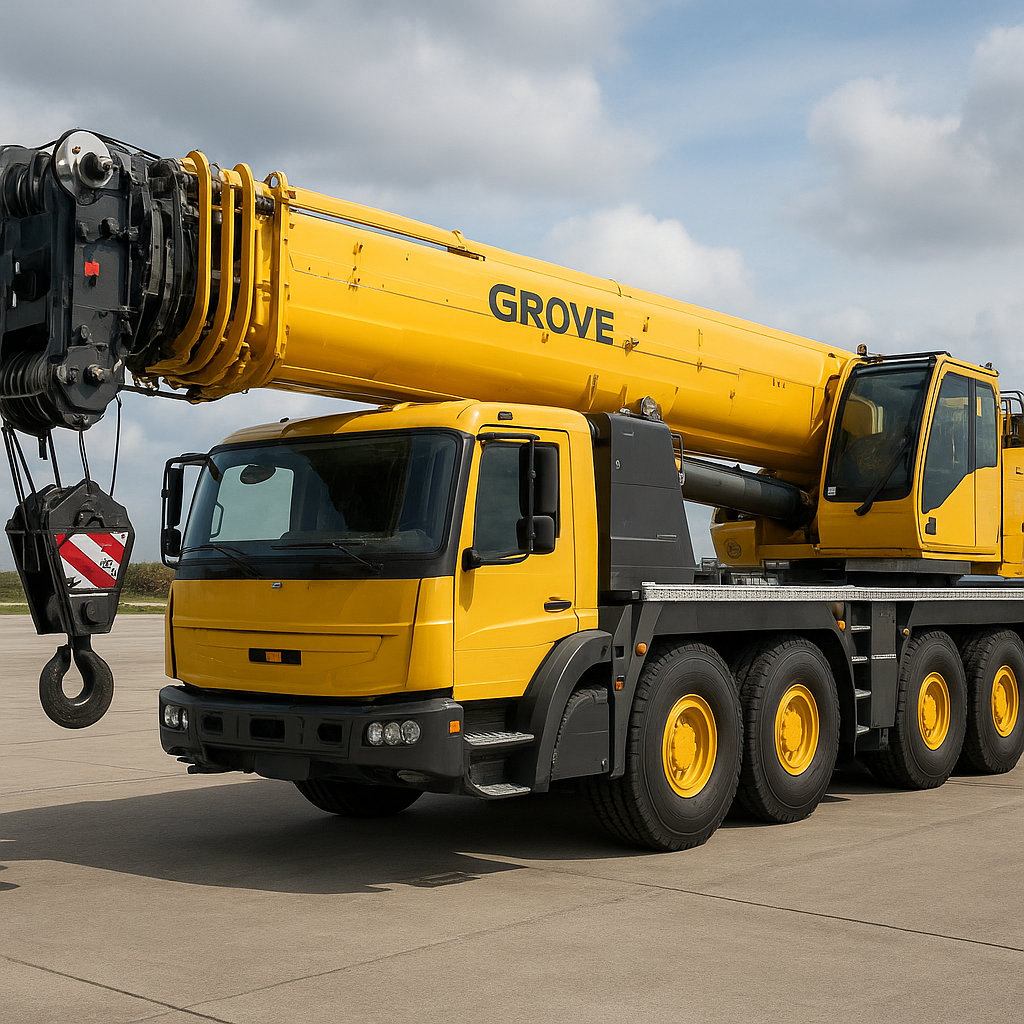
The Grove GMK5250XL-1 is a heavy-duty, five-axle all-terrain crane designed to combine highway mobility with robust lifting capability for complex industrial and civil projects. Built under the Grove brand (part of the Manitowoc group), this model blends a high-capacity telescopic boom, versatile attachment options, and modern control systems to serve a wide range of sectors. In the following sections you will find a detailed overview of its design, typical technical data and performance figures, common applications, operational features, maintenance considerations, and safety and attachments that make this crane a preferred tool for demanding lifting tasks.
Overview and design philosophy
The GMK5250XL-1 follows Grove’s design philosophy of delivering a balance between transportability and lifting power. Its carrier chassis is engineered for long-distance travel on public roads while providing the stiffness and axle configuration necessary to support a heavy superstructure. The crane’s superstructure houses a multi-section telescopic boom with optional lattice or swing-away jibs for extended reach, and a powerful hoisting system capable of handling large loads with precision.
Key elements of the design include a hydraulic outrigging system for fast setup and optimal load-bearing distribution, a compact counterweight system for on-site adaptability, and an operator cab that integrates ergonomics with an advanced control interface. The GMK5250XL-1 is intended for situations where operators must move large lifting capacity machines between jobs without disassembling major components, and where site conditions require both off-road mobility and on-road speed.
Typical technical specifications and performance (indicative)
Exact values depend on configuration, regional variants, and optional equipment. The figures below are representative of the GMK5250XL-1 class and commonly published ranges for this model.
- Rated lifting capacity: around 250 metric tons (depending on radius and configuration).
- Boom length: standard telescopic main boom typically between 10–60 m, with some configurations and optional inserts or jibs extending tip height significantly (when a jib is fitted, tip heights can exceed 100 m in certain setups).
- Axle configuration: five-axle carrier, designed for road-legal transport in many markets; steering on multiple axles for tight turns.
- Engine power: in the range of 300–400 kW (varies by engine selection and emissions package); the engine provides drive for the carrier and power take-off to hydraulic systems.
- Gross vehicle weight (GVW): commonly in the 60–75 tonne range depending on counterweights and options.
- Maximum road speed: typical highway speed capability up to 70–80 km/h (local regulations and configuration apply).
- Hydraulic hoist and swing: high-capacity winches and robust slewing gear for continuous operation at rated loads; hydraulic systems are designed for precise load handling.
- Outrigger spread: variable to suit working envelopes; outriggers offer full 360-degree stability when fully deployed.
- Onboard electronics: integrated load moment indicator (LMI), stability control, and operator display for real-time load charts and safe working parameters.
Manufacturers often publish full load charts that indicate permissible lifting capacities at specific radii, boom extensions and counterweight setups. Operators must consult the exact load chart for their crane’s serial number and configuration before lifts.
Primary applications and industries
The GMK5250XL-1 is a multi-purpose machine used across many segments. Its mix of mobility and lifting capacity suits projects where shipments of large, heavy components must be placed precisely and where site access can vary.
- Construction: Erection of multi-storey steel structures, precast concrete placement, and installation of heavy mechanical plant items where a high-capacity lift at moderate radii is required.
- Energy sector: Installation of medium-to-large wind turbine components (nacelles, hubs, tower sections), assembly of substation transformers, and work in conventional power plants where reliable, repeatable heavy lifts are needed.
- Oil & gas and petrochemical: Installation and maintenance of process vessels, piping modules, and heat exchangers—especially where the crane must travel between multiple plants or modules across a project site.
- Industrial maintenance and heavy transport: Lift-and-place operations for machinery, modular factories, shipyard mobilization, and handling of pre-assembled modules for rapid construction.
- Bridge and civil engineering: Placement of bridge girders, pre-cast segments, and complex lifts where reach and controlled positioning are critical.
Because of its road mobility, the GMK5250XL-1 is often chosen by rental fleets and large contractors who need a single crane that can serve multiple job types without extensive disassembly and transport logistics.
Operational features and control systems
The modern GMK5250XL-1 integrates advanced electronic and hydraulic control technologies to improve safety and productivity. Typical features include an electronic load moment indicator (LMI) that continuously monitors the crane’s operating envelope, alerting the operator to unsafe conditions and restricting certain movements when limits are approached. The operator interface commonly includes color displays showing load charts, boom angle, radius, and load percentage in real time.
Comfort and ergonomics in the operator’s cab enhance accuracy during complex lifts. Controls are usually proportional hydraulic joysticks with adjustable response settings, offering fine control for hoist, telescope, swing and steering. For mobile operations, multi-axle steering systems are implemented to reduce turn radii and tire scrub, permitting better access on urban and restricted sites.
Remote monitoring and telematics solutions are increasingly available for this class of cranes. Fleet managers can monitor engine hours, fuel consumption, geolocation, and fault codes remotely, aiding preventive maintenance and utilization analysis. Additionally, some units may offer optional anti-two-block systems, wind speed monitoring, and automatic outrigger leveling to minimize setup time and increase safety margins.
Transportability, setup and site logistics
A major advantage of the GMK5250XL-1 is its combination of highway mobility and on-site capability. The machine’s five-axle carrier generally allows it to travel on public roads without specialized heavy-haul permits in many regions, though oversize/overweight regulations must always be checked. The crane’s compact boom stowage and counterweight arrangements are designed to meet axle load limits for road transport.
On arrival at site, hydraulic outriggers are deployed to establish a secure base. The speed of setup is a selling point: automated or semi-automated outriggers and leveling reduce the manpower and time required to prepare for lifting. Counterweight systems on modern units are modular, enabling crews to add or remove weight modules to match the required lifting capacity versus transport restrictions.
For extremely restricted sites or where the crane cannot be brought to the lift location, the GMK5250XL-1 can be combined with supplemental equipment such as luffer/jib attachments, high-capacity rigging, and auxiliary gantries to maximize reach or to perform tandem lifts with crawler cranes and other all-terrain units.
Maintenance, lifecycle costs and resale
Lifecycle cost for a large all-terrain crane depends on utilization, maintenance discipline, and operating conditions. Predictable maintenance schedules—regular hydraulic system checks, engine servicing, periodic non-destructive testing on critical structural components, and electrical diagnostics—are essential to preserve availability and resale value.
Major cost items include fuel consumption during travel and operation, tires and axle components, hydraulic hoses and seals, and periodic replacement of wear items in winch and slewing gear. Telematics and condition-monitoring tools can reduce unplanned downtime by highlighting issues before failures occur.
Resale value for a well-maintained GMK5250XL-1 can remain robust because this capacity class is in sustained demand by rental fleets and contractors. Factors that influence resale include total operating hours, proof of regular service, the configuration of boom and jib options, and regional demand for 250-ton class cranes.
Safety, training and regulatory considerations
Operating a high-capacity all-terrain crane requires trained personnel, certified riggers, and adherence to local lifting regulations and codes. The GMK5250XL-1’s built-in safety systems—such as the LMI, outrigger position sensors, and optional anti-two-block devices—are aids, not substitutes, for proper planning.
Lift planning should account for ground-bearing pressure, outrigger loadings, environmental factors (wind, lightning, ground frost), and proximity to power lines or other hazards. For complex lifts, use of independent lift directors, certified rigging gear, and redundant safety checks is standard best practice. Regular operator training on the specific crane model is critical because control layouts, response characteristics, and load charts differ between manufacturers and even between models from the same brand.
Attachments, customizations and complementary equipment
The versatility of the GMK5250XL-1 is amplified by a wide range of optional attachments and customizations:
- Swing-away jibs and lattice jib inserts to increase reach and tip height for tall structures.
- Auxiliary winches and multiple reeving options for varied hoisting speeds and capacities.
- Different counterweight kits to balance transport restrictions and on-site capacity needs.
- Specialized spreader beams, gantry systems, and multi-point rigging for unusual loads.
- Telematics packages for remote diagnostics and fleet management, and operator-assistance systems for automated setup and leveling.
Combining the crane with specialized lifting tools (e.g., vacuum lifters, rotating spreaders) expands the types of loads it can handle safely and productively.
Comparisons and position in the market
In its capacity class, the GMK5250XL-1 competes with other manufacturer offerings that target the 200–300 tonne all-terrain segment. The choice between models is often driven by:
- Transportability and legal axle loads in the operating region.
- Available boom length and jib options for site-specific reach requirements.
- Manufacturer support, dealer network and parts availability.
- Fuel efficiency and operating costs tied to engine and hydraulic system designs.
Rental companies frequently favor models like the GMK5250XL-1 for their balance of road travel efficiency and lifting capability, which reduces the need for disassembly and multi-truck transport for many projects.
Concluding remarks
The Grove GMK5250XL-1 is a versatile and powerful solution for contractors and rental fleets that need a mobile crane capable of handling heavy lifts across varied job sites. With a combination of a robust telescopic boom, modular counterweight systems, advanced control and safety electronics, and road-going mobility, the GMK5250XL-1 serves industries ranging from construction and infrastructure to energy and industrial maintenance. While exact specifications vary by configuration and market, the model class is characterized by a nominal lifting capacity in the neighborhood of 250 tonnes, flexible reach through boom and jib options, and an emphasis on operator safety and uptime through integrated diagnostics and ergonomic design.


)
)