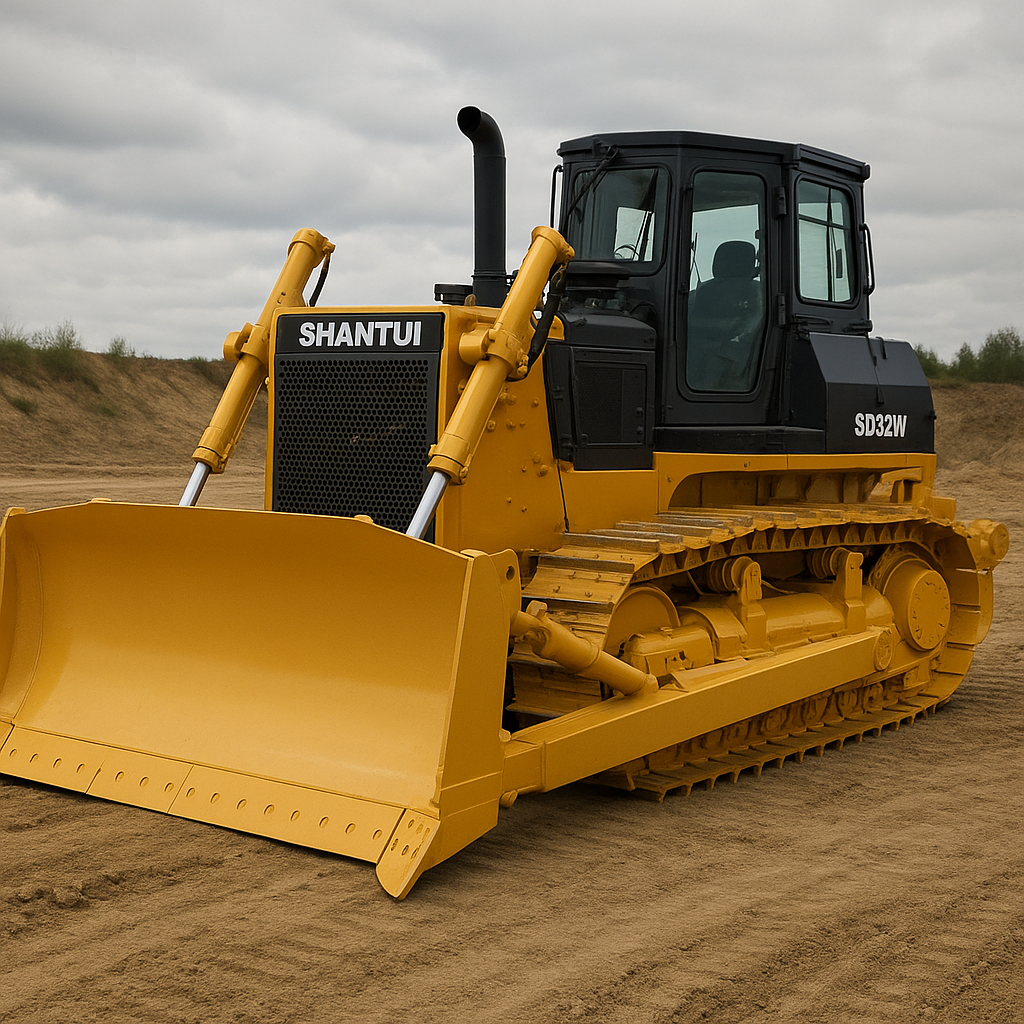
The Shantui SD32W is a heavy-duty wheeled dozer designed to bridge the gap between classic crawler bulldozers and mobile wheeled equipment. Intended for tasks that require speed and maneuverability while still providing significant pushing power, the SD32W has earned attention in industries such as mining, port operations, road building and large-scale earthmoving. This article examines the machine’s design, typical specifications, common applications, operational strengths and practical considerations for owners and operators.
Overview and design philosophy
Shantui, one of China’s leading construction equipment manufacturers, expanded its product range beyond crawler dozers to include wheeled models like the SD32W. The core idea behind a wheeled dozer is to offer a machine that combines the high tractive effort and blade control of a conventional dozer with the mobility and travel speed of a wheeled loader or articulated hauler. The SD32W is engineered to work effectively on compacted surfaces, stockyards, and graded roads where tracked machines would cause excessive wear or damage to paved surfaces.
The design emphasizes a robust powertrain, heavy-duty frame, and a variety of blade and ripper configurations to handle different materials and site conditions. Key design priorities are ease of service, operator comfort, and modularity so the machine can be adapted to a wide range of tasks with relatively minor changes.
Technical characteristics and typical specifications
Exact specifications can vary with market, model year and optional equipment, but typical figures for the SD32W family usually fall in the following ranges. These figures are presented as representative values rather than absolute guarantees — final numbers depend on customer configuration.
- Engine: Usually a turbocharged diesel unit from a major supplier, providing robust torque and good low-end performance for pushing loads. Nominal power commonly ranges from 235 to 260 kW (roughly 315–350 hp).
- Operating weight: Depending on blade, ripper and counterweight, the machine’s operating weight typically sits between 28,000 and 36,000 kg (28–36 tonnes).
- Blade capacity: Standard blades for the SD32W are available in capacities from about 4.5 to 7.0 m³, with options for straight, universal and semi-universal styles to suit grading or bulk pushing.
- Travel speed: As a wheeled machine, the SD32W is capable of higher road speeds than a crawler dozer. Typical travel speeds are in the range of 20–30 km/h, depending on transmission selection and axle gearing.
- Fuel consumption: Under working loads, specific fuel consumption varies widely by duty cycle; typical average consumption figures are in the range of 25–40 L/h during heavy pushing, with lower rates during travel or light grading.
- Transmission and axles: Robust powershift or torque-converter transmissions paired with heavy-duty planetary axles provide the necessary torque multiplication and durability. Differential locks and multiple drive modes improve traction on mixed surfaces.
- Hydraulics: High-flow hydraulic circuits operate blade lift, tilt and articulation/ripper functions. Load-sensing hydraulic systems improve fuel efficiency and blade response.
The SD32W’s undercarriage substitutes large, heavy axles and tires for tracks. Tire choices are crucial; typical fitment uses high-capacity articulated tires rated for heavy loads, sometimes with beadlocks or dual-tire arrangements depending on application.
Common applications and industry use cases
The wheeled configuration makes the SD32W particularly attractive where surface preservation and mobility are priorities. Typical applications include:
- Stockyard and bulk material handling — moving heaps of coal, minerals, aggregates and other bulk goods where rapid repositioning between piles increases productivity.
- Road construction and maintenance — grading and shaping base layers on compacted or paved surfaces where tracks would cause damage.
- Ports and terminals — reclaim yards in ports benefit from wheeled dozers because they can travel longer distances on paved surfaces and reduce road maintenance.
- Reclamation and landfill operations — spreading and compacting fill where a combination of mobility and blade control are needed.
- Soft-surface grading — while not as effective as specially equipped tracked dozers on loose soft soils, the SD32W can be fitted with flotation tires or used on compacted surfaces to perform grading tasks.
In mining operations, the SD32W is often used in support roles: clearing roads, leveling haul-road shoulders, and moving fines where a high-speed, heavy pusher is more efficient than a crawler for transit between work areas.
Operator environment and controls
Modern SD32W cabs prioritize visibility, ergonomics and climate control to reduce operator fatigue and improve productivity. Standard features typically include a ROPS/FOPS-certified cab, adjustable seats with suspension, noise insulation, and straightforward control layouts.
Operator comfort is often cited as a reason for higher productivity: clear sightlines to the blade and work area reduce rework while comfortable seating and simple controls reduce the risk of errors during long shifts. Instruments often include digital readouts for engine parameters, fuel level and system diagnostics to aid preventive maintenance.
Maintenance, support and lifecycle costs
Maintenance considerations for a wheeled dozer like the SD32W differ from crawler machines in several ways:
- Tire management becomes a major ongoing expense — selection of appropriate tire type, management of pressures, and rotation schedules can dramatically affect operating costs.
- Hydraulic and transmission service intervals are similar to other heavy-duty dozers, but access panels and modular component layouts can shorten downtime for routine checks and repairs.
- Consumables such as hydraulic oil, engine oil and filters, as well as blade and cutting-edge wear parts, represent predictable maintenance costs; effective preventive maintenance programs can reduce unscheduled downtime and extend machine life.
Typical lifecycle considerations:
- Fuel is the single largest variable operating cost. Efficient duty-cycle management and modern engine controls can keep fuel consumption competitive with similar-capacity tracked machines.
- Depreciation and resale: wheeled dozers often retain value in markets that value mobility and paved-surface operation. Resale prices depend on hours, maintenance history and regional demand.
- Parts availability: Shantui has a broad distribution network in many regions; availability of genuine parts and local service partnerships are important for minimizing repair lead times.
Performance in the field: strengths and limitations
Strengths of the SD32W include:
- High mobility — faster travel speeds and reduced wear on paved surfaces relative to tracked machines.
- Versatility — compatible with multiple blade types and optional rippers, making it useful for both grading and pushing tasks.
- Lower ground disturbance on hard surfaces — wheels reduce pavement damage and decrease cleanup costs in urban or port environments.
- Operator comfort and cab features that support longer shifts and better productivity.
Limitations to consider:
- On very soft, muddy or highly uneven terrain, a wheeled dozer cannot match the flotation and traction of a tracked machine.
- Tire wear can be rapid in abrasive environments; tire replacement and management must be budgeted carefully.
- Tractive effort, while high for a wheeled machine, may be lower than a comparable-weight crawler dozer for heavy ripping and deep earthmoving tasks.
Attachments and optional equipment
To maximize utilization across tasks, the SD32W can be equipped with a variety of attachments and options:
- Blade types: straight, semi-universal (S/U), universal (U), and angled blades for pushing, spreading and finishing.
- Rippers: single-shank or multi-shank rear rippers for loosening compacted material.
- Tire options: radial or bias-ply heavy-duty tires, foam-filled tires for puncture resistance, and dual-wheel configurations for greater flotation.
- Hydraulic quick-coupler systems and auxiliary circuits for specialized tools.
- Weight options and counterweights to optimize traction or reduce ground pressure depending on task.
Operational tips and best practices
For operators and fleet managers, the following practices help realize the SD32W’s potential:
- Match tire selection to the majority of your working surface. Investing in the right tire specification reduces replacement frequency and downtime.
- Use proper blade selection: universal blades for bulk pushing, semi-universal for combined pushing and finishing, straight blades for fine grading.
- Implement a preventive maintenance schedule focused on transmission and hydraulic system checks, since these systems see high loads in wheeled pushers.
- Train operators on techniques unique to wheeled dozers, such as momentum control to avoid wheel spin and effective use of differential locks where provided.
Market position and deployment considerations
In markets where mobility, road travel and minimal pavement damage are priorities (ports, municipal works, landfill and stockyard operations), wheeled dozers like the SD32W offer tangible advantages. Shantui’s scale as a manufacturer means parts and dealer networks are often available in many global regions, improving serviceability compared with smaller OEMs.
Economic factors influencing purchase decisions include initial capital cost, expected fuel consumption, tire life, and resale values. In many cases the SD32W’s higher travel speeds and lower road impact can translate to operational savings that offset a premium over a competitively specified tracked machine.
Comparisons with other machines
Compared with a similarly powered tracked dozer, the SD32W trades some traction and flotation for superior travel speed and lower pavement wear. Compared with a wheel loader, the SD32W offers greater blade/pushing capacity and blade geometry optimized for spreading and finishing, though loaders may still outperform in material picking and loading into trucks.
When evaluating the SD32W alongside competitors, consider:
- Engine power and torque curves — look for machines with strong low-end torque for pushing tasks.
- Transmission durability and serviceability.
- After-sales support and parts availability in the area of operation.
Environmental and safety considerations
Modern diesel engines comply with emissions standards appropriate to the market where they’re sold (Stage/ Tier levels). Emissions packages, including aftertreatment systems like DOC and SCR, will affect fuel consumption and maintenance procedures.
Safety features commonly found on the SD32W include ROPS/FOPS certification, rearview cameras or monitoring systems, audible alarms for travel, and strong access points for safe maintenance. Proper site risk assessment — ensuring the working surface is suitable for a wheeled machine — reduces the likelihood of incidents.
Summary and practical recommendation
The Shantui SD32W occupies a niche where speed and mobility are essential but pushing power and blade control cannot be compromised. For operations such as stockyards, ports, road maintenance and reclamation where machines must travel between work sites on hard surfaces, the SD32W is a capable and cost-effective choice. Key advantages include mobility, versatility, and operator-focused features that increase productivity. Potential owners should weigh site conditions carefully — particularly surface hardness and slope — and plan tire and drivetrain maintenance to control lifecycle costs.
When considering acquisition, request configuration specifics, verify local support for parts and service, and evaluate total cost of ownership across fuel, tires, maintenance and resale. With the right match between machine and application, the SD32W can deliver strong performance and an attractive return on investment.


)
)