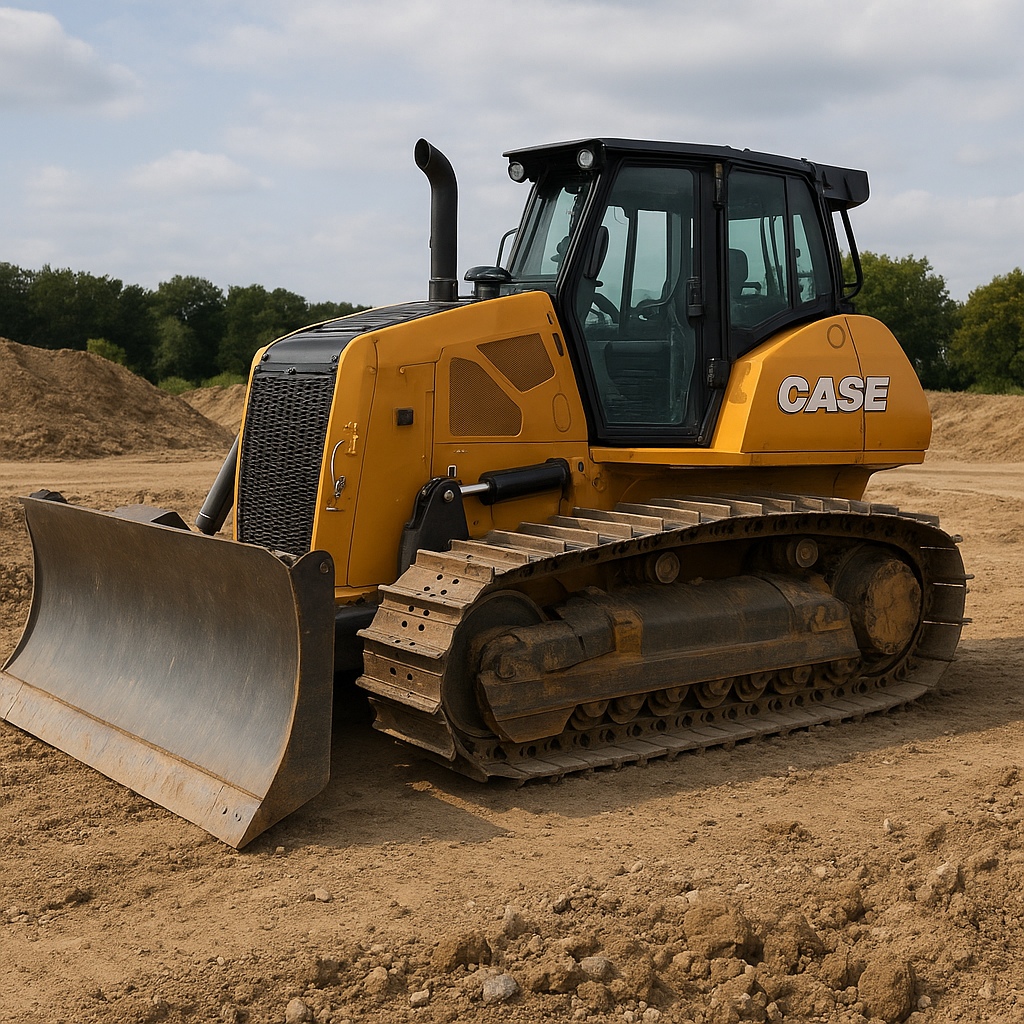
The Case 1650M is a versatile medium-sized construction machine designed to perform heavy earthmoving tasks with reliability and efficiency. Built for a variety of site conditions, this model combines proven mechanical systems with operator-focused ergonomics, offering a balance between power, maneuverability and lifecycle cost management. Below you will find a comprehensive overview of the machine’s design, typical applications, operational considerations and some useful performance indicators that help explain why this dozer remains a relevant choice for contractors, municipalities and large-landscape projects.
Design and technical characteristics
The Case 1650M is a modern interpretation of the classic crawler dozer platform, focused on delivering robust pushing force and consistent traction on uneven terrain. Key elements of its design include a rigid undercarriage, hydraulically controlled blade systems and a purpose-built powertrain tuned for low-end torque. These components allow the machine to handle a wide range of materials, from cohesive clays to compacted aggregates.
Powertrain and engine
- The machine is typically equipped with a turbocharged diesel engine delivering a balance of fuel efficiency and torque for heavy-duty work cycles. The engine is tuned to provide strong low-RPM performance, which is essential for pushing tasks and grade control.
- Transmission options generally include powershift or hydrostatic systems, providing smooth speed changes and reliable power transfer to the sprockets.
- Depending on emission regulations and regional options, the power unit can be fitted with aftertreatment systems to meet current standards while minimizing downtime.
Undercarriage and traction
The undercarriage is a critical element for any bulldozer. The Case 1650M uses a heavy-duty track frame with reinforced rollers and adjustable track tension to handle abrasive environments. Track width and shoe configuration are often customizable to prioritize flotation or traction depending on the job.
- Crawler-style undercarriage for high stability.
- Multiple track shoe widths available for different soil conditions.
- Robust final drives and idlers designed for long service intervals.
Blade and attachments
The Case 1650M supports a variety of blades and optional attachments to match job requirements. Standard blade choices typically include straight blades (S-blade) for fine grading, universal blades (U-blade) for maximum carrying capacity and combination blades for a middle ground. Additional attachments such as rippers, winches and rear push arms expand the machine’s versatility.
- Blade configurations tailored for dozing, spreading and finish grading.
- Hydraulic controls for precise blade positioning and float.
- Optional front and rear attachments increase productivity on specialty tasks.
Where the Case 1650M is used
The most common applications for the Case 1650M span civil construction, site preparation, aggregate and mining support, forestry road work and agricultural land leveling. Its medium size makes it particularly suited for projects where a balance of maneuverability and pushing capacity is required.
Construction and civil engineering
On road projects and building sites, the Case 1650M excels at clearing, bulk earthmoving, spreading fill and finish grading. The machine’s blade control and stability make it effective for creating road subgrades, embankments and prepared surfaces prior to paving.
Mining and aggregate operations
In smaller quarry or aggregate operations, the dozer is frequently used for stockpile shaping, reclaiming material and supporting loading areas. Its traction and robust undercarriage handle repeated cycles over uneven, rocky ground.
Forestry and land management
When fitted with protective guarding and wider tracks, the 1650M can navigate soft forest soils to build skid roads, construct firebreaks and perform reclamation tasks after logging. Its ability to pair with rippers helps break up compacted soils and root mats.
Municipal and utility works
Municipalities use this class of dozer for tasks such as levee maintenance, ditch clearing and utility corridor preparation. The medium frame size is advantageous in urban or semi-urban settings where larger machines would be impractical.
Performance, efficiency and statistics
While precise specifications vary by market and configuration, typical performance characteristics for a machine in this class offer useful benchmarks for operators and fleet managers.
- Gross power: machines in the medium dozer class commonly feature engines delivering roughly 120–160 horsepower (90–120 kW), offering a compromise between fuel economy and push power.
- Operating weight: depending on blade and attachment choices, typical operating weights for similar models are often in the mid-tonnage range, providing stability without excessive ground pressure.
- Blade capacity: blade sizes are matched to machine mass and commonly range from smaller low-capacity blades for finish grading to larger universal blades for bulk moves.
Operational statistics reported by fleet users and independent tests (values will vary with material type and working conditions) generally indicate:
- Fuel consumption per hour that reflects efficient load-sensing hydraulic systems and automatic idle features, often resulting in lower liters per operating hour than older models.
- Availability metrics (uptime over total time) that improve with predictive maintenance and modular component design—many fleets report uptime improvement after adopting manufacturer-recommended service intervals and telematics monitoring.
- Resale value: medium dozers from established brands tend to retain a significant portion of their value when maintained properly, particularly those with documented service histories and low track wear.
Telematics and data
Modern versions of the Case 1650M may be equipped with telematics packages that provide fuel usage, engine hours, location and fault codes. These data streams enable fleet managers to optimize deployment, schedule maintenance proactively and analyze productivity by job or operator.
Operator experience, control and safety
Operator comfort and control are important components of the machine’s overall effectiveness. The Case 1650M places emphasis on visibility, ergonomics and straightforward control layouts so operators can work longer with less fatigue and greater precision.
Cab design and ergonomics
- Clear sightlines to the blade and surrounding area reduce the need for repeated repositioning.
- Intuitive joystick or lever controls for blade and implement functions improve fine control during grading operations.
- Climate-controlled cabs and vibration-reducing mounts enhance comfort and reduce operator fatigue during long shifts.
Safety systems
Standard safety features typically include ROPS/FOPS-certified cabs, redundant hydraulic locks and easy-to-access emergency shutoffs. Optional features can include rear cameras, proximity alerts and blade guards for specialized tasks.
Maintenance, lifecycle costs and best practices
Maintenance strategy significantly affects the total ownership cost of any heavy machine. The Case 1650M’s design supports straightforward servicing, with easy access to common service points and modular components that simplify replacements.
Routine service items
- Regular track adjustment and undercarriage inspections to avoid accelerated wear.
- Hydraulic oil and filter changes at manufacturer-recommended intervals to protect the hydraulics and ensure smooth blade operation.
- Engine oil, air filter and fuel filter maintenance to preserve fuel economy and longevity.
Predictive maintenance and parts
Using telematics and scheduled inspections, fleets can move from time-based to condition-based maintenance, reducing downtime and preventing catastrophic failures. Stocking wear parts like track shoes, rollers and cutting edges is a common practice to minimize repair lead times.
Cost of ownership considerations
Key factors that influence lifecycle costs include fuel consumption, undercarriage life, component replacement frequency and resale value. Purchasing extended support packages or certified rebuild programs can be financially prudent for machines with heavy utilization.
Practical tips for maximizing productivity
Getting the best results from a Case 1650M requires attention to both machine setup and operator technique. A few practical tips:
- Match track shoe width and blade type to ground conditions to balance flotation and traction.
- Train operators on gradual power application to reduce track slip and undercarriage strain.
- Plan work sequences to minimize repositioning and empty travel distance; group tasks to use the dozer’s pushing capacity efficiently.
- Use telematics data to identify periods of excessive idling, inefficient routes and opportunities to improve cycle times.
Environmental impact and sustainability
Modern construction machinery must balance performance with environmental responsibility. The Case 1650M conforms to contemporary emission regulations through engine design and optional aftertreatment technologies. Additionally, efficient hydraulic and engine controls reduce fuel burn and related emissions during typical site operations.
Noise and emissions
Advances in muffler design, engine tuning and isolation of noisy components reduce the machine’s acoustic footprint, which is important for urban and residential projects. Emission control systems help achieve compliance with regional standards and contribute to lower lifecycle environmental impact.
Recycling and end-of-life
Many major components of dozers are recyclable or reusable; tracked frames, blades and certain engine parts can be remanufactured. Choosing remanufactured parts and participating in manufacturer take-back programs can lower long-term environmental costs.
Comparisons and fleet integration
When selecting a medium dozer for a mixed fleet, consider how the Case 1650M compares on serviceability, parts availability and operator familiarity. Integration into a fleet benefits from consistent attachment interfaces, shared maintenance practices and centralized telematics for cross-machine performance comparison.
- Smaller than heavy-class dozers, the 1650M offers better site access and lower ground pressure while keeping substantial push capacity.
- Compared with compact dozers, it provides greater traction and larger blade volume for bulk earthmoving tasks.
- Fleet managers often prioritize commonality of parts and service networks when adding models to their lineup.
Conclusion
The Case 1650M stands as a practical middle-weight dozer that combines solid mechanical design with operator-friendly features and adaptable attachments. It is well-suited for civil construction, aggregate handling, forestry and municipal maintenance where a machine must deliver dependable pushing power while remaining maneuverable and cost-effective to operate. With proper maintenance strategies, telematics integration and operator training, the 1650M can offer strong productivity and favorable lifecycle economics for a wide range of projects.
)
)