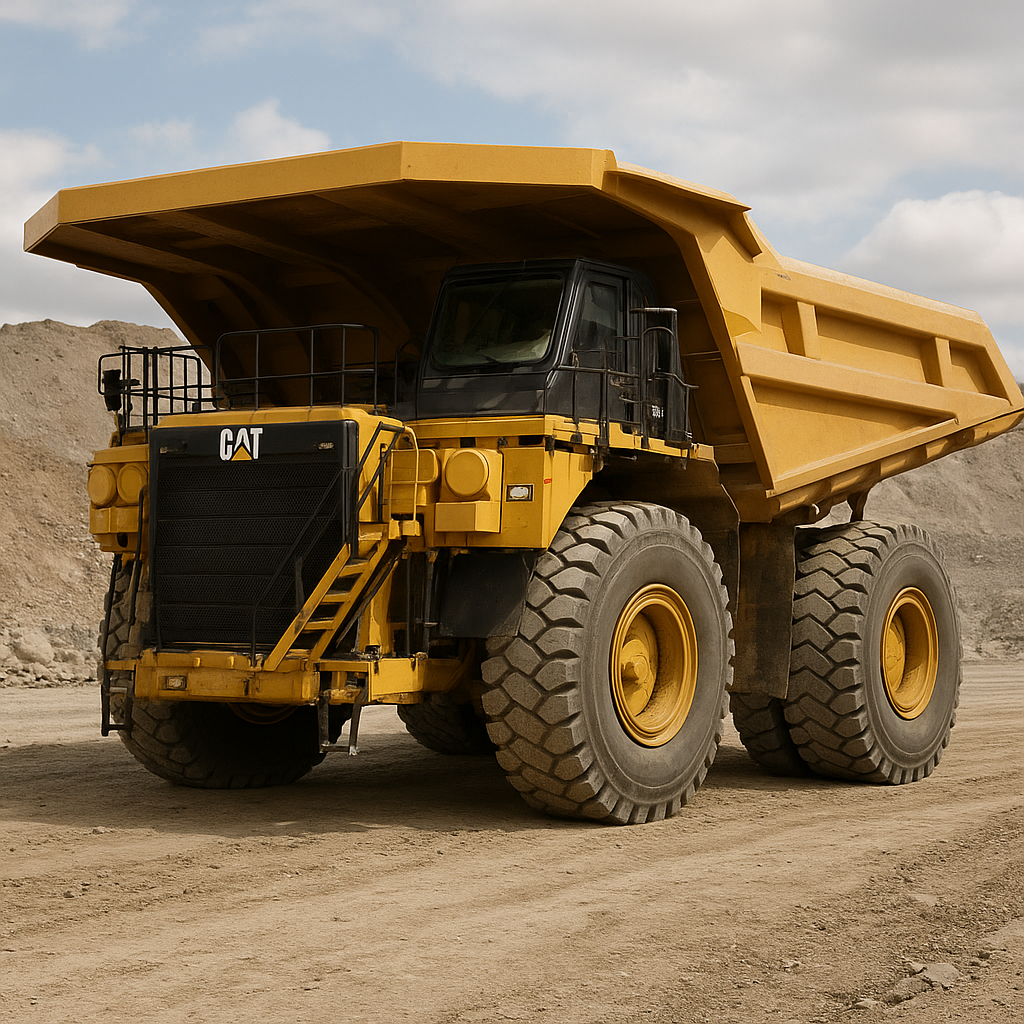
The Caterpillar 793F is a purpose-built, high-capacity haul truck designed primarily for large-scale surface mining operations. As part of Caterpillar’s long-standing series of ultra-class mine trucks, the 793F balances massive payload capability with robust engineering, advanced electronics and serviceability features tailored to harsh work environments. This article explores its design, typical applications, technical and operational characteristics, maintenance and lifecycle considerations, and the economic and environmental factors that influence its use in modern mining fleets.
Design and core specifications
The Caterpillar 793F is engineered to transport heavy loads across open-pit mines, quarry operations and large-scale earthmoving projects. Its design reflects decades of incremental improvements in durability, operator comfort and integrated controls. Key design priorities include frame strength, suspension and drivetrain robustness, modular service access, and safety systems that minimize downtime and reduce operational risk.
Typical technical specifications (approximate)
- Payload: around 240 short tons (≈218 metric tonnes) nominal capacity, depending on configuration and local regulations;
- Operating weight (empty): typically in the order of 120–130 metric tonnes (varies by configuration and optional equipment);
- Gross machine weight (loaded): often above 340 metric tonnes, depending on payload and equipment;
- Engine: high-displacement diesel powerplant in the 2,000–2,500 kW class (exact model and rating depend on production year and options);
- Transmission: heavy-duty automatic transmission designed for continuous mining duty cycles, often with advanced electronic control;
- Top travel speed (empty): in the range of 60–70 km/h (dependent on gearing and terrain);
- Braking systems: multiple redundant braking mechanisms including service, engine and dynamic braking, built for high thermal loads;
- Body style: high-capacity dump body with engineered plate thicknesses and wear packages suited to the material being hauled;
- Cab: reinforced, climate-controlled operator station with ergonomic controls, monitoring displays and air-ride seating for operator comfort.
Note: exact figures vary by market, serial number, and the particular package chosen by operators. Many 793F units have optional features such as payload monitoring systems, telematics, upgraded cooling packages for high-altitude or high-temperature operations, and various tire or rim options to suit local haul road conditions.
Applications and operational roles
The primary role of the 793F is bulk material movement in the mining sector. It excels where large volumes of ore, overburden, coal or aggregate must be moved efficiently between excavation faces, crushing and processing plants, and waste dumps. Because of its scale and operating cost profile, the 793F is typically deployed in high-production mines where cycle times and payload utilization can be optimized.
Common operational contexts
- Open-pit metal mines (copper, iron, gold): moving blasted ore to primary crushers and stockpiles;
- Coal mines and longwall operations: transporting run-of-mine coal to preparation plants;
- Large quarries and aggregate sites where long hauls and high-volume production justify ultra-class trucks;
- Overburden and waste removal in major earthworks projects, dams and large infrastructure excavations;
- Fleet mixed operations alongside hydraulic shovels, hydraulic excavators and surface miners where truck–shovel matching is critical for productivity.
Operational deployment requires careful matching of truck size to shovel capacity, haul road design and pit geometry. Using a 793F where payloads are underutilized or haul distances are very short will reduce overall fleet efficiency; conversely, in the right environment, the 793F can deliver significant economies of scale by reducing the number of trucks needed per shift.
Productivity, economics and fleet integration
Productivity with a machine like the 793F is a function not only of payload capacity but of cycle time, uptime, fuel efficiency and effective fleet management. Modern mines use fleet management systems to monitor each truck’s performance and to optimize dispatching, haul cycle planning and maintenance scheduling.
Factors affecting productivity
- Operator skill and training: smooth loading, precise positioning and controlled acceleration/braking reduce tire and structural wear and maximize payload per cycle;
- Shovel/truck matching: selecting loaders that can fill the body in a minimal number of passes improves cycle time and reduces loading-induced stress;
- Haul road geometry and maintenance: gradients, cornering radii and road surface condition influence average speeds and fuel consumption;
- Maintenance and reliability: predictive maintenance and component life extension programs increase availability and lower operating costs;
- Payload management: onboard weighing systems and dispatch software ensure trucks carry designed loads without overloading, extending component life while maximizing tonnage moved.
From an economic perspective, the 793F is capital-intensive but can reduce unit costs of production in large operations by lowering the number of trucks, drivers and supporting equipment needed to move the same tonnage. Operators balance the truck’s acquisition cost, fuel burn, tire consumption and maintenance against the revenue-per-ton of the product being mined.
Technology, operator aids and safety systems
Caterpillar integrates a range of electronic and mechanical systems into the 793F to improve safety and operational efficiency. These systems continually evolve with software updates and options that enable miners to extract more value while maintaining safe operations.
Key technological features
- Onboard payload monitoring and truck payload verification systems that help manage load targets and minimize overloading;
- Advanced telematics and fleet management software (for remote monitoring of fuel use, location, fault codes and utilization statistics);
- Operator-assist features: camera packages, proximity detection, hill-hold controls and automated retarding functions that reduce accident risk;
- Diagnostics: on-board and remote diagnostics that enable predictive maintenance scheduling and faster troubleshooting;
- Optional electrical systems: some configurations include AC drive or enhanced electrical systems that reduce mechanical drivetrain wear and improve retarding performance.
Safety systems are an integral part of the 793F design. Reinforced cabs, rollover protection, multi-zone braking, fire suppression options and visibility aids are standard or optional depending on customer requirements and local regulations. As mines progressively adopt autonomy, the platform of the 793F can be adapted for semi-autonomous or fully autonomous haulage in certain retrofit programs or factory-equipped variants.
Maintenance, lifecycle and common wear items
Maintaining an ultra-class truck like the 793F requires a structured approach: planned preventive maintenance, condition-based interventions and component life cycle management. A single major unscheduled failure can eliminate the productivity gains of the machine for days or weeks, so operators invest heavily in maintenance infrastructure and spare parts for these trucks.
Typical maintenance considerations
- Tires: one of the highest recurring costs; tire life depends on haul road conditions, loading technique and operating speed. Operators often monitor tire usage closely and rotate tires to extend life;
- Powertrain: engines, transmissions and final drives are subject to high torques and thermal loads. Regular fluid analysis and scheduled component inspections prevent catastrophic failures;
- Suspension and frame fatigue: the heavy cyclic loads on the frame and suspension demand routine inspections for cracks and fastener integrity;
- Brake systems and heat management: retarding systems and brake components must be checked for thermal wear, particularly on steep or long hauls;
- Body liners and wear plates: the tray and belly wear packages are consumables; monitoring material abrasiveness and liner wear rates helps plan rebuilds or replacements.
Lifecycle strategies commonly include mid-life rebuilds, component remanufacture and eventual resale or cannibalization for parts. The long-term value of a 793F in a fleet is strongly influenced by the operator’s ability to keep it in production with minimal unscheduled downtime.
Environmental impact and fuel considerations
Large haul trucks consume significant diesel fuel, and the 793F is no exception. Fuel use per ton moved is a critical KPI for mines, and operators seek to reduce it through route optimization, speed controls, and selecting the most efficient machine for each task. Additionally, new initiatives in electrification and hybrid systems are influencing future truck designs.
Strategies to reduce environmental footprint
- Improved mine planning to shorten average haul distances and reduce idling;
- Engine tuning and regular maintenance to keep combustion efficient and reduce emissions;
- Retrofitting or purchasing machines with selective catalytic reduction (SCR) and particulate controls where regulatory frameworks demand it;
- Exploring electrified shovels or trolley-assist systems to reduce fuel consumption on steep hauls;
- Integration into broader mine emissions reduction strategies, including renewable energy at fixed facilities to offset electrical demands.
While fully electric ultra-class haul trucks remain nascent, fleet electrification is progressing through hybridization, trolley systems and site-level power strategies. The 793F platform can be part of transitional strategies where fuel reduction is achieved without immediately replacing the entire fleet with battery-electric machines.
Market position and comparative context
Within Caterpillar’s product lineup and the broader market for ultra-class mining trucks, the 793F occupies a position suited to very large open-pit operations. It competes with models from other manufacturers that offer similar payload classes and differing technology packages. Choice among models often depends on existing fleet commonality, dealer support infrastructure, total cost of ownership analyses and special conditions such as altitude or extreme temperatures.
Points of comparison
- Payload and load-carrying efficiency relative to the competitor’s models;
- Dealer network and global parts availability which drives uptime through fast support;
- Resale and remanufacture value, especially in markets where used large-capacity trucks retain value;
- Technology stack: fleet monitoring, operator aids, and options for autonomy;
- Serviceability features such as modular components, walkways and service platforms that reduce maintenance time.
Large mining companies often standardize on a single manufacturer or a limited set of models to simplify maintenance and logistics. The Caterpillar brand’s extensive dealer presence and remanufacturing programs can be decisive advantages in procurement decisions.
Interesting facts, history and notable deployments
The 793 series has a lineage stretching back through several generations, each improving powertrain, operator environment and structural durability. The 793F iteration represents a mature platform that benefited from lessons learned in previous models and from customer feedback across diverse geographies.
- Many major copper and iron ore mines worldwide have deployed fleets of 793-series trucks, demonstrating the model’s suitability for high-tonnage, continuous operations;
- Caterpillar’s emphasis on remanufacturing parts and engines helps many operators extend the usable life of these trucks into multi-decade service lives with appropriate rebuild cycles;
- Some operators choose factory-installed or aftermarket telematics and payload systems to enable real-time optimization of haul cycles and to support shift-by-shift performance incentives;
- Although autonomous haulage systems (AHS) often target the largest trucks first, the 793F has been included in retrofit and purpose-built autonomous programs in some operations, highlighting its adaptability.
Procurement, resale and total cost of ownership
Buying a 793F is a strategic decision with long-term implications. The initial capital cost is only the start; operators evaluate warranties, dealer support, anticipated fuel consumption, parts availability and potential resale value. The total cost of ownership (TCO) methodology is widely used to compare acquisition options, incorporating projected uptime, maintenance costs, fuel burn per ton, tire consumption and expected useful life.
Considerations for purchasers
- Assess local dealer capabilities for parts supply and field service;
- Model options that reduce operating costs (for example, fuel-efficient packages or specialized cooling systems for hot climates);
- Availability of certified reman and rebuilt components to lower lifecycle expenditures;
- Training programs for operators and maintenance crews to maximize uptime and component life;
- Financing, rental, and fleet-sharing options to match capital expenditure profiles with production needs.
Conclusion
The Caterpillar 793F is a heavyweight among surface mining haul trucks, offering a blend of high nominal payload, durability and technological features tailored to large-scale operations. When properly matched to a mine’s production profile, haul distances and loading equipment, it can deliver strong economies of scale and reliable long-term performance. Success with machines of this class depends as much on fleet management, maintenance regimes and operator training as on the machine’s raw specifications. As the mining industry evolves toward lower emissions and greater automation, the 793F platform remains a versatile candidate for integration into modern, efficiency-driven fleets.


)
)