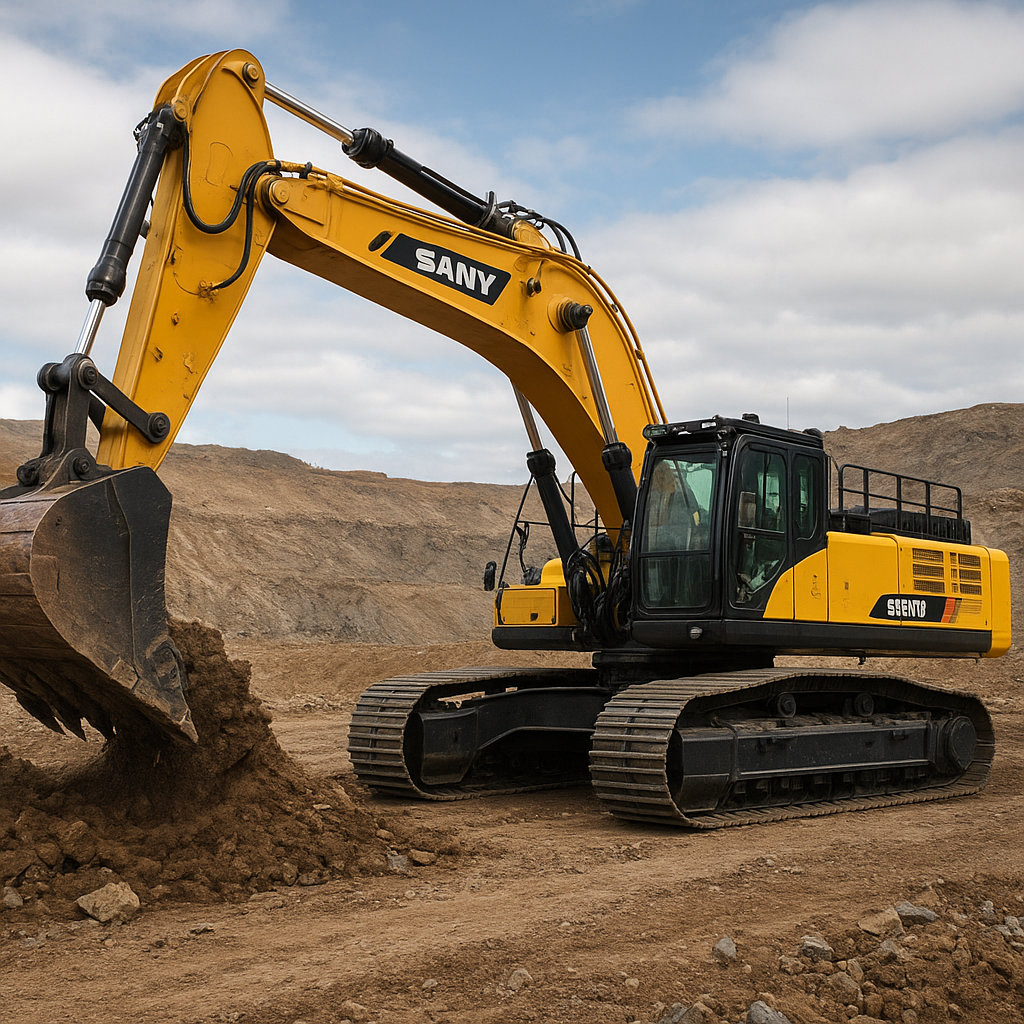
The SANY SY1350 represents a class of heavy-duty hydraulic mining excavators designed to handle the most demanding earthmoving tasks in open-pit mines, quarries and large infrastructure projects. In this article we examine its design principles, typical applications, operational performance, maintenance considerations and the technological features that make machines from this class valuable to modern mining operations. The following sections provide a detailed view of the machine’s role on site, what operators and fleet managers can expect, and how the SY1350-class excavator contributes to productivity, safety and lifecycle economics.
Design and technical characteristics
The SANY approach to large hydraulic excavators focuses on structural strength, hydraulic efficiency and operator ergonomics. Although the exact factory specifications for a model named SY1350 may vary between markets and production years, machines in the same category share a set of common design features that determine their performance in heavy mining applications.
Basic architecture
- The machine is a conventional track-mounted hydraulic excavator with a heavy-duty undercarriage built for high stability and long service life.
- Hydraulic systems are optimized for both high breakout force and smooth cycle times, balancing digging power with controllability.
- Attachments commonly include large general-purpose and rock buckets, ripper teeth, hydraulic breakers and material grapples for handling diverse tasks.
Typical dimensional and power ranges
Excavators in the 100–150 tonne class—where the SY1350 is commonly positioned—typically have the following ballpark characteristics (values given as typical ranges because exact model specifications change by configuration and region):
- Operating weight: ~110–150 tonnes
- Engine power: ~300–600 kW (400–800 hp)
- Bucket capacity: ~2.5–6.0 m³ for standard rock and general purpose buckets
- Hydraulic system pressure and flow tuned for high breakout torque and fast cycle times
- Maximum digging reach and depth tailored per boom/arm configuration for either bench digging or deeper cuts
These ranges give the SY1350-class machines the ability to load large haul trucks efficiently and to operate across a variety of material types from overburden to hard rock.
Key mechanical choices
- Reinforced boom and arm structures with optimized stress distribution to extend fatigue life.
- Heavy-duty swing systems and final drives sized for continuous operation in mining cycles.
- Service-friendly layout: grouped daily-check points, wide-access panels and modular components make diagnostics and repairs faster.
Applications and operational uses
The primary role of the SY1350-class machine is in large-scale material handling and excavation. Its adaptability allows it to be used across a broad spectrum of operations.
Open-pit mining
- Primary loader for bench-to-truck loading: matches with 30–60 tonne and larger haul truck fleets depending on payload and bucket size.
- Overburden removal and stripping benches: strong breakout forces and large bucket capacities speed the removal of waste rock.
- Ore handling and selective mining: with appropriate buckets and cycle planning, the excavator is used to selectively load higher-grade zones.
Quarrying and aggregates
Quarries benefit from the SY1350-class excavator’s ability to move large volumes of rock and aggregate. Typical tasks include primary rock extraction, secondary sizing with hydraulic breakers and feed operations to crushers and screens.
Port handling, stockpiling and heavy civil works
- Bulk material handling: when equipped with clamshell or orange-peel grabs, the excavator serves as a shore-side handler for bulk cargos.
- Construction of large infrastructure: excavation for dams, foundations and erosion control where large volumes of material must be moved quickly.
Specialized tasks and attachments
Beyond the standard bucket, a versatile attachment package extends the machine’s use:
- Hydraulic breakers for secondary fragmentation.
- Rippers for breaking hardpan or frozen ground.
- Sorting and grappling tools for demolition or material handling.
Performance, productivity and matching to fleet
Productivity of the SY1350-class excavator is determined by a combination of machine capability, operator skill and the system it operates within. Proper matching of bucket size to haul truck capacity and material type is critical to maximize the value of the machine.
Cycle time and truck loading
Typical cycle times for heavy-class excavators range broadly due to site conditions and operator efficiency. For planning, mine engineers often use productivity models that account for bucket fill factor, truck cycle, and material density. When matched correctly, an excavator in this class can achieve high truck-fill efficiencies, reducing idle time for haul trucks and increasing overall production.
Fuel consumption and operating costs
Fuel use depends on engine size, hydraulic efficiency and duty cycle. In heavy mining operation, fuel can be one of the largest variable costs. Manufacturers and fleet operators work to reduce consumption through:
- Advanced hydraulic control strategies that optimize pump output to demand.
- Automatic engine idle and shutdown features.
- Regular maintenance to keep filters, fluids and moving parts within optimal tolerances.
Comparative studies across brands typically show that improvements in hydraulic efficiency and powertrain tuning deliver measurable fuel savings across a fleet, improving the total cost of ownership.
Maintenance, availability and lifecycle
Availability is a vital metric in mining operations. Key maintenance considerations for SY1350-class machines include:
- Preventive maintenance schedules based on hours of operation and temperature or load conditions.
- Structural inspections focused on pins, bushings and welds to detect fatigue early.
- Hydraulic component service to prevent contamination-related failures.
- Rapid-access wear parts and rebuild kits to minimize downtime.
Planned rebuilds for major components (engine, swing drive, travel motors, boom/arm replacement) are part of lifecycle management. Effective parts logistics and local dealer support greatly influence mean time between failures and repair turnaround—two primary determinants of lifecycle cost.
Safety, environmental impact and technological innovations
Modern excavators integrate features to protect people and the environment while increasing operational intelligence.
Operator safety and cabin ergonomics
- ROPS/FOPS certified cabins with excellent visibility and climate control to reduce operator fatigue.
- Advanced camera systems and proximity sensors to assist during truck loading and operation in congested yards.
- Ergonomic controls and adjustable seating to improve comfort and precision during long shifts.
Emissions, fuel economy and environmental management
Engine emissions meet regional regulations (Tier/Stage levels or equivalent) through turbocharging, fuel mapping and aftertreatment systems. Beyond compliance, fleet managers focus on reducing greenhouse gas intensity per tonne moved. Strategies include:
- Optimizing machine duty cycles to reduce unnecessary idling.
- Using higher-efficiency hydraulic systems and low-viscosity fluids where suitable.
- Exploring electrification or hybrid solutions where infrastructure allows, especially in depot or port applications.
Connectivity and fleet intelligence
A significant trend in the mining industry is the use of telematics and fleet management tools. SANY and other OEMs offer systems that capture operational data remotely, including:
- Hours and fuel use monitoring to analyze consumption patterns
- Diagnostics and predictive alerts to plan maintenance
- Fleet-level dashboards that optimize machine allocation and truck-excavator matching
These systems improve uptime and allow supervisors to make evidence-based decisions about asset utilization. The combination of on-machine sensors and cloud analytics supports condition-based maintenance and reduces unscheduled stops.
Economic and operational considerations for purchasers and fleet managers
When evaluating a heavy excavator like the SY1350-class for purchase, several economic and operational aspects should be considered to ensure the right long-term fit.
Total cost of ownership (TCO)
TCO exceeds the initial acquisition price and includes:
- Fuel and consumables
- Routine and major maintenance
- Parts availability and local service network
- Residual value and potential for refurbishment or resale
Buying decisions are often driven by the expected productive life on the primary project, availability of local support, and the potential to redeploy the machine to other sites.
Operator training and productivity
Operator skill strongly affects productivity. Investing in training—both on controls and in routine checks—pays back through lower wear rates, fewer incidents and better fuel economy. Simulators and on-site mentoring can accelerate proficiency when new types of machines are introduced to the fleet.
Customization and fleet standardization
Adapting attachments, hydraulic flow rates and control maps allows the machine to be optimized for a specific mine’s materials and truck sizes. At the fleet level, standardizing on a common set of parts and control philosophies reduces spare parts complexity and training needs.
Market presence, support and examples of use
SANY has grown into a major global supplier of construction and mining equipment. In many regions, its dealer networks provide parts, maintenance and training. Real-world deployments of SY1350-class excavators are common in medium- to large-scale mines and quarries where throughput demands require continuous, heavy-duty operation.
Deployment examples
- Bench mining operations where the excavator serves as the primary loader feeding a primary crusher or fleet of haul trucks.
- Quarry operations that require high hourly production with minimal downtime.
- Bulk port and intermodal facilities where excavators are used for ship and rail loading/unloading when fitted with appropriate attachments.
After-sales and parts support
Strong local support networks reduce downtime. Key after-sales features include:
- Availability of genuine wear parts and rebuild kits
- Field service agreements and remote diagnostics
- Training for on-site technicians to perform routine servicing and level-one diagnostics
Concluding perspective
The SY1350-class heavy hydraulic excavator embodies the strengths required for high-production mining and large civil applications: structural robustness, hydraulic power, and the versatility to work with multiple attachments. For operators and managers, the priorities when integrating such a machine into a fleet are matching bucket size to truck payload, maintaining strict preventive maintenance routines, and leveraging telematics to increase uptime and control operating costs.
Key attributes that make machines of this class valuable in practice include SANY’s attention to component durability, the SY1350-class balance between power and reach, and features that enhance operator comfort and safety. Optimizing for productivity and fuel efficiency, and using modern telematics and maintenance practices, ensures that the excavator delivers consistent results over a long service life. Ultimately, fleet-wide performance depends as much on maintenance strategy and operator training as on the nominal mechanical specifications of the machine.


)
)