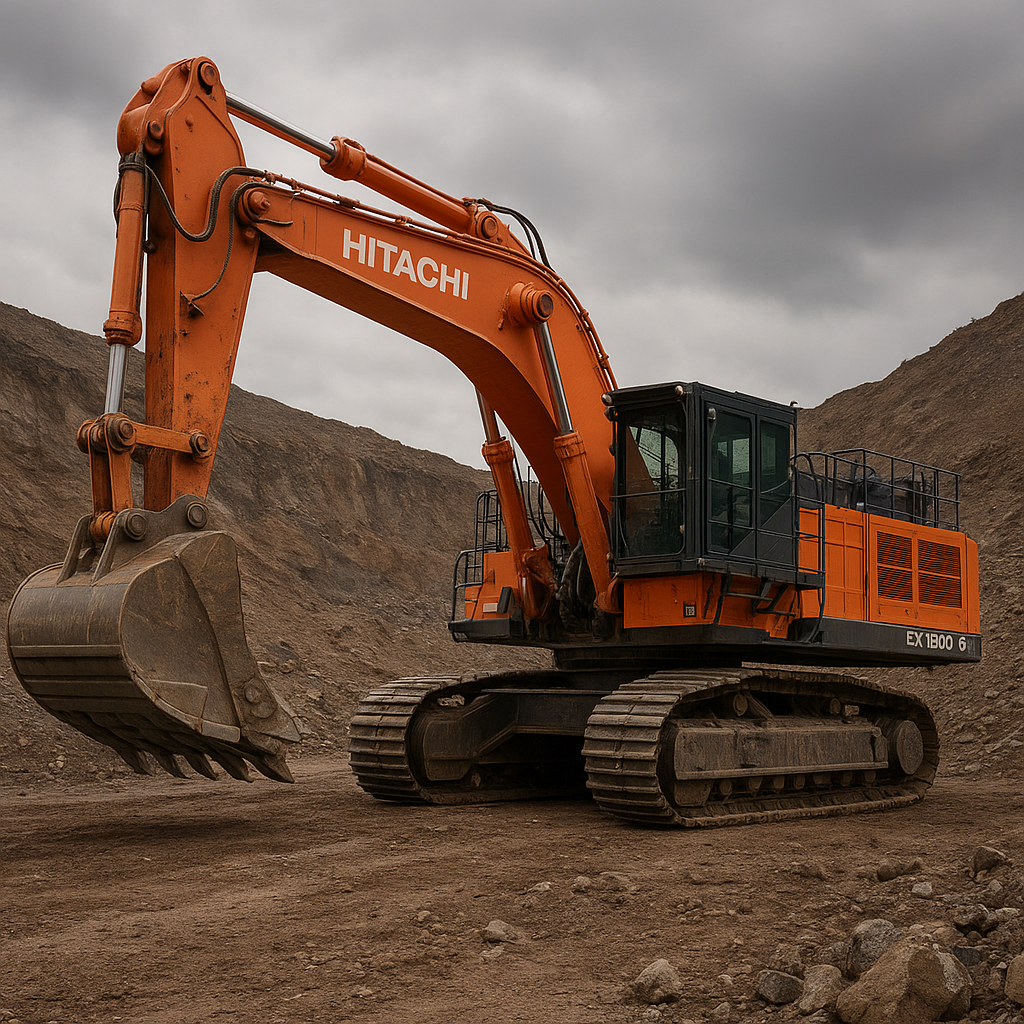
The Hitachi EX1800-6 is a heavyweight hydraulic excavator widely used in open-pit mining and large-scale earthmoving operations. Designed to combine robust construction with advanced hydraulics and operator-oriented features, this model serves as a workhorse where high-volume digging and reliable truck loading are required. The following article explores the machine’s design, typical technical characteristics, practical applications, operational considerations, and lifecycle and market aspects.
Overview and design philosophy
The EX1800-6 belongs to Hitachi’s EX series of large hydraulic excavators. Its layout follows the classic configuration for mining machines: a heavy-duty undercarriage, a reinforced house with a powerful diesel engine, a durable boom and arm assembly, and a large bucket adapted to rock and ore handling. From the outset Hitachi designed the EX1800-6 to balance three priorities: productivity, durability, and operator ergonomics.
Key design choices emphasize serviceability and uptime. The engine and hydraulic systems are packaged to allow easier access for routine service, while modular components reduce downtime during repairs. Hitachi’s engineers also focused on structural reinforcement—critical for machines that endure repeated high-impact loading and abrasive environments typical of mining and quarrying.
Technical specifications and performance
Exact factory specifications for the EX1800-6 vary with configuration (boom/arm length, bucket style, undercarriage options, and optional equipment). Below are typical figures and performance characteristics to give a representative picture. Where precise numbers are not universal, ranges are provided.
Typical mass and dimensions
- Operating weight: generally in the range of approximately 160,000–190,000 kg (about 160–190 tonnes) depending on configuration and attachments.
- Overall length and transport dimensions: depends on boom and arm, but transport-ready configurations prioritize rail or road shipping limits for the region.
- Ground pressure and track type: wide-track undercarriage options available to reduce ground pressure for soft surfaces or narrow shoes for firm ground and improved maneuverability.
Engine and hydraulic system
- Engine power: typically a high-output diesel in the 500–800 kW class (varies with emissions standard and tuning).
- Hydraulic pumps and flow: a high-flow, variable-displacement axial piston system to provide strong bucket and crowd forces along with smooth control of large attachments.
- Control system: proportional electro-hydraulic controls and pilot-operated valves optimized for simultaneous multi-function performance.
The combination of engine output and hydraulic flow translates into powerful digging and crowding forces. Those forces allow the EX1800-6 to load large-capacity haul trucks efficiently and to handle stiff or heavily consolidated materials.
Bucket capacity, cycle time and productivity
- Bucket sizes: rock and mining buckets typically range from approximately 6 m³ to 13 m³, depending on the intended application (large rock buckets for quarrying vs. higher-capacity buckets for low-density overburden).
- Payload per cycle: depends on bucket fill factor and material density; typical loaded payloads range from 6–15 tonnes per bucketful for dense rock to much higher mass for low-density materials when using larger buckets.
- Cycle time and theoretical hourly output: with optimal digging and truck matching, the EX1800-6 can achieve several hundred to a few thousand tonnes per hour. Exact throughput depends heavily on bench geometry, truck size, operator skill, and material characteristics.
Fuel consumption and efficiency
Fuel consumption for machines in this size class varies with duty cycle but common operating ranges are between 60 and 160 liters per hour under typical mining loads. Factors that influence fuel burn include engine tuning, hydraulic power demand, idle time, and the match between bucket size and truck capacity. With modern control strategies and proper maintenance, operators emphasize fuel efficiency through component tuning and optimized work cycles.
Applications and typical use cases
The EX1800-6 is tailored to demanding environments where high-volume excavation and loading are required. Typical applications include:
- Open-pit mining — primary loading of haul trucks for ore and waste removal.
- Quarry operations — extraction and loading of rock and aggregate products.
- Large earthworks and civil projects — mass excavation, foundation digging, and heavy material handling.
- Stockpile management and reclamation — reclaiming secondary material and transferring to processing equipment.
- Marine and bulk loading — in some ports and terminals the machine is used for shiploading or barge loading when mounted or arranged appropriately.
Because the model emphasizes both power and endurance, the EX1800-6 is common where continuous high-intensity cycles are required and machine availability is critical to overall site productivity.
Operator, maintenance and lifecycle considerations
Operator environment and controls
The EX1800-6 cabins are designed to improve long-shift comfort and reduce operator fatigue—important for maintaining high productivity and safety. Cab features commonly include heated and air-conditioned environments, adjustable high-back seats, joystick controls, and good visibility across the digging area. Ergonomic design contributes to accurate cycle execution, which in turn improves bucket fill and reduces wear on structural components.
Maintenance practices and serviceability
Mining machines are judged not just by their hourly output but also by their lifecycle availability. The EX1800-6 facilitates maintenance through:
- Accessible service points: grouped routine service points, wide-opening engine panels, and walkways for safe access.
- Modular components: hydraulic pumps, swing motors, and final drives that can be replaced or rebuilt to expedite repairs.
- Diagnostic systems: many Hitachi machines are equipped for remote telemetry and diagnostics to detect issues before they lead to catastrophic failure.
Regular preventive maintenance, oil analysis, and scheduled component inspections are essential to extend the machine’s lifecycle and keep total cost of ownership under control.
Lifecycle and refurbishment
Heavy excavators commonly serve for many years—often decades—through scheduled rebuilds and component overhauls. Typical lifecycle phases include initial years of full production, followed by mid-life component rebuilds (engine or hydraulic overhauls), and later full refurbishments or remanufacturing. When refurbished, an EX1800-6 can regain much of its original performance with modernized engine controls and rebuilt hydraulic systems.
Attachments, adaptability and fleet integration
The utility of the EX1800-6 is amplified by the variety of attachments and configurations available. Typical attachment options include:
- Rock buckets and heavy-duty mining buckets — for maximum wear resistance and controlled fill.
- Specialty buckets (sieve/reclamation) — for handling non-cohesive materials or sorting operations.
- Hydraulic breakers and grapples — for secondary breaking and material handling where required.
- Rippers and thumb attachments — for loosening compacted material prior to loading.
- Quick couplers — to change attachments rapidly and increase machine versatility.
For fleet integration, the EX1800-6 is commonly matched with large-capacity haul trucks. A correct match between bucket capacity and truck payload maximizes loading cycle efficiency and reduces wheel-to-wheel delays. Modern operations also integrate telematics and fleet management systems to coordinate truck dispatch and excavator tasking, helping to increase overall pit throughput.
Safety, environment and regulatory considerations
Safety is a key focus for mining operations and Hitachi designs features to reduce hazards associated with large hydraulic excavators. Typical safety and environmental features include:
- ROPS/FOPS-certified cab structures and safety glass to protect the operator.
- Backup alarms, cameras, and optional proximity detection systems to reduce collision risks.
- Fire suppression options and insulated hydraulic and fuel lines to lower fire risk in hot or dusty environments.
- Exhaust aftertreatment and emissions controls appropriate to regional emissions regulations; older models may need retrofit solutions to meet updated standards.
Environmental management strategies on site also include controlling hydraulic oil leaks, managing waste filters and fluids, and reducing idling times to limit emissions and fuel consumption. Rebuilding and remanufacturing enhances sustainability by extending the usable life of capital assets.
Market position, resale, and economic aspects
Large excavators like the EX1800-6 represent significant capital investments. Key economic considerations for mine managers and fleet planners include:
- Initial acquisition cost versus expected lifecycle and productivity gains.
- Matching equipment size to site scale: oversizing an excavator leads to higher fuel and maintenance costs; undersizing leads to reduced throughput and longer cycle times.
- Resale and secondary market: these machines hold value when well maintained; refurbishment and remanufacturing increase resale potential.
- Parts availability and OEM service networks: comprehensive service and parts support reduce downtime and are a major factor in the total cost of ownership.
Many operators choose leasing or power-by-the-hour service contracts to align equipment costs with production cycles and to transfer maintenance risk.
Strengths, limitations and practical tips
- Strengths: robust structure for heavy-duty use, strong hydraulic performance, good serviceability, and broad support from Hitachi’s commercial network.
- Limitations: high fuel consumption compared with smaller machines, significant transport logistics for relocation, and potential emissions compliance issues in regions with strict modern standards unless upgraded.
- Practical tips: match bucket and truck sizes carefully; schedule predictive maintenance using oil analysis and telemetry; maintain a parts inventory for high-wear items (pins, bushings, bucket teeth); and train operators on efficient digging techniques to improve fuel economy and reduce wear.
Case examples and operational contexts
In a typical open-pit iron ore operation, an EX1800-6 can be used in a primary loading role, pairing with 100–200 tonne haul trucks. When operating on a hard rock bench with a large rock bucket, the machine’s robust boom and arm deliver the crowd force necessary to break and pry rock free for loading. In a softer overburden application, larger volume buckets increase mass moved per cycle and enhance overall site throughput.
In quarry operations producing aggregate, the EX1800-6 can perform both extraction and stockpile management duties. The ability to switch attachments—such as from a tooth bucket to a rake or grapple—makes the machine versatile across different tasks within the quarry.
Conclusion
The Hitachi EX1800-6 is a high-capacity hydraulic excavator engineered for the demands of mining and large-scale earthmoving. Its core strengths—structural robustness, powerful hydraulics, and serviceability—make it a favored choice where sustained heavy-duty performance is required. While fuel consumption and transport logistics are practical considerations, careful matching to site requirements, diligent maintenance, and appropriate operator training can maximize uptime and reduce total lifecycle costs. For operations seeking a dependable machine for continuous loading and excavation, the EX1800-6 remains a compelling option within its class.


)
)