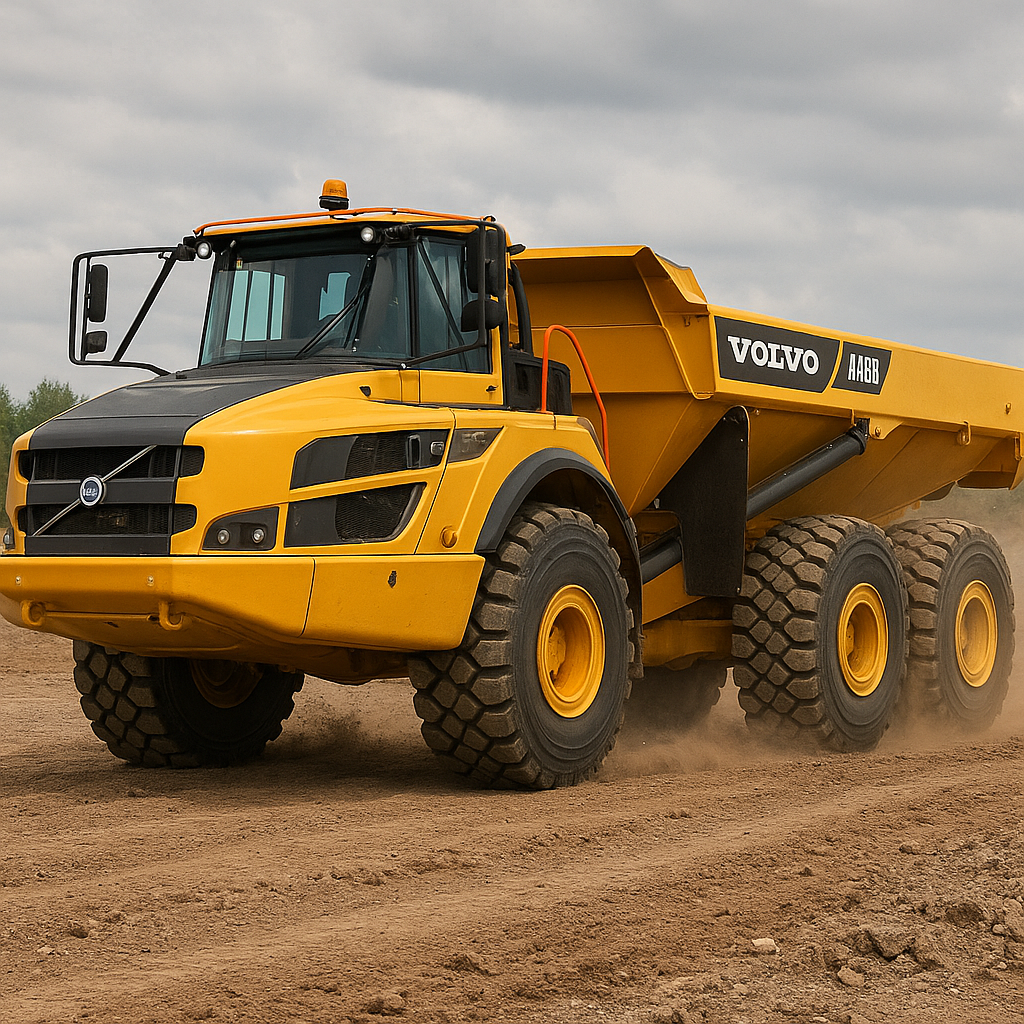
The Volvo A45G is a heavyweight, purpose-built **articulated** hauler designed to move large payloads across rough terrain with high productivity, durability and operator comfort. Combining robust mechanical systems with advanced electronics and **telemetry**, the A45G has been a mainstay on large construction sites, quarries and mines where mobility, load capacity and uptime are critical. This article explores the A45G in depth — its typical specifications, operational uses, technologies that improve efficiency and safety, and practical guidance for buyers and operators.
Overview and defining features
The Volvo A45G belongs to the class of articulated haulers commonly referred to as ADTs (articulated dump trucks). Its fundamental strengths lie in the combination of chassis articulation for exceptional off-road **mobility**, all-wheel drive, and a high-capacity dump body that enables efficient bulk material movement in environments where rigid-frame trucks are limited.
- Articulated hauler layout — front chassis and rear dump body connected by a pivot articulation that provides unrivaled traction and manoeuvrability on uneven ground.
- operator cab with controls and visibility optimized for safety and productivity.
The A45G is positioned as a 45‑tonne class machine — its design intent centers on balancing large payload capacity with off-road agility and reduced cycle times.
Applications and operating environments
The Volvo A45G finds applications across multiple heavy-duty industries where moving large volumes of material quickly and reliably is essential. Typical environments include:
- Quarries and aggregates — transporting blasted rock and aggregate from primary crushers to processing or stockpile areas.
- Mining (surface) — short-haul carrying of overburden, waste rock and ore within open pits where road conditions vary and heavy payloads are frequent.
- Large-scale earthworks and infrastructure projects — highway construction, dam building, and land reclamation where material movement is continuous.
- Pipeline and civil construction sites — moving fill and excavation spoils in areas with limited road infrastructure.
- Specialized operations such as forestry roads and remote construction sites where articulated steering and off-road capability are advantageous.
Because of its articulation and all-wheel drive, the A45G excels where steep gradients, soft ground and tight turning radius requirements would challenge rigid-frame haul trucks. Its adaptability with different body types (standard, rock, high-capacity or specialized bodies) makes it suitable for a wide range of materials and operational preferences.
Typical technical specifications and performance (model‑dependent)
Specifications for the A45G can vary with market, optional packages and body configurations. The figures below are typical for factory-standard configurations and should be treated as indicative; always consult Volvo’s official documentation or your local dealer for exact numbers for a given machine.
Key performance and capacity figures (typical)
- Nominal payload: approximately 45 tonnes (metric).
- Engine power: around 330–350 kW (roughly 440–470 hp), depending on tuning and emissions package.
- Top speed: up to 55–60 km/h (on-road, limited by transmission settings and local regulations).
- Typical body volume (heaped): roughly 22–30 m3, depending on body design (standard vs rock or high-capacity).
- Operating weight (empty): in the neighborhood of 26,000–28,500 kg.
- Turning radius (inside): tight compared with rigid trucks due to articulation; enables better manoeuvrability in confined sites.
- Fuel tank capacity: commonly between 350 and 550 litres depending on market and options.
Drive and transmission
The A45G typically uses a robust drive train designed for high torque and frequent directional changes. Key qualities include:
- Full-time all-wheel drive with differentials optimized for traction.
- Powertrain tuning focused on low-speed torque for climbing grades and exiting soft pits.
- Automatic or automated transmissions that smooth shifting and reduce operator fatigue while maintaining efficient tractive effort.
Hydraulics and dump system
Lift cylinders and dump linkage are sized to handle full payload dumps reliably and quickly. Optional features often include controlled body dump sequences and high-lift bodies for improved discharge in certain applications.
Productivity, cycles and fuel economy
Productivity for an A45G in the field depends on cycle length, payload, site layout and operator technique. Below are practical considerations and ballpark productivity estimates.
Calculating productivity
- Nominal payload (45 t) × effective loaded cycles per hour = hourly material moved. For example, at 6 loaded cycles/hour, theoretical throughput ≈ 270 t/h. At 8 cycles/hour that rises to 360 t/h.
- Real-world productivity is typically lower due to queuing, loading variation, travel distances and dumpsite delays. Typical effective productivity ranges widely — often between 150 and 380 t/h depending on conditions.
Fuel consumption
Fuel use is influenced by load, terrain, engine tuning and duty cycles. Typical fuel consumption under heavy duty might range from approximately 25 to 45 litres per hour. When operating under lighter duty or steady high-speed haul roads, hourly consumption can be more favourable. Application of smart **telematics** and operator training can reduce fuel burn by optimising gear selection, idle time and cycle planning.
Operator comfort, safety and technology
Volvo places emphasis on operator ergonomics and safety — a factor that improves productivity and reduces turnover. Key areas include:
- Comfortable cab with climate control, adjustable seat and intuitive control layout to reduce fatigue during long shifts.
- Excellent forward and peripheral visibility achieved through cab placement and window design; useful for tight quarry and pit conditions.
- Active safety systems such as vehicle stability support, hill start assist and articulated vehicle-specific protections (depending on spec).
- Integrated telematics and fleet management platforms (e.g., Volvo telematics solutions) provide remote monitoring of hours, fuel consumption, location and fault codes — tools that raise **uptime** and simplify logistics.
Driver aids and situational awareness
Modern A45G units often come with rear-view cameras, proximity sensors and collision mitigation options. These improve worker safety around machines that operate in busy environments with foot traffic and light vehicles.
Maintenance, serviceability and lifecycle costs
Whole-life cost is frequently more important than upfront purchase price for fleet managers. The A45G is engineered with serviceability and durability in mind to reduce downtime and maintenance cost per tonne moved.
- Accessible service points and grouped daily check locations speed routine maintenance and pre-start inspections.
- Heavy-duty components such as axles, suspension and chassis are designed for long service intervals; still, regular inspections are essential for early wear detection in abrasive environments.
- Volvo dealer networks typically offer tailored service agreements, parts availability and telematics-based predictive maintenance programs to increase machine availability.
Proper maintenance scheduling, the use of genuine replacement parts and operator training (on correct loading and driving practices) are among the most effective measures to control operating expenses over the machine’s lifecycle.
Variants, options and attachments
The A45G can be configured to suit specific operational needs. Common options and variants include:
- Different body types: standard, rock, high-capacity and wear-resistant bodies for abrasive materials.
- High-lift bodies or tailgate packages that improve dump clearance for certain loading/hauling scenarios.
- Advanced lighting packages for night-shift operations and low-visibility conditions.
- Enhanced filtration and pre-cleaner packages for dusty environments to extend air filter life.
- Telematics and fleet management upgrades, including automatic diagnostics and remote data services.
Environmental considerations and emissions
Modern variants of the A45G meet contemporary emission standards using engine calibrations, after-treatment systems and selective catalytic reduction where required by region. Environmental benefits and considerations include:
- Improved fuel efficiency through powertrain optimization and operator-assist technologies reduces greenhouse gas emissions per tonne moved.
- Options for idle management and automatic shutdown reduce unnecessary fuel use and emissions during downtime.
- Choice of body design and cycle optimisation to minimise unnecessary trips and lower site dust generation during dumping.
Market position, competitors and resale
In the 45-tonne articulated hauler segment, the Volvo A45G competes with machines from other major manufacturers that offer similar capacity and performance. Volvo’s strengths lie in its global dealer network, integrated telematics and a reputation for durability. Resale values for well-maintained A45-series machines remain strong in markets where articulated haulage is preferred due to terrain constraints.
- Primary competitive considerations include total cost of ownership, dealer support, fuel economy, and machine uptime under real working conditions.
- Used A45G units can offer compelling value if they come with detailed service histories and validated telematics records showing conscientious operation and maintenance.
Buying and operating tips
To get the most out of an A45G, operators and fleet managers should consider the following practical guidance:
- Match body type and specification to the primary material and haul distances — a rock body will wear differently than a standard plate body for lighter aggregates.
- Use telematics actively: monitor cycle times, idle periods and fuel consumption to identify performance improvements and training needs.
- Invest in operator training that emphasises efficient shifting, route selection and safe loading/dumping procedures.
- Create a preventative maintenance schedule and use genuine parts to protect resale value and reduce downtime risk.
- Consider machine rotation and fleet composition to reduce wear on units operating in the harshest conditions; specialized machines can be deployed to the most demanding tasks.
Summary
The Volvo A45G is a purpose-built, high-capacity articulated hauler engineered for heavy-duty hauling in quarries, mines and large earthmoving projects. With a nominal payload of roughly 45 tonnes, robust drivetrain design, operator-focused cab features and integrated telematics, it offers a balance of productivity, durability and safety. While exact specifications vary by market and configuration, the core strengths of the A45G—mobility on difficult terrain, flexible body options and strong dealer support—make it a compelling choice where large-volume material handling must be combined with off-road capability. Careful configuration, disciplined maintenance and data-driven fleet management are the keys to maximising return on investment and ensuring the Volvo A45G performs reliably throughout its working life.


)
)