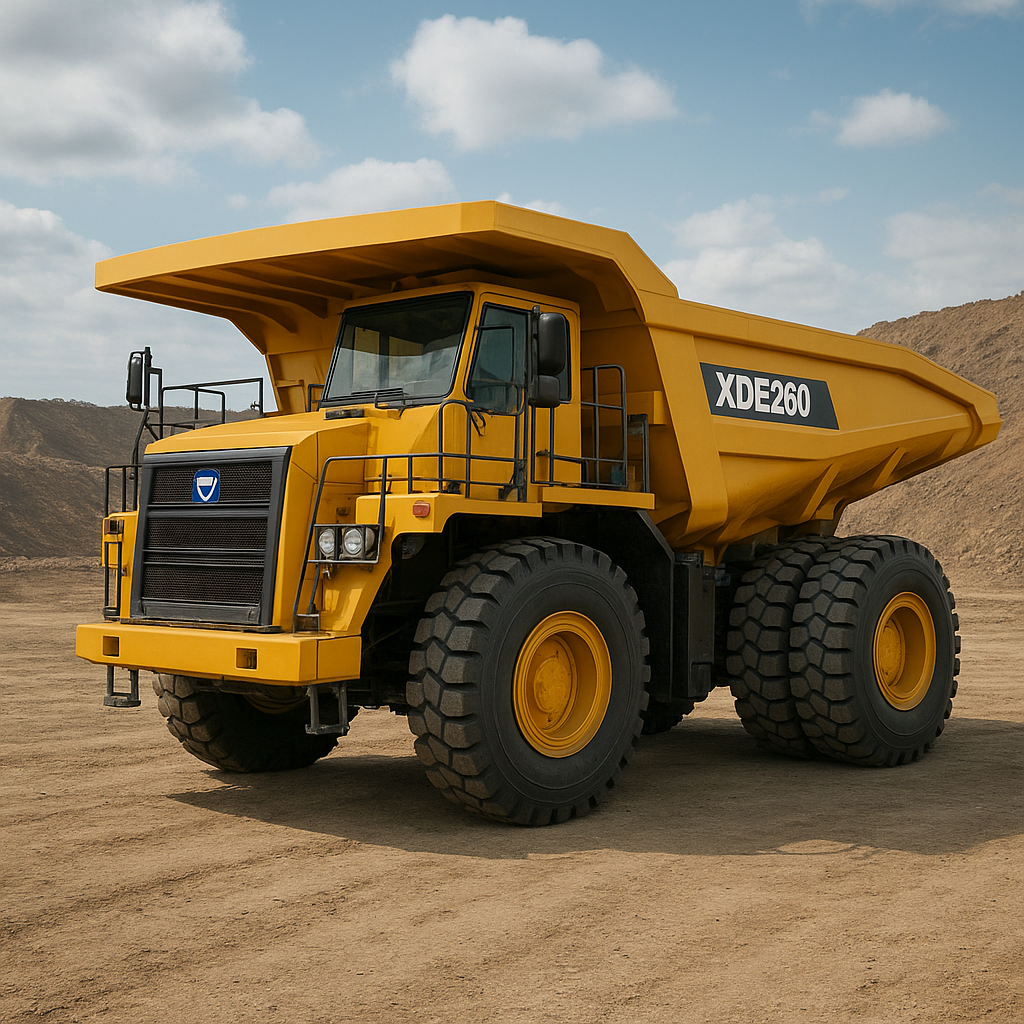
The XCMG XDE260 is a heavy-duty rigid haul truck designed for demanding open-pit mining, large-scale quarrying and major earthmoving projects. Engineered by XCMG — one of the world’s largest construction equipment manufacturers — the XDE260 is intended to compete in the high-capacity haul-truck segment where reliability, uptime and cost-efficiency are paramount. In this article I describe the machine’s main design characteristics, typical applications, operational strengths and economic and environmental considerations. The text also includes practical guidance for fleet integration, maintenance and safety management.
Design and technical overview
The XDE260 belongs to the class of high-capacity rigid dump trucks commonly used in heavy mining. The model designation “260” normally indicates a nominal nominal payload capacity in the neighborhood of 260 tonnes, positioning this model between medium-heavy and ultra-heavy haul trucks. The XDE260’s design focuses on balance between durability, payload efficiency and maintainability to deliver consistent performance in harsh operating conditions.
Powertrain and transmission
Haul trucks in this payload category typically use large diesel engines paired with either mechanical or more commonly nowadays electric drive systems. The XDE260 is offered with a heavy-duty engine and a robust drive-systems package intended to provide excellent torque at low speeds for steep ramp climbs and heavy loading cycles. Many modern haul trucks of this class utilize AC electric traction systems (diesel-mechanical prime mover powering electric traction generators) to improve traction control, reduce mechanical wear and simplify power distribution to the traction motors.
Chassis, suspension and body
The frame and suspension are engineered to withstand millions of repetitive load cycles. The XDE260’s body (haul bed) is built of high-strength steel with wear-resistant liners available for abrasive materials. The structural layout aims to optimize the ratio of payload to tare weight, maximizing productivity while maintaining structural safety margins. Typical features include reinforced dump-box geometry to ease material flow and reduce sticking, heavy-duty axles, and large-diameter wheels and tires designed for long service life under heavy loads.
Operator environment
Modern XCMG mining trucks emphasize operator comfort and ergonomics to reduce fatigue and improve productivity. The XDE260 cab generally offers climate control, noise insulation, adjustable seating with multiple suspension options, and easy-to-access controls and displays. Advanced models include integrated telematics, touchscreen displays for machine diagnostics, and visibility aids such as rear cameras and proximity sensors to support safe operations in congested pit environments.
Braking and safety systems
For safe operation on steep grades, the truck is equipped with multiple redundant braking systems: service brakes, retarders (engine or electric), and emergency braking systems. Electronic stability systems, speed limiters, and hill-hold functions help manage descent and prevent runaways. Many units are fitted with collision-avoidance and object detection systems when integrated into modern mine-site safety architectures.
Applications and operational roles
The XDE260 is primarily intended for large open-pit surface mining operations, but its capabilities make it useful across several heavy-duty applications:
- Open-pit mining — Hauling overburden, ore, and waste materials from benches to processing plants, stockpiles or waste dumps. The XDE260 is sized to match medium-to-large shovels and loaders and to optimize shovel-truck cycle times.
- Quarrying — Transporting blasted rock and aggregate from extraction faces to crushers or primary processing sites.
- Major civil earthworks — Moving large volumes of earth in projects like dam construction, major infrastructure corridors and port expansion works.
- Bulk materials handling — In some ports or bulk terminals where road haulage of heavy units is practical and infrastructure supports large-axle loads.
One key operational consideration is fleet matching. Productivity is driven by the harmony of digger capacity (shovels, backhoe loaders, excavators) with payload and cycle time of the truck. A 260-ton truck is typically paired with large hydraulic shovels or rope shovels in the class that can load the truck in one or two passes. Effective matching reduces truck idle time and improves overall site productivity.
Cycle performance and productivity
In practical operation, mine productivity is measured in tons moved per hour or per shift. The XDE260’s value is in its ability to move large loads per cycle, which reduces the number of cycles required for a given tonnage compared with smaller trucks. Key metrics for operators include cycle time (load, haul, dump, return), fuel consumption per tonne moved, and mean time between failures (MTBF). Properly maintained and operated, a truck of this class can significantly lower unit production costs when matched correctly to the site’s loading equipment and haul distances.
Maintenance, lifecycle and economics
Lifecycle cost, not purchase price alone, determines the economic attractiveness of mining haul trucks. The XDE260 is designed to lower operating expenses through simplified maintenance access, modular components, and in some configurations telematics-enabled predictive maintenance.
Maintenance practices and intervals
Routine maintenance for large haul trucks includes oil and filter changes, drivetrain inspections, brake servicing, tire management, and structural inspections for frame cracks and wear. Predictive maintenance using oil analysis, vibration monitoring, and telematics alerts helps to schedule major overhauls at optimal times, reducing unscheduled downtime. Key practices to maximize availability:
- Regular inspections of suspension and steering systems to detect early wear.
- Scheduled engine and transmission servicing according to hours operated and load profiles.
- Proactive tire management — correct pressure, rotation strategies and scheduled replacements reduce cost-per-ton.
- Structural inspections of the dump body and chassis for fatigue-related issues.
Costs and return on investment
Initial purchase price for a new high-capacity haul truck can represent a significant capital expenditure for a mining operation; however financing, leasing and fleet procurement strategies can spread costs. Operating costs that most affect the total cost of ownership include fuel, tires, consumables, labor for maintenance and depreciation. Savings from improved payload efficiency, lower downtime and reduced fuel burn per tonne carried can justify the investment in modern, well-specified trucks.
As a general indicator, buyers and fleet managers assess machines using metrics such as cost-per-tonne, availability percentage (targeting >90% for productive fleets), and lifecycle hours to rebuild. For heavy-duty machines, lifecycle planning commonly anticipates mid-life rebuilds of the powertrain and major component replacement schedules to extend service life to several tens of thousands of hours.
Safety, emissions and environmental considerations
Safety and environmental compliance are now central to mining equipment specification. The XDE260 is designed to meet or exceed contemporary regulatory and customer expectations in these areas.
Safety features
Key safety elements commonly found on trucks of this class include reinforced ROPS (Roll-Over Protective Structure) cabs, emergency egress points, integrated seat restraint systems, and anti-slip access platforms. Modern safety suites include:
- Proximity detection systems and collision avoidance sensors that reduce the risk of vehicle-to-vehicle contact.
- Driver fatigue monitoring and telematics-driven behavior alerts.
- Speed-governing software for critical haul roads and downhill sections to prevent excessive speeds.
- Integrated cameras and 360-degree visibility systems to assist in reversing and maneuvering in tight locations.
Emissions and fuel efficiency
Environmental performance is influenced by engine emissions controls and fuel efficiency per tonne moved. Modern heavy haul trucks are available with engines that comply with applicable emissions standards (such as Stage IV/Tier 4 in many markets) and can be fitted with selective catalytic reduction (SCR) and diesel particulate filters (DPF) as needed. Some operations reduce in-pit diesel consumption by combining haul trucks with trolley assist systems, hybridization or fuel-optimization strategies.
Alternative power arrangements — including trolley assist systems (overhead electrification on ramps), battery-electric drive and hybrid energy storage — are being trialed and adopted in mines worldwide to lower greenhouse gas intensity and diesel particulate emissions. While direct electrification of a large rigid haul truck like the XDE260 requires substantial infrastructure and investment, the model can often be integrated into mixed-power fleets and site-specific energy strategies.
Integration into modern mine operations and fleet management
Deploying the XDE260 effectively requires careful planning of haul roads, loading tools, pit layout and maintenance facilities. Integration with mine planning and fleet-management systems is key to maximizing utilization and minimizing cost.
Telematics and data-driven operations
Telematics systems provide real-time data on location, fuel burn, payload estimates, engine health and operator performance. When combined with fleet-management software, these data streams enable:
- Load-and-haul optimization to reduce empty travel and balance fleet workload.
- Predictive maintenance scheduling to minimize unscheduled downtime.
- Performance benchmarking across shifts, mines or regions to identify improvement opportunities.
Matching with loading equipment and pit design
To achieve low-cost per tonne, mines plan their shovels, loaders and truck fleets so that truck size and shovel dipper bucket size produce high loading efficiency and short cycle times. The XDE260 is typically paired with large-class hydraulic shovels or face shovels whose bucket capacities allow full loads within a small number of passes. Road maintenance, grade gradients and turning radii must be designed for the safe and efficient movement of such heavy trucks.
Market position, global reach and future outlook
XCMG has grown steadily in the global market by offering competitively priced equipment with increasing levels of quality, support and technological features. The XDE260 is positioned to appeal to customers seeking high-capacity hauling capability with a value-oriented cost profile compared to some legacy Western brands.
Competition and value proposition
In the 200–300 tonne class, major global competitors include manufacturers such as Caterpillar, Komatsu, Liebherr and BelAZ. XCMG competes by offering modern designs with robust local support networks in many regions, attractive purchase pricing, and modular maintenance packages. For mining companies looking to lower capital costs and secure spare-parts availability, XCMG’s growing dealer network and factory support are important factors in procurement decisions.
Trends and innovation
Key industry trends that will influence the future of haul trucks like the XDE260 include:
- Increased electrification and hybrid systems to reduce diesel use and emissions.
- Greater automation and autonomy — from semi-autonomous features to fully autonomous haulage systems (AHS) — for safety and productivity gains.
- Advanced materials and designs to reduce tare weight and increase payload efficiency.
- Enhanced telematics and AI-driven analytics for real-time optimization and predictive maintenance.
Practical recommendations for purchasers and fleet managers
To get the best value from an XDE260 acquisition, consider the following practical points:
- Conduct a total-cost-of-ownership analysis rather than focusing solely on purchase price. Include fuel, tires, maintenance and expected downtime.
- Ensure that local service capability (spare parts, trained technicians) is available; remote sites can face long delays without a strong dealer network.
- Match the truck to the right loading equipment — oversized trucks on too-small shovels reduce efficiency dramatically.
- Implement telematics and performance monitoring from day one to build a baseline for improvements and warranty support.
- Plan for lifecycle rebuilds and component exchanges; many successful fleets schedule mid-life overhauls to extend useful life and maintain resale value.
Summary
The XCMG XDE260 is a purpose-built heavy haul truck designed for high-volume surface mining and major earthmoving applications. With a nominal payload in the 260-tonne class, the truck targets operations that require a balance of productivity, durability and cost-effectiveness. Its strengths include high capacity per cycle, robust structural design, operator-focused cab features and compatibility with modern telematics and safety systems. For mining operations considering the XDE260, success will depend on correct fleet matching, structured maintenance regimes and integration of advanced data-management tools to maximize uptime and reduce unit production costs. As the industry evolves, future variants or options for this platform may increasingly incorporate electrification, autonomy and other technologies that reduce environmental impact and improve overall efficiency.


)
)