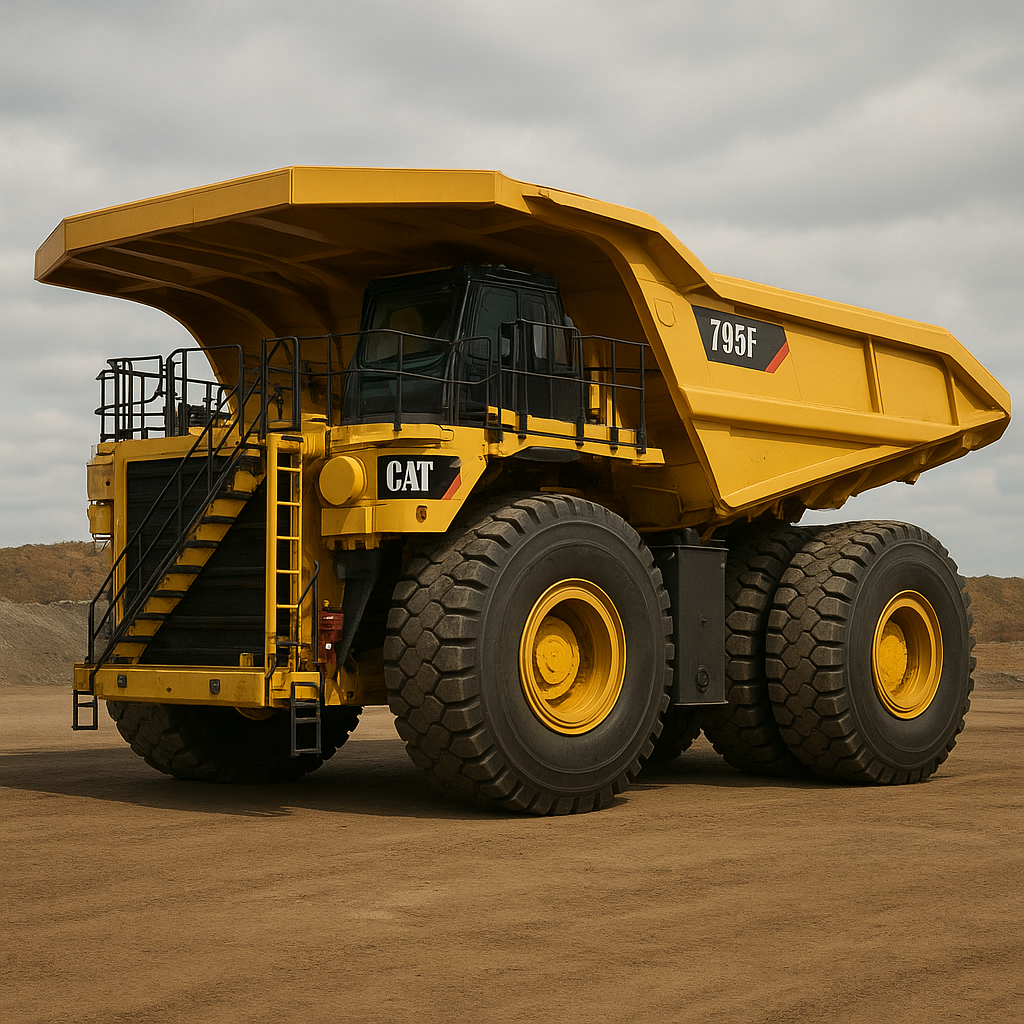
The Caterpillar 795F is a class-leading large-mining haul truck designed for the most demanding surface mining operations. Built to move massive volumes of material efficiently and reliably, the 795F combines heavy-duty structural design, advanced drivetrains and operator-focused systems to maximize production while controlling operating costs. This article describes the machine’s key features, typical applications, technical and operational considerations, and the broader economic and environmental context in which such trucks operate.
Design and engineering highlights
The Caterpillar 795F represents a culmination of engineering focused on extreme-duty performance for open-pit mining. At its core the truck is engineered to carry very large payloads while delivering uptime and serviceability. Important design themes include structural strength, robustness of the drivetrain, and accessibility for maintenance. The 795F is often offered in mechanical-drive and AC electric-drive configurations; the latter provides improved traction control and energy efficiency in many loading cycles.
Chassis and body
- The frame and dump body are fabricated from high-strength steel with designs that prioritize durability and fatigue resistance. Key stress points are reinforced and designed for long service life under repetitive heavy loading.
- Suspension and steering systems are engineered to cope with high payloads and challenging haul-road surfaces while preserving component life and ride quality for the operator.
- Dump bodies are available in various volumes and liner configurations to match different materials and shovels/excavators, which helps optimize cycle times and lug-to-lug productivity.
Drivetrain and powertrain
The 795F is available with Caterpillar’s proven powertrain options that include advanced diesel engines coupled to either an electric-drive system or mechanical power transmission. The electric-drive (AC) systems provide smoother torque delivery, superior traction control on grades and improved retardation characteristics, while mechanical configurations are recognized for their simplicity and lower initial cost in some applications.
- Electric drive variants use diesel generators that supply power to traction inverters and AC traction motors mounted on the axles—this allows for regenerative braking and more precise wheel slip control.
- Mechanical drive setups use a high-capacity transmission and final drives designed to handle extreme torque and long-term wear.
Primary applications and operating environments
The Caterpillar 795F is built primarily for large-scale open-pit mining operations. Its target uses include haulage of overburden, ore and waste rock, as well as specialized material movements in quarries and major earthmoving projects. Typical environments and tasks include:
- Large copper, iron ore, coal and gold open-pit mines where continuous high-productivity haulage is required.
- High-tonnage earthworks and infrastructure projects where shifting very large volumes of material quickly matters.
- Operations with heavy loading equipment (electric rope shovels, large hydraulic shovels, ultra-class wheel loaders) where truck-shovel matching is critical to cycle efficiency.
Because of their size and mass, these trucks are typically used on haul roads designed specifically for heavy equipment, with gradients, widths and turn radii that accommodate large trucks safely. Road maintenance and drainage are crucial to maintaining cycle times and minimising wear and fuel consumption.
Performance, capacity and approximate specifications
Exact specifications for the 795F vary by configuration and customer options. The following figures are typical ranges and representative numbers commonly associated with this model family; treat them as approximate reference points rather than absolute factory data for every build.
- Payload: approximately 300–365 metric tonnes (depending on configuration and local regulations).
- Operating weight (loaded): generally in the range of 400,000–450,000 kg (varies with payload and body configuration).
- Engine output: power ratings typically in the multi-megawatt class for electric-drive systems and in the several-hundred to a few-thousand-kilowatt range for diesel powerplants—precise kW values depend on model and emission-spec engine choices.
- Top travel speed: unloaded higher speeds typically achieve 45–65 km/h depending on gearing and road conditions; loaded travel speed is lower and is dictated by safety and grade.
- Fuel consumption: depends strongly on duty cycle, payload, terrain and drive system; electric-drive options often demonstrate better fuel-equivalent efficiency in heavy stop-start and steep grade conditions.
Note: Mining OEMs often provide custom configurations and local dealers supply site-specific data. For precise performance and specification figures for a particular truck, consult Caterpillar product literature or an authorized dealer.
Operational efficiency and productivity
Maximizing productivity with a 795F is a systems exercise: matching truck payload and cycle time to the mine’s loading equipment, road geometry and dispatching strategy. Important drivers of productivity include:
- Effective truck-shovel or truck-loader matching so the truck carries near its design payload without excessive overloading that shortens component life.
- Well-maintained haul roads to keep travel times and fuel use down and reduce tire and suspension wear.
- Optimized haul profiles and fleet scheduling that minimize empty hauls and reduce dwell time at shovels and crushers.
- Use of Loader-Operator training and autonomous or semi-autonomous systems to ensure consistent loading and compact cycles.
Where implemented, advanced fleet management systems and machine health monitoring provide real-time feedback on performance, enabling predictive maintenance, route optimization and data-driven decision-making that improve overall equipment effectiveness (OEE).
Maintenance, lifecycle and reliability
Large haul trucks like the 795F are capital-intensive assets. Operators aim to maximize availability and life-of-asset through planned maintenance and component life management. Key maintenance strategies include:
- Condition-based monitoring of engine, drivetrain, hydraulic and braking systems using onboard sensors and telematics to detect anomalies early.
- Predictive replacement intervals for high-wear items such as tires, brakes, and components of the final drive, based on accumulated hours, cycles, and recorded loads.
- Routine inspections of structure and welds, particularly in high-stress areas of the frame and body.
- Strategic spare parts management to reduce downtime when major components need replacement.
Manufacturers and dealers often support mines with tailored maintenance programs and rebuild options that extend truck service life. Rebuilds of major components or the whole truck can return it to near-new capability at a fraction of the cost of purchasing new equipment, which is an important economic lever in long-life mine operations.
Safety systems and operator ergonomics
Safety is central to the design and operation of large haul trucks. The 795F incorporates a range of systems and design elements intended to protect personnel and equipment while simplifying operation:
- High-visibility cabs with ergonomically arranged controls reduce operator fatigue and improve situational awareness. Modern cabs include climate control, advanced seating and noise suppression to enhance comfort and productivity.
- Integrated camera systems, proximity detection and collision avoidance technologies are commonly fitted to support safe operation in busy pit environments.
- Robust braking systems and retarding options are essential for safe travel on steep grades. Electric-drive systems provide excellent retarding through regenerative capability.
- Access ladders, handrails and maintenance platforms are designed for safe service access, and fall-protection consideration is built into service routines.
Environmental and economic considerations
Large haul trucks are major contributors to a mine’s fuel consumption and greenhouse gas emissions. Given the scale of their operations, small improvements in fuel efficiency or cycle optimization can produce significant environmental and cost benefits. Considerations include:
- Choice of drive system (electric vs mechanical) impacts fuel-equivalent efficiency and emissions profiles. Electric-drive trucks can be more efficient on steep grades and start-stop cycles and allow better integration with hybridization strategies.
- Engine emissions standards and local regulations influence engine selection and after-treatment systems, which can affect operational costs and maintenance.
- Implementation of mine-wide efficiency programs—route optimization, reduced idling, improved loading practices and tire management—can reduce fossil fuel use and operating cost per tonne moved.
- Some operations examine electrification of haul fleets (including trolley assist or full electrification where grid or on-site power makes sense) to reduce diesel consumption and associated emissions.
Economic lifecycle
Because of the large upfront cost of ultra-class trucks, mines calculate total cost of ownership (TCO) across lifecycle metrics: purchase price, uptime, maintenance, fuel, resale or rebuild value. Optimal decisions balance capital expense against longer-term savings from fuel efficiency, lower maintenance downtime and higher productive availability.
Technology trends and future directions
Advances in mining truck technology continue to push the envelope in automation, connectivity and emissions reduction. Key trends relevant to machines like the 795F include:
- Autonomous operation: large haul trucks are prime candidates for automation because repetitive routes and structured pit environments allow reliable algorithmic control. Automated fleets can increase utilization, reduce human-error incidents and improve fuel economy by optimizing driving behavior.
- Telematics and digital twins: high-fidelity machine data supports predictive maintenance and operations optimization. Digital twin modeling allows planners to simulate haul cycles and test improvement strategies virtually.
- Electrification and alternative fuels: opportunities for trolley assist, plug-in electric systems or alternative fuels such as biodiesel, HVO and hydrogen-derived fuels are being explored to reduce carbon footprint.
- Advanced materials and design: improvements in materials science and structural engineering aim to reduce tare weight while retaining strength, increasing payload capacity or reducing fuel consumption per tonne hauled.
Case examples and real-world usage
In major mining regions worldwide—Chile, Western Australia, Canada, the United States and southern Africa—machines of this class operate around the clock. Typical examples of value delivered include:
- High-tonnage copper mines where fleets of ultra-class trucks move millions of tonnes of ore and waste each year; matching a few high-capacity trucks to large rope shovels or hydraulic shovels keeps throughput high.
- Iron ore operations in remote regions that rely on reliable, maintainable trucks because logistical support windows are tight and component lead times are prolonged.
- Coal and bulk material operations where continuous, high-cycle haulage is needed and fuel efficiency and uptime are major cost drivers.
In many projects, decisions on truck complement, payload target and route design are critical: an improperly matched truck fleet reduces overall mine productivity regardless of individual truck capacity.
Buying considerations and aftermarket support
Prospective buyers evaluate a number of factors before selecting a 795F or similar ultra-class truck:
- Compatibility with loading equipment and pit geometry to ensure trucks can be filled efficiently without overloading.
- Availability of dealer and OEM support for parts, service and rebuilds—this is especially important in remote operations.
- Choice of options such as tires, body liners, camera and proximity systems, automation readiness and emission-specific engine choices.
- Financing, lease and trade-in options which influence the economic feasibility of expanding or replacing a haul fleet.
Aftermarket support from the manufacturer and third parties—parts supply, rebuild capabilities, field service and operator training—significantly influences long-term operating costs and asset life.
Summary and outlook
The Caterpillar 795F is a representative example of ultra-class haul trucks that form the backbone of modern surface mining logistics. Designed for immense loads and continuous operation, these machines excel when integrated into a well-planned mining system that includes matched loading equipment, optimized haul roads and rigorous maintenance programs. As the mining industry increasingly emphasizes efficiency, safety and environmental performance, trucks like the 795F will continue evolving—embracing electrification, automation and digitalization to deliver lower cost-per-tonne and improved sustainability. For operators, maximizing the value of these assets requires careful attention to truck-shovel matching, predictive maintenance and investment in supporting technologies and workforce skills.
Key terms highlighted
- Caterpillar
- 795F
- haul truck
- payload
- electric drive
- efficiency
- reliability
- maintenance
- operator
- productivity


)
)