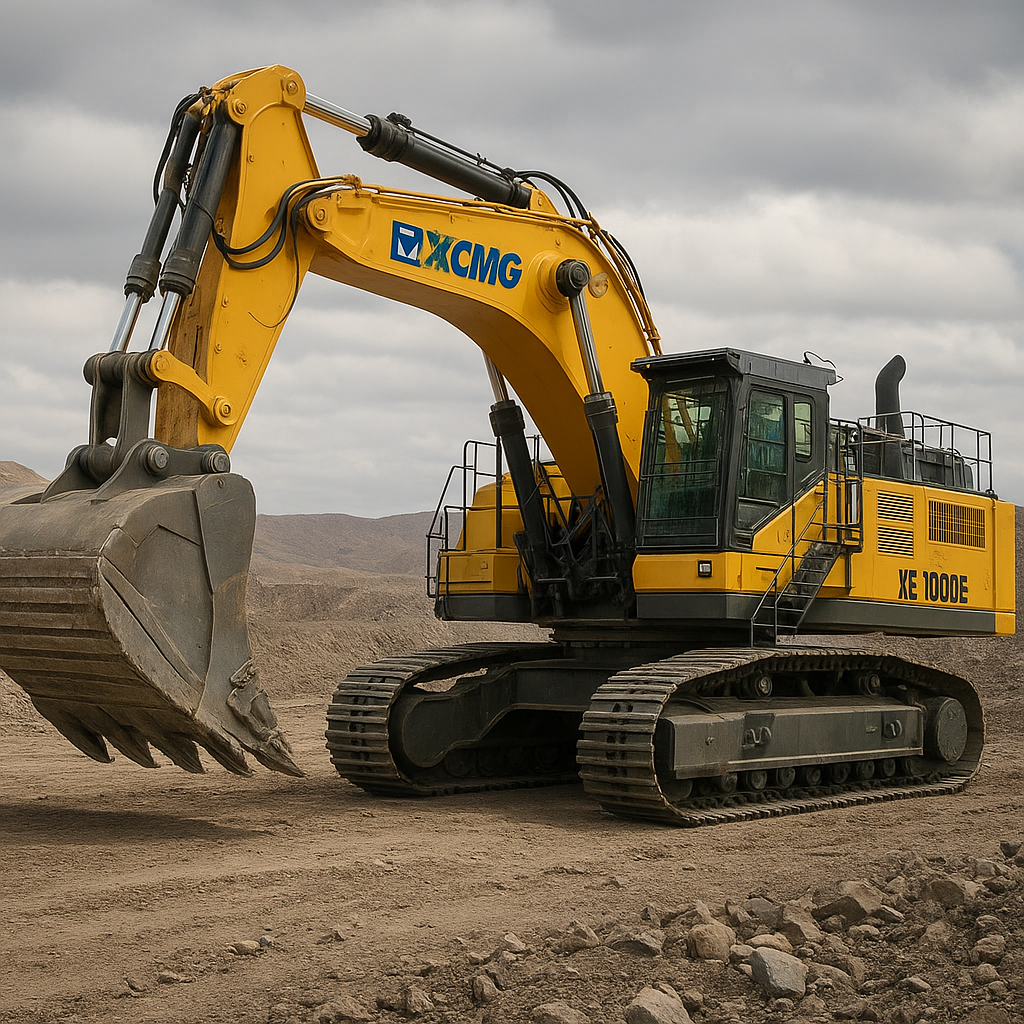
The XCMG XE7000E is a heavy-duty hydraulic mining excavator designed for large-scale open-pit and surface mining, quarrying and earthmoving projects. Combining robust structural design, modern hydraulics and operator-focused ergonomics, the XE7000E targets operators who require high productivity, reliable performance and competitive life-cycle costs. Below you will find an in-depth look at its design, typical specifications, principal uses, advantages and operational considerations.
Overview and design philosophy
XCMG’s approach to the XE7000E emphasizes a balance of power, durability and serviceability. The machine is intended to compete in the large excavator segment by offering a design that accommodates sustained heavy duty cycles typical in mining operations. Several design priorities are evident:
- Robust undercarriage and structural components engineered for high stress and long fatigue life.
- Powertrain and hydraulic systems sized to deliver steady bucket filling, high digging force and predictable control.
- Operator comfort and visibility to improve on-shift productivity and reduce fatigue.
- Ease of maintenance and service access to lower downtime and total operating cost.
Structurally, the XE7000E typically uses heavy box-section booms and arms, reinforced swing frames and a crawler undercarriage with wide shoes suitable for uneven, abrasive terrain. The machine’s hydraulic architecture typically incorporates large main pumps, robust valves and heat dissipation systems sized for continuous operation in harsh environments.
Key technical characteristics (typical ranges and features)
Exact specifications for the XE7000E can vary by configuration, market and optional equipment packages. The values below reflect typical attributes for excavators in this class and can be used as a reference point when considering the XE7000E for a project.
Powertrain and hydraulics
- Engine: A high-output diesel engine optimized for mining workloads, with electronic controls for fuel injection and emissions management. Power ratings for machines in the large mining excavator segment typically range from several hundred to over a thousand kilowatts depending on class and configuration.
- Hydraulic pumps: Large displacement axial piston pumps or variable-displacement pumps to supply sustained flow at required pressures for heavy digging cycles.
- Heat management: Heavy-duty cooling packages, often with multi-core radiators and thermostatic control to manage temperature during prolonged high-load operation.
Operating mass and bucket capacity
- Operating weight: Excavators in the heavy mining class vary widely. The XE7000E is positioned as a high-capacity machine; its operating weight is designed to ensure stable digging performance and good cycle times when equipped with typical mining buckets.
- Bucket capacity: Configurable according to material density and mine loading systems. Typical capacities in large mining excavators span several cubic meters to tens of cubic meters, selected to match truck fleet size and material characteristics for optimal loading efficiency.
Digging performance and reach
- Breakout force: The hydraulic system and boom geometry produce significant breakout and crowd forces for efficient penetration of compacted overburden or ore.
- Reach: Boom and arm lengths are offered in configurations to match digging depth and truck loading heights. Designs aim to minimize cycle times and maximize truck-loading fill factors.
Operator station and control systems
- Ergonomically arranged cab with HVAC, suspension seating and wide glass areas for visibility.
- Intuitive joystick controls, adjustable consoles and digital instrument displays that provide machine diagnostics, fuel consumption and hydraulic parameters.
- Optional operator-assist systems such as payload weighing, camera systems and proximity detection improve safety and efficiency.
Applications and typical working environments
The XE7000E is primarily suited for the following situations and environments:
- Open-pit mining: Loading large haul trucks and feeder conveyors in primary and secondary excavations where continuous heavy digging is required.
- Quarry operations: Removing overburden and extracting rock or aggregate, where high production rates and tool durability are essential.
- Large earthmoving projects: Bulk cut-and-fill construction, dam and canal works that require large-scale material displacement.
- Stockpile and reclamation: Handling bulk materials in port terminals and reclamation sites, particularly where material flow and throughput matter.
In each of these roles, the XE7000E aims to deliver consistent production with efficient loading cycles and a design that can be adapted to regional conditions—such as extreme temperatures, dusty environments or high altitudes—through appropriate options and service strategies.
Operational advantages and productivity
When configured and operated correctly, the XE7000E provides a number of operational benefits valuable to mining and large earthmoving operations:
- High payload handling — matched to truck fleets to maximize fill factor and reduce truck idle times.
- Stable cycle times — hydraulic and structural design focuses on consistent heaping and filling of buckets.
- Serviceability — ground-level service points, modular components and accessible filters reduce routine maintenance time.
- Operator ergonomics — modern cabs reduce operator fatigue, helping sustain output over long shifts.
Productivity in mining depends not only on the excavator itself but on the system it operates within: haul truck size and speed, material characteristics, bench design and operator skill. Selecting the right bucket size, arm/boom geometry and hydraulic tuning is essential to achieve target cycle times and minimize fuel per tonne of material moved.
Maintenance, reliability and life-cycle cost
Reliable performance over years of heavy operation is a central concern for fleets investing in large excavators. The XE7000E emphasizes the following areas to control life-cycle cost:
- Component durability — heavy-duty pins, bushings and wear components specified to extend service intervals in abrasive environments.
- Modular maintenance — commonality of parts across the product family (where applicable) to simplify stocking of spares and shorten repair times.
- Monitoring systems — onboard telematics and diagnostic tools to plan preventative maintenance and track machine health indicators.
- After-sales support — local dealer networks and planned maintenance programs are critical for minimizing unplanned downtime.
Planned maintenance intervals typically include daily inspections, periodic hydraulic fluid and filter changes, and scheduled major service tasks. The total cost of ownership is driven by fuel consumption, component wear, operator efficiency and support infrastructure—factors that operators should evaluate during procurement decisions.
Safety features and operator considerations
Mining environments place elevated demands on machine safety. The XE7000E incorporates structural and system-level features aimed at protecting personnel and equipment:
- High-visibility cab placement with guard rails and safe access ladders to reduce fall risk during ingress/egress.
- Fire suppression system options for high-risk sites, and emergency shutdown circuits for rapid isolation of the powertrain and hydraulics.
- Electronic interlocks and limiters to prevent unsafe swing or boom movements near personnel or infrastructure.
- Integrated cameras, proximity sensors and operator alerting systems to reduce collision and entrapment hazards.
Operator training remains a vital element. Even with advanced aids, competent operators produce better outcomes in terms of safety, fuel use and wear management.
Market position, adoption and statistical observations
While specific commercial sales figures for the XE7000E may vary by region and are typically reported by manufacturers or regional dealers, several broader market observations apply:
- The global demand for large hydraulic excavators is closely tied to commodity prices, mining capital expenditure cycles and infrastructure spending.
- Manufacturers like XCMG have pursued aggressive global expansion, offering high-capacity machines at competitive price points compared with traditional incumbents in the large-excavator space.
- Adoption of machines like the XE7000E often increases in regions where local support networks are present and where operators can obtain parts and service reliably.
Typical performance metrics operators monitor include tonnes per hour loaded, fuel consumption per tonne, mean time between failures (MTBF), and parts replacement intervals. When comparing machines, it is advisable to request field performance data such as fuel burn under similar operating cycles and payload achieved against truck target volumes.
Environmental and efficiency considerations
Modern excavators increasingly incorporate features to reduce environmental impact and improve operating efficiency:
- Engine efficiency and emissions controls to meet regional regulatory requirements and reduce fuel consumption.
- Hydraulic system optimization—load-sensing hydraulics, variable pumps and intelligent control strategies can cut wasted energy.
- Design for recyclability and use of materials and finishes that facilitate component reuse or recycling at end-of-life.
In many mine sites, fleet-level strategies (including optimized truck-excavator matching and route planning) have a greater environmental effect than incremental machine-level improvements. Nonetheless, improved hydraulics and engine tuning in a machine like the XE7000E contribute meaningfully to reduced fuel per tonne moved.
Customization and optional systems
To fit diverse operational needs, the XE7000E can be offered with a variety of options and attachments:
- Multiple bucket types and sizes (general purpose, rock, heavy-duty waste) to match material abrasiveness and density.
- Hydraulic hammer or grapple attachments for multi-role use in demolition or material handling contexts.
- Advanced telematics packages for remote monitoring, payload management systems and integration with fleet management platforms.
- Cold-weather or hot-climate kits to maintain performance in extreme ambient conditions.
Choosing the correct configuration ensures that the excavator works efficiently within a site’s operational model and maintenance capability.
Practical procurement and deployment advice
When considering the XE7000E for purchase or rental, operators typically evaluate several practical factors:
- Site compatibility — ensure carriage width, transport dimensions and ground pressure are compatible with access roads and bench conditions.
- Truck fleet match — select bucket size and cycle strategy to match haul-truck capacities for optimal payload and minimized cycle inefficiency.
- Support network — assess local dealer and parts availability for timely service and major component support.
- Resale and lifecycle planning — consider the machine’s expected resale value, refurbishability and the availability of used components over time.
Field trials or pilot programs can be especially valuable in large procurements, allowing a project to validate cycle times, fuel burn and maintenance needs under local conditions before committing to a larger fleet order.
Conclusion
The XCMG XE7000E represents a class of large hydraulic mining excavators that emphasize a combination of heavy-duty structural design, hydraulic capacity and operator-focused features. Its strengths lie in robust productivity potential, adaptable configurations and a focus on serviceability, which are critical for mining and large-scale earthmoving operations. While specific numeric specifications can vary with configuration and should be confirmed with official manufacturer documentation or local dealers, the machine is intended to serve demanding environments where consistent loading, reliable operation and manageable life-cycle costs are priorities.
XCMG, XE7000E, mining, excavator, bucket capacity, digging force, productivity, fuel efficiency, maintenance and safety are central themes when evaluating this machine for a fleet. Prospective buyers should request detailed technical data, site-specific performance references and a total-cost-of-ownership analysis to ensure the XE7000E fits their operational goals.


)
)