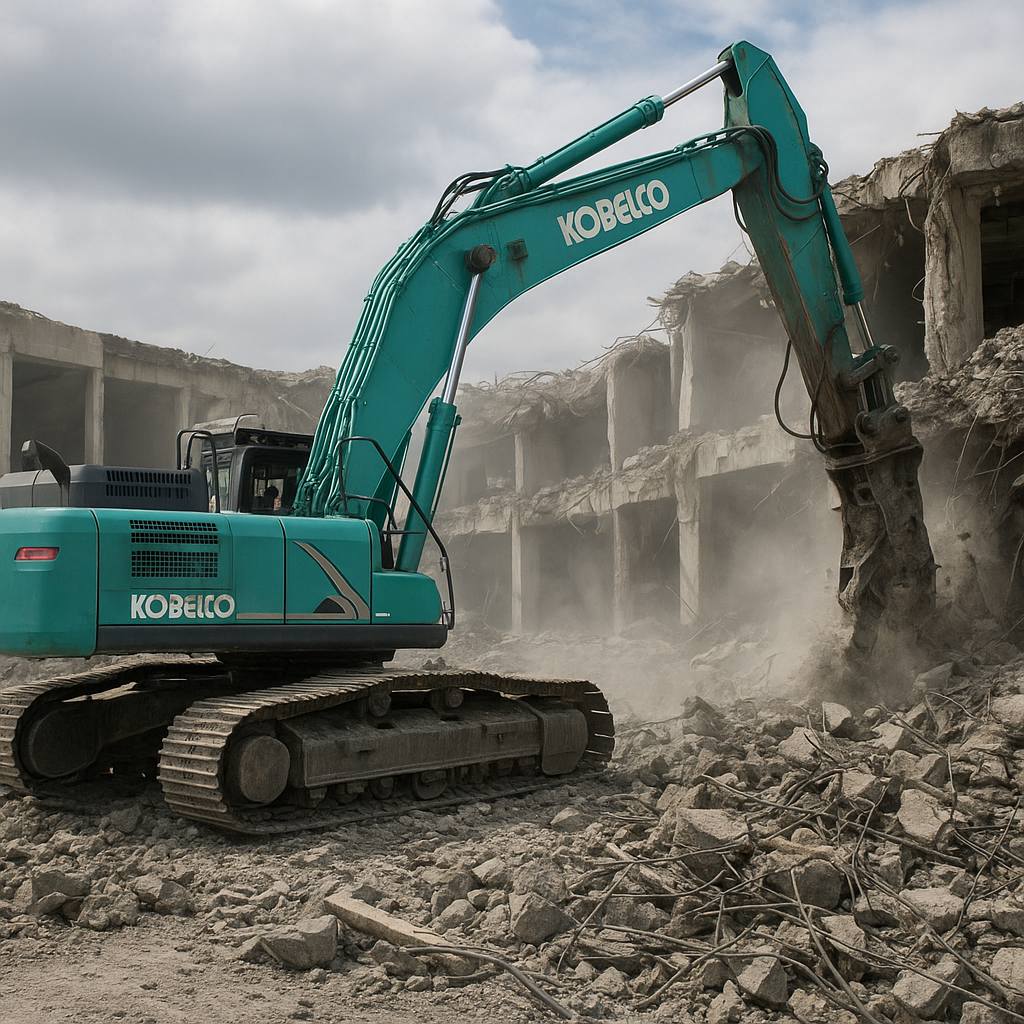
The Kobelco SK550D, in its demolition configuration, is a heavy-duty hydraulic excavator designed to meet the demanding requirements of modern dismantling, selective demolition and large-scale site preparation. Combining robust structural design, adaptable attachment options and operator-focused features, this machine is widely used where controlled, efficient and safe removal of structures and material handling are required. The text below examines its construction, typical uses, technical considerations, safety and maintenance aspects, and practical information for fleet managers and operators. Wherever technical figures are given they are indicated as typical ranges for this class of machine; for precise model-year specifications consult official Kobelco documentation or supplier specification sheets.
Overview and design principles
The SK550D is built around a heavy-frame undercarriage and an upper structure engineered for durability under high stress. Its architecture emphasizes three core principles: structural strength to resist repeated impact and lateral loads during demolition, hydraulic capacity to power demanding attachments, and cabin ergonomics to protect and enable the operator.
- Reinforced boom and arm options are a hallmark of demolition versions: these components are often thicker, with additional bracing and special pins to resist side loads and fatigue.
- High-flow hydraulic systems deliver continuous power to attachments such as shears, pulverizers and crushers; hydraulic circuits are typically designed with priority and safety valves to prevent overloads.
- Modular attachment compatibility allows the SK550D to switch between a wide array of tools, making it a multipurpose asset on demolition sites.
The machine’s chassis is designed to support heavy counterweights required for long-reach or high-lift demolition. Tracks and rollers are selected to provide stability on uneven surfaces and in material piles, while the upper structure often incorporates additional guarding and optional protective cages around the cab and hydraulic lines to mitigate flying debris and impact hazards.
Key technical characteristics (typical for the class)
Exact figures vary by configuration (standard excavator vs. demolition/long-reach variants) and model year. The numbers below represent typical ranges for a machine in the SK550 class and should be used as a general reference.
- Operating weight: roughly 45–60 tonnes (45,000–60,000 kg) depending on counterweight and attachment fitment.
- Engine power: commonly in the range 250–350 kW (335–470 hp); engines in this class are tuned to deliver steady torque for hydraulic work.
- Hydraulic flow and pressure: high-flow main pumps with system pressures often between 280–350 bar, and combined flow rates tailored for heavy attachments.
- Reach (long-reach configuration): standard demolition sticks can extend reach to around 12–16 m, while purpose-built long-reach setups may reach 18–24 m or more for selective dismantling.
- Bucket capacity (standard earthworks): 1.0–2.5 m3, though demolition tools have different volumetric metrics and are specified by tool type rather than traditional bucket capacity.
Manufacturers equip the SK550D with emission-compliant engines appropriate to the market and model year (e.g., Stage/ Tier standards). Fuel efficiency for the class benefits from hydraulic load-sensing systems and electronic engine management, which can reduce fuel burn during idling and partial-load cycles typical of demolition work.
Primary applications and attachments
As a demolition-oriented machine, the SK550D is used across a wide set of tasks that require controlled dismantling, heavy material handling and site clearance. Its adaptability comes largely from attachment options and the capacity to reconfigure booms and arms.
Common applications
- Urban building demolition — selective dismantling of multi-story structures where precision and minimal collateral damage are critical.
- High-reach demolition — removing upper stories and roof structures safely from ground level using long-reach booms and specialized racks.
- Concrete processing and recycling — primary and secondary breaking, sorting and loading of recyclable material into containers and screening plants.
- Industrial dismantling — removal of steel frameworks, tanks and heavy equipment in manufacturing plants and power stations.
- Scrap and bulk handling — using grapples and magnets for moving recyclables and loose materials in yards and ports.
Typical attachments
- Hydraulic shears — for cutting steel beams and rebar.
- Concrete pulverizers and crushers — for reducing concrete to manageable sizes.
- Hydraulic breakers (hammers) — for heavy breaking in foundations and hard materials.
- Sorting grapples and hydraulic thumbs — for precise material handling and sorting of debris.
- Rotating demolition heads — specialized tools combining cutting and crushing actions for complex dismantling.
- Quick couplers — to accelerate tool changes on busy sites.
Attachment selection depends on the job: a high-reach demolition of a multi-storey building will prioritize a long stick, reinforced boom and shears, while site clearance may favor grapples and magnets for speed and versatility.
Operator ergonomics, controls and safety features
Operator safety and efficiency are central to the SK550D design. Long hours and precision tasks require an ergonomic, well-protected working environment.
- Cab protection: Many demolition versions come with optional ROPS/FOPS-certified cages, heavy-duty windscreen guards, and armored doors to protect operators from falling debris.
- Visibility and camera systems: Large glazed areas and optional multi-view camera packages improve sight lines around the machine, which is essential during complex demolition sequences.
- Comfort features: Air-suspension seats, climate control, noise reduction measures and intuitive joystick layout reduce operator fatigue and increase precision.
- Hydraulic safety: Lockout valves, pressure relief systems and load-holding hydraulic circuits prevent unintended drops or tool failures.
- Operator aids: Some configurations offer electronic monitors that display machine status, diagnostics and load limits; programmable auxiliary circuits simplify tool operation.
On structured demolition sites, the SK550D can be fitted with fall-protection anchors and integrated lighting to enable safe night work. Emergency egress and fire-suppression options are also available as factory or aftermarket additions depending on local regulations and job risk assessments.
Maintenance, uptime and lifecycle costs
For large machines like the SK550D, lifecycle cost management is as important as purchase price. Planned maintenance, timely replacement of wear parts and proper operator training extend service life and maximize uptime.
Maintenance best practices
- Follow scheduled hydraulic oil, engine oil and filter changes and use manufacturer-recommended lubricants to prevent accelerated wear.
- Inspect pins, bushings and welds frequently, especially on boom/arm assemblies subject to cyclic stress.
- Monitor undercarriage wear and adjust track tension as required; heavy-duty tracks and undercarriage components are often necessary on demolition sites with abrasive debris.
- Use condition monitoring and diagnostic systems where available; early detection of hydraulic leaks or engine issues prevents costly downtime.
Regularly replacing wear components and using correct operating procedures significantly reduces the risk of catastrophic failures. On high-hour demolition machines, expect major overhauls of the upperstructure and attachment interfaces after several thousand hours if the machine is used intensively.
Fuel and operating costs
Hydraulic excavators of this class are fuel-intensive when operating at high hydraulic loads, but modern electronic engine controls and load-sensing hydraulics improve efficiency. Operators who minimize idle time, use appropriate gear ranges and optimize attachment selection can lower fuel consumption substantially. Lifecycle cost calculators typically show that maintenance and fuel together account for the majority of total cost of ownership (TCO) after acquisition cost.
Transport, setup and regulatory considerations
Moving a machine in the 50-ton class requires planning. Transport dimensions, road permits, disassembly of long booms and counterweight removal are standard procedures to comply with legal and safety requirements.
- Transport: Many demolition versions require partial disassembly (removal of long reach attachments, counterweights) to meet road transport width, length and axle-weight limits.
- Site setup: Establishing a stable base, use of matting or cribbing under tracks, and ensuring adequate bank or slope stabilization are essential before heavy demolition begins.
- Regulatory compliance: Emission standards, noise restrictions and local demolition permitting processes must be observed. Machines that meet the latest Tier/Stage emission categories may be required on certain jobs.
Market context and statistical insights
The SK550D sits in the heavy demolition excavator segment, which is influenced by construction cycles, urban redevelopment projects and industrial decommissioning. Market trends for heavy demolition machines typically follow macroeconomic investment in infrastructure and commercial real estate.
- Fleet composition: Large demolition contractors maintain a mix of standard and long-reach excavators; machines in the 40–60 tonne class are common for mid-to-large-scale urban demolition.
- Utilization rates: Typical annual utilization for such machines varies widely — from a few hundred hours for rental fleets to 2,000+ operating hours per year for high-demand demolition companies.
- Resale value: Well-maintained SK-class machines generally retain a strong resale value due to their versatility and demand across markets. Resale price depends heavily on hours, maintenance history and condition of structural components.
Note: Specific sales volumes and regional market share data fluctuate and are tied to quarterly industry reports. For precise statistical figures on sales and historical resale values, consult industry analytics firms, Kobelco sales reports or equipment auction data services.
Case examples and operational tips
Below are illustrative scenarios showing how the SK550D can be deployed effectively and safely.
Urban multi-storey building dismantling
- Use a long-reach boom with a reinforced stick and shears to remove upper floors progressively, minimizing vibration transmission to adjacent structures.
- Position the machine on reinforced matting on ground level, keeping a safe standoff distance from the structure’s collapse zone.
- Implement dust suppression (water sprays) and debris segregation on site to facilitate recycling.
Industrial plant decommissioning
- Pair the SK550D with heavy shears and magnet attachments for cutting steel and moving scrap efficiently.
- Sequence work to remove hazardous materials first and provide clear lifting paths for large components.
Practical operator tips
- Program hydraulic auxiliary flow to match the attachment — over-pressurizing or using incorrect flow settings can damage tools and hoses.
- Perform daily walk-arounds to spot hydraulic leaks, loose guardings, or cracked welds; early detection prevents downtime.
- Train operators in attachment-specific techniques: for example, shears require different swing and leverage strategies than crushers or breakers.
Strengths, limitations and procurement considerations
Understanding where the SK550D excels and where alternatives might be preferable helps in procurement and fleet planning.
- Strengths: High structural durability, versatility with attachments, stable platform for long-reach work and good operator protection options.
- Limitations: Size and weight make access to tight urban sites more challenging; transport costs and site setup time can be significant. For specialized super-high-reach jobs, purpose-built long-reach variants or attachment-specific machines might outperform a general SK550D configuration.
- Procurement tips: Evaluate total cost of ownership (purchase, transport, maintenance, fuel), and consider factory-fit demolition packages to ensure integrated guarding and hydraulic plumbing for attachments.
Environmental and sustainability aspects
Demolition projects increasingly prioritize recycling and reduced environmental impact. Machines like the SK550D contribute by enabling on-site processing of concrete and steel, reducing haul distances and facilitating material segregation. Additionally, modern engines and hydraulic systems can lower fuel consumption and emissions relative to older machines.
- On-site recycling reduces landfill demand and transport emissions.
- Regular maintenance and engine calibration improve combustion efficiency and reduce particulate emissions.
- Retrofitting LED lighting and efficient auxiliary pumps reduces electrical and hydraulic energy waste during low-load tasks.
Conclusion and recommendations
The Kobelco SK550D in demolition specification is a robust, adaptable machine suited to a wide range of dismantling and material-handling tasks. Its combination of reinforced structure, powerful hydraulics and operator protection makes it a reliable choice for contractors engaged in urban demolition, industrial decommissioning and large-scale recycling operations. When considering acquisition, focus on real-world operating scenarios: select the appropriate boom/arm configuration, verify hydraulic flow compatibility with intended attachments, and plan for transport and site-preparation costs. Proper maintenance, operator training and attachment selection are the keys to maximizing productivity and extending machine life.
Final practical checklist before deployment:
- Confirm machine weight and dimensions for transport permits and site access.
- Match hydraulic flow and pressure to selected demolition attachments.
- Specify cab protection and undercarriage options for the expected debris environment.
- Schedule preventive maintenance and ensure spare parts availability for pins, bushings and seals.
- Train operators on demolition-specific techniques and safety procedures.
The SK550D remains a strong candidate for companies that require a heavy, flexible excavator capable of handling demanding demolition tasks while offering options to optimize safety, efficiency and lifecycle economics.


)
)