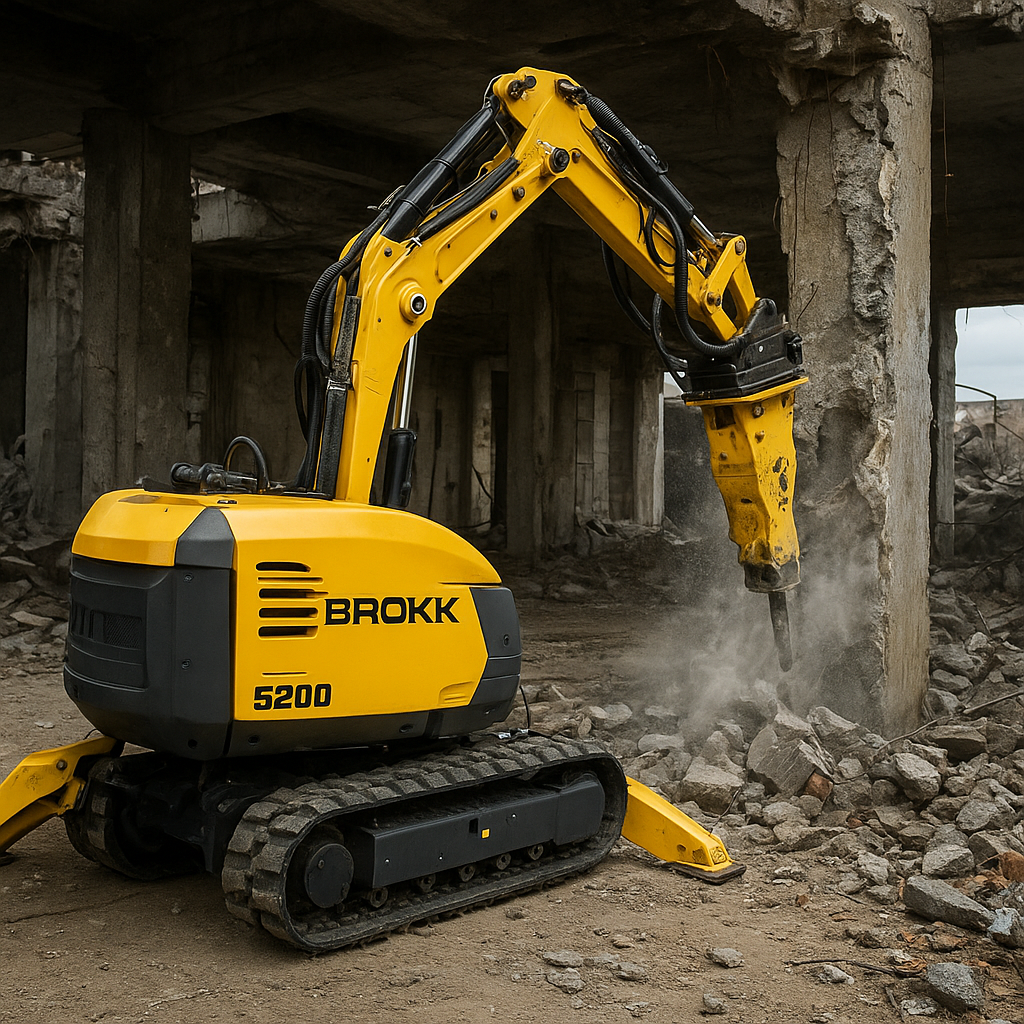
The Brokk 520D is a heavy-duty remote-controlled demolition machine that blends compact design with high-power hydraulics to tackle demanding demolition, renovation and civil-engineering tasks. Designed for environments where human access is limited or hazardous, this robotic platform extends the reach and capability of traditional demolition equipment while significantly improving safety, productivity and precision. The following article explores the machine’s design, typical applications, operational advantages, maintenance needs and market considerations.
Design and technical overview
The Brokk 520D belongs to Brokk’s large-class lineup of demolition robots. It is engineered to deliver robust performance in heavy demolition scenarios while retaining the benefits of a remote-operated platform. The “D” suffix commonly designates a diesel-powered variant, giving the machine autonomy and a feature set suited for outdoor and remote sites where electric power may not be available.
Core components
- Primary structure: A heavy-duty, crawler-mounted chassis provides stability on uneven surfaces and allows the machine to enter restricted zones where larger excavators cannot. Tracks and low ground pressure keep damage to flooring and substrates minimal.
- Hydraulic boom and tool interface: A multi-section articulated boom offers a combination of reach and maneuverability. The hydraulic quick-coupler accepts a wide array of attachments — breakers, crushers, shears, grapples, drum cutters and buckets — enabling fast tool changes and versatility on site.
- Power system: As a diesel variant, the 520D carries an onboard engine driving a hydrostatic system. This arrangement yields continuous high hydraulic flow and pressure for heavy tools, and allows operation where AC power is unavailable.
- Remote control and electronics: Operators control the robot via a radio remote with proportional joysticks, switches and often a display for status indicators. Many units can be equipped with cameras, floodlights and sensors to improve situational awareness when the operator is located a distance from the machine.
Typical technical characteristics (approximate)
Manufacturers frequently update specifications, and exact values vary by configuration. Below are representative figures for a machine in this class (figures should be verified against current official datasheets):
- Operating weight: approximately 5,200 kg (model-dependent)
- Maximum reach (arm fully extended): up to ~8 meters
- Hydraulic system: high-flow hydraulics for continuous heavy-tool operation
- Track width and ground pressure: engineered for stability while minimizing substrate damage
- Transport dimensions: designed to fit on common low-bed trailers for road transport
These characteristics position the Brokk 520D in the heavy category of remote demolition robots — powerful enough to replace small excavators in some contexts while retaining access advantages and the safety profile of remote operation.
Primary applications and use cases
The Brokk 520D is tailored for tasks where conventional demolition crews would face safety hazards, restricted access, or inefficient manual labor. Key application areas include:
Construction and building demolition
- Interior strip-outs and floor removal where operator safety is a concern.
- Precision demolition of load-bearing elements in staged takedowns, where controlled force and reach are advantageous.
- High-rise building façades and confined spaces where the remote robot can access areas that personnel or larger machines cannot.
Infrastructure, tunnelling and civil engineering
- Tunnel refurbishment: lining removal, rail-bed modifications and portal works benefit from the robot’s low profile and powerful attachments like drum cutters and multi-tool interfaces.
- Bridge repairs and concrete removal in tight or hazardous environments.
- Road and civil maintenance where reduced site footprint and improved operator safety are important.
Industrial demolition and decommissioning
- Plant shutdowns and refurbishment: working in confined industrial halls, processing plants and petrochemical facilities where remote operation lowers exposure to risks.
- Nuclear and hazardous-environment decommissioning: the robot’s remote capabilities reduce human exposure to contamination and radiation (when additional protective measures are used).
Mining and quarrying support
- Selective rock removal, clearing of unstable overhangs in underground mines, and tasks in confined spaces where cabless remote operation is an advantage.
Emergency response and rescue
- Collapsed structures, unstable environments and post-disaster scenes where robots can enter zones too dangerous for manual crews.
Across these applications, the core benefits of a machine like the Brokk 520D include the ability to operate continuously with powerful hydraulics, exert significant force through attachments, and protect operators by keeping them at a safe distance from falling debris, dust and noise.
Operational features and advantages
Operators and site managers choose robots such as the Brokk 520D for several tangible operational advantages. These benefits are often the deciding factor when comparing traditional methods to robotic demolition.
Safety and risk reduction
- Remote operation: Operators control the robot from a safe distance, reducing exposure to falling debris, dust, toxic atmospheres and noise. Many systems include fail-safes and emergency stop features.
- Reduced need for scaffolding and manual work at heights, lowering the risk of falls and related injuries.
Efficiency and productivity
- The robot’s hydraulics deliver continuous power, allowing heavy tools to operate longer without the fatigue issues human crews face.
- Quick attachment changes and precise control translate into faster cycle times for repetitive tasks like breaking and sorting.
- Remote operation enables a single operator to perform work that would otherwise require several crew members.
Versatility and attachments
- Standard attachments include hydraulic breakers, crushers, pulverizers, concrete shears, grapples and drum cutters. Specialty tools can be fitted for unique tasks.
- Attachment modularity makes the machine adaptable across many job types — from coarse-breaking concrete to selective cutting for salvage operations.
Access and mobility
- Low-profile design and track-based mobility let the robot navigate confined areas, narrow ramps and interior floors without the footprint or weight of larger excavators.
- Transportability on standard trailers enables rapid redeployment between sites.
Safety systems, operator ergonomics and controls
Safety architecture is central to the Brokk 520D’s value proposition. Manufacturers incorporate multiple layers of protection to ensure predictable behavior and quick operator intervention.
- Emergency stop systems interrupt hydraulic flow and engine power to bring the robot to a safe state instantly.
- Redundant control channels and watchdog systems reduce the risk of runaway motion from electronic faults.
- Optional camera systems, thermal sensors and floodlights improve visibility and situational awareness for operators working at a distance.
- Ergonomically designed radio remotes with proportional control reduce operator fatigue and improve precision. Some systems include full-color displays with diagnostics, warnings and maintenance prompts.
Maintenance, lifecycle and total cost of ownership
Like any heavy equipment, the Brokk 520D requires scheduled maintenance to achieve reliable performance and a long service life. Machine owners evaluate not only the purchase price but also operating costs, downtime risks and resale value.
Routine maintenance tasks
- Hydraulic fluid and filter changes according to service intervals.
- Track and undercarriage inspections and adjustments.
- Engine servicing for diesel models: oil, fuel and air filter replacements, and fuel-system checks.
- Attachment inspection: wear parts (e.g., breaker chisels, shear blades) must be monitored and replaced to maintain productivity.
Support and parts logistics
A robust dealer network and rapid access to replacement components reduce downtime. Many operators value manufacturer-backed service plans, on-site training and remote diagnostics to optimize uptime.
Economic considerations
While upfront costs for a heavy demolition robot are significant, the total cost of ownership can be favorable when factoring:
- Reduced labor costs due to smaller crews.
- Lower insurance and liability exposure thanks to improved site safety.
- Faster project completion and less secondary damage to structures due to precise operation.
Environmental and regulatory aspects
Environmental performance depends on configuration and operating practices. Diesel-powered models like the 520D offer mobility but require attention to emissions, fuel handling and noise.
- Emissions compliance: operators should ensure engines meet local emissions standards and consider retrofits or alternative power options where necessary.
- Dust suppression: demolition activities generate dust; integrating water-spray systems or local extraction helps meet site and regulatory requirements.
- Noise mitigation: remote operation does not eliminate noise at the workface; hearing protection and scheduling practices can reduce community impact.
Market presence, case studies and statistical context
Robotic demolition equipment has seen increasing adoption globally in the past decade as projects demand safer, more precise and cost-effective alternatives to manual demolition. While exact market penetration varies by region and industry, a few trends are notable:
- Growth in urban construction and renovation is driving demand for compact, high-power machines able to work in constrained sites.
- Industrial decommissioning (including hazardous and nuclear sites) favors robotic solutions for safety and contamination control.
- Rental markets for demolition robots are expanding, allowing contractors to access high-capability machines without heavy capital investments.
Case studies often highlight reductions in crew size and incident rates, as well as faster completion times on tasks like concrete floor removal, selective wall demolition and tunnel renovation. Quantitative results depend on job specifics, but many operators report productivity gains in the range of 20–50% compared with manual methods in comparable scenarios, combined with lower exposure to hazards.
Choosing the Brokk 520D: selection criteria
When deciding whether the Brokk 520D (or similar heavy demolition robot) is the right fit for a project, consider:
- Nature and scale of demolition tasks — heavy structural tasks and long reach requirements favor a large robot.
- Site constraints — access, floor load limits and transportation logistics.
- Availability of power — whether diesel autonomy is necessary or an electric variant is preferable for reduced emissions.
- Required attachments — ensure the toolset supports breakers, shears, pulverizers or drum cutters as needed.
- Support and training — dealer service, spare-parts availability and operator training options influence total lifecycle performance.
Future developments and trends
The demolition-robot market is evolving rapidly. Key trends likely to influence machines like the Brokk 520D include:
- Electrification: battery and hybrid powertrains are gaining interest to reduce emissions, noise and operating costs, especially in indoor or urban sites.
- Advanced teleoperation and semi-autonomous features: improvements in sensors, cameras and control algorithms may enable assisted tasks, automated repetitive motions and remote diagnostics.
- Digital integration: telematics, predictive maintenance and fleet-management systems improve uptime and asset utilization.
- Attachment innovation: more specialized tools expand the number of tasks a single platform can perform, increasing versatility and return on investment.
Conclusion
The Brokk 520D exemplifies how remote-controlled demolition robots bring together powerful hydraulics, compact footprints and operator-protecting remote systems to address the demands of modern demolition, renovation and industrial decommissioning. Its strengths lie in delivering heavy-duty performance in environments that would be hazardous, inefficient or inaccessible for manual crews or traditional construction equipment. When chosen and operated appropriately — with attention to maintenance, logistics and environmental controls — machines in this class can improve project efficiency, lower risk and expand the range of feasible demolition strategies.
Note: Technical specifications and performance figures can vary by model year, configuration and attachments. For precise data, verify the latest manufacturer datasheets and consult authorized dealers for configuration-specific information.


)
)