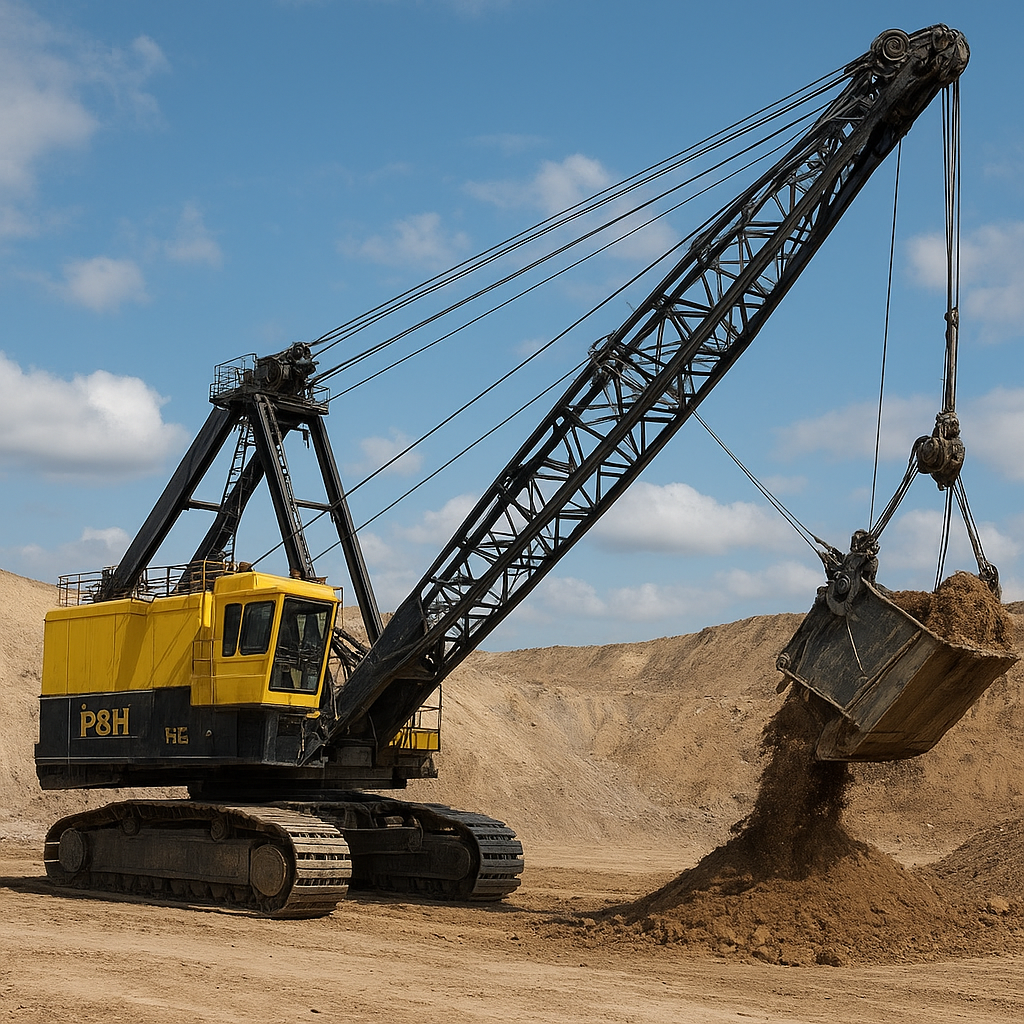
The P&H 9020C is a heavyweight representative of the class of large-scale cable-operated excavators known as draglines. Built for continuous, high-volume removal of overburden and other surface-material handling tasks, this machine combines a robust structural design with heavy-duty electrical drives and a cable system engineered for reliability and long service life. The following article explores the machine’s design features, typical applications, operational considerations, economic and environmental implications, and practical statistics and performance estimates where available.
Design and technical characteristics
The P&H 9020C is a purpose-built machine that exemplifies the core principles of dragline design: long reach, high-capacity excavation, and durable, low-cycle wear components. At its heart, the dragline uses a large fabric or steel bucket attached to a system of ropes and pulleys. The bucket is dragged across the surface to fill, then hoisted and swung to dump the load at a spoil pile or truck loading area.
Structure and boom
- The frame and superstructure are engineered to support the loads transmitted by the boom, bucket, and ropes. Typically, the boom is a lattice-type structure to provide maximum stiffness at minimum weight, enabling very long spans without excessive weight penalties.
- Boom length on machines in this class usually ranges from medium to very long spans to maximize reach; this allows spoiling at a distance from the cut and reduces the need to reposition the machine frequently.
- The boom, sheaves, and mounting points are designed for high fatigue life and inspection access; modern units can be fitted with health-monitoring sensors.
Bucket, ropes and hoist system
- The bucket on a P&H 9020C is large, designed for high payloads and to resist abrasive wear. Typical dragline buckets are lined with replaceable wear packages and tooth systems that can be renewed in the field.
- The dragline uses separate rope systems for hoist, drag, and crowd. Ropes are typically high-strength steel wire ropes chosen for fatigue resistance and rated safety factors.
- The hoist and drag winches are electrically driven, often with variable-frequency drives for precise control of speed and torque.
Power and control
- Electric drive systems are standard for large draglines: these provide high torque, good part-load efficiency and are easy to integrate with modern control systems. Power may be supplied by on-board diesel generators or, more commonly in large mines, by a dedicated substation and electrical supply.
- Control systems have evolved to include operator ergonomics, programmable cycle control, remote monitoring and diagnostics, and sometimes semi-automated functions to improve consistency of digging and dumping.
Mobility and foundation
- Large draglines are usually either walking or sled-mounted. The P&H 9020C typically uses a walking mechanism—heavy plates that alternately lift and move the machine in small increments—allowing the machine to relocate without a prepared foundation.
- Walking systems are powerful but require careful geotechnical planning: ground stability, bearing capacity and movement frequency all impact operational logistics and maintenance.
Applications and operational roles
P&H 9020C draglines are built for high-volume surface applications where reach and bulk excavation are more important than precision digging. Their primary uses include:
- Surface mining and overburden removal — The most common application is in coal and lignite surface mines where vast quantities of overburden must be removed to expose the ore seam.
- Large-scale earthmoving in civil works — For projects that require moving millions of cubic meters of material, such as reservoir construction or surface infrastructure earthworks, draglines bring economy of scale.
- Oil sands and tar sands surface mining — In some operations, draglines contribute to bulk removal of unconsolidated materials at low cost per ton.
- Reclamation and spoil handling — Their ability to place spoil at a distance makes them suitable for constructing spoil banks and reclaiming mined-out areas.
Operational advantages
- High single-pass volume: by design, draglines move large volumes per cycle, giving low cost-per-ton in suitable material conditions.
- Extended reach: a single machine can serve a wide bench face, reducing the need for multiple shovels or trucks near the cut.
- Low wheel/undercarriage wear: unlike wheeled or tracked shovels, draglines walk slowly and have relatively low frequent-moving wear on traction elements.
Operational limitations
- Sensitivity to geology: draglines are best in soft to moderately cohesive materials. Hard rock, large boulders or frozen ground can drastically reduce productivity and increase wear.
- Lower precision: draglines are inherently less precise than hydraulic excavators and are not ideal for selective mining or fine-grained exposure of ore.
- Large footprint: they require substantial swing and spoil space and complex logistical planning for relocation.
Performance, statistics and productivity estimates
Exact published specifications for specific P&H models vary with customer configuration, but performance characteristics for machines in the 9020 class can be estimated and illustrated with reasonable assumptions. When using these figures operational planners should always consult manufacturer data sheets or field performance records.
Bucket capacity and cycle productivity
- A machine designated 9020 commonly indicates a large bucket class; many machines in the 9000 series use buckets in the range of tens to low hundreds of cubic yards. An illustrative estimate for a P&H 9020C bucket capacity might be on the order of 60–100 cubic yards (roughly 46–76 cubic meters), depending on the lining, material and specific customer ordering.
- Practical productivity depends on several factors: bucket capacity, fill factor, cycle time (hoist, drag, swing, dump, return), and operability conditions (face geometry, operator skill, and electrical availability).
- Example calculation (illustrative): assuming a 90 yd3 bucket with a 0.85 fill factor gives ~76.5 yd3 per cycle. If the material bulk density is ~1.4 t/yd3, that equates to ~107 t per cycle. At 20 cycles per hour the theoretical hourly output would be ~2,140 t/h. Real-world rates vary widely, and sustained hourly averages will be lower when factoring in repositioning, maintenance and non-productive delays.
Power and energy use
- Large draglines typically require multi-megawatt installed power. The aggregate power for hoist, drag, swing and auxiliary systems can be several megawatts; in many operations the unit is supplied from a dedicated mine substation rather than on-board diesel generation.
- Electric drives with regenerative capabilities or soft-start systems can improve energy efficiency and reduce stress on the electrical network.
Availability and lifecycle metrics
- Availability targets for large mining draglines are typically aimed at 80–90% or higher on well-supported fleets, but actual availability depends strongly on maintenance strategy and supply chain support.
- Major life-cycle elements include rope replacements (rope life expressed in thousands of hours depending on service), gearbox and motor maintenance, and bucket/boom refurbishments. Planned major overhauls are scheduled based on component condition monitoring rather than calendar time alone.
Operation, maintenance and lifecycle management
Because draglines like the P&H 9020C are capital-intensive assets, the heart of their value is found in disciplined operation and predictive maintenance. A well-run maintenance program extends component life, increases availability, and reduces total cost of ownership.
Inspection and preventive maintenance
- Routine inspections focus on ropes, sheaves, boom members, wear surfaces on the bucket and drag chain components, walking mechanism elements, structural welds, and electrical gear.
- Modern fleets implement condition monitoring: vibration analysis on motors and gearboxes, rope monitoring (visual and instrumented), and oil analysis for hydraulic or gear systems where present.
- Fast and well-planned access to critical spares—ropes, winch parts, motor spares, wear liners—is crucial for minimizing downtime.
Major component management
- Bucket and lining replacements are routine and scheduled. Liner and tooth systems are consumables sized for easy replacement in the field.
- Rope handling is a major maintenance concern: wire ropes used on draglines are designed for fatigue resistance but require proper storage, handling and replacement at defined wear or internal damage limits.
- Electrical systems may require periodic upgrades: retrofits to variable-frequency drives, PLCs, and human-machine interfaces are common mid-life investments that extend capability and efficiency.
Safety and training
- Operators require specialized training to handle the unique dynamics of cable-operated digging. Safe operation includes attention to swing area exclusion, rope handling, and emergency-stop procedures.
- Access platforms, fall protection, and lockout/tagout procedures for electrical systems are mandatory elements of the safety program.
Economic and environmental considerations
Draglines are chosen when the economies of scale favor their use: when large volumes of material must be removed over long horizons, and when operating conditions suit a cable-operated bulk mover.
Cost advantages
- Unit cost per cubic meter of material moved tends to be competitive with truck-and-shovel fleets over long-term, continuous operations because of high instantaneous payload and low fuel/energy use per ton moved when supplied by efficient electric networks.
- Lower labor intensity per ton: a single dragline can replace multiple hydraulic shovels and many haul trucks in specific mining configurations.
Environmental impacts and mitigation
- Direct impacts include alteration of surface landscapes, generation of large spoil heaps and potential effects to groundwater if not managed. Reclamation planning is a legal and ethical requirement in most jurisdictions for dragline operations.
- Noise and dust controls are part of operational design: water sprays, staged dumping of spoil to reduce windblown dust, and timing of high-noise operations help minimize local community impacts.
- Electric drives can reduce onsite emissions when power is provided by low-carbon electricity, an increasingly relevant factor as mines seek decarbonization strategies.
Case studies, historical notes and industry context
Draglines have been an iconic part of surface mining for many decades. Machines in the same broad family as the P&H 9020C have enabled large-scale coal production and major earthmoving projects worldwide. The P&H brand has a long history in mining equipment and today exists within larger global mining equipment groups, supplying custom configurations for major mine operators.
Fleet considerations
- Operators of machines like the P&H 9020C often pair them with complementary fleets: dozers for bench and face preparation, water trucks for dust control, and compacting machines for reclaim operations.
- Decision to procure or maintain a dragline is usually based on life-of-mine planning: these machines are long-life assets, often in service for decades with major refurbishments and retrofits.
Historical perspective
- Cable-operated draglines have been progressively improved through stronger materials, more reliable ropes, and refined electric drive systems. Their role shifted from general earthmoving to niche, large-volume operations where their cost advantages are compelling.
- While modern hydraulic shovels have advantages in flexibility and precision, draglines remain unmatched in sheer-volume, long-reach spoil placement for many large surface mines.
Practical advice for potential operators and buyers
Investing in or operating a P&H 9020C-style dragline requires careful evaluation beyond the machine price. Considerations include site geology, long-term production curves, electrical infrastructure, skilled labor availability, spare parts logistics and a planned maintenance regime.
- Conduct detailed geotechnical and material character studies: draglines perform best in softer strata with predictable fragmentation characteristics.
- Plan power supply redundancy and harmonics mitigation in the mine electrical network to support heavy electric loads.
- Implement a robust training program and succession planning for operators and maintenance staff; the value of experienced crews is substantial in maximizing availability.
- Consider retrofit and modernization potential: many older draglines can gain significantly from upgraded controls, monitoring systems and more efficient electrical components.
Summary
The P&H 9020C is emblematic of the class of large draglines that deliver unmatched economies of scale in the right surface-mining and bulk earthmoving environments. With a combination of long reach, high bucket volumes, and electrically driven hoist and drag systems, these machines are central to operations that remove and place massive quantities of material. Operational success depends on careful site matching, disciplined maintenance, and modern control and monitoring systems. Although specific published specification sheets should be consulted for any procurement or operational planning, the general capabilities outlined here show why such draglines remain a powerful tool for large-scale surface excavation.
P&H 9020C dragline bucket capacity boom length electric drive overburden surface mining productivity maintenance safety


)
)