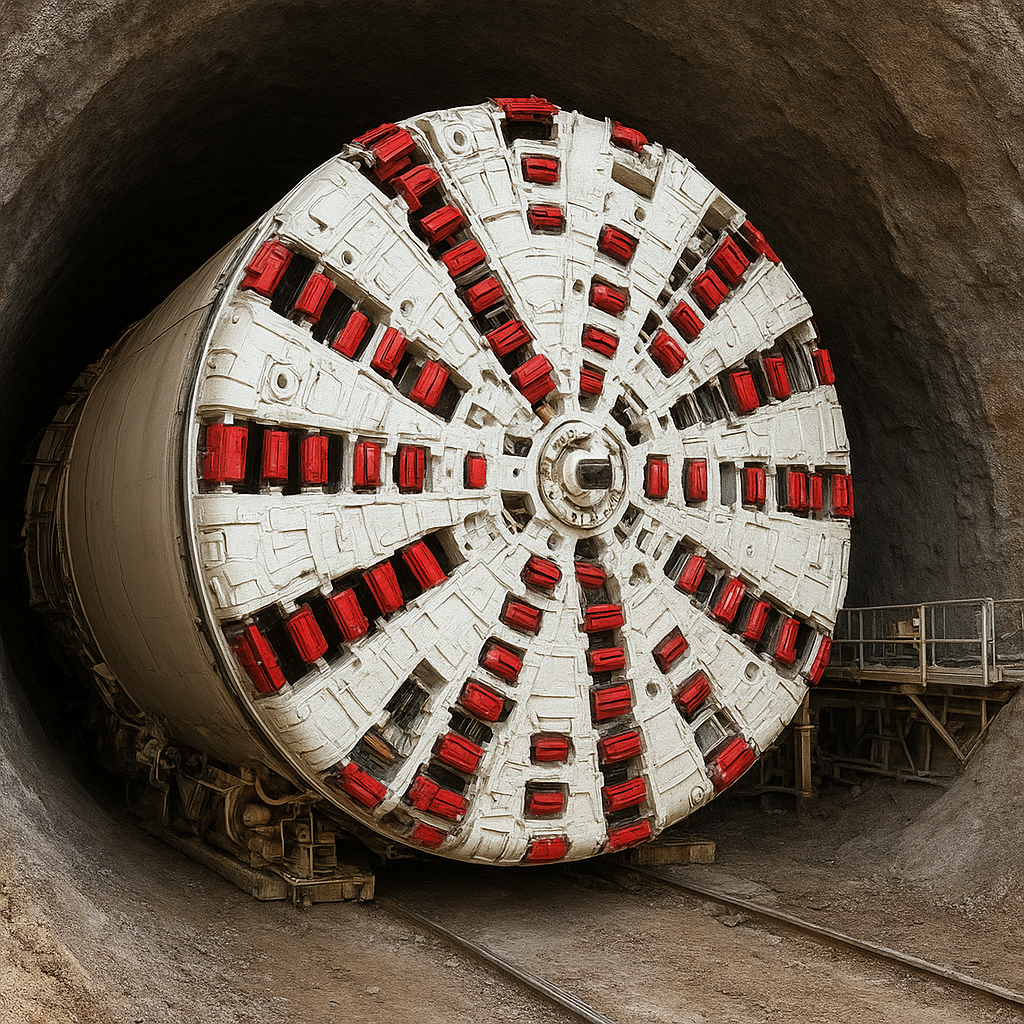
The Hitachi Ø17.6m tunnel boring machine represents a class of very large-diameter mechanized excavators used where underground space requirements exceed conventional tunnel sizes. These giants are designed for ambitious infrastructure projects such as deep metro stations, large road tunnels, subsea crossings and cavernous underground facilities. This article examines the machine’s design principles, typical applications, technical characteristics, operational challenges and the innovations that make such a machine a viable choice for complex tunneling projects worldwide.
Overview and design principles
The term TBM (tunnel boring machine) covers many types and sizes; the Ø17.6m configuration belongs to the category of large-diameter and sometimes classed as “mega” TBMs. A machine of this diameter features a massive rotating cutterhead and an extensive trailing system (backup) that houses support equipment, conveyors, segment erectors and systems for power, ventilation and slurry or soil management. At 17.6 metres outer cutting diameter, the cutterhead sweeps a cross-sectional area of roughly 244 m², enabling excavation of very large circular tunnels or the creation of cavernous spaces in a single bore.
Design choices depend on ground conditions. Two main pressure-balanced types are commonly used for large soft-ground drives:
- EPB (Earth Pressure Balance) TBMs — suited to cohesive soils with controlled moisture; they balance face pressure by using excavated material.
- Slurry TBMs — preferred for very soft soils, high groundwater pressures or mixed-face conditions; they use a pressurized slurry (bentonite) to balance and transport the spoil.
Large-diameter TBMs typically incorporate robust structural frames, high-capacity hydraulic systems for thrust and shield jacking, and redundant safety and monitoring systems. The cutterhead can be equipped with disc cutters for rock, soft-cutting tools for soil, or mixed configurations. The machine must also handle logistics of segmental lining installation: a precast concrete ring system installed immediately behind the shield to provide permanent support.
Applications and project types
TBMs of approximately 17.6 m diameter are used where a single large opening is preferable to multiple smaller tunnels or to extensive underground excavation. Typical applications include:
- Large urban metro stations or tunnels where multiple tracks or station boxes are needed in constrained urban environments.
- Subsea or cross-harbour tunnels carrying roads, rail or utilities under waterways where minimizing surface interruptions and navigational impacts is crucial.
- Road tunnels with wide cross-sections for multiple lanes, emergency lanes and overhead clearances.
- Underground caverns for hydroelectric powerhouses, pumping stations, or large utility vaults where a single bore can form the main volume.
- Cut-and-cover alternatives where long stretches of open excavation are impractical due to urban density, environmental protection or traffic continuity.
Using a single large TBM often reduces the need for multiple parallel bores, simplifies station construction (by creating large internal volumes in one pass), and lessens surface disruption compared with multiple smaller tunnels and extensive open excavations.
Technical specifications and typical performance data
A 17.6m TBM is a complex assembly of mechanical, hydraulic and electronic systems. Below are typical ranges and characteristics commonly associated with machines in this size class. Specific values depend on manufacturer, model and project requirements.
Physical and mechanical characteristics
- Cutterhead diameter: 17.6 m (nominal); effective excavated diameter corresponds to the shield and sealing arrangements.
- Cross-sectional area: approximately 244 m².
- Machine weight: often in the range of several thousand to over 6,000 tonnes for the shield and cutterhead alone; fully assembled with backup equipment the system may exceed 8,000 tonnes depending on configuration.
- Overall installed length: backups can range from 60 m to over 200 m depending on the amount of trailing equipment, supplies storage and logistics
- Cutterhead drive power: usually in the order of 5–12 MW (5,000–12,000 kW) for machines of this class; powerful motors provide sufficient torque to break rock and push through high-pressure faces.
- Thrust and torque: jacking forces and cutter torque are very large — typically in the order of several thousand to tens of thousands of kilonewtons of thrust and correspondingly large torque figures to rotate the cutterhead.
Excavation and advance rates
- Daily advance rates vary widely with geology, logistical constraints and project methodology. In favorable soft ground, advance rates of 10–30 metres per day are occasionally achieved; in stiff mixed-face or hard rock sections, progress may drop to under 1–3 metres per day.
- Ring construction: precast segment rings are commonly 1.5–2.4 metres in axial length; a typical ring might comprise 8–14 segments depending on ring geometry.
- Spoil transport: continuous conveyor systems and slurry pipelines are sized to handle hundreds to thousands of tonnes of spoil per day, depending on the tunnel length and excavation rate.
Operational systems
- Slurry systems include separation plants (hydrocyclones, decanting centrifuges) to recycle slurry and reduce disposal volumes.
- EPB systems rely on soil conditioning agents and screw conveyors to control the muck properties for transport.
- Instrumentation: real-time monitoring of face pressure, torque, thrust, cutterhead rotation speed, shield breakout, settlement and groundwater flow is essential for safe operation.
Construction logistics and operational workflow
Deploying a Ø17.6m TBM is a significant logistical undertaking. Typical steps and considerations include:
Assembly and launch
- Assembly often occurs in a large launch cavern or shaft. A machine this size requires heavy lifting cranes, pre-built segments of the shield and modular backup units to be brought underground and assembled piece by piece.
- Launch shafts must be large enough to accommodate assembly and provide space for launch support operations; in many urban projects a new shaft or an adapted building foundation is used.
Shield operation and lining installation
- As the cutterhead excavates, a shield provides temporary support while the segment erector installs precast concrete rings immediately behind the shield.
- Grouting systems inject mortar behind the segments to fill annulus gaps between the lining and the excavated ground, improving long-term support and reducing settlements.
Spoil management and logistics
- Spoil handling can be via conveyor belts into spoil wagons, slurry pipelines to separation plants, or a combination. Managing spoil in an urban environment requires careful routing and temporary storage planning.
- Supplies: segments, steel reinforcement, grout materials and cutter replacements must be staged regularly. Backup trains store spare cutters, tools and maintenance equipment.
Maintenance and cutter management
- Cutter wear is a major maintenance issue for large TBMs. Cutterhead inspections and periodic replacement of cutters and wear plates are scheduled based on monitoring data and expected wear rates.
- Fast and well-planned interventions minimize downtime; some projects use redundant cutterheads or on-board cutter handling equipment to speed maintenance.
Advantages of using a large-diameter TBM
Choosing a single large-bore solution can provide multiple benefits:
- Reduced surface disruption — fewer shafts and less cut-and-cover work compared with multiple parallel smaller bores.
- Space efficiency — a single large tunnel can accommodate multiple traffic lanes, tracks, service ducts or expansive station cavities.
- Improved safety — mechanized excavation reduces the need for extensive open excavations and exposure to surface activities.
- Faster overall schedule — in some projects a single TBM drive can be faster and simpler to coordinate than constructing multiple tunnels and linking cross-passages.
Challenges, risks and mitigation strategies
Despite the advantages, mega TBMs pose unique challenges that must be managed through planning and engineering controls.
Geotechnical uncertainty
Large-diameter drives are particularly sensitive to variations in ground conditions. Unexpected cobbles, boulders, or variable face conditions can slow progress and increase wear. Comprehensive geotechnical investigation, probe drilling ahead of the face, and contingency plans (grout injection, freezing, face support) are critical.
Settlement and environmental impacts
Settlement risk is magnified by the volume of soil displaced. Mitigation includes careful face pressure control (in EPB/slurry TBMs), compensation grouting, and continuous surface monitoring. Environmental permitting often requires detailed monitoring programs for noise, vibration and groundwater displacement.
Logistics and site constraints
Assembly space, transport of segments (which are large and heavy), and spoil removal can strain urban infrastructure. Detailed logistics plans, off-site segment yards, and coordinated transport windows reduce community impact.
High capital and operational cost
Initial manufacturing and mobilization costs are significant. Nevertheless, project lifecycle cost analyses often favor TBMs when considering long-term benefits, reduced surface works and accelerated program schedules.
Innovations and technologies enabling mega TBMs
Recent decades have seen improvements that make very large TBMs more viable and reliable:
- Advanced control systems with real-time data analytics for predictive maintenance and automated face control.
- Improved materials for cutterheads and wear components, extending service life in abrasive conditions.
- Hydrocyclone and centrifuge slurry separation plants that recycle slurry on-site, reducing disposal costs.
- Digital twins and simulation tools that assist in planning, soil conditioning strategies and jacking sequences.
- Robotic assistance and mechanized cutter change systems that reduce human exposure and downtime.
Example and historical context
One of the most publicized large TBMs built by a Japanese manufacturer was the machine nicknamed Bertha (cutterhead diameter roughly 17.5 m), constructed by a consortium led by Hitachi Zosen for the Seattle SR 99 tunnel project. Bertha illustrated both the potential and the challenges of very large TBMs: when operating in difficult ground conditions it experienced a prolonged stoppage and subsequent repair complex, highlighting the importance of geotechnical investigation, contingency planning, and robust maintenance strategies for machines of this scale.
While every machine and project is different, some commonly reported metrics from very large TBM projects include:
- Typical cutterhead drive power: 5–12 MW.
- Machine weights: often several thousand tonnes for shield and backup assemblies; full mobilized systems may reach or exceed 8,000 tonnes.
- Advance rates: very variable — from less than 1 m/day in challenging geology up to 20–30 m/day in favorable conditions for short periods.
Economic and planning considerations
Choosing a Ø17.6m TBM requires balancing capital cost, schedule, and lifecycle factors. Key considerations during planning:
- Comparative cost analysis of one large bore versus multiple smaller bores or cut-and-cover methods.
- Site access for shipment and assembly of large components, and the availability of suitably large launching shafts or caverns.
- Regulatory and community engagement strategies to manage traffic, noise and spoil disposal impacts.
- Risk allocation in contracts: geotechnical risk, unforeseen obstructions, and ground-related stoppages are often the most costly and must be clearly addressed in contract terms.
Conclusion
The Hitachi-class Ø17.6m TBM embodies current capabilities in mechanized tunneling for projects demanding very large internal volumes under urban or underwater environments. These machines combine enormous mechanical power, sophisticated pressure-balancing systems (EPB or slurry), and complex logistics — delivering a solution that minimizes surface disruption while creating expansive underground spaces in one continuous drive. Success with this technology depends heavily on thorough geotechnical study, precise planning for logistics and maintenance, and the application of modern monitoring and control systems. When applied appropriately, a 17.6m TBM becomes a transformative tool for delivering major infrastructure projects that would otherwise be far more disruptive, slower or costlier to build by traditional methods.


)
)