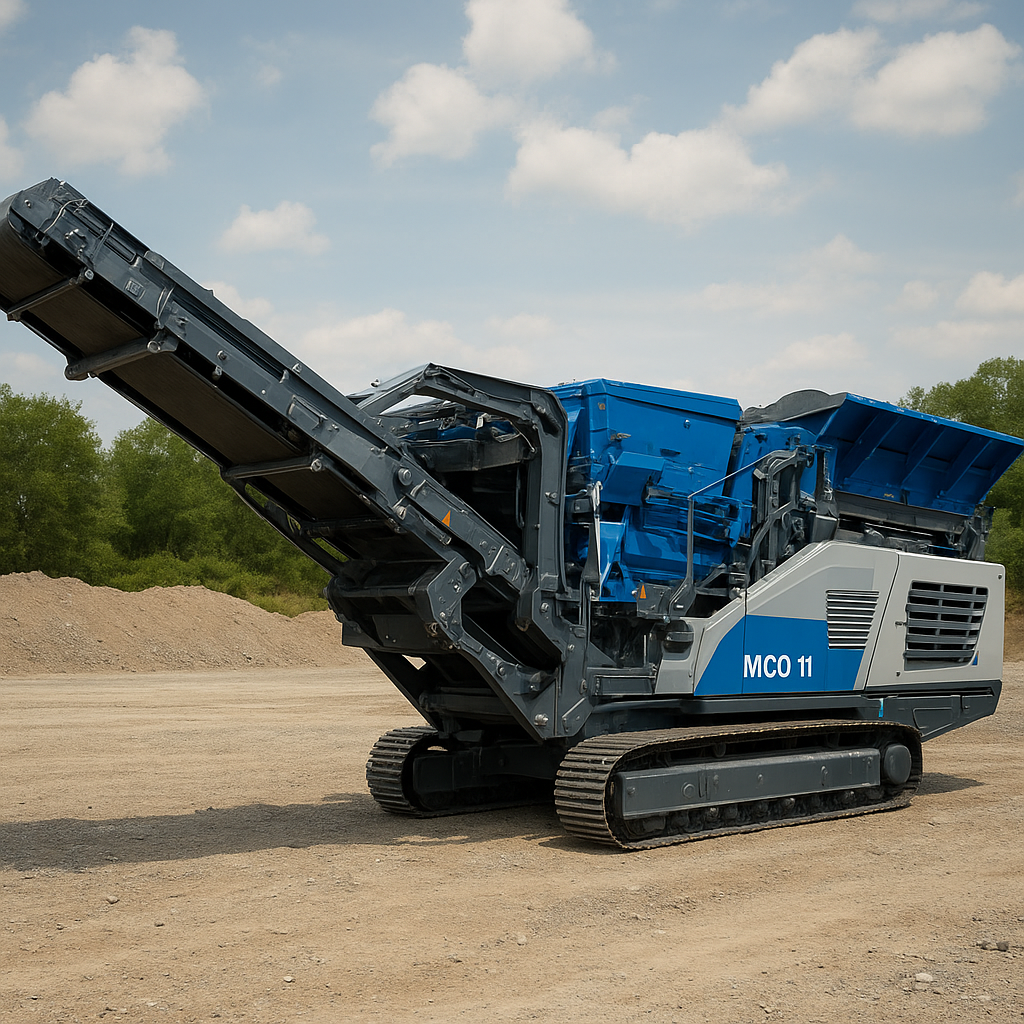
The Kleemann MOBICONE MCO 11 is a mobile cone crusher that has gained recognition for combining robust crushing performance with high mobility and user-focused design. Designed to handle a variety of raw materials — from hard rock to recycled concrete — this unit is commonly selected where reliable secondary or tertiary crushing is needed directly at the jobsite. Below you will find a detailed examination of the machine’s design, typical applications, operational features, maintenance considerations, economic factors and environmental impacts, together with typical performance ranges and practical advice for operators and buyers.
Overview and design features
The MOBICONE MCO 11 is part of Kleemann’s family of tracked, mobile cone crushers. Its architecture centers on a hydraulically adjustable cone crushing chamber, efficient material flow paths, and an integrated plant layout that reduces setup time and simplifies transport. Key elements of the machine include an intake hopper with feeder, a cone crusher unit with adjustable eccentric settings, return conveyors for recirculating oversized material, and a screened or prescreened bypass depending on the configuration.
Core components and working principle
- MOBICONE chassis: a tracked undercarriage enabling movement across worksites and easy repositioning without the need for heavy transport equipment in many cases.
- cone crusher unit: a hydraulic cone that offers a combination of high crushing force and adjustable stroke for varying product gradations and wear compensation.
- Feeding and screening: integrated or modular feeders and screens, sometimes with prescreening options to remove fines and increase throughput efficiency.
- Conveyors: primary discharge conveyor and recirculating conveyors configured to create closed-circuit crushing circuits where required.
- Power unit: usually a diesel-driven powerpack providing hydraulic power; some owners pair the crusher with matched engines or external electric drives where site supply allows.
The machine is engineered to balance crushing performance with straightforward maintenance access. Walkways, service platforms and centralized lubrication points are typical features intended to reduce downtime and simplify daily checks.
Applications and industries
The MOBICONE MCO 11 is widely used across sectors where compact, reliable secondary and tertiary crushing is required. Its mobility and flexibility make it attractive for projects where permanent crushing plants are impractical or where frequent relocation is necessary.
- Aggregates production — producing cubical aggregates for concrete and asphalt from primary crushed rock.
- Recycling and demolition — crushing demolished concrete, bricks and asphalt to produce recycled aggregates for reuse on site.
- Road construction — onsite production of base and sub-base materials to reduce transport costs and lead times.
- Quarrying — secondary or tertiary crushing stages within a quarry where throughput variability and product quality control are critical.
- Mining — specialized applications for crushing certain rock types as part of smaller-scale or remote mining operations.
- Temporary works and infrastructure projects — where rapid mobilization and the ability to produce specified material grades are required.
Because of its flexibility, the MCO 11 can be integrated into short-term contracts, rental fleets, and contractor operations that need to optimize logistics and production economics.
Performance, capacities and typical specifications
Exact specifications for the MOBICONE MCO 11 vary depending on configuration (standard vs. short head, prescreen options, engine and powerpack choices) and the properties of the feed material (hardness, abrasiveness, moisture, particle shape). Below are typical performance ranges and specification highlights to give realistic expectations for planning and comparison.
- Throughput (typical): approximately 100–350 tonnes per hour (t/h) depending on material hardness, feed size, and circuit configuration. Harder materials and fine product demands are at the lower end; softer materials and coarser product requirements push toward the higher end.
- Feed size (maximum): commonly up to around 200–250 mm for standard configurations. Oversized feed requires appropriate primary crushing or prescreening.
- Product sizes: adjustable by selecting the correct crushing chamber and eccentric setting; product gradations can be tailored to produce fine to coarse secondary/tertiary material suitable for specific applications.
- Reduction ratio: typically 4:1 to 6:1, depending on chamber profile and setting.
- Power requirements: engine or powerpack in the approximate range of 150–300 kW, depending on configuration and regional variations in model specification.
- Weight and transport dimensions: as a mobile tracked plant, gross weight and transport size are optimized for road and onsite moves; exact figures depend on attachments and optional equipment.
- Cycle and setup time: quick setup is a key feature — many operators can commission the plant within a few hours of arrival on site when proper ground conditions and feedstock are available.
When assessing expected capacity, remember that material characteristics (e.g., moisture, clay content, attrition resistance) and the selected closed- or open-circuit configuration play a decisive role. The presence of a prescreen can significantly increase effective throughput by removing fines before they use crushing capacity.
Operational advantages and innovations
The MOBICONE MCO 11 integrates a number of design elements intended to boost operational effectiveness, reliability and usability:
- Mobility: The tracked undercarriage and compact layout allow relocation across rough terrain and quick repositioning, which reduces logistic costs and improves responsiveness on dynamic construction sites.
- Versatility: Configurable crushing chambers and adjustable eccentric settings enable operators to fine-tune output quality for different end uses — from structural concrete aggregates to sub-base materials.
- Efficiency: Hydraulic drive systems and optimized crushing geometry aim to maximize throughput per unit of fuel consumed while extending wear part life through even load distribution.
- Automation and controls: Many units feature intuitive operator interfaces, automatic overload protection, and monitoring systems for temperature, pressure and production metrics. These systems reduce operator workload and enhance safety.
- Quick maintenance access: Smart placement of service platforms, central lubrication points, and modular wear parts reduce downtime and keep operating costs manageable.
These advantages make the MCO 11 suitable for operations that need a balance of performance, portability and low lifecycle disruption.
Maintenance, safety and environmental considerations
Proper maintenance and safety procedures are essential to maximize uptime and minimize operating cost. The MCO 11 is designed with accessibility in mind, but routine attention to several areas ensures longer component life and safer operation.
Maintenance best practices
- Implement a scheduled inspection program for wear parts (mantles, concaves, liners) and hydraulic systems. Wear rates depend heavily on material abrasiveness and feed size distribution.
- Maintain conveyor belts, rollers and idlers to prevent contamination and premature wear of moving parts.
- Regularly check and maintain the hydraulic oil and powerpack according to the manufacturer’s intervals to avoid failures that cause downtime.
- Keep prescreening and dust suppression equipment clean to prevent blockages and wear from fines build-up.
Safety features and protocols
- Lockout/tagout procedures for maintenance activities and clearly marked emergency stops and access points.
- Guarding for moving parts, conveyor transfer points and crusher feed areas to minimize risk of contact injuries.
- Operator training and safe operation manuals to ensure correct use of hydraulic adjustments, overload protection and remote control functions.
Environmental considerations
- Fuel consumption: modern powerpacks and optimized hydraulics aim to reduce fuel burn, but consumption varies with workload. Using prescreening and appropriate sizing helps lower energy per tonne produced.
- Dust control: on-site water sprays, dust suppression systems and enclosed transfer zones reduce airborne particulate emissions, important for compliance and worker health.
- Noise: tracked mobile crushers still generate significant noise; placement, acoustic covers and working-hour restrictions can mitigate community impact.
- Recycling benefits: when used to process demolition materials, the MCO 11 contributes to circular material flows and reduces landfill dependence and raw material extraction.
Economics and lifecycle costs
When evaluating the MOBICONE MCO 11 from an economic perspective, purchasers should account for initial capital expenditure, expected operating costs (fuel, wear parts, maintenance, personnel), and the machine’s residual or rental value. Mobility often provides substantial economic benefits by lowering material transport costs and enabling production close to the point of need.
- Capital and rental: the MCO 11 is often found in rental fleets because its flexibility suits many short-term projects. Renting can reduce upfront capital commitment while offering access to updated equipment.
- Operational cost drivers: wear parts and fuel are typically the largest ongoing expenses. Predictable feed and prescreening reduce wear and improve cost per tonne metrics.
- Return on investment: calculated by comparing added value of produced material (or avoided disposal/transport costs) to the total cost of operating the machine over a given period. Operators that use the unit efficiently — by optimizing feed and avoiding excessive tramp material — see faster payback.
Lifecycle planning should also consider the resale market. Well-maintained units from established manufacturers tend to retain value and can be upgraded via replacement wear parts and control system updates.
Field examples and practical tips for operators
Real-life use cases for the MCO 11 underline its strengths. Typical scenarios include:
- Urban redevelopment project: a demolition contractor uses the MCO 11 to crush concrete onsite, producing aggregate for onsite reuse in sub-base and bedding layers. This lowers haulage costs and disposal fees while shortening project timelines.
- Road maintenance: a highway contractor supplements a quarry supply by producing base material on demand using the mobile cone crusher, allowing adaptive material management across multiple short road sections.
- Quarry secondary crushing: a quarry operator pairs a primary jaw crusher with the MCO 11 in a secondary role to generate cubical aggregate sizes required by concrete producers.
Operator tips
- Use prescreening to remove fines that can pack the crusher chamber, lowering wear and increasing effective throughput.
- Match the chamber profile to the material and desired product; small adjustments to eccentric settings can dramatically change gradation quality.
- Monitor production data and fuel use — small process improvements (consistent feed, reduced recirculation) often yield disproportionate cost savings.
- Keep a basic inventory of critical wear items onsite (liners, belts, spray nozzles) to reduce unplanned stoppages.
Statistics and industry context
While specific sales figures and fleet counts for the MCO 11 vary by region and distributor, some broader market context helps frame where this model fits in the industry:
- The mobile crushing market has seen steady demand driven by infrastructure programs, urban redevelopment and the rising emphasis on construction and demolition recycling. Mobile cone crushers are a key segment within tracked mobile crushers due to their ability to deliver high quality cubical product.
- Typical mobile cone crushers in the MCO 11 class contribute a significant share of secondary/tertiary onsite crushing operations, especially where compact footprint and rapid relocation are priorities.
- Operational data shared by contractors commonly show throughput ranges aligning with the typical values noted earlier (around 100–350 t/h), with fuel consumption proportionate to workload and powerpack sizing.
For precise statistical data such as annual production numbers, fleet inventories by region, or model-specific lifetime averages, contacting Kleemann/Wirtgen Group dealers or rental companies will provide the most accurate and current figures tailored to your market.
Buying considerations and comparison points
If you are evaluating the MOBICONE MCO 11 against competitors or other Kleemann models, consider the following comparison points:
- Required product quality: ensure the chosen chamber and configuration meet target gradation, shape and specification for end-use (e.g., concrete aggregates versus road base).
- Mobility needs: consider transport frequency, site access and whether tracked mobility alone suffices or if a combination of trucking and on-site movement is planned.
- Service network: the availability of spare parts and technician service in your region strongly affects operating uptime.
- Energy source: diesel powerpack is standard in many regions; if electric supply is available onsite, evaluate electric drive options to reduce fuel cost and emissions.
- Lifecycle cost modeling: build scenarios for expected annual tonnage, wear rates and downtime to estimate total cost of ownership and payback.
Conclusion
The Kleemann MOBICONE MCO 11 is a versatile, mobile cone crusher well suited for contractors and operators who need reliable secondary or tertiary crushing with the flexibility to move between sites. Its design balances mobility, efficiency and maintainability, while configurations allow adaptation to a broad range of materials and product specifications. When planning deployment, assessing feed characteristics, prescreening needs, and the available service support network will be crucial to achieving strong production figures and cost-effective operation. For projects emphasizing onsite production, recycling and rapid setup, the MCO 11 remains a practical and proven option.


)
)