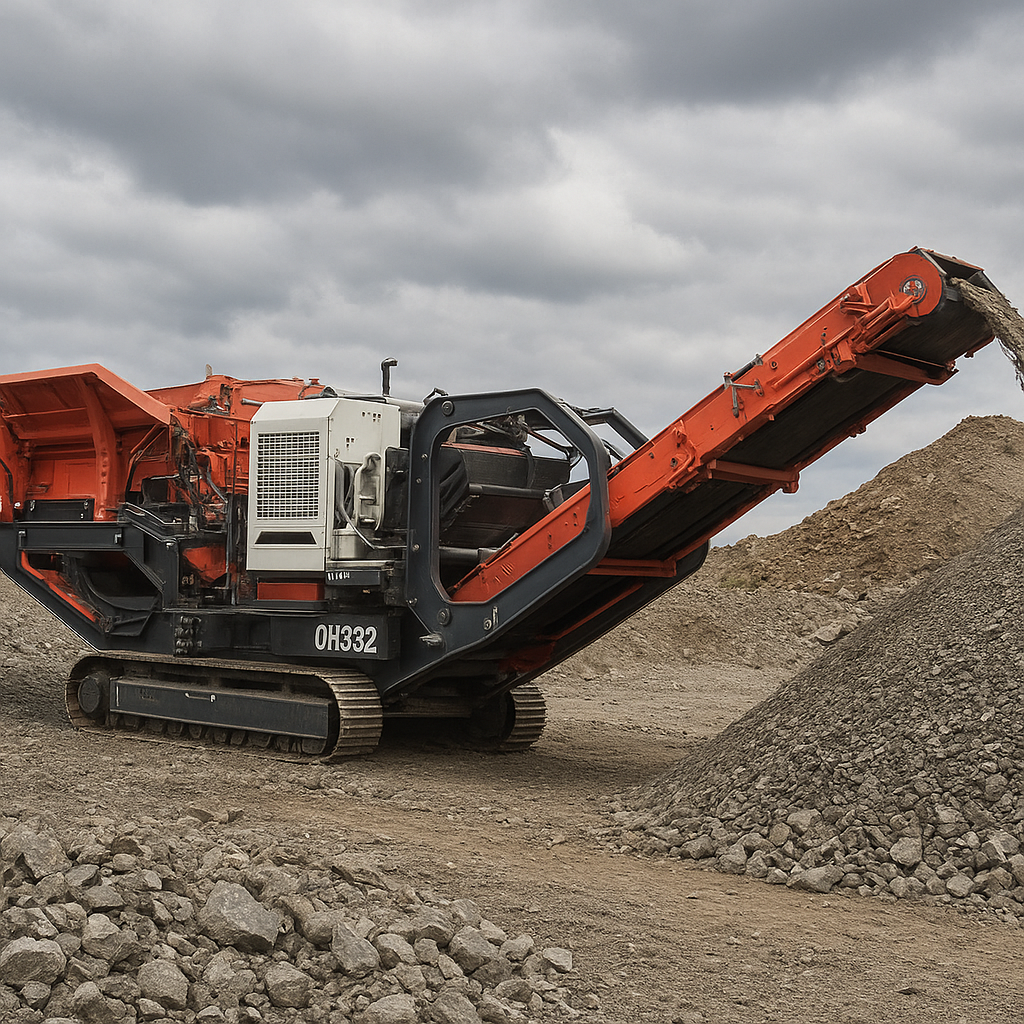
The Sandvik QH332 is a widely used tracked mobile cone crusher designed for flexibility and high-quality aggregate production on-site. Combining robust mechanical design with modern control systems, the QH332 is built to deliver consistent performance in a variety of demanding applications, from primary and secondary crushing to fine and tertiary stages. This article examines the machine’s design, typical applications, operational considerations, maintenance and lifecycle economics, and practical tips for maximizing performance.
Design and key features
The Sandvik QH332 is engineered as a compact, highly mobile cone crushing solution that can be moved between sites with minimal downtime. Its construction emphasizes a balance between durability and serviceability. Typical machine features include a tracked undercarriage for mobility, a hydraulically adjustable cone chamber for accurate product control, and an integrated feed and discharge system to create an efficient crushing circuit.
- Tracked mobility: The crawler chassis allows quick repositioning on uneven ground without the need for extensive site preparation.
- Hydraulic settings: On-the-fly adjustment of crusher settings enables rapid changeovers between different aggregate sizes and product gradings.
- Integrated hopper and feeder: Designed to accept large feed sizes and provide consistent material flow into the cone chamber.
- Wear management: Easily replaceable liners and wear parts minimize downtime and keep operating costs under control.
- Control systems: Modern PLC-based controls and optional remote monitoring support optimized throughput and predictive maintenance.
The machine is typically available with several chamber designs to suit different material types and end-product requirements. These chambers, combined with variable eccentric speeds and closed-side settings, allow operators to optimize for either maximum throughput or finer product distribution.
Applications and industries
The QH332 finds application across a broad range of industries due to its adaptability and capacity to produce high-quality aggregates. Typical use cases include:
- Quarrying and aggregates production — producing roadstone, ballast, and construction aggregates with accurate sizing and better cubical product.
- Recycling — processing concrete, asphalt, and demolition material where a mobile, compact plant can reduce haulage and handling costs.
- Mining operations — secondary and tertiary crushing on small- to medium-scale mining sites where mobility and on-site processing reduce ore transport.
- Infrastructure projects — on-site crushing for roadbuilding, rail works, and large construction projects to supply consistent material without relying on off-site suppliers.
- Specialty aggregates — producing shaped stone for precast concrete or architectural stone by choosing the appropriate chamber and operating parameters.
Because it can be rapidly deployed and reconfigured, the QH332 is particularly valuable on projects with changing feedstocks or where temporary crushing capacity is needed for specific phases of a larger development.
Performance and operational characteristics
The operational performance of the QH332 depends heavily on the selected chamber, feed gradation, and operational settings. Some general performance characteristics include:
- Throughput ranges that suit small to medium production requirements; typical site use often sees outputs in the low hundreds of tonnes per hour depending on material hardness and desired product size.
- High reduction ratios achievable when the machine is operated in an optimized circuit, allowing the QH332 to produce a well-graded product in a single pass in many scenarios.
- Consistent product shape and reduced fines generation when the correct chamber and speed are used, improving downstream screening and product value.
Operators often choose settings that trade off between throughput and product fineness. For example, tighter closed-side settings and slower eccentric speeds yield finer products but reduce tonnage, while open settings and higher speeds maximize production but produce coarser material.
Control systems and automation
Modern implementations of the QH332 often include advanced control systems designed to simplify operation and improve uptime. These systems can include:
- PLC-based logic for crusher protection, automatic start/stop sequences, and alarm handling.
- Variable speed control for feeders and conveyors to maintain optimal feed rates and reduce stalling or overfeeding.
- Remote monitoring options that report operating hours, load levels, and basic performance metrics to an off-site operations center.
- Interlocks and safety systems that protect personnel and equipment during maintenance and feeding operations.
Automation reduces the need for constant manual adjustment and helps enforce operating parameters that extend component life. Remote diagnostics can significantly cut troubleshooting time, allowing service teams to arrive prepared with correct spares and tools.
Maintenance, wear parts and lifecycle costs
Maintenance strategy is a primary factor in total lifecycle cost for any mobile crusher. The QH332’s design aims to make routine tasks straightforward so that scheduled checks and parts replacement can be done rapidly on-site. Key considerations:
- Wear parts: Cone liners, mantles, bushing assemblies, and feeder plates are typical wear components. Keeping a stock of commonly replaced parts dramatically reduces downtime.
- Lubrication: Proper lubrication of the cone and auxiliary equipment is essential for reliability. Many units include automated lubrication systems to ensure correct intervals.
- Inspection: Daily checks for feed distribution, liner wear, hydraulic leaks and belt alignment help catch issues early.
- Scheduled servicing: Hydraulic, engine, and electrical system checks at defined hour intervals minimize risk of unplanned stoppages.
While initial capital expenditure for a modern QH332 can be significant, careful maintenance extends machine life and typically yields strong lifecycle economics. Operating costs are influenced by fuel, wear part consumption and labor for maintenance. In many applications, on-site crushing with a mobile plant reduces transportation and handling costs, offsetting initial outlay.
Safety and environmental considerations
Safety features on the QH332 are designed to meet modern site requirements and include emergency stops, guarded access points, and interlocked panels. Environmental considerations increasingly influence plant selection:
- Dust control: Integration with water sprays, misting systems or local dust extraction helps meet site environmental standards and improves working conditions.
- Noise reduction: Acoustic enclosures, low-noise fans and strategically placed conveyors reduce noise footprint when working in urban or sensitive environments.
- Emissions: Engine choices and compliance packages can be selected to meet local emissions regulations, particularly important for work in regulated jurisdictions.
Safe operation starts with training. Operators need to understand locked-out maintenance procedures, correct feeding and blocking techniques, and how to interpret on-board diagnostics. Proper housekeeping around the machine (clearing fines buildup, securing walkways) prevents incidents and improves access for maintenance tasks.
Typical transport, setup and operational logistics
One of the QH332’s significant advantages is its ability to be moved and set up quickly. Typical logistics include:
- Transport on low-loaders or trailers to comply with regional axle-load regulations.
- Rapid on-site deployment thanks to hydraulically folding conveyors and compact footprint.
- Minimal civil works in many sites — only simple level platforms are required in most cases.
Setup time can be a few hours to a day depending on site conditions and the degree of integration with existing plant. The ability to crush material near the point of generation reduces double-handling and lowers project timelines.
Comparisons and alternatives
When choosing a cone crusher like the QH332, operators often weigh it against portable jaw crushers, impact crushers, or larger stationary cones. Key comparative points include:
- Compared to a jaw crusher, a cone delivers a higher-quality cubical product and is typically used further down the crushing circuit (secondary/tertiary).
- Compared to impact crushers, cones generally produce fewer fines and are better suited to harder rock; impactors can provide more pronounced shaping for softer materials.
- Compared to stationary units, mobile solutions like the QH332 offer unmatched flexibility at the cost of somewhat lower maximum throughput potential than large fixed stations.
Selecting the optimal machine always depends on feed characteristics, product specs, required capacity, site logistics, and capital vs operating cost trade-offs.
Operational tips to maximize performance
To extract the best performance from a QH332, consider these practical tips:
- Ensure even feed distribution across the crusher mantle to avoid asymmetric wear and reduce shock-loading events.
- Monitor and record operating parameters — changes in power draw, feed rate or product gradation often indicate wear or setup drift that can be corrected.
- Adopt a proactive spare parts plan: keep the most frequently replaced liners and hydraulic fittings in stock.
- Use the correct chamber profile and eccentric speed for the specific material — trial runs with adjustments will identify the best compromise between product quality and tonnage.
- Implement a dust suppression plan early. Clogged screens and conveyors caused by dust or fines will degrade throughput and increase maintenance.
Case uses and economic value
Across numerous projects, mobile cone crushers like the QH332 provide measurable economic value. Typical benefits observed in the field include:
- Reduced haulage costs by crushing at source or near the excavation face.
- Lower project timelines by supplying material on-demand rather than awaiting deliveries.
- Improved product control and higher-value aggregate products with better grading and particle shape.
For operations where product specification or frequent relocations are required, the loss in absolute maximum capacity (compared to a large stationary plant) is often offset by the operational flexibility and reductions in handling and transport costs.
Common questions and practical considerations
What materials are suitable?
The QH332 can handle a wide range of materials from granite, basalt and hard lava to recycled concrete and asphalt. Hard, abrasive rock will increase wear rates, so operators should account for increased liner consumption and plan maintenance accordingly.
How do I estimate fuel and operating costs?
Fuel consumption and operating costs depend on engine selection, operating load, and duty cycle. Estimating requires input about expected daily hours, typical tonnage, and local fuel prices. Many operators track consumption against production in the first months to set realistic budgets.
What is the expected uptime?
Planned uptime is strongly linked to maintenance discipline and operator training. With proactive parts replacement and correct lubrication, many operators report consistent availability above 85% in typical onsite operating conditions. Implementation of remote diagnostics and timely servicing further improves uptime.
Conclusion
The Sandvik QH332 is a versatile, mobile cone crusher that fills an important niche between static crushing plants and smaller portable units. It offers a blend of mobility, product quality and operational flexibility that makes it appropriate for quarries, recycling yards, road construction sites and certain mining contexts. Proper selection of chamber configuration, consistent maintenance, and intelligent use of its control systems are key to maximizing return on investment. When chosen for appropriate duties and supported by a robust service and parts strategy, the QH332 can be a highly productive component of a modern, mobile crushing fleet.


)
)