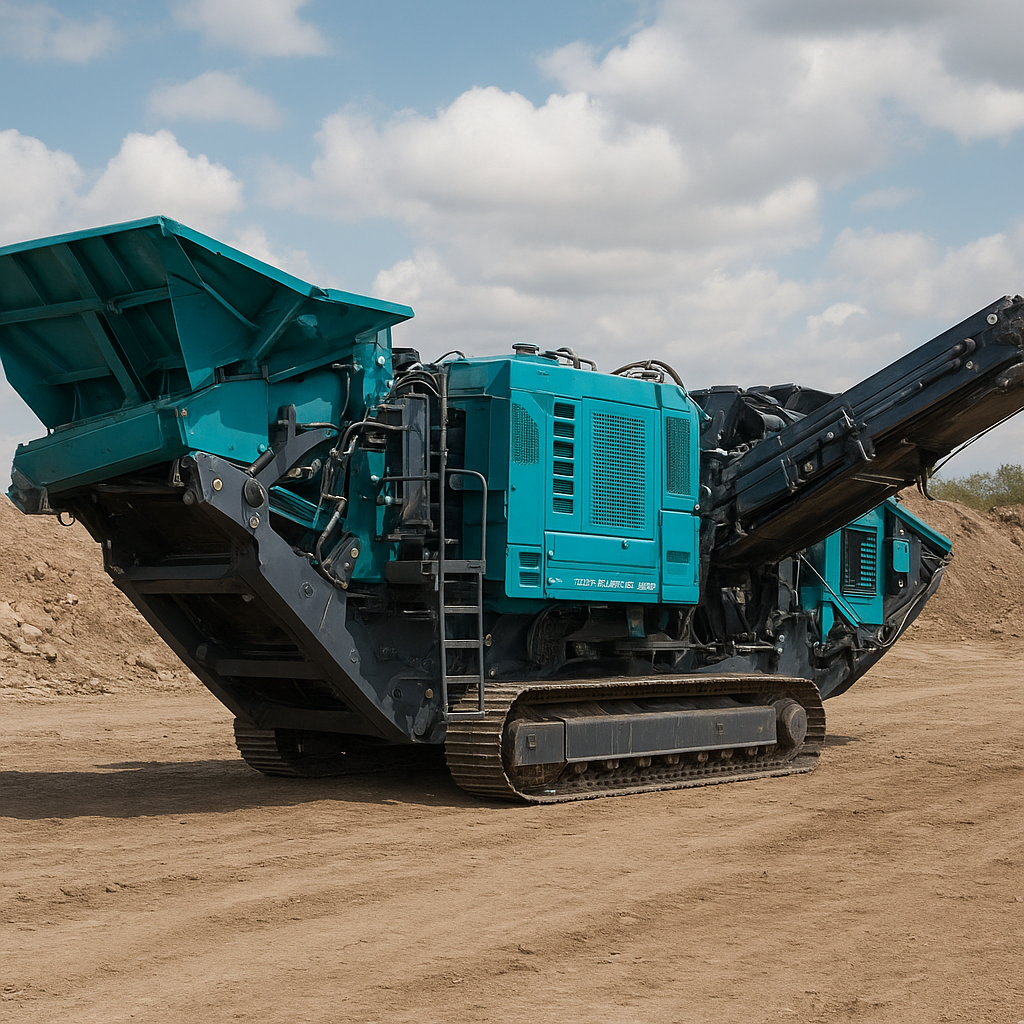
The Powerscreen Premiertrak 600 is a widely used track-mounted mobile jaw crusher designed to deliver reliable primary crushing in a variety of demanding applications. Combining robust construction with user-friendly controls and flexible on-site configuration, this machine has become a popular choice for contractors, quarry operators and recycling businesses that require a balance of mobility, productivity and low operating cost. In the following sections, you will find a detailed look at the machine’s design, typical uses, performance characteristics, operational considerations, and market context—along with practical tips for maximizing uptime and value.
Overview and core design philosophy
At its core the Powerscreen Premiertrak 600 is conceived as a compact but powerful primary jaw crusher that can be transported easily between jobsites and set up quickly. The unit is built around a heavy-duty jaw chamber that provides primary reduction for a wide range of materials, including hard rock, construction and demolition waste, concrete, and recycled asphalt. Key design goals include high throughput for a machine in its class, straightforward maintenance access, and integrated features that reduce the need for additional on-site equipment.
The machine typically sits on a tracked chassis for full mobility across rough ground without the need for additional transport attachments at the operating site. The tracked undercarriage, folding conveyors and hydraulic adjust mechanisms all contribute to a fast transition from arrival to crushing. The combination of mobility and a full primary crushing solution enables operators to process material at source, lowering haulage costs and improving overall project logistics.
Design and key features
Several aspects of the Premiertrak 600 stand out for operators looking for a dependable primary crusher. Below are the most important design and operational features commonly highlighted by users and product literature.
- Jaw chamber: A rugged, heavy-duty jaw chamber capable of accepting large feed sizes and designed for high reduction ratio, providing the initial break-down of feed material.
- Tracked chassis: Provides on-site mobility, allowing the unit to move across quarries and demolition sites without external handling equipment.
- Hydraulic adjust: Simple hydraulic adjustment of the closed side setting (CSS) and hydraulic jaw release help manage uncrushable material and reduce downtime.
- Integrated feeder: A vibratory feeder and grizzly option help to remove fines and regulate material flow into the jaw, improving efficiency and output consistency.
- Folding conveyors: Discharge conveyors fold for transport and deploy quickly for operation, reducing set-up time and transport footprint.
- Optional prescreen or trommel: Pre-separation reduces wear on the jaw and improves finished product quality when processing mixed waste or abrasive material.
- Control system: User-friendly controls for tracking machine status, engine diagnostics and operational settings—many models include remote-control or PLC interface options.
Build quality and wear components
The Premiertrak 600 uses high-quality wear liners and replaceable jaw plates designed for longevity and easy replacement. Critical wear parts such as cheek plates, jaw dies and toggle plates are engineered for straightforward access, minimizing service time. For abrasive rock or operations with extended runtimes, a structured maintenance schedule for wear part inspection and timely replacement is essential to maintaining throughput and avoiding catastrophic failures.
Typical applications and use cases
The machine’s design makes it suitable for a broad spectrum of industries and applications. Below are the most common where the Premiertrak 600 is frequently deployed:
- Quarrying: Primary crushing of blasted rock and stone to produce aggregates for construction and road-building.
- Construction and demolition (C&D) recycling: Processing concrete, brick and mixed demolition waste into re-usable aggregates.
- Road construction and maintenance: On-site crushing of materials for sub-base and fill, reducing the need to import aggregates.
- Small-scale mining: Initial primary break-down of ore or waste rock where a small, mobile crusher is more economical than fixed plants.
- Land reclamation and remediation projects: Processing site-won materials for reuse in landscaping and infrastructure projects.
In recycling contexts, the Premiertrak 600’s capacity to accept mixed feed and its optional pre-screening setup can dramatically reduce the cost of disposal and transport by producing marketable fractions on-site. In quarrying, its compact footprint and reliable feed handling make it an effective solution on smaller sites or as a mobile supplement to larger fixed plants.
Performance, capacities and specifications
Caps and performance figures for mobile crushers depend heavily on material type, block size distribution, operator settings, and the chosen jaw profile. The following figures are representative ranges and should be treated as approximate; for precise figures consult the manufacturer’s datasheets and model configurations.
- Feed opening: Typical feed openings for a machine in this class are in the range of approximately 1,000 mm x 600 mm (roughly 39″ x 24″), allowing it to accept large material directly from blasting or demolition.
- Throughput: Rated throughput often falls in the approximate range of 150–350 tonnes per hour (tph), depending on material hardness, feed grading and operational settings.
- Engine power: Typical installed diesel engine power is often in the range of 140–220 kW (190–295 HP) for units with standard hydraulic and conveyor systems.
- Transport weight: Depending on specification and options, transport weight commonly ranges between about 25–40 tonnes.
- Closed Side Setting (CSS): Adjustable CSS typically ranges from a few millimetres up to 100 mm or more, allowing operators to trade off between product size and throughput.
These specifications can vary by model year, aftermarket options and region-specific configurations (for instance, models with additional screening or sorting attachments). The presence of a pre-screen can reduce fines entering the jaw, improving throughput and lowering wear consumption.
Operational performance factors
Several variables strongly influence the actual performance achieved in real-world operation:
- Material hardness and abrasiveness — harder or more abrasive rock will reduce throughput and increase wear costs.
- Feed gradation and consistency — a consistent, well-graded feed maximizes crusher productivity and longevity.
- Operator settings — CSS, feeder speed and conveyor settings directly influence product size distribution and tonnage.
- Wear part condition — worn jaw plates and liners reduce efficiency and product control.
- Site logistics — availability of a steady feed supply and efficient removal of finished product prevents bottlenecks.
Operational considerations and maintenance best practices
The Premiertrak 600 is designed to be simple to maintain, yet planned maintenance and operator competence are essential to maximize service life and minimize downtime. Below are recommended practices and considerations that experienced operators and fleet managers emphasize.
- Implement a scheduled inspection program for wear parts and hydraulic systems; track hours and replace jaw plates according to wear curves rather than only by visual inspection.
- Maintain consistent feed to the crusher—surges, tramp material and oversized lumps are common causes of spillage, blockages and damage.
- Use the hydraulic overload protection and jaw release features appropriately to manage uncrushable objects and protect the drive train.
- Keep the engine and hydraulic systems cooled and clean—dust control measures and regular filter changes increase component life.
- Train operators on correct start-up/shutdown procedures and emergency response to jams or hydraulic faults.
- Stock critical wear items on-site if the operation is remote—jaw dies, toggle plates and conveyor belts are typical items that determine time-to-repair.
Correct lubrication, monitoring of oil condition, and electrical system checks (where equipped) further reduce unexpected stoppages. Modern models may include telematics, which can help monitor engine hours, fuel consumption and diagnostic alarms remotely, supporting predictive maintenance.
Environmental and economic benefits
On-site mobile crushing with machines like the Premiertrak 600 can deliver several environmental and economic advantages:
- Reduced transport emissions and costs by processing materials where they are generated rather than hauling them to fixed plants.
- Ability to recycle demolition materials into reusable aggregates that displace virgin material extraction.
- Lower overall project carbon footprint when aggregate production is decentralised and optimized.
- Quick redeployment saves project time, reducing idle equipment and site disturbance.
Economically, the ability to produce immediate, saleable material on-site improves cash flow and reduces reliance on third-party processing. Contracting firms often find that the flexibility of a mobile primary crusher enables them to bid on a wider range of projects, making it a strategic asset.
Safety, operator ergonomics and controls
Safety is a primary design consideration for modern Powerscreen equipment. Operator ergonomics, visibility and remote-control capability minimize the need for manual intervention near moving parts. Typical safety-related features include:
- Emergency stop circuits and accessible isolation points for hydraulic and electric systems.
- Guards around drive components and conveyors to prevent accidental contact.
- Safe access platforms and ladders with anti-slip surfaces for inspection and maintenance.
- Intuitive control panels with alarms for oil level, temperature and other diagnostic signals.
Good site practice—establishing exclusion zones around operating equipment, using banksmen or radio communication during setup and movement, and ensuring PPE adherence—remains essential regardless of built-in safety features.
Market context and statistical insights
The mobile crushing market has grown steadily over the past decade as quarry owners, recyclers and contractors seek flexible, lower-cost solutions that can be moved between sites. Industry reports from the last several years (varied by region and data provider) indicate a global mobile crushers and screeners market that has experienced compound annual growth rates (CAGR) generally in the mid-single digits. Factors propelling this growth include infrastructure investment, urban redevelopment projects, and stronger emphasis on recycling and sustainable construction practices.
Specific statistics relating directly to the Premiertrak 600 model are typically maintained by Powerscreen dealers and fleet operators rather than aggregated in public databases. However, aggregate indicators that contextualize its role include:
- Estimated typical production ranges for medium-sized track-mounted jaw crushers: 100–400 tph depending on configuration and material.
- Residual values: well-maintained mobile jaw crushers from established brands retain a significant portion of their value on the second-hand market, largely because of their utility across multiple job types.
- Adoption trends: increased uptake in regions emphasizing recycling and flexible infrastructure projects, notably Europe, North America, and parts of Asia-Pacific.
When evaluating purchase or lease decisions, examine local resale values, parts availability and dealer service networks—these variables have a meaningful impact on total cost of ownership and machine uptime.
Comparisons and complementary equipment
The Premiertrak 600 is typically considered a middle option in the range of Powerscreen jaw crushers, balancing size and capacity between smaller portable units and larger fixed or semi-fixed primary crushers. Complementary equipment and attachments that often accompany a Premiertrak 600 in a production circuit include:
- Scalping or pre-screen units to remove fines and reduce jaw wear.
- Secondary crushers (cone or impact crushers) to produce final aggregate sizes.
- Wash screens and trommels when producing certain high-specification materials.
- Conveyors, stackers, and hoppers to streamline material flow and stockpiling operations.
Selecting the right combination of machines depends on project objectives: whether the priority is maximum tonnage, specific product sizing, or a low environmental impact through material recycling.
Buying, leasing and lifecycle costs
When considering acquisition of a Premiertrak 600, operators should weigh upfront purchase price against leasing options, finance rates, expected utilization and maintenance budgets. Key lifecycle cost drivers are fuel consumption, wear parts, labor for maintenance and the availability of local aftersales support.
- Leasing or hire: useful for short-term projects or to trial the solution before committing to purchase.
- Purchase: attractive for fleets with consistent, long-term crushing requirements and the ability to perform scheduled maintenance in-house.
- Refurbished units: can provide a lower-cost entry point; ensure thorough inspection and service history review to avoid hidden costs.
Operators should request detailed fuel consumption figures and specific wear part life estimates from suppliers based on the intended feed material and expected operating hours to model total cost of ownership accurately.
Practical tips for maximizing value
To get the most from a Premiertrak 600 in daily operation, consider the following practical recommendations:
- Optimize feed: consistent feed and removal of fines before crushing increase throughput and reduce wear.
- Monitor settings: regular checks of CSS and jaw profile help maintain target product size and consistent production rates.
- Use telematics: where available, remote monitoring provides actionable data on fuel use, idle time and fault conditions.
- Rotate wear parts: using multiple sets of jaw dies and rotating them helps distribute wear and extend overall part life.
- Plan parts inventory: keep critical spares close at hand for remote operations to reduce machine downtime.
Conclusion
The Powerscreen Premiertrak 600 is a versatile and robust mobile primary jaw crusher that meets the needs of quarrying, recycling and construction operations that require dependable primary reduction with the flexibility to move between sites. Its combination of a heavy-duty jaw chamber, tracked mobility, hydraulic adjustment and options for prescreening make it a strong candidate for operations that value rapid deployment, consistent throughput and manageable lifecycle costs. While exact performance numbers vary with material and configuration, operators consistently cite the machine’s balance of portability, capacity and serviceability as the reasons for choosing it. For any procurement decision, align expected feed material characteristics and production goals with supplier specifications and consult local dealers about proven configurations and support services to ensure the machine delivers the intended operational and financial benefits.


)
)