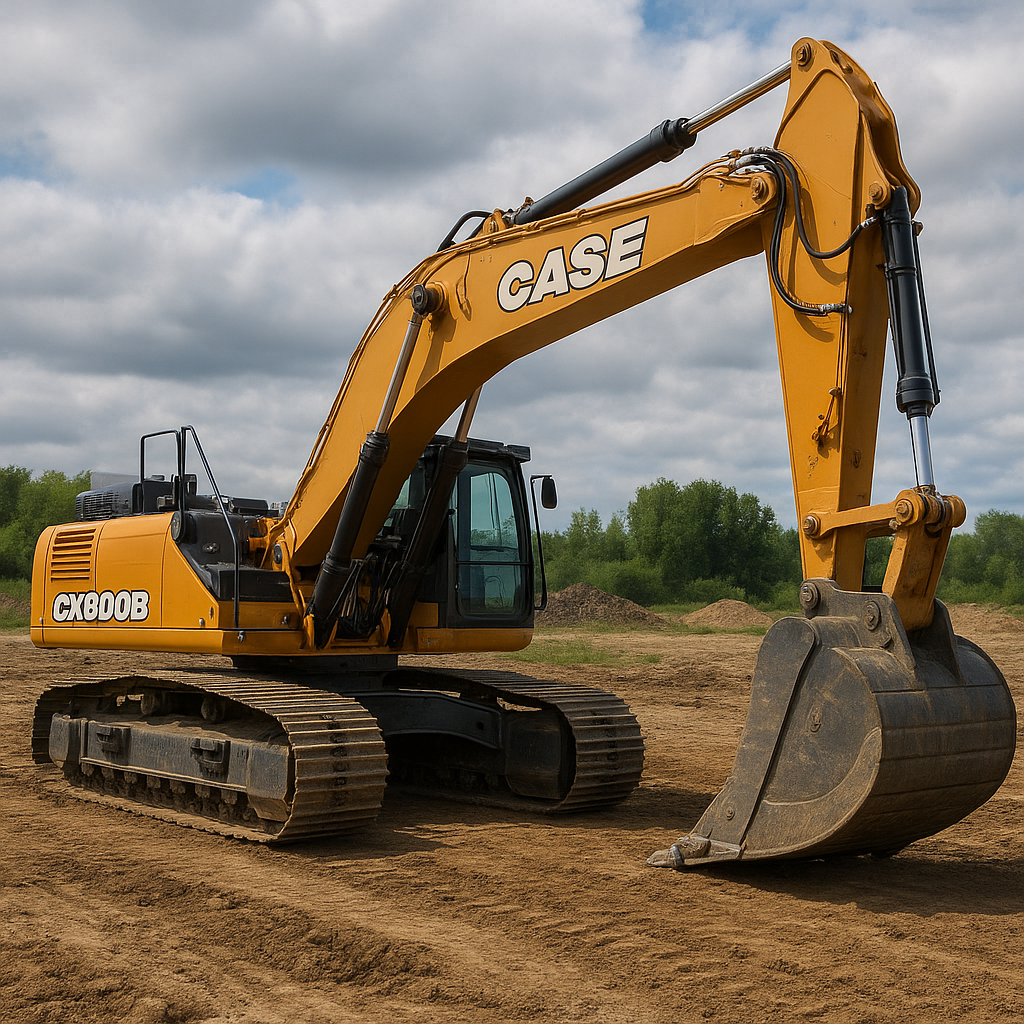
The CASE CX800B is a heavy-duty hydraulic excavator designed for demanding earthmoving, mining, quarrying and large-scale construction projects. Built to deliver robust performance, long service intervals and versatile attachment compatibility, the CX800B targets owners who require a machine capable of sustained high productivity in harsh conditions. This article explores the machine’s design, technical characteristics, typical applications, operational performance, maintenance and safety features, as well as notes on market placement and practical considerations for buyers and fleet managers.
Design philosophy and main components
The CX800B follows a design philosophy that balances raw power with serviceability and operator ergonomics. CASE focused on structural durability, hydraulic efficiency and simplified maintenance access to create a machine that performs reliably over long operating cycles. Key elements include a reinforced undercarriage and chassis, a heavy-duty boom and arm, and a hydraulic system tuned for both power and precision.
Engine and powertrain
At the heart of the machine is a high-output diesel engine engineered to provide strong torque for digging, lifting and continuous operation under load. The powertrain is matched to a robust final drive and undercarriage designed to withstand abrasive conditions. The combination of engine mapping and hydraulic controls allows the operator to select modes that emphasize performance, fuel savings or a balance of the two depending on the task.
Hydraulic system and controls
The hydraulics of the CX800B are central to its capabilities. A high-flow, high-pressure hydraulic system provides consistent control for the boom, arm, bucket, swing and auxiliary circuits. Proportional electro-hydraulic controls allow for smoother, more precise movements which improve cycle times and reduce operator fatigue. Modern systems incorporate electronic load-sensing features to match pump output to demand, increasing overall efficiency.
Structural durability and attachments
Structural components — including the boom, arm and subframe — are reinforced and often fabricated from high-strength steel. Attachment compatibility is broad: standard rock buckets, heavy-duty buckets, ripper attachments, hydraulic breakers and specialized grabs can be fitted. The machine’s ability to accept a range of attachments makes it adaptable across industries and jobsite conditions.
Technical overview and typical specifications
Specifications can vary by region and optional configurations, but the CX800B is generally categorized as an upper-70 to 90 tonne class machine. Below are representative technical figures and descriptions commonly associated with this model class (figures are indicative and subject to change by year or market):
- Operating weight: approximately 75,000–85,000 kg depending on configuration and counterweight.
- Engine power: roughly 350–450 kW (470–600 hp), depending on emission standards and tune.
- Bucket capacity: typical ranges from about 2.5 to 5.0 m3, with options for specialized rock buckets and high-capacity buckets for quarry work.
- Hydraulic system pressure: commonly up to around 350 bar in heavy-duty circuits.
- Fuel tank capacity: often in the order of 800–1,200 liters to support long operating shifts.
- Undercarriage: heavy-duty track frames with wide shoes for stability and flotation on soft ground.
These values provide a baseline for fleet planning. For exact numbers, prospective buyers should consult the factory specifications for the production year and selected options since engines and electronics are frequently updated to meet emissions and performance targets.
Applications and industries
The CX800B’s size and power make it suitable for a range of heavy applications. It is commonly found in:
- Mining operations — especially open-pit mining where large material handling and removal rates are required.
- Quarrying — extracting stone and aggregate where large buckets and robust structures are essential.
- Major civil construction — dam building, highway earthworks, and large-scale excavation projects.
- Bulk material handling — loading of haul trucks, stockpiling and reclaiming in terminals and industrial sites.
- Demolition and recycling — when fitted with breakers and grapples for heavy demolition tasks.
The machine’s adaptability to different attachments allows rapid re-tasking between jobs, which improves fleet utilization and reduces the need for multiple specialized machines.
Performance and productivity
Productivity with the CX800B comes from a combination of hydraulic responsiveness, bucket fill factor and cycle time optimization. In practical operations, benefits are realized through:
- High bucket payload per cycle — larger buckets move more material per swing, reducing total cycles required.
- Sustained digging force — designed to penetrate compacted materials and maintain performance during heavy loading.
- Efficient swing and travel speeds — aiding faster loading of haul trucks and better cycle choreography on busy sites.
- Operator-selectable modes — economy modes reduce fuel consumption in light-duty tasks while power modes provide maximum digging performance.
On productivity comparisons, machines in the 80-tonne class typically outperform smaller excavators on large bulk tasks due to higher breakout force and larger payloads, but they consume more fuel and require stronger supporting equipment (haulers, ramps, transport solutions).
Fuel efficiency and emissions
Fuel efficiency is a critical consideration for large excavators because fuel is a major operating expense. The CX800B integrates engine management and hydraulic load-sensing technologies to reduce unnecessary fuel burn. Typical efficiency strategies include automatic idle shutdown, load-sensing hydraulic pumps that reduce parasitic losses, and smart machine controls that optimize power delivery.
Emission standards (Tier 4 Final / Stage V and equivalents) have required manufacturers to adopt exhaust after-treatment systems like selective catalytic reduction (SCR) and diesel particulate filters (DPF). These systems affect fuel efficiency and maintenance patterns, and operators must follow regeneration and service schedules to maintain compliance and performance.
Operator environment and controls
Operator comfort has become a focus because a comfortable, less-fatigued operator is more productive and safer. The CX800B cabins typically offer:
- Ergonomic seating with adjustable controls and armrests.
- Low-noise insulation and climate control for long shifts.
- Clear visibility with optimized sight lines and camera options to cover blind spots.
- Intuitive multi-function displays that present performance metrics and diagnostics.
Modern control systems often include customizable joystick responses, telematics integration for remote monitoring and fault codes, and on-board diagnostics that simplify troubleshooting and reduce downtime.
Maintenance, serviceability and lifecycle costs
Serviceability is a major selling point. The CX800B’s design typically emphasizes easy access to filters, fluid points and routine check locations. Long service intervals on items such as hydraulic filters, engine oil and coolant reduce downtime. Key maintenance considerations include:
- Accessible maintenance panels and grouped service points to speed routine checks.
- Robust cooling packages to prevent overheating in heavy-duty or high-ambient-temperature operations.
- Heavy-duty undercarriage components that are replaceable on a per-segment basis to manage repair costs.
- Manufacturer-supported parts availability and aftermarket support networks which impact total cost of ownership.
Lifecycle cost can often be more important than initial acquisition price for large machines. Evaluating fuel consumption, expected uptime, parts and labor costs, and resale value is critical when selecting an excavator for a fleet.
Safety and compliance features
Safety systems on the CX800B typically include reinforced cabins meeting ROPS/FOPS standards, anti-slip surfaces, well-placed handrails, and optional camera packages or proximity detection systems to prevent collisions. Emergency shut-off systems and clear warning indicators for hydraulic and engine faults further protect operators and the machine.
Attachments and customization
One of the most valuable aspects of a large excavator is its ability to multiply utility through attachments. Common attachments and their uses include:
- Heavy-duty buckets for excavation of compact soils and rock.
- High-capacity buckets for bulk loading in quarries and stockpiles.
- Hydraulic breakers for rock fragmentation and demolition.
- Rippers for breaking up compacted surfaces and subsoils.
- Grapples and sorting arms for material handling and recycling work.
Attachment choice dramatically affects cycle time, fuel use and wear patterns, so matching attachment design to the job is essential for peak performance.
Market placement and comparisons
The CASE CX800B competes with other large-class hydraulic excavators from global OEMs. Buyers typically compare machines based on:
- Digging forces and bucket capacities relative to machine weight.
- Fuel consumption per cubic meter moved.
- Service intervals and ease of maintenance.
- Dealer support, parts availability and warranty terms.
- Resale value and historical reliability.
CASE positions its machines by emphasizing durability, operator comfort and dealer network support. For fleets operating in remote or harsh environments, local service presence and parts logistics can be as important as the machine’s technical advantages.
Real-world use examples and case notes
Examples of where large excavators like the CX800B shine include:
- Open-pit mining benches where excavators load 80–200 tonne haul trucks — large payloads and rapid cycle times reduce the number of trucks required and can lower per-tonne costs.
- Quarry primary digging where rock buckets and reinforced structures allow constant removal of raw material.
- Major infrastructure projects such as dam excavation, where the ability to move huge volumes of earth quickly and safely shortens critical-path schedules.
- Material handling terminals, where excavators equipped with grabs or clamshells handle bulk commodities like coal, scrap metal or wood chips.
Operators report that predictable performance in consistent cycles yields the best fuel economy and ROI. In many operations a well-matched excavator and haul fleet provide the fastest return on investment.
Buying considerations and tips for fleet managers
When evaluating a CX800B for purchase or lease, consider:
- Match machine size and bucket capacity to the haul truck and task — oversizing can increase capital and operating costs, undersizing can hurt productivity.
- Review local dealer support and spare parts logistics for the region of operation.
- Ask for telematics and diagnostic options to enable remote monitoring and proactive maintenance.
- Consider operator training packages to maximize cycle efficiency and reduce wear.
- Factor in transport and site access constraints — large excavators require specific transport permits and lifting/placement capabilities.
Leasing or rental can be an attractive route for projects with limited duration or when trying a new model in a fleet before committing to purchase.
Environmental considerations
Large excavators consume significant fuel, so efforts to reduce emissions and improve efficiency are important. Choosing lower-emission engines, maintaining proper fuel burn through correct servicing, and deploying machine control strategies (like auto-idle and eco-modes) help reduce environmental impact. Proper fuel and fluid handling procedures and spill prevention are also critical at sites that value environmental compliance.
Conclusion
The CASE CX800B represents a class of heavy excavators designed for demanding applications where power, durability and versatility are essential. With robust engine and hydraulics, wide attachment support and operator-focused design, it is suited to mining, quarrying, large civil works and bulk material handling. Key decision factors for buyers include the machine’s operating weight and capacity relative to their operational needs, projected lifecycle costs, dealer support, and the potential for improved fuel efficiency and uptime through correct configuration and maintenance. For fleet managers, attention to matching buckets and attachments to material type, investing in operator training, and leveraging telematics for proactive maintenance will maximize the productivity and reliability of this large excavator platform.


)
)