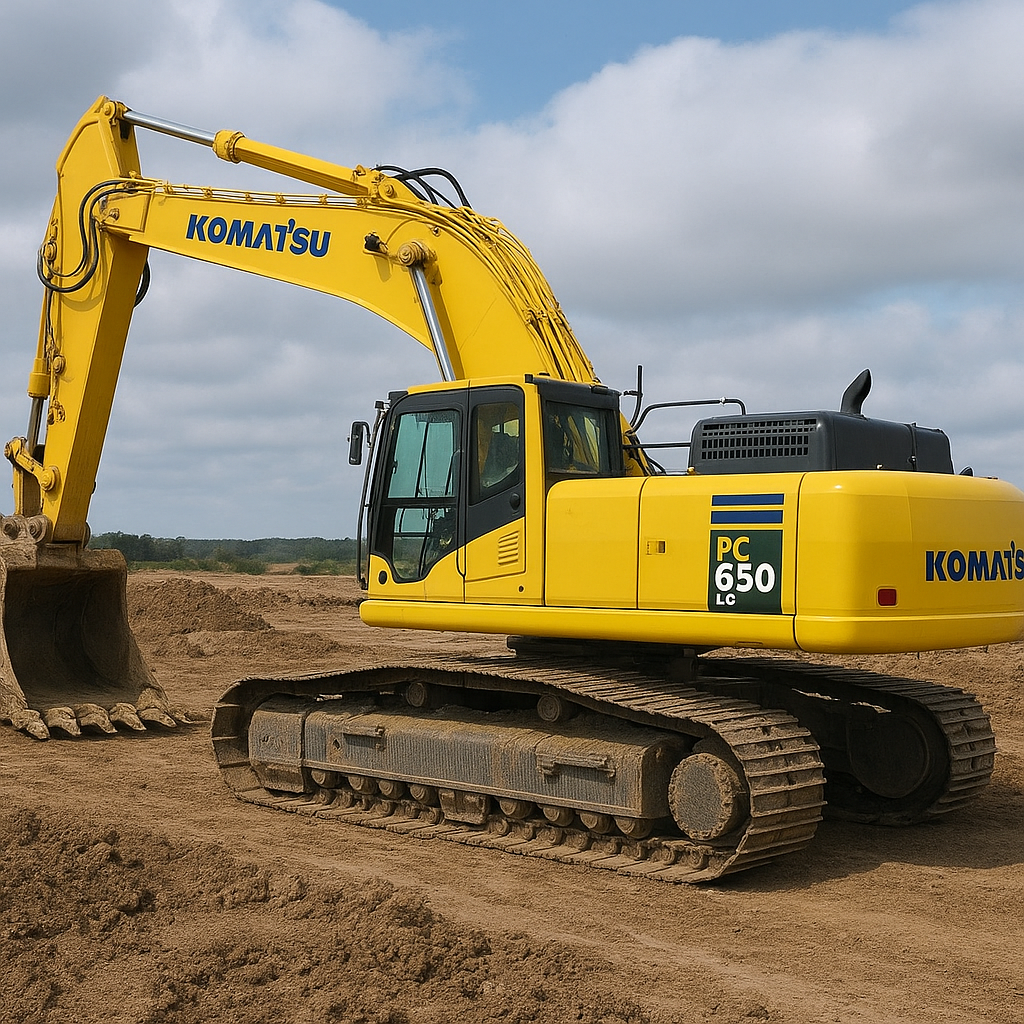
The Komatsu PC650LC is a heavy-duty hydraulic excavator widely used in demanding earthmoving, mining and construction environments. Designed for power, stability and long-term reliability, this class of machine combines robust undercarriage components, a high-output engine and advanced hydraulic controls to handle large-scale digging, loading and material-handling tasks. The following article explores its design, typical specifications, common applications, maintenance and operational considerations, as well as practical tips for maximizing productivity and uptime.
Overview and evolution
The Komatsu PC650LC belongs to Komatsu’s lineup of large excavators built to serve industries where size and power matter. Over successive generations Komatsu refined the model with improvements in engine efficiency, hydraulic responsiveness and operator comfort. While the exact specification can vary by series (for example PC650LC-6, -7, -8, -11 and later variants or market-specific configurations), the machine consistently targets heavy civil works, quarrying and certain open-pit mining tasks.
Design philosophy
- Robust frame architecture to withstand high stress and repeated shock loads.
- High-capacity hydraulic systems for fast cycle times and strong breakout force.
- Durable undercarriage and track systems optimized for stability and long service life.
- Cab ergonomics and controls oriented to reduce operator fatigue and improve precision.
Technical characteristics and typical specifications
Exact technical data depends on the specific sub-model and configuration (boom length, stick type, counterweight, attachments and regional emission standards). Below are typical specification ranges and performance parameters for the PC650LC-class machines. These figures should be used as general guidance; consult the machine’s datasheet or dealer for precise numbers for a particular serial/model.
Power and weight
- Engine power: typically in the range of approximately 260–370 kW (350–500 horsepower), depending on the emission stage and tuning.
- Operating weight: commonly around 55,000–75,000 kg (about 55–75 tonnes). The “LC” (long carriage) configuration gives improved stability for lifting and deep digging.
Hydraulics, digging and reach
- Hydraulic system: large-flow, load-sensing or electronically controlled hydraulics to balance speed and power; multiple hydraulic circuits for attachments.
- Bucket capacity: typical buckets for the PC650LC class range from 2.5 to 5.0 m3, depending on material density and application.
- Maximum digging depth: usually in the 7.5–9.5 m range, based on boom/stick combination.
- Maximum reach at ground level: roughly 12–14 m with standard arms.
- Bucket digging force and arm crowd force: high breakout and crowd forces suited for heavy clay, compacted fill and rock-handling when fitted with appropriate buckets and teeth.
Undercarriage and mobility
- Track width options: multiple shoe widths are available to balance flotation and transport width limits.
- Ground pressure: varies with track shoe width and counterweight, but configurations are available for both soft-ground flotation and hard-surface stability.
- Travel speed: lower-speed, high-traction travel suitable for on-site repositioning; recommended transport by low-bed trailer for long distances.
Capacity and performance indicators
- Fuel tank capacity: large tanks to support long shifts; exact volumes depend on model year and optional tanks.
- Hydraulic oil volume and cooling systems: designed to handle continuous heavy cycles; auxiliary hydraulic circuits for attachments such as breakers, grapples and shears.
- Serviceability: grouped service points and ground-level filters to reduce downtime.
Typical applications and industry uses
The PC650LC is engineered for tasks requiring substantial lifting and digging capacity. Its scale and versatility make it valuable across several sectors.
Mining and quarrying
- Primary loading of haul trucks in medium-sized open-pit operations where shovel-class excavators are not required.
- Bench cleaning, rock removal and sizing when outfitted with heavy-duty buckets or rippers.
- Material handling of blasted rock, overburden stripping and secondary excavation.
Civil engineering and infrastructure
- Large-scale earthworks for dams, highways, airport construction and major commercial developments.
- Mass excavation, deep foundation trenching and preparation of large building pads.
- Pipe-laying and trench excavation when combined with appropriate sticks and tilt couplers.
Demolition, recycling and scrap handling
- With specialized hydraulic attachments (shears, pulverisers, grapples) the machine can perform heavy demolition tasks on structures and concrete removal.
- Material sorting and loading at recycling yards when equipped with rotation and sorting tools.
Bulk material handling and stockpiling
- Loading barges, rail cars and high-capacity haul units.
- Stacking and reclaiming bulk materials such as aggregates, coal or minerals.
Attachments and versatility
One of the strengths of the PC650LC family is adaptability. The machine can be configured with a wide range of tools to suit a given jobsite.
- Attachments: buckets (general purpose, heavy-duty rock, skeleton), hydraulic breakers, shears, pulverisers, multi-processor demolition heads, grapples and plate compactors.
- Quick couplers and pin-on systems to reduce changeover time and increase uptime.
- Custom booms and sticks (long reach, heavy-duty, short-radius) to adapt to specific tasks — e.g., long-reach for dredging or riverbank work, heavy-duty for rock handling.
Operator comfort, controls and on-board technology
Modern large excavators place emphasis on the operator environment and integrated electronics to improve productivity and reduce operating costs.
- Comfort: roomy cabs with climate control, adjustable seats and low vibration mounts to reduce operator fatigue during long shifts.
- Control systems: proportional joysticks, multiple working modes (power, economy, fine control), and memory settings allow operators to fine-tune performance for task-specific needs.
- Telematics and monitoring: systems such as Komatsu’s remote telematics (commonly known as Komtrax for Komatsu machines) provide hours, fuel consumption, error codes and location data to fleet managers for remote diagnostics and maintenance planning.
Maintenance, reliability and uptime strategies
Heavy machines like the PC650LC are capital-intensive assets. Maximizing availability requires planned maintenance and operational discipline.
Maintenance best practices
- Regular inspection of undercarriage components (track rollers, idlers, sprockets and shoes) because undercarriage wear is a major operating expense.
- Hydraulic system checks: monitor hydraulic oil cleanliness and temperature; replace filters at recommended intervals.
- Engine service: follow recommended oil and fuel filter change intervals, and maintain cooling system cleanliness to avoid overheating in dusty or hot environments.
- Wear-part management: schedule planned replacement for bucket teeth, adapters and cutting edges before excessive wear diminishes productivity and increases fuel consumption.
Reliability features
- Protected hose routing and heavy-duty linkages for high-stress applications.
- Robust counterweight and chassis design to prevent frame fatigue under repetitive heavy loading.
- Optional guarding packages (rock guards, undercarriage protection) for severe-service work.
Safety and regulatory considerations
Safety is integral to heavy equipment operation. Machines in this class are fitted with features to protect operators and ground personnel.
- Cab structures typically meet ROPS/FOPS standards to protect the operator from rollovers and falling objects.
- Advanced visibility aids: wide glass areas, mirrors and optional rear/side cameras to reduce blind spots.
- Interlocks, load-limiting functions and alarms to prevent accidental overloads or unsafe operating configurations.
- Compliance with emissions regulations: engines are calibrated to meet regional emission standards (Tier/Stage levels), which affects fuel consumption and maintenance regimes.
Operational economics and environmental impact
When evaluating a machine like the PC650LC, total cost of ownership (TCO) and environmental footprint are critical considerations.
- Fuel consumption: large excavators consume significant fuel; newer models and well-tuned engines aim to improve fuel efficiency and reduce liters per hour compared with older generations.
- Resale and lifecycle: brand reputation, maintenance history and condition of wear parts influence residual value. Komatsu machines generally have a strong aftermarket presence supporting resale.
- Emissions: modern engine technologies and exhaust aftertreatment systems lower particulate and NOx output; operators must be aware of service schedules for aftertreatment components (e.g., DPF regeneration) to avoid operational interruptions.
Transport, setup and site logistics
Due to their mass and dimensions, PC650LC-class machines require planning to transport and position them on site.
- Transport: use of multi-axle low-bed trailers with appropriate permits for weight and width. Track shoe width can often be changed to meet transport width regulations.
- Site access: assess bridge load limits, turning radii and ground bearing capacity for access roads and staging areas.
- Assembly/disassembly: some locations require removal of counterweights, boom or stick sections for legal transport; follow manufacturer guidance for safe rigging.
Case studies and real-world performance
Across quarries, civil projects and mining sites, end-users report the PC650LC’s strengths in sustained heavy-duty cycles and its versatility when paired with the right attachments. Common performance themes include quick cycle times for loading applications, long undercarriage life when maintained correctly, and predictable fuel use when operators utilize economy modes and follow best-practice machine matching (right bucket size and correct hydraulic settings).
Example scenarios
- Quarry loader: a PC650LC fitted with a heavy-duty rock bucket averages high tph (tons per hour) loading to 30–50 tonne haul trucks when cycle times and bucket fill factors are optimized.
- Pipe trenching: configured with a narrow bucket and standard stick, the machine offers efficient deep trench excavation with good visibility and control for pipe-lay crews.
- Demolition: when equipped with a shear or demolition grapple, the excavator serves well for structural teardown and material sorting, while its mass provides necessary counterbalance for lifting heavy elements.
Purchase considerations and fleet integration
Deciding on a PC650LC should consider immediate project needs and long-term fleet strategy.
- New vs used: new machines provide warranty and latest emissions technologies; used machines can offer lower capital cost but require careful inspection of undercarriage, hydraulic system and structural integrity.
- Fleet telematics: integrate monitoring data with fleet management systems to schedule predictive maintenance and reduce unplanned downtime.
- Operator training: proper operator training pays dividends in productivity and reduced wear; many manufactures and dealers provide simulation and on-site training programs.
Conclusion
The PC650LC excavator represents a heavy-duty solution for contractors and mine operators needing a reliable, adaptable machine for large-scale earthmoving and material handling. With strong hydraulic performance, a stable long-carriage configuration and a wide range of attachments, it is suitable across quarrying, civil construction and demolition. Attention to planned maintenance, proper machine matching (bucket sizing and attachment choice), and integration of telematics such as Komtrax will help maximize uptime, control operating costs and extend service life. When considering a purchase, evaluate total cost of ownership, intended applications and the local support network to ensure the machine meets both immediate and long-term operational goals.


)
)