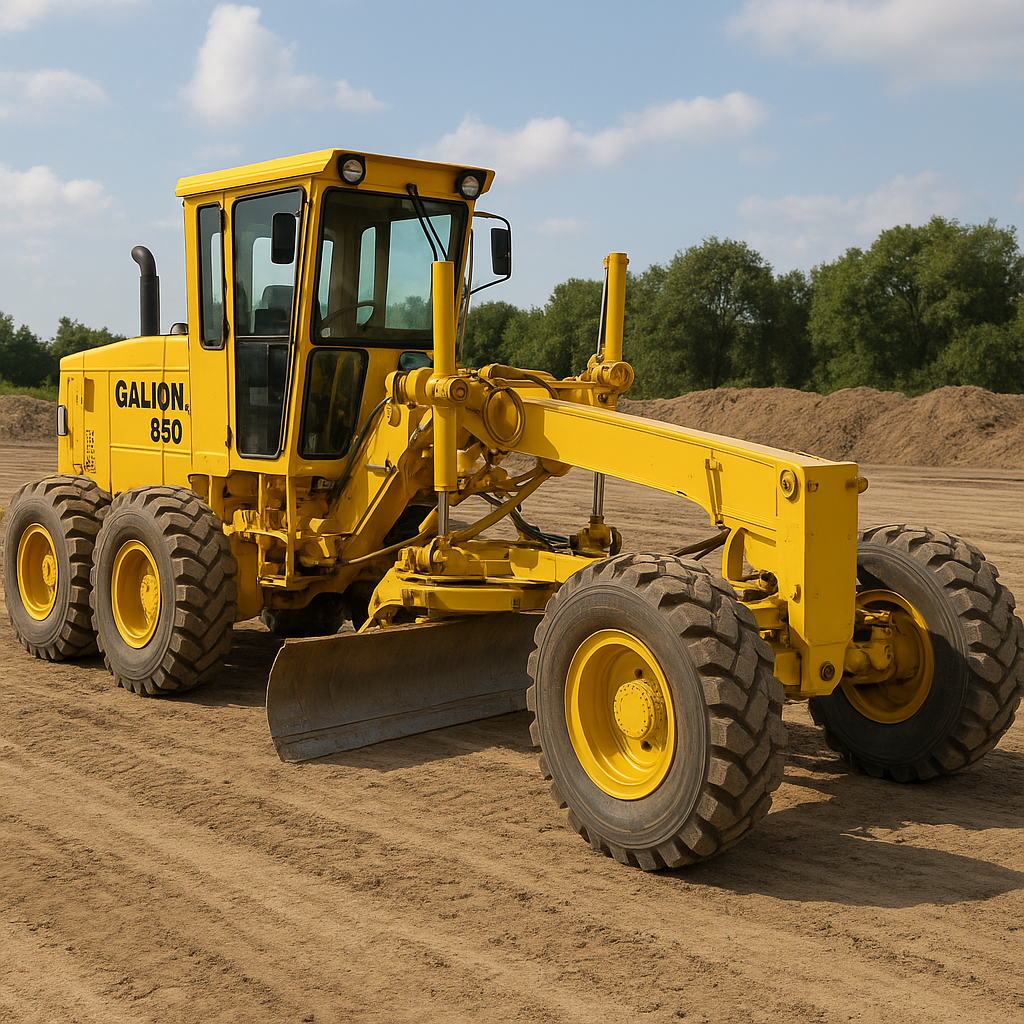
The Galion 850 is a classic example of a heavy civil-engineering machine designed for precision earthmoving and road finishing. As a type of motor grader, it serves as an essential tool in building and maintaining roadways, preparing construction sites, and shaping large areas of land. This article examines the design, capabilities, typical specifications, common applications, operation and maintenance practices, and historical context surrounding the Galion 850. Wherever precise figures vary by year or configuration, typical ranges are given and noted.
Design and technical characteristics
The Galion 850 is built around a long, rigid frame with a centrally mounted blade (moldboard) that provides fine control of the grading surface. Key elements of its design emphasize precision, stability, and ease of service. Below are the typical technical features and components that characterize the Galion 850 family.
Powertrain and drivetrain
- Engine: The Galion 850 was commonly fitted with diesel engines appropriate to its class. Typical output for machines in this category is in the range of 120–200 horsepower (90–150 kW), depending on engine make and year of manufacture. Engines are selected to balance torque for blade work and fuel economy for prolonged operation.
- Transmission: Manual or power-shift transmissions were used on various units, offering multiple forward and reverse speeds. The drivetrain is designed to provide sufficient tractive effort for working on loose, uneven surfaces and to allow precise blade movement at low ground speeds.
- Drive configuration: Most units of this size employ rear-wheel drive with a tandem rear axle to distribute traction, while front-wheel steering and sometimes an oscillating front axle improve maneuverability and ride.
Blade and implement systems
- Moldboard: The core grading tool is a long steel moldboard typically in the 12–14 foot (3.7–4.3 m) range for a mid-size grader like the Galion 850. The moldboard can be angled, lifted, tilted, and articulated to shape and finish surfaces.
- Circle and turn mechanisms: The blade sits on a rotating circle that enables the operator to swing the moldboard left or right and set precise cutting angles. Robust mechanical or hydraulic circle drives are central to durability and responsiveness.
- Attachments: Optional attachments commonly include a front-mounted scarifier or ripper for breaking compacted material, rear rippers, snow wings for plowing, and specialized blades or tires for particular conditions.
Hydraulics, controls, and operator station
- Hydraulic systems control blade lift, tilt, and articulation. Reliable hydraulics are crucial for maintaining alignment and responsiveness during grading tasks.
- Operator station: Ergonomics focus on visibility over the blade and along the machine frame. Many units include cab options with heating and later models may have air filtration and climate control to improve operator comfort and productivity.
- Safety features: Rollover protection structures (ROPS), seat belts, and clear sightlines are integral to safe operation.
Weight, dimensions and typical performance
Exact dimensions vary by serial year and optional equipment, but representative figures for a machine in the Galion 850’s size category include:
- Operating weight: roughly 9,000–16,000 kg (20,000–35,000 lb), depending on configuration and ballast.
- Moldboard width: commonly around 3.7–4.3 m (12–14 ft).
- Ground speed: designed for precise low-speed grading; road speeds for repositioning typically in a modest range (e.g., up to 30–40 km/h depending on gearing).
Applications and field uses
The Galion 850 is a multi-purpose machine employed across a wide set of industries wherever controlled grading and surface finishing are required. Its versatility makes it valuable in both construction and ongoing infrastructure maintenance.
Road construction and maintenance
- Initial roadway formation: shaping subgrades, spreading and leveling gravel, and creating the first finish layer prior to paving.
- Gravel road maintenance: restoring crown and ditch slope, removing potholes and washboarding, and redistributing surface material.
- Pavement preparation: fine grading and establishing precise slopes before asphalt or concrete paving.
Earthworks and site preparation
- Construction site leveling: achieving uniform grades for building pads, parking areas, and laydown yards.
- Drainage shaping: cutting and shaping ditches, side slopes, and channels that require consistent grade control.
- Bulk excavation finishing: after heavier equipment completes rough cuts, a motor grader provides the final surface tolerances.
Specialized uses
- Snow removal: with appropriate wings and blades, graders can efficiently clear snow on roads and airport service surfaces.
- Mining and quarrying: maintaining haul roads to reduce vehicle wear and preserve safety.
- Agriculture and forestry roads: building and maintaining access tracks where controlled crown and drainage are essential.
Operation, productivity and typical metrics
Productivity with a Galion 850 depends on operator skill, site conditions, equipment condition, and attachment choices. The machine is optimized for tasks that require continuous precision rather than high-volume bulk removal.
Productivity considerations
- Grade accuracy: experienced operators can achieve sub-inch tolerances in finish grading when using a properly adjusted moldboard and consistent passes.
- Cycle rates: on a grading pass, speeds are slow and deliberate; productivity is often measured in linear meters or hectares graded per shift rather than cubic meters moved per hour.
- Fuel consumption: varies with engine size, load and duty cycle. For mid-sized diesel graders, typical consumption under working loads might range from approximately 12–28 liters per hour (this is highly dependent on engine model and operating conditions).
Operational best practices
- Pre-shift inspection: check hydraulic fluid, engine oil, tires, blade cutting edges and circle components to avoid downtime.
- Blade set-up: using correct cutting angles, tilt and side-shift dramatically improves finish quality and reduces rework.
- Progressive cutting: for heavy sections, make multiple shallow passes rather than a single deep cut to reduce stress on the machine and the engine.
- Operator training: skilled operators can significantly increase productivity and reduce fuel usage and wear on components.
Maintenance, reliability and lifecycle costs
Long-term value from a Galion 850 depends on regular maintenance and the availability of parts. The machine’s reputation centers on mechanical simplicity and ease of service, which keep lifecycle costs competitive compared with more complex equipment.
Routine maintenance tasks
- Daily: visual check for leaks, tire condition, moldboard cutting edge wear, and hydraulic hose condition.
- Weekly/biweekly: lubricate circle, articulation points, and control linkages; check fluid levels and battery condition.
- Monthly/seasonal: change filters and fluids per manufacturer schedule, inspect transmission and gearing, assess structural integrity of frame and circle.
Common wear items and typical replacement cycles
- Cutting edge and end bits: replaced frequently depending on abrasive conditions—often measured in hundreds to thousands of hours.
- Hydraulic seals and hoses: service intervals depend on environment but are critical to prevent sudden failures.
- Bearings and gears: regular lubrication extends life; replacement intervals can span many thousands of hours when well maintained.
Availability of parts and aftermarket support
Because Galion machines have been popular historically, many parts are available through OEM remnants, aftermarket suppliers and parts remanufacturers. For older models like the 850, it is common to source components such as blades, circle segments, hydraulic pumps and standard engine parts from a combination of original and generic suppliers.
Historical context and market perspective
Galion Iron Works has a long history as a manufacturer of roadbuilding equipment, and models such as the 850 represent the company’s focus on durable, serviceable motor graders for municipal and contractor fleets. While the exact production run and serial volumes for a specific model like the Galion 850 can vary by year and market, the general market placement is as a mid-sized grader suitable for regional roadwork and construction firms.
Who typically owns and operates a Galion 850?
- Local governments and municipalities for road maintenance and snow clearing.
- Contracting companies for grading, paving preparation, and site development.
- Quarries and mining operations for haul road maintenance.
Resale and lifecycle considerations
Due to rugged construction and straightforward mechanical systems, well-maintained units retain resale value in secondary markets where buyers favor proven simplicity over highly electronic systems. Buyers commonly evaluate service history, engine hours, and condition of the moldboard and circle when determining price.
Safety, environmental and regulatory aspects
Safe operation of the Galion 850 requires adherence to industry-standard practices and local regulations. Environmental considerations increasingly influence how older diesel-powered graders are used and retrofitted.
Safety measures
- Operator protection: ROPS and seat belt usage are mandatory in many jurisdictions; good visibility and lighting enhance safety during night or low-visibility work.
- Worksite controls: use of flaggers, traffic management and clear communication reduces the risk of incidents in public road environments.
Emissions and retrofits
Older diesel engines may not meet modern emissions standards. Common approaches to bring machines into compliance include engine repower with newer, cleaner engines, or the application of selective catalytic reduction (SCR) or diesel oxidation catalysts where feasible. These solutions can extend useful service life while reducing environmental impact.
Practical tips for buyers and fleet managers
When considering acquisition of a Galion 850—new, if available as a legacy production model, or used—evaluate the following factors to match machine selection to operational needs.
- Condition of moldboard and cutting edges: these are central to grading performance and can be costly to replace if severely worn.
- Engine hours and maintenance records: a clear service history often correlates with future reliability.
- Availability of spare parts and qualified service technicians in your region.
- Compatibility with intended attachments (scarifiers, wings, rippers) to ensure the machine can perform all required tasks.
- Consider refurbishment or repower options if emissions compliance or improved fuel efficiency is required.
Summary and final observations
The Galion 850 motor grader represents a robust, versatile tool for precise surface shaping and road maintenance. With a focus on mechanical simplicity, durability and operator-oriented design, it has been a reliable asset for municipal fleets, contractors and industrial operations. While specific specifications and production details vary with year and configuration, the machine’s typical features—diesel power, an adjustable moldboard, and robust hydraulics—make it a capable performer for a wide range of tasks including road construction, site preparation, and snow removal. Effective operation depends on skilled operators, consistent maintenance, and appropriate attachments, while environmental compliance may require modernizing power units or applying emissions-control technologies.
For those evaluating a Galion 850 for purchase or seeking to maximize uptime and productivity, the best approach is a thorough equipment inspection, review of maintenance records, and an assessment of parts availability. Properly maintained, a Galion 850 remains a cost-effective grader with strong utility across many sectors of the construction and infrastructure industry.


)
)