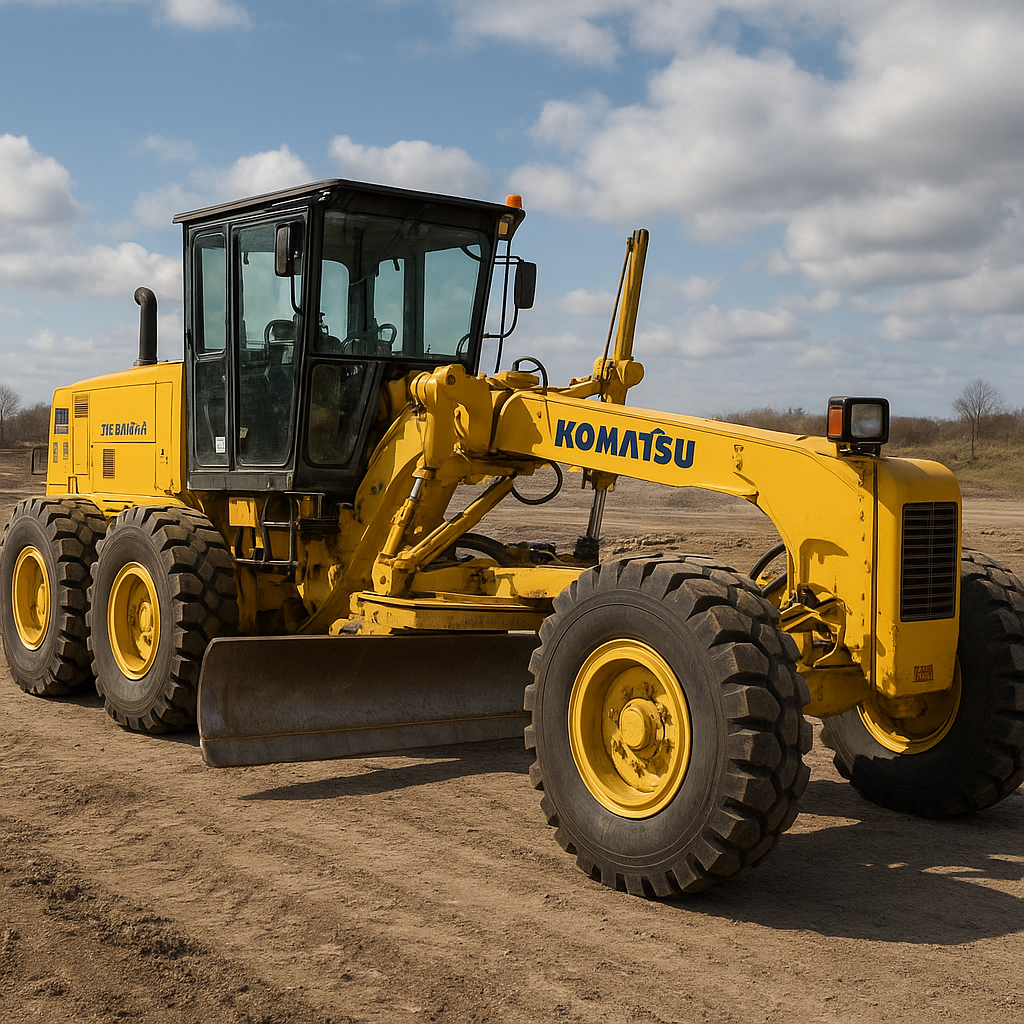
The Komatsu GD825A represents a class of heavy, purpose-built road construction equipment that combines durable engineering with practical versatility. Designed to perform a wide range of earthmoving, grading and finishing tasks, this machine is a common sight on highways, airports, mines and large civil works. In the paragraphs that follow you will find an overview of the machine’s design, typical applications, operational capabilities, maintenance considerations and market context. The article highlights key elements such as Komatsu, the model GD825A and the general role of the motor grader in modern infrastructure projects.
Design philosophy and core components
The GD825A is built around a robust frame and a set of components engineered to deliver consistent grading performance under heavy use. Komatsu’s design philosophy for machines in this category focuses on durability, serviceability and operator ergonomics. Key subsystems include the chassis and articulation system, the powertrain, the blade and circle assembly, the hydraulic controls, and the operator station. Each subsystem is sized and arranged to provide the balance between precision and longevity required on long-term construction and mining projects.
Powertrain and drivetrain
At the heart of the grader is its engine, whose job is not only to provide forward travel but also to power the hydraulic systems, blade oscillation, and auxiliary equipment. Komatsu configures its large graders with engines designed for continuous heavy-duty operation, with an emphasis on torque at low RPMs rather than peak top-end speed. This allows operators to make fine adjustments to blade position while carrying heavy loads of material across the site.
The drivetrain typically combines a heavy-duty torque converter or power-shift transmission with robust axles and differentials. Transmission choices aim to give the operator a wide range of ground speeds for both fine grading and rapid repositioning. Electronic or electro-hydraulic controls may be used for smoother shifting and to integrate with machine monitoring systems.
Blade, circle and moldboard systems
The grader’s cutting and shaping power is concentrated in the moldboard and its circle assembly. The GD825A is engineered to accept a large moldboard and a strong circle cradle that resists deformation under lateral stress. Blade lift, tilt, and blade side-shift are driven by heavy-duty hydraulic rams, enabling precise angle and depth control. The ability to mount different blade profiles and edge types allows the machine to perform a wider range of tasks—from fine finish grading to rough cutting and ditching.
Operator environment and controls
Komatsu places significant emphasis on the operator station for machines in this class. The cab is designed to improve visibility to the moldboard and the work area, reduce fatigue through better ergonomics, and provide climate control for comfort in varied working conditions. Controls can be conventional lever-and-pedal layouts or integrated joystick/electronic command systems in later configurations, often with diagnostic displays to provide real-time machine data.
Typical applications and industries
The GD825A is a heavy utility machine that finds use across multiple sectors. Its combination of power, reach and adjustable grading geometry makes it suitable for any task that requires shaping large expanses of surface or maintaining precise rolling profiles. Primary applications include:
- Road construction and maintenance — establishing subgrades, shoulders and final road surfaces.
- Airport runway and taxiway construction — achieving stringent tolerances for evenness and drainage.
- Mining and quarry operations — forming haul roads, ramps and maintenance of hardened surfaces.
- Large-scale civil engineering projects — dam works, levee construction and site preparation.
- Snow removal and large area clearing — when fitted with specialized blades or attachments.
Because of its size and power, the GD825A is often selected for projects where both high productivity and long service intervals are required. Contractors deploy such graders where the extension of road networks, heavy traffic demands, or the need for durable surface profiles make lighter machines impractical.
Performance characteristics and operational capabilities
Performance of a grader is measured not just by its top speed or engine rating but by how precisely and productively it can manipulate earth and aggregate. The GD825A typically excels in areas such as cutting depth consistency, lateral reach, blade control responsiveness, and stability under load. These traits are important when producing long, continuous runs of surfaced material where small variations can cause significant rework.
Control precision and productivity
Advanced hydraulic circuits and responsive joysticks (or levers) allow operators to maintain a consistent grade over extended distances. Combined with good visibility and cab ergonomics, this means fewer passes, less fuel burned per meter graded, and less wear on cutting edges. Operators can use side-shift and blade pitch adjustments to minimize material segregation and achieve desired surface profiles.
Durability under heavy use
Large graders from Komatsu are engineered to withstand hours of heavy cyclic loading. Major wear items — circle gears, cutting edges, pins and bushings — are designed for straightforward replacement. Frame and articulation joints are reinforced to avoid premature fatigue in high-stress applications such as quarry face approaches or steep road grade cuttings.
Mobility and site flexibility
While built for heavy duty work, graders still need to reposition across sites rapidly. The GD825A balances a stable working platform with travel performance that lets crews move between tasks without requiring transport on trailers for short distances. Articulation and tandem axle configurations help maintain traction and steering control on uneven terrain.
Maintenance, lifecycle and operating costs
Owning and operating a heavy grader is a long-term investment. Maintenance strategies, parts availability, fuel consumption patterns and operator training all contribute to lifecycle cost. The GD825A is designed for serviceability, with access panels, grouped service points and diagnostics intended to reduce downtime.
- Routine maintenance items include engine oil and filter changes, hydraulic fluid and filter service, inspection and replacement of cutting edges, and articulation joint lubrication.
- Major component life expectancy (engine, transmission, hydraulic pumps) is extended by consistent preventive maintenance and by using recommended lubricants and filters.
- Parts support and dealer networks for Komatsu machines tend to be strong in many markets, which reduces lead times for critical spares and contributes to predictable repairs.
Operational economics also depend on matching the machine to the task: an oversized grader used for tight, finish-only chores may incur unnecessary fuel and tire costs, while an undersized machine will be pushed beyond its efficient duty cycle and require more frequent repairs.
Safety, ergonomics and operator training
Safety on grading sites involves both machine design and operational protocols. The GD825A’s cab is usually fitted with modern rollover protection and visibility aids. Proper use of backup alarms, lighting, reflective markings and a clear cab layout helps avoid incidents on crowded construction sites.
Operator training is a key factor in safe, efficient grading operations. Skilled operators reduce wear on machine components by managing blade load properly, selecting optimal working speeds and executing appropriate steering and articulation techniques. Trained personnel also interpret diagnostic displays and scheduling for maintenance before failures occur.
Environmental considerations and regulation
Modern heavy equipment manufacturers are focusing more on emissions, noise and fuel consumption. Komatsu has progressively updated engine control systems, exhaust after-treatment and fuel management to meet evolving emissions standards. In many regions, compliance with local emissions regulations (Tier, Stage) will determine the specific engine and exhaust configuration for machines like the GD825A.
Operationally, efficient grading reduces fuel consumption per cubic meter of material moved. Techniques such as fewer rework passes, optimized blade angles, and on-board monitoring systems contribute to better fuel efficiency and lower site emissions. Dust suppression and responsible site management help meet environmental and community expectations during grading operations.
Attachments, options and customization
Large graders are often customized to match an operator’s needs. Common options and attachments for machines in this class include specialized cutting edges, snow blades, scarifiers/rippers, GPS/grade-control systems, enhanced lighting packages, and various tire or wheel configurations. Integration with machine control systems (GNSS, laser-guidance, 3D models) can greatly enhance grading speed and accuracy for precision civil works.
Machine control and automation
The addition of automated grade control and GPS guidance transforms a grader into a productivity tool that reduces human error and accelerates work. Operators can work from digital models and receive direct feedback on cut/fill status, slope, elevation and alignment. Over time, these technologies reduce material waste and make it easier to reproduce consistent profiles across long runs.
Market role, variants and competitive landscape
Within the market for heavy graders, the GD825A sits alongside competitor offerings from other major OEMs. Selection between models is influenced by total cost of ownership, dealer support network, availability of parts and the presence of advanced features such as telematics and automation-ready electronics.
Variants in the same model family may differ by cab options, engine emissions package, transmission type and axle/tire choices. Large contractors and rental fleets often prefer machines with standardized options that simplify maintenance and operator transition between jobsites.
Practical tips for operation and upkeep
- Establish a preventive maintenance schedule aligned with the manufacturer’s service intervals and keep detailed service logs to preserve resale value.
- Train operators on blade handling techniques to minimize edge wear and reduce cycles of unnecessary material movement.
- Use machine telematics, when available, to monitor fuel consumption, idle time, and diagnostic codes — these data help optimize site workflows.
- Keep a stock of frequently replaced consumables (cutting edges, pins, bushings, filters) to minimize downtime on remote sites.
- Match the grader’s tire type and pressure to site conditions to maximize traction and prolong tire life.
Performance metrics and statistical considerations
Exact technical specifications such as rated engine power, operating weight, moldboard dimensions and hydraulic flow depend on the model year and regional configuration of the GD825A. In class-based comparisons, heavy motor graders typically exhibit the following statistical trends:
- Operating weights for heavy graders often fall in the mid to high tens of tonnes — reflecting robust frames and heavy-duty components built for long-term reliability.
- Engine power tends to emphasize torque; therefore gross horsepower ratings for machines of this class are sufficient to maintain cutting performance and hydraulics without excessive RPMs.
- Work rates are commonly measured in linear meters graded per hour or cubic meters of cut material per hour; experienced crews with modern control systems can markedly increase these metrics compared with manual grade control.
- Lifecycle costs often show that fuel and maintenance together account for the majority of a grader’s operating expense; optimizing these factors yields the best returns on initial capital outlay.
For exact technical values—such as specific horsepower ratings, hydraulic flow rates, blade dimensions and recommended service intervals—consult the manufacturer’s datasheet for the GD825A or contact an authorized Komatsu dealer. They can provide configuration-specific numbers and verify the emissions package or option list for machines sold in a particular market.
Summary and outlook
The Komatsu GD825A is representative of the heavy-duty end of the motor grader spectrum: a machine designed for demanding environments that require continuous, high-precision earthmoving and surface finishing. Strong construction, robust powertrains, hydraulic control systems and flexible blade arrangements allow such graders to serve a critical role in roadworks, airports, mines and large civil projects. Key competitive advantages include durability, serviceability and the potential to integrate modern control and monitoring technologies that improve productivity and reduce lifecycle costs. For fleets and contractors focused on long-term projects and heavy traffic surfaces, a machine like the GD825A embodies the balance between raw capability and the refined control needed to deliver professional-grade results.
Note: Specific figures and detailed specifications vary by model year and market; for procurement and technical planning, always obtain the latest factory documentation and confirm available options with an authorized dealer.


)
)